Agricultural Production Sector in the GCC Countries
There is no doubt that the agricultural sector holds significant importance in the global economy today. It contributes to achieving self-sufficiency and food security, reduces unemployment, alleviates poverty, and serves as the primary source of raw materials for many manufacturing industries. This vital sector employs approximately 935.6 million workers, representing 28.3% of the global labor force.
According to the latest statistics, the amount of plant production in the Gulf Cooperation Council (GCC) countries for various agricultural crops is estimated at about 8.7 million tons. Notably, Saudi Arabia alone contributes 60.5% of Gulf plant production, followed by Oman with about 19.1%, then the UAE with 12.5%, while the remaining percentage is shared among the other countries.
Vegetables account for 41% of Gulf plant production. They are the top agricultural product in Kuwait, Bahrain, Qatar, Oman, and Saudi Arabia. Saudi Arabia leads the region in vegetable production, contributing 55.1% of the total output.
Cereals account for 7% of total plant production in the GCC countries, amounting to 1.9 million tons. The UAE leads in grain production among the GCC countries, contributing 42.9%.
The amount of fish caught in the GCC countries was estimated at 740 tons, according to the latest statistics. Oman contributes 74.8% of this total. There are 124,700 people working as fishermen in the GCC countries, with 40% of them in Oman and 33% in the UAE. The region has 41,100 fishing boats, with Oman accounting for 57.7% and Saudi Arabia 26.6%.
Despite all this, the contribution of this sector to the global GDP does not exceed 4%. This percentage must be reconsidered for the future, as by 2050, the global population will exceed 9 billion, and the agricultural sector alone will be responsible for feeding this population and protecting them from hunger.
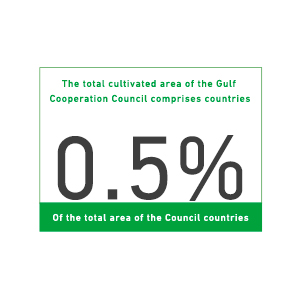
The total area of the GCC countries is estimated at about 2.4 million square kilometers, with the cultivated area being 11.8 thousand square kilometers, constituting 0.5% of the total area of the GCC countries. In all GCC countries, the cultivated area compared to the total area does not exceed 1%, except in Bahrain, where the cultivated land reaches 4.8% of the total area.
Fruit production in the GCC countries is expected to grow significantly in the coming years, with a compound annual growth rate (CAGR) of 3.8%.
Agricultural Production Sector Globally
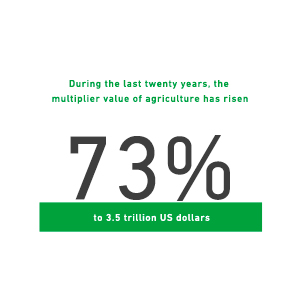
- Over the last twenty years, the value added by agriculture increased by 73%, reaching $3.5 trillion USD.
- Agriculture represents 4% of the global GDP.
- The number of people employed in agriculture is 874 million, constituting approximately 27% of the global labor force.
- The total agricultural land in the world is 4.8 billion hectares, divided into 3.2 billion hectares of pastures and rangelands and 1.6 billion hectares of crops.
- The total global production of primary crops is 9.4 billion tons.
- The total global production of red and white meat is 337 million tons.
- The total global production of fruits is 883 million tons.
- The total global production of vegetables is 1,128 million tons.
- The total global production of vegetable oils is 201 million tons.
- The total global production of milk is 883 million tons.
- The total global production of eggs is 83 million tons.