ALT Shift Program – Organizational Change Simulation - Mashroo3k

What is the ALT Shift – Organizational Change Simulation Under Pressure program?

ALT Shift is a training simulation program aimed at teaching organizational change management through direct experience rather than abstract theories, where participants are placed in the role of “transformation operators” inside an organization undergoing forced and sudden change—neither gradual nor optional. As its name reflects: ALT meaning an alternative reality, and Shift meaning a sudden movement; thus, ALT Shift represents that moment when the entire system transitions into a new configuration without prior warning.
The program runs over one or two days, during which participants go through four consecutive stages: shock, resistance, alignment, and momentum. It is grounded in well-known theoretical foundations such as Bridges’ Transition Model, the ADKAR model, and Lewin’s Change Model, with the aim of allowing participants to practically experience feelings of confusion and resistance through to breakthrough and progress moments. In doing so, they train in real leadership under conditions of uncertainty, pressure, and organizational resistance.
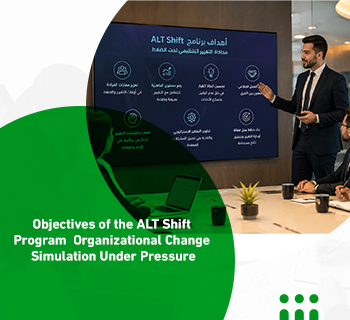
Objectives of the ALT Shift Program – Organizational Change Simulation Under Pressure

  • Transform change management from an abstract theoretical framework into a lived, immersive experience. Instead of merely memorizing concepts, participants actively engage in the stages of shock, resistance, and transformation, enabling them to internalize change management principles in a way that traditional lectures cannot achieve.
  • Reveal how people emotionally respond to organizational change by simulating the confusion, fear, denial, and frustration that typically emerge during the early stages of transformation. This enables participants to anticipate these natural reactions and respond to them with awareness and intention, rather than being driven by them.
  • Equip leaders with practical tools to stabilize, guide, and influence their teams by allowing them to practice proven strategies for addressing different forms of resistance—whether overt, silent, or passive. The program enables leaders to transform resistance into engagement and engagement into lasting commitment, strengthening their ability to lead successful organizational change.
  • Develop the ability to lead effectively in the face of uncertainty and persistent resistance by enabling participants to maintain strategic focus, confidence, and leadership stability even during the most challenging phases of transformation, when change initiatives may encounter internal disruption, opposition, or deliberate sabotage.
  • Develop the ability to manage workload pressure, ambiguity, and organizational politics, recognizing them as unavoidable factors in any genuine change initiative, and empowering participants to manage these challenges effectively rather than allowing them to control their decisions and actions.
  • Instill the capability to sustain momentum and reinforce change after it has been achieved by developing phased implementation plans—immediate, medium-term, and long-term—that safeguard the transformation from regression or a return to the previous state.

Why do companies need the ALT Shift Program-Organizational Change Simulation Under Pressure?

  • Organizational change in the real world is often sudden, disruptive, and unavoidable—exactly as reflected in the program’s name, ALT Shift. Organizations undergoing restructuring, digital transformation, mergers, or AI integration rarely have the luxury of implementing change gradually. Instead, they require leaders who are prepared to respond decisively from the moment disruption occurs, rather than learning through costly trial and error after valuable time has been lost.
  • Human resistance to change remains the leading cause of failure in most transformation initiatives. Whether it takes the form of open opposition from influential employees, silent resistance rooted in deeply embedded organizational culture, or genuine fears about job security or personal competence, each type of resistance requires a different leadership response. Organizations therefore need leaders who can accurately identify the source of resistance and apply the most effective strategy for addressing it—turning potential obstacles into opportunities for engagement and successful transformation.
  • Change management cannot remain confined to theory, presentation slides, or classroom discussions. The decisions leaders make under real pressure are often fundamentally different from those they plan in calm and controlled environments. Organizations therefore need leaders to experience the realities of high-pressure decision-making within a safe simulation, allowing them to build confidence, refine their judgment, and learn from mistakes before facing the costly consequences of real-world transformation.
  • The gap between announcing change and achieving genuine employee adoption can only be bridged through advanced communication and influence skills. Employees differ in their levels of influence, concerns, and readiness to embrace change, making a one-size-fits-all approach ineffective. Organizations therefore need leaders who can build alignment, address rumors proactively, earn trust, and engage stakeholders at every level—rather than relying solely on formal announcements or top-down directives.
  • Many transformation initiatives achieve early success but lose momentum over time as organizations gradually revert to old habits and established ways of working. This regression is one of the most common reasons sustainable change fails. Organizations therefore need leaders who can design phased implementation plans—immediate, medium-term, and long-term—that reinforce progress, sustain momentum, and embed change into the organization’s culture, ensuring it becomes a lasting capability rather than a temporary initiative.
  • The cost of failed organizational change extends far beyond financial losses. It can erode trust in leadership, damage employee morale, weaken engagement, and create lasting resistance to future transformation efforts. Investing in leaders who are equipped to guide change with confidence, credibility, and strategic awareness is far more cost-effective than rebuilding the trust, commitment, and organizational cohesion lost after a failed change initiative.

Target groups of the ALT Shift Program – Organizational Change Simulation Under Pressure

  • Managers, Supervisors, and Team Leaders, who carry the primary responsibility for translating strategic change decisions into practical execution on the ground. They are often the first to face employee resistance, skepticism, or uncertainty, making it essential for them to develop the leadership skills needed to communicate change effectively, address concerns, build commitment, and guide their teams through the challenges of transformation.
  • Project Managers and Organizational Transformation Teams, who are responsible for leading change initiatives from launch through stabilization. They need practical tools and hands-on experience to navigate every stage of the transformation journey—from the initial shock of change and employee resistance to alignment and long-term adoption—without losing control of the initiative or becoming overwhelmed by the internal conflicts, competing interests, and organizational politics that often accompany major transformation projects.
  • HR Business Partners and Change Leaders, who are expected to serve as the vital link between leadership and employees throughout the transformation journey. They need a deep understanding of the psychological dynamics of resistance to change so they can design targeted interventions, foster employee engagement, maintain morale, preserve trust, and ensure that change is embraced rather than resisted.
  • Any Employee Responsible for Leading or Navigating Organizational Change, regardless of their formal job title. Successful transformation is not limited to senior leadership—it affects everyone who must adapt to new systems, processes, technologies, or ways of working. This program equips participants with the practical skills and confidence to respond effectively to change, contribute positively to transformation initiatives, and support lasting adoption within their everyday work environment.
  • Organizations Undergoing Critical Transformation, including those experiencing restructuring, digital transformation, mergers and acquisitions, the implementation of new systems and technologies, AI integration, or enterprise-wide performance improvement initiatives. These environments are inherently characterized by high levels of uncertainty, disruption, and resistance to change, making it essential to prepare leaders and key stakeholders with the practical capabilities needed to navigate complexity, maintain momentum, and lead successful transformation with confidence.

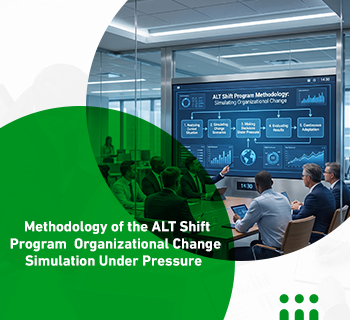
Methodology of the ALT Shift Program – Organizational Change Simulation Under Pressure

  • The Shock Stage
    Participants begin the simulation by receiving a sealed envelope announcing an unexpected organizational change that has not been communicated in advance—such as a leadership transition, organizational restructuring, or the implementation of a new system. They immediately respond using emotional reaction cards that represent common initial responses to change, including confusion, fear, denial, and uncertainty. Participants then map their reactions on the Transition Curve, allowing them to recognize the emotional impact of change before it is analyzed from a leadership perspective.
    To intensify the experience and mirror the realities of organizational transformation, a second disruptive event is introduced shortly afterward—such as a compressed implementation timeline, resource reductions, or another unexpected operational constraint. This escalation forces participants to adapt under increasing pressure, demonstrating how multiple, overlapping disruptions influence decision-making, emotional responses, and leadership effectiveness.
  • The Resistance Stage
    Participants receive a series of scenario cards representing authentic patterns of workplace resistance encountered during organizational change. They are challenged to identify and classify each response as active resistance, passive resistance, or silent resistance, then conduct a Force Field Analysis to distinguish the forces driving change from those resisting it.
    Based on their analysis, participants develop tailored intervention strategies for each type of resistance—whether by engaging, neutralizing, bypassing, or transforming resistance into constructive support. Rather than applying a single solution, they learn to adapt their leadership approach to the underlying motivations and behaviors of different stakeholders.
    Midway through the exercise, an unexpected Disruption Event is introduced—such as internal conflict, political interference, the loss of a key sponsor, or the spread of damaging rumors—to simulate the organizational friction that frequently emerges during real transformation initiatives. Participants must reassess their assumptions, revise their strategies, and maintain momentum despite escalating complexity and pressure.
  • The Alignment Stage
    During this phase, participants work with a diverse set of stakeholder persona cards, representing key organizational actors such as an executive sponsor, a long-serving employee, a union representative, and a skeptical manager. Using these profiles, they develop a Power–Interest Matrix to assess stakeholder influence and engagement levels, then design targeted influence and engagement plans based on the McKinsey Influence Model.
    Participants put these strategies into practice through a series of realistic communication simulations, including organization-wide town hall meetings, difficult one-to-one conversations, and informal influence opportunities. These exercises strengthen their ability to tailor messages, build trust, address concerns, and secure commitment from different stakeholder groups.
    To replicate the unpredictability of real organizational change, a Rumor Storm is introduced during the simulation. As misinformation spreads across the organization, participants must respond quickly by refining their communication strategy, increasing transparency, clarifying key messages, and rebuilding alignment to maintain confidence and momentum throughout the transformation process.
  • The Momentum Stage
    In the final phase of the simulation, participants receive an Implementation Planning Board that challenges them to design a phased action plan across three critical time horizons: Now (the first 72 hours), Next (the first 30 days), and Always (long-term cultural reinforcement). This structured approach helps participants translate strategic intentions into sustainable execution while reinforcing the behaviors and systems required to embed change within the organization.
    Throughout the exercise, participants monitor a Momentum Dashboard, which tracks key transformation indicators such as organizational energy, employee adoption, resistance levels, and emerging risks. Using this live feedback, they continuously evaluate the health of the transformation and adjust their implementation strategies as conditions evolve.
    To reflect the realities of organizational change, the simulation introduces a series of unexpected Crisis Interruptions—including key employee resignations, budget reductions, shifting executive priorities, and compressed timelines. These disruptions test participants’ ability to preserve momentum, reprioritize effectively, and sustain progress without allowing the transformation to lose direction or regress to previous ways of working.
  • Closure and Reflection
    Participants engage in a structured reflection session to examine the causes of resistance, the moments when momentum increased, and the impact of communication on the stability of the transformation. Each team concludes the program by writing a Transformation Charter—a practical guide consisting of five principles for leading change in real-world organizational settings.

Risks of not implementing the ALT Shift Program – Organizational Change Simulation Under Pressure

  • Leaders remain without practical tools to manage the initial shock of organizational change, causing them to respond to transformation announcements with reactive, inconsistent, or delayed decisions instead of leading their teams with confidence during the most critical and sensitive stage of the entire change journey.
  • Failure to distinguish between different types of resistance and relying on a single, ineffective response for all situations can allow silent resistance to grow unnoticed. As a result, leaders may not recognize its impact until it has evolved into a significant organizational obstacle that is far more difficult to address and overcome.
  • Repeating one of the most common patterns of failed transformation initiatives, where the initial phase of announcing and promoting change succeeds, but momentum quickly fades due to the absence of a well-structured implementation plan spanning the short, medium, and long term. This significantly increases the risk of regression and undermines the long-term sustainability of the transformation.
  • Limited ability to build alignment among diverse stakeholders can lead to the spread of rumors, misinformation, and misunderstanding instead of clarity and shared commitment. As a result, negative interpretations of the transformation may spread more rapidly than the organization’s official communications, weakening trust, increasing resistance, and undermining the success of the change initiative.
  • Gradual erosion of trust and team morale over the long term, as every unsuccessful change initiative leaves a lasting psychological impact that makes employees more skeptical and resistant toward future transformation efforts. As a result, each subsequent change initiative becomes more difficult, more costly, and less likely to achieve sustainable success.
  • The continued gap between understanding change management theories and applying them in practice under pressure means that a leader who has not experienced these situations in a safe simulation environment is more likely to make either reckless or frozen decisions when facing a real organizational change crisis for the first time.

Why do companies request the ALT Shift Program – Organizational Change Simulation Under Pressure through Mashroo3k Consulting?

  • To benefit from our strategic partnership with Ajax Training and Consulting, led by Eng. Ahmed Ali Al-Dabaa, one of the region’s leading project management experts. With more than 15 years of extensive practical experience in project management, organizational transformation, and professional development, this partnership brings exceptional depth, credibility, and real-world expertise to the program—delivering a level of quality and professional rigor that goes well beyond conventional training solutions.
  • To benefit from the extensive experience of a specialized trainer who has worked directly with more than 200 organizations across a wide range of industries. This breadth of practical experience provides a unique ability to design customized learning solutions that address each client’s specific organizational challenges, objectives, and transformation needs, rather than relying on standardized, one-size-fits-all training programs.
  • To bridge the gap between understanding change management theories and applying them effectively under real-world pressure. Reading about frameworks such as the ADKAR Model or the Change Curve is fundamentally different from experiencing and applying these concepts in a realistic simulation that replicates the shock, resistance, uncertainty, and decision-making challenges of organizational transformation. This immersive, hands-on experience is what gives the program its true value, enabling participants to convert theoretical knowledge into practical leadership capability.
  • To prepare leaders and supervisors to face the moment of announcing change with confidence rather than confusion, recognizing it as the most critical stage in any transformation journey—one that often determines the overall direction of team response throughout all subsequent phases of change.
  • To develop practical skills in classifying resistance and responding to it with tailored approaches for each type, rather than relying on a single, ineffective reaction. This includes managing different forms of resistance—whether open, passive, or driven by internal political alliances—through more adaptive and context-sensitive leadership strategies.
  • To build a real capability to influence diverse stakeholders and gain their commitment through practicing a range of communication scenarios—including town hall meetings, difficult one-on-one conversations, and informal influence interactions—that leaders are required to navigate during any organizational transformation.
  • To ensure the sustainability of change after its announcement and prevent regression to previous ways of working, through practicing the design of phased implementation plans—short-term, medium-term, and long-term—that embed the transformation into the organization’s culture rather than treating it as a one-time event that ends once the announcement phase is over.
  • To provide a safe training environment for testing decisions under pressure before facing them in real-life situations, as mistakes made within a controlled simulation setting serve as valuable learning experiences at a significantly lower cost compared to errors made while leading a real transformation that can directly impact the organization’s future and its employees.
Green Friday

فرصة لا تتكرر

GREEN FRIDAY

خصم 25% على خدمات مشروعك استفد من العرض الآن، فالفرصة متاحة لفترة محدودة فقط
سجّل بياناتك واحصل على خصم 25% الآن