DISCOVERY Program – Emotional Intelligence Under Pressure - Mashroo3k

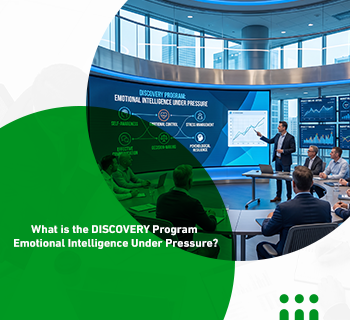
What is the DISCOVERY Program – Emotional Intelligence Under Pressure?

It is a training simulation program that lasts for one or two days and places participants in an engaging role-playing scenario: a diving crew called “The Architects” attempting to salvage gold from a sunken ship, using the DISC behavioral model as the operational language for the mission. Participants go through five escalating stages of tension — from getting acquainted with behavioral patterns, to communicating under time pressure, to conflicts over decisions, to a severe crisis that tests the application of the “Golden Rule of DISC” (treating others according to their needs, not yours), culminating in a final challenge requiring complete coordination between roles. The true goal is not entertainment, but to transform DISC from a theoretical tool into a practical mechanism for understanding oneself and others, revealing behavioral weaknesses that only emerge under real pressure, ending the program with a feedback session where each team develops a behavioral agreement to implement in the workplace.
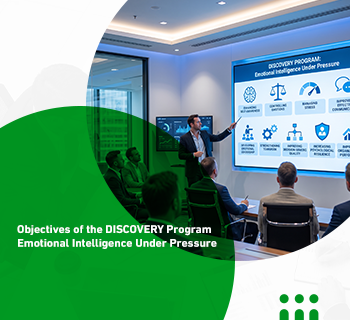
Objectives of the DISCOVERY Program – Emotional Intelligence Under Pressure

  • Transform the DISC Behavioral Model from a widely recognized theoretical framework into a practical, real-world tool for effective collaboration, resilience, and success in high-pressure team environments.
  • Reveal hidden behavioral and emotional blind spots that typically emerge only under conditions of genuine pressure and stress.
  • Establish the DISC Behavioral Model as a shared operating language for team members, enabling each participant to better understand colleagues’ behavioral styles, preferences, and communication approaches.
  • Reveal how communication channels gradually break down under pressure, and how different behavioral styles react to increasing stress and anxiety.
  • Reveal the points of conflict and tension between different behavioral styles during complex and difficult problem-solving processes.
  • Show how behavioral styles break down, intensify, or develop positively during crises, and how teams with high emotional intelligence are able to stabilize their behavior.
  • Emphasize that true team success depends primarily on adaptive and flexible behavior, not on technical skills alone.
  • Analyze the behavioral patterns displayed under pressure and identify the moments of miscommunication that occurred during the simulation.
  • Clearly distinguish between adaptive, flexible behaviors and rigid, unproductive behaviors within the team.
  • Understand the different conflict resolution approaches associated with each of the four DISC behavioral styles.
  • Link the DISC Behavioral Model to the ability to predict the actual performance of individuals and teams in the real work environment.
  • Establish the “Golden Rule” as a fundamental leadership principle that guides everyday behavior.
  • Conclude the program with a clear and practical behavioral agreement that the team commits to implementing in the workplace.

Why do companies need the DISCOVERY Program – Emotional Intelligence Under Pressure?

  • To transform employees’ theoretical knowledge of DISC into a practical skill applied in real-world situations.
  • To identify communication problems between teams that do not appear during calm meetings and only surface under pressure.
  • To reduce recurring conflicts and friction among employees resulting from differences in their behavioral styles and ways of working.
  • To develop managers’ flexibility in leading each individual according to their behavioral style, rather than applying a single approach to everyone.
  • To train teams to remain stable and coordinated during crises and under time pressure, rather than losing focus.
  • To create an immersive learning experience that leaves a lasting impact beyond the end of the training program.
  • To build a shared behavioral language among team members, enabling everyone to understand one another quickly without misinterpretation.
  • To enhance collective decision-making skills under time pressure and with incomplete information, a situation that is very common in the real work environment.

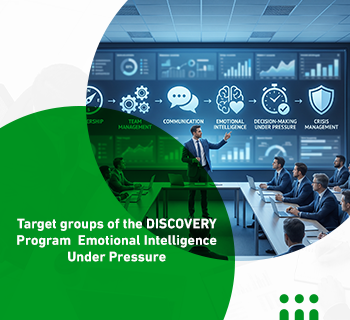
Target groups of the DISCOVERY Program – Emotional Intelligence Under Pressure

  • Employees across the organization, regardless of their roles, departments, or organizational levels.
  • Team leaders and frontline supervisors responsible for managing teams on a day-to-day basis.
  • Managers at all organizational levels.
  • Professionals working in cross-functional teams whose roles require continuous coordination across different disciplines.
  • Project teams responsible for delivering specific objectives within defined timelines and under pressure.
  • Operations teams that work under daily pressure and continuously make rapid decisions.
  • Groups and leadership teams responsible for making strategic decisions under pressure

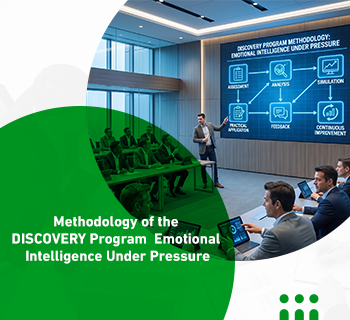
Methodology of the DISCOVERY Program – Emotional Intelligence Under Pressure

  • Adopting an immersive experiential simulation methodology (Immersive Simulation) instead of traditional theoretical instruction.
  • Building a complete story framework in which participants become a diving crew tasked with recovering gold from a sunken ship, using the DISC model as an operational language to accomplish the mission.
  • Dividing participants into small teams (4–6 members) that work in parallel with other teams (3–5 teams).
  • The intensity of pressure gradually escalates through five consecutive stages, moving from relative stability to a critical crisis. It begins with the briefing stage, where participants identify behavioral patterns and build the crew map. This is followed by the descent stage, which tests communication under time pressure and reduced information. The wreck stage then challenges participants to make collective decisions amid conflict and opposing viewpoints. Next comes the critical currents stage, representing a severe crisis that tests the application of the “DISC Golden Rule.” Finally, the recovery stage presents a final challenge requiring complete alignment between roles to successfully accomplish the mission.
  • Using tangible tools and elements at each stage (role envelopes, conflict cards, measurement logs, and performance trackers) to bring the situation to life and increase engagement.
  • Introducing carefully designed “pressure triggers” at each stage (time constraints, limited information, and unexpected failures) to evoke genuine behavioral responses rather than artificial ones.
  • Producing tangible outputs after each stage (the crew map, communication log, and stabilization plan) that allow the team’s development to be measured step by step.
  • The program concludes with a structured behavioral feedback session led by a specialized facilitator to analyze what actually occurred during the simulation.
  • Each team leaves with a clear behavioral agreement that can be immediately applied in the real workplace environment.

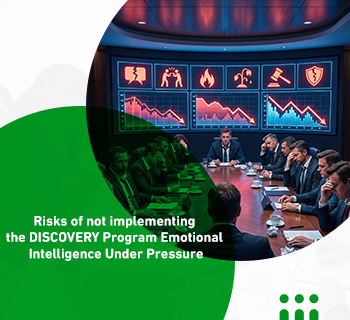
Risks of not implementing the DISCOVERY Program – Emotional Intelligence Under Pressure

  • Communication breaks down as soon as the team faces real pressure, such as tight deadlines or unexpected crises, as each individual automatically reverts to their instinctive behavioral patterns without awareness or the ability to regulate their reactions.
  • Recurring conflicts between different personalities continue to arise repeatedly and are only resolved superficially, while the root cause remains unaddressed because no one has learned how to understand others and interact with them according to their true behavioral nature.
  • Prejudices and negative stereotypes begin to form within the team, such as describing someone as cold and indifferent, or labeling another as overly sensitive, without realizing that what is perceived is not a flaw but a different behavioral style that requires understanding rather than judgment.
  • The team lacks a shared language for dealing with behavioral differences, causing each individual to interpret their colleagues’ actions solely from their own perspective. This creates accumulated misunderstandings that gradually turn into silent tension, weakening the spirit of collaboration.
  • Decisions during crises are often delayed or incorrect due to leaders’ inability to understand their teams’ reactions and anticipate their behaviors under pressure, resulting in confusion during execution and conflicting directions.
  • Managers assign tasks and responsibilities without considering each individual’s behavioral nature, resulting in people who require careful analysis and deliberation being assigned tasks that demand speed and decisiveness, while those who need stability are placed in rapidly changing environments. This leads to performance levels below expectations.
  • Many projects fail not because of technical shortcomings or a lack of resources, but because of the breakdown of human collaboration within the team during critical moments that require the highest levels of coordination and alignment.
  • Trust among team members gradually declines without anyone recognizing the real cause, weakening team spirit and causing individuals to work in isolation. This transforms the team from an integrated unit into a group of people who merely share the same workplace.
  • Valuable time is wasted on arguments and conflicts that could have been avoided if the team had sufficient behavioral awareness to understand and manage differences, rather than being drawn into disputes that drain energy and hinder achievement.
  • Managers and leaders often lack practical tools to de-escalate tensions and reset team dynamics during high-pressure situations, causing manageable crises to escalate into open conflicts that negatively impact the overall organizational climate.

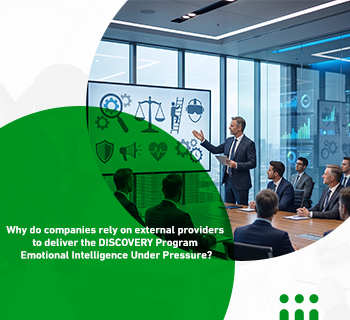
Why do companies rely on external providers to deliver the DISCOVERY Program – Emotional Intelligence Under Pressure?

  • Because objectivity is compromised when a manager trains their own team, as hierarchical relationships become intertwined with the training process. Participants may avoid revealing their true behaviors or honestly confronting their behavioral patterns, whereas an external facilitator provides a safe and neutral environment that enables genuine self-discovery.
  • Because designing a simulation with this level of complexity and depth requires specialized expertise in behavioral science and models such as DISC, along with a precise understanding of how to emotionally and intellectually engage participants within an artificial pressure environment—expertise that internal teams typically do not possess.
  • Because an external provider brings accumulated experience from companies and multiple industries, enriching discussions with real-world examples and comparative behavioral patterns rather than being limited to a single internal context that may narrow the perspective.
  • Because an internal trainer is often part of the existing team dynamics and may unconsciously avoid sensitive issues or influential individuals, whereas an external provider has no internal political obligations that could prevent addressing the root causes of the problem.
  • xBecause delivering the program internally consumes leadership’s time and energy in preparation, facilitation, and evaluation, while an external provider manages the entire process efficiently. This enables leaders to participate as learners rather than facilitators, allowing them to gain the full value of the experience and maximizing the program’s impact on the organization’s decision-makers.
  • Because delivering the program internally consumes leadership’s time and energy in preparation, facilitation, and evaluation, whereas an external provider manages the entire process efficiently. This allows leaders to participate as learners rather than facilitators, enhancing the program’s impact on decision-makers themselves.
  • Because participants tend to engage more openly with an external facilitator, knowing that their comments and behaviors during the simulation will not influence their performance evaluations or relationships with their managers. This creates a more honest learning experience with a deeper and more lasting impact.
  • Because an external provider brings an objective perspective to the organization and often uncovers deeply rooted behavioral patterns that internal leaders may overlook simply because they have become accustomed to them. This outside perspective alone provides significant strategic value.
  • Because delivering a program of this emotional sensitivity requires an experienced facilitator with the ability to manage unexpected reactions and handle the intense emotional moments that may arise during the simulation—a level of expertise that is not typically found among non-specialist internal trainers.
  • Because partnering with a credible external provider sends a clear message to your team that your organization is genuinely committed to emotional intelligence and people development, increasing participants’ sense of value, commitment, and engagement even before the first session begins.

Why do companies request the DISCOVERY Program – Emotional Intelligence Under Pressure through Mashroo3k Consulting?

  • Because we are an authorized partner of Ajax Training & Consulting, the original developer of this program and its methodology from the ground up, ensuring that you receive the full experience exactly as it was designed—not a shortened or modified version.
  • Because our team combines academic expertise in behavioral science with practical experience in corporate training, ensuring that every moment of the simulation is grounded in sound principles and immediately applicable in the workplace.
  • Because we have a proven track record of working with companies and teams across multiple industries, enriching the learning experience with comparative behavioral insights and real-world examples that extend beyond your organization’s internal context.
  • Because our experienced facilitators are highly skilled at managing unexpected reactions and handling the intense emotional moments that arise during the simulation, turning pressure into genuine learning rather than allowing it to become a crisis.
  • Because we deliver the program with the flexibility to meet your organization’s needs, whether you require an intensive one-day program or a more comprehensive two-day experience, and whether your team is small or consists of multiple parallel groups.
  • Because we do more than deliver a training program—we partner with your organization from the diagnostic stage and understanding the team’s dynamics through to the final debrief, where participants develop a behavioral agreement they take back and apply in the workplace.
  • Because partnering with us sends a clear message to your team that your organization takes emotional intelligence and people development seriously, increasing participants’ commitment and engagement even before the first session begins.
  • Because we ensure that participants leave with more than the memory of an enjoyable experience—they leave with genuine behavioral awareness, practical tools, and a shared team agreement that transforms how they work with one another over the long term.
Green Friday

فرصة لا تتكرر

GREEN FRIDAY

خصم 25% على خدمات مشروعك استفد من العرض الآن، فالفرصة متاحة لفترة محدودة فقط
سجّل بياناتك واحصل على خصم 25% الآن