Mashroo3k Consulting offers a feasibility study for a nuts shop and oil press project, ensuring the highest return on investment and the best payback period, through a set of precise studies including: In-depth analysis of the target market size Assessment of local and international competitor strategies Development of competitive pricing proposals
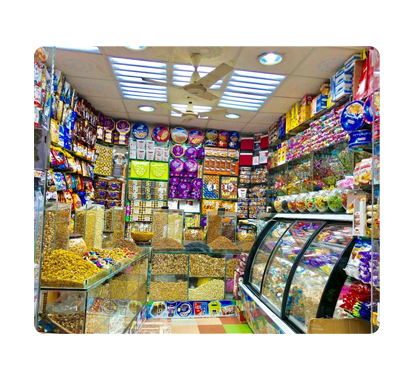
The nuts shop and oil press offers a wide variety of nuts and dates, as well as different types of oils, including olive oil, sesame oil, coconut oil, and wheat germ oil. The shop also includes a herbal and natural remedies section, commonly referred to today as alternative medicine, which features a wide range of products such as spices, coffee, and herbs.<br>Mashroo3k Consulting provides investors interested in launching a nuts shop and oil press project with a set of specialized feasibility studies, based on up-to-date market databases. These studies are designed to support the project’s success and ensure maximum profitability and the best payback period.

A diverse store with a wide range of products.
A number of different activities within the store.
Adequate space.
A wide variety of exhibits.
The design is as distinctive as possible.
Consistent and complete cleanliness of the place, its contents, and its employees.
Executive summary
Study of project services/products
Market Size Analysis.
According to the macroeconomic theory of sectors, the economy is divided into three main sectors:
The Primary Sector, which involves the extraction and collection of natural resources. This includes mining, logging, oil exploration companies, agriculture, and fishing industries.
The Secondary Sector, which is based on manufacturing and selling goods, such as automobile manufacturing, furniture, clothing retail, etc.
The Tertiary Sector, known as the Service Sector, which focuses on providing and producing services. It primarily deals with intangible outputs such as entertainment, healthcare, transportation, hospitality, restaurants, and more.
This theory holds that the more developed a country becomes, the more it relies on the service sector—unlike less developed nations that primarily depend on the primary sector. For example, in the United States, the service sector accounts for 85% of the total economy.
The service sector in Saudi Arabia is broad and includes various activities such as:
Wholesale and retail trade
Restaurants and hotels
Transportation, storage, information, and communications
Financial services, insurance, real estate, and business services
Social, personal, and community services
Government services
Key indicators:
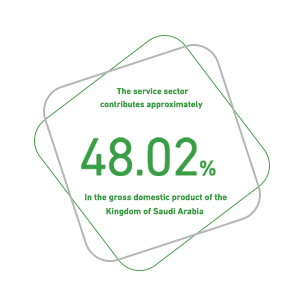
The service sector contributes approximately 48.2% to Saudi Arabia’s GDP.
Wholesale and retail trade, restaurants, and hotels contribute 10.8%.
Transport, storage, information, and communications contribute 6.6%.
Financial, insurance, real estate, and business services contribute 6.4%.
Collective, social, and personal services contribute 2.5%.
Government services contribute 21.9%.
According to the latest statistics, 100,944 new commercial licenses were issued in the past year, bringing the total to 348,173 active commercial licenses. Wholesale and retail trade, and vehicle and motorcycle repair activities accounted for the largest share with 48,242 licenses, followed by 16,531 for accommodation and food services, and 11,521 for construction activities.
The wholesale and retail trade sector is valued at 50.083 billion Qatari Riyals.
There are 11,139 establishments in this sector, employing 213,954 workers.
Employee compensation in this sector amounts to 11.29 billion QAR.
Hotel and Restaurant Sector:
2,396 establishments operate in this field, with 78,194 workers.
Employee compensation amounts to 2.95 billion QAR.
Telecommunications:
Mobile phone subscribers (regular): 976,015 individuals.
Prepaid mobile subscribers: 2,941,556 individuals.
Transport and Infrastructure:
Roads paved last year: 2,224 kilometers.
Driving licenses issued last year: 242,923 licenses.
Employee compensation in the transport and communication sector: 24.34 billion QAR.
Insurance:
Number of insurance policies issued last year: 715,897 policies.
Business Services:
Number of establishments: 4,973.
Employees in this sector: 215,285.
Employee compensation: 15.35 billion QAR.
Social and Personal Services (Private Sector):
Number of workers: 80,569.
Compensation: 6.13 billion QAR.
The wholesale and retail trade sector contributes approximately 1.6443 billion Kuwaiti Dinars to the GDP.
The hotel and restaurant sector contributes 418.6 million KWD.
The transport, storage, and communications sector contributes 2.5545 billion KWD.
Total paved road surface area: 91,340,068 square meters.
Wholesale and retail trade, and motor vehicle and motorcycle repair contribute 12.3% to GDP (approx. AED 172.29 billion).
Transportation and storage contribute 5.9% (approx. AED 82.46 billion).
Accommodation and food services contribute 2.3% (approx. AED 32.36 billion).
Information and communications contribute 2.9% (approx. AED 41.35 billion).
Financial and insurance activities contribute 9.6% (approx. AED 134.77 billion).
Number of insurance policies issued by year-end: 7,584,607.
Employment Distribution:
Wholesale and retail trade employs 13% of the total UAE workforce.
Transport and storage sector employs 6.2%.
Accommodation and food services employ approximately 5%.
Total GDP: OMR 29.3 billion.
Wholesale and retail trade contributes 7% (approx. OMR 2.065 billion).
Hotel and restaurant activities contribute 1.1% (approx. OMR 308.6 million).
Transport, storage, and communication contribute 5.9% (approx. OMR 1.721 billion).
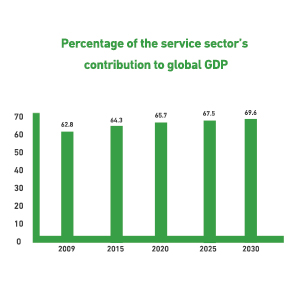
The global service sector is the largest contributor to the world’s GDP, accounting for more than three-fifths of the total. It does not rely on tangible goods like automobiles or furniture, but rather on intangible services such as banking, healthcare, transportation, hospitality, entertainment, and more.
In 2020, the global service market was valued at USD 10,814.49 billion and increased to USD 11,780.11 billion in 2021, achieving a compound annual growth rate (CAGR) of 8.9%. Following the recovery from the COVID-19 pandemic, experts predict the market will reach USD 15,683.84 billion by 2025, with a projected CAGR of 7% in the coming years.
Strategic goals and benefits: Technologies and Quality Standards: The economic and social impact:
Read moreStrategic goals and benefits: Technologies and Quality Standards: The economic and social impact:
Read more
He contributes as a financial and accounting expert with extensive experience in financial data analysis, feasibility studies, and evaluating the financial performance of institutions across various sectors. He is distinguished by his ability to prepare strategic reports and analyze performance indicators to enhance efficiency and improve financial and operational results

She contributes as a market research expert and economics researcher by providing advanced market analyses and accurate feasibility studies, focusing on consumer behavior, competition analysis, and monitoring market indicators, making her an effective member of consulting teams
Melsan School Project Melsan is a comprehensive online school that provides distance learning services for kindergarten and primary school students. It offers an integrated educational system that combines high-quality curricula, modern teaching methods, and continuous interaction between teachers and students.The project aims to deliver an educational experience comparable to that of international schools, enabling students […]
Read moreAbout Rabi’ Tihama Glass & Aluminum Company Rabi’ Tihama Glass & Aluminum Company aims to be an active and influential partner in achieving the goals of Saudi Vision 2030 by enhancing the contribution of the construction and building sector to the national economy and supporting its sustainable and balanced growth.The company’s vision centers on establishing […]
Read more


We work with all indicators applicable in the bank of New York-City bank-bank barleys London and we use the applicable IRR in the quality of investment measurement or comparison between different investments and this is the way in which banks are employed.
Mashroo3k possesses specialized expertise and a team of seasoned professionals with extensive experience across various consultation domains, encompassing economic, technical, and implementation facets.
The company has established strategic partnerships with numerous international consulting firms.
It offers certified specialized training programs that adhere to rigorous standards of implementation and evaluation.
Furthermore, it conducts studies and develops products using rigorous scientific methodologies, ensuring the highest standards of accuracy.
Lastly, it possesses infrastructure and facilities distinguished by their high level of readiness for executing various projects.
Economic Feasibility Study:
Administrative Consulting:
Marketing Consulting:
Financial and Accounting Consulting:
Consulting Services:
Egypt: 1) Zahraa El Maadi, Grand Plaza, Hegaz Gardens, Office 301, Third Floor
2) 9 Abu Bakr El Siddiq Street, Beni Suef.
Kingdom of Saudi Arabia: Othman bin Affan Road, Al-Taawun District, Riyadh 12476
Next to Al Rajhi Bank, above Juhayna Sweets and Chocolate
Second floor, Office No. 14 (Your Strategic Project for Business Solutions Company).
Sultanate of Oman: Muscat Governorate, Wilayat of Seeb – Al Khoud 6
New Work Square, next to Sultan Qaboos University – Office No. 1041-1.
.UAE: Office No. 806, Al Tharaa Tower, Al Garhoud, Behind Union National Bank, Dubai
Iraq: University District – Al-Rabi’ Street – Baghdad.
Qatar: Al Tawbah Street, Muaither – First Floor – Doha.
Yemen: Haddah Street – Al-Masbahi Roundabout – Al-Nazili Building “First Floor” Sana’a
Sudan: Nilein Towers – Khartoum
China: Room 915,9 floor, Building C, Jinfuyuan, Yiwu, Zhejiang
Guangzhou Office
3A01
Room 3A01, R&F International Shoo Trade Center, No. 37 Huanshi West Road,
Liwan District, Guanghou
Services are delivered in 10 phases, starting from submitting the service request and ending with follow-up and technical support, passing through several key steps such as collecting the required data, agreeing on funding sources, and other related matters. The implementation mechanisms depend on the client’s available resources and the company’s assessment of the target market. The company may redirect the investment decision or suggest a new idea that aligns more closely with the investor’s or entrepreneur’s interests.
Below are the ten phases of service implementation at “Mashroo3k”:
We focus on all agreed-upon indicators with City Bank, Barclays, and BNY Mellon. We utilize the Internal Rate of Return (IRR), which is endorsed by major banks, to assess investment quality and compare different investment opportunities.
Machinery, equipment, and production lines differ based on project requirements and capital constraints. Mashroo3k has established robust partnerships with over 7,513 suppliers of production lines and machinery, guaranteeing high efficiency and significantly lower prices for its clients. The key countries with which “Mashroo3k” engages in dealings with their supplier companies are: China – India – Turkey – Latvia – Estonia – Russia – Korea – Spain – America – Italy – Germany – Canada – Netherlands – Ukraine – Finland – Sweden – Denmark – Austria – Czech Republic – Egypt.
Mashroo3k Company is acknowledged as an accredited financing entity by governmental institutions and relevant ministries. Here are the foremost authorities and institutions:
Saudi Industrial Development Fund (Social Development Bank)
Industrial Center
Supreme Commission for Tourism (SCT)
Khalifa Fund For Enterprise Development
Bahrain Business Incubator Centre
Qatar Development Bank.
Industrial Bank of Kuwait.
Bank Muscat
Al Raffd Fund
Saudi Agriculture Bank
Saudi Agriculture Bank
Kafalah.
The Centennial Fund
Riyada
Waed
Badir Program for Technology Incubators and Accelerators
The National Charitable Fund
Abdul Latif Jameel Community Services Program
Al-Rajhi Bank

خصم 25% على خدمات مشروعك استفد من العرض الآن، فالفرصة متاحة لفترة محدودة فقط
سجّل بياناتك واحصل على خصم 25% الآن


