The **fish feed manufacturing project** represents a strategic investment at the heart of the aquaculture industry, providing specialized nutritional solutions tailored to the growing needs of aquatic resources. Guided by this vision, the plant focuses on producing high-quality feed formulations based on the latest technologies and international standards, ensuring balanced nutrition for fish across different growth stages. In addition, the facility develops a variety of blends that combine plant- and animal-based proteins, enriched with essential vitamins and minerals, to promote healthy growth and high productivity. From a supply chain perspective, the project targets a wide spectrum of clients — from large and medium-scale commercial aquaculture ventures to small family-run farms seeking to boost their yields. The supply network further extends to fish traders, regional distribution centers, and specialists in ornamental fish and freshwater tanks, strengthening the plant’s position as a key player in the market. Ultimately, the project’s impact goes beyond meeting the rising demand for feed: it also supports self-sufficiency in animal protein, creates quality job opportunities, and contributes to the path of sustainable economic development in the agricultural sector.

The <strong>feasibility study for a fish feed manufacturing project</strong> presents a promising and strategic investment opportunity, built upon a set of interconnected key indicators.<br>On the technical side, the focus lies on selecting a suitable location near aquaculture areas, supported by modern production lines capable of producing both floating and sinking feed in different sizes to meet the nutritional needs of fish across all growth stages. Ensuring the use of high-quality raw materials guarantees an efficient, high-performance product.<br>From the marketing perspective, the market shows steady growth, making it essential to prioritize direct distribution channels with farms and distributors, in addition to adopting a simple yet effective promotional strategy to strengthen market share.<br>On the financial front, the indicators confirm the investment’s viability, as the sector carries relatively low risks compared to others. The continuous demand for fish feed ensures stable cash flows and growing profitability.<br>Regarding the administrative aspect, the project is based on a clear organizational structure, supported by well-trained operational staff to maintain high standards of quality and efficiency By integrating all these factors, a fish feed plant emerges as a comprehensive investment option that not only enhances economic value but also supports sustainable growth in a vital sector where demand continues to rise.<br>
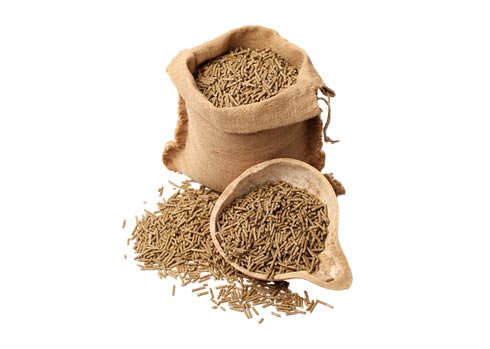
Rising and continuous demand for fish feed driven by the growth of the aquaculture sector.
Lower market volatility risks compared to other projects, as the market relies heavily and essentially on feed.
Significant potential for product diversification to meet the needs of different fish species, opening opportunities for multiple markets and expanding the factory’s market share.
Ability to reduce costs through the use of local resources and raw materials, enhancing financial efficiency and increasing profit margins.
Opportunity to expand into exports, reaching external markets and increasing investors’ cash returns.
Easy access to multiple distribution channels, including fish farms, wholesale, and retail outlets, which contributes to boosting sales.
Environmental and economic sustainability, as the factory helps reduce dependency on imported feed and strengthens the local economy.
Clear operational and management requirements, enabling the development of a skilled and professional workforce supported by a precise monitoring and control system to enhance productivity.
Attractive financial returns and a reasonable payback period relative to the investment size, with strong potential for future growth.
Support available from government entities and investors due to the project’s importance in enhancing food security and supporting the growth of the fisheries sector.
Executive summary
Study project services/products
Market Size Analysis.
Risk Assessment.
Agricultural Production Sector in the GCC Countries
There is no doubt that the agricultural sector holds significant importance in the global economy today. It contributes to achieving self-sufficiency and food security, reduces unemployment, alleviates poverty, and serves as the primary source of raw materials for many manufacturing industries. This vital sector employs approximately 935.6 million workers, representing 28.3% of the global labor force.
According to the latest statistics, the amount of plant production in the Guشlf Cooperation Council (GCC) countries for various agricultural crops is estimated at about 8.7 million tons. Notably, Saudi Arabia alone contributes 60.5% of Gulf plant production, followed by Oman with about 19.1%, then the UAE with 12.5%, while the remaining percentage is shared among the other countries.
Vegetables account for 41% of Gulf plant production. They are the top agricultural product in Kuwait, Bahrain, Qatar, Oman, and Saudi Arabia. Saudi Arabia leads the region in vegetable production, contributing 55.1% of the total output.
Cereals account for 7% of total plant production in the GCC countries, amounting to 1.9 million tons. The UAE leads in grain production among the GCC countries, contributing 42.9%.
The amount of fish caught in the GCC countries was estimated at 740 tons, according to the latest statistics. Oman contributes 74.8% of this total. There are 124,700 people working as fishermen in the GCC countries, with 40% of them in Oman and 33% in the UAE. The region has 41,100 fishing boats, with Oman accounting for 57.7% and Saudi Arabia 26.6%.
Despite all this, the contribution of this sector to the global GDP does not exceed 4%. This percentage must be reconsidered for the future, as by 2050, the global population will exceed 9 billion, and the agricultural sector alone will be responsible for feeding this population and protecting them from hunger.
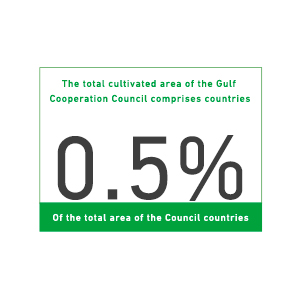
The total area of the GCC countries is estimated at about 2.4 million square kilometers, with the cultivated area being 11.8 thousand square kilometers, constituting 0.5% of the total area of the GCC countries. In all GCC countries, the cultivated area compared to the total area does not exceed 1%, except in Bahrain, where the cultivated land reaches 4.8% of the total area.
Fruit production in the GCC countries is expected to grow significantly in the coming years, with a compound annual growth rate (CAGR) of 3.8%.
Agricultural Production Sector Globally
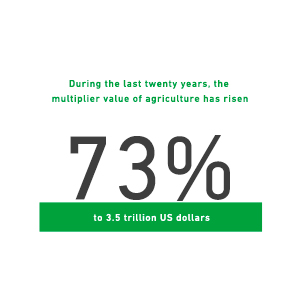
According to the Food and Agriculture Organization of the United Nations (FAO), hunger is on the rise, with the number of undernourished people worldwide rising to 770 million; a large number that we hope agriculture and its products will help reduce. It is noteworthy that agricultural land around the world decreased by 127 million hectares between 2000 and 2019 (roughly the size of Niger), while forest area decreased by 94 million hectares (the size of the United Republic of Tanzania) during the same period. These numbers are undoubtedly somewhat unsettling, especially since the world’s population is increasing; therefore, Mashroo3k supports investment under the umbrella of the agricultural sector in order to keep pace with the demand for food.
Strategic goals and benefits: Technologies and Quality Standards: The economic and social impact:
Read moreStrategic goals and benefits: Technologies and Quality Standards: The economic and social impact:
Read more
He contributes as a financial and accounting expert with extensive experience in financial data analysis, feasibility studies, and evaluating the financial performance of institutions across various sectors. He is distinguished by his ability to prepare strategic reports and analyze performance indicators to enhance efficiency and improve financial and operational results

She contributes as a market research expert and economics researcher by providing advanced market analyses and accurate feasibility studies, focusing on consumer behavior, competition analysis, and monitoring market indicators, making her an effective member of consulting teams
Melsan School Project Melsan is a comprehensive online school that provides distance learning services for kindergarten and primary school students. It offers an integrated educational system that combines high-quality curricula, modern teaching methods, and continuous interaction between teachers and students.The project aims to deliver an educational experience comparable to that of international schools, enabling students […]
Read moreAbout Rabi’ Tihama Glass & Aluminum Company Rabi’ Tihama Glass & Aluminum Company aims to be an active and influential partner in achieving the goals of Saudi Vision 2030 by enhancing the contribution of the construction and building sector to the national economy and supporting its sustainable and balanced growth.The company’s vision centers on establishing […]
Read more


We work with all indicators applicable in the bank of New York-City bank-bank barleys London and we use the applicable IRR in the quality of investment measurement or comparison between different investments and this is the way in which banks are employed.
Mashroo3k possesses specialized expertise and a team of seasoned professionals with extensive experience across various consultation domains, encompassing economic, technical, and implementation facets.
The company has established strategic partnerships with numerous international consulting firms.
It offers certified specialized training programs that adhere to rigorous standards of implementation and evaluation.
Furthermore, it conducts studies and develops products using rigorous scientific methodologies, ensuring the highest standards of accuracy.
Lastly, it possesses infrastructure and facilities distinguished by their high level of readiness for executing various projects.
Economic Feasibility Study:
Administrative Consulting:
Marketing Consulting:
Financial and Accounting Consulting:
Consulting Services:
Egypt: 1) Zahraa El Maadi, Grand Plaza, Hegaz Gardens, Office 301, Third Floor
2) 9 Abu Bakr El Siddiq Street, Beni Suef.
Kingdom of Saudi Arabia: Othman bin Affan Road, Al-Taawun District, Riyadh 12476
Next to Al Rajhi Bank, above Juhayna Sweets and Chocolate
Second floor, Office No. 14 (Your Strategic Project for Business Solutions Company).
Sultanate of Oman: Muscat Governorate, Wilayat of Seeb – Al Khoud 6
New Work Square, next to Sultan Qaboos University – Office No. 1041-1.
.UAE: Office No. 806, Al Tharaa Tower, Al Garhoud, Behind Union National Bank, Dubai
Iraq: University District – Al-Rabi’ Street – Baghdad.
Qatar: Al Tawbah Street, Muaither – First Floor – Doha.
Yemen: Haddah Street – Al-Masbahi Roundabout – Al-Nazili Building “First Floor” Sana’a
Sudan: Nilein Towers – Khartoum
China: Room 915,9 floor, Building C, Jinfuyuan, Yiwu, Zhejiang
Guangzhou Office
3A01
Room 3A01, R&F International Shoo Trade Center, No. 37 Huanshi West Road,
Liwan District, Guanghou
Services are delivered in 10 phases, starting from submitting the service request and ending with follow-up and technical support, passing through several key steps such as collecting the required data, agreeing on funding sources, and other related matters. The implementation mechanisms depend on the client’s available resources and the company’s assessment of the target market. The company may redirect the investment decision or suggest a new idea that aligns more closely with the investor’s or entrepreneur’s interests.
Below are the ten phases of service implementation at “Mashroo3k”:
We focus on all agreed-upon indicators with City Bank, Barclays, and BNY Mellon. We utilize the Internal Rate of Return (IRR), which is endorsed by major banks, to assess investment quality and compare different investment opportunities.
Machinery, equipment, and production lines differ based on project requirements and capital constraints. Mashroo3k has established robust partnerships with over 7,513 suppliers of production lines and machinery, guaranteeing high efficiency and significantly lower prices for its clients. The key countries with which “Mashroo3k” engages in dealings with their supplier companies are: China – India – Turkey – Latvia – Estonia – Russia – Korea – Spain – America – Italy – Germany – Canada – Netherlands – Ukraine – Finland – Sweden – Denmark – Austria – Czech Republic – Egypt.
Mashroo3k Company is acknowledged as an accredited financing entity by governmental institutions and relevant ministries. Here are the foremost authorities and institutions:
Saudi Industrial Development Fund (Social Development Bank)
Industrial Center
Supreme Commission for Tourism (SCT)
Khalifa Fund For Enterprise Development
Bahrain Business Incubator Centre
Qatar Development Bank.
Industrial Bank of Kuwait.
Bank Muscat
Al Raffd Fund
Saudi Agriculture Bank
Saudi Agriculture Bank
Kafalah.
The Centennial Fund
Riyada
Waed
Badir Program for Technology Incubators and Accelerators
The National Charitable Fund
Abdul Latif Jameel Community Services Program
Al-Rajhi Bank

خصم 25% على خدمات مشروعك استفد من العرض الآن، فالفرصة متاحة لفترة محدودة فقط
سجّل بياناتك واحصل على خصم 25% الآن


