هذا النص هو مثال لنص يمكن أن يستبدل في نفس المساحة، لقد تم توليد هذا النص من مولد النص العربى، حيث يمكنك أن تولد مثل هذا النص أو العديد من النصوص الأخرى إضافة إلى زيادة عدد الحروف التى يولدها التطبيق.
The five-a-side football field project is considered one of the most prominent and successful sports investment opportunities in recent years, due to its combination of ease of implementation, reasonable investment cost, and the growing demand for football as a recreational and competitive activity. By providing a sports facility equipped to high standards, the project meets the needs of a wide range of young people and transforms the site into a preferred daily destination, ensuring a steady and sustainable cash flow throughout the year.
Amid the growing trend towards sports and recreational activities, the five-a-side football field project stands out as a promising investment. It does not require vast spaces or large capital compared to traditional football fields, and it can be operated efficiently with relatively low operating costs. However, the success of the project primarily depends on careful planning, especially selecting a strategic location, outlining precise financial feasibility indicators, and preparing an operational plan that considers future expansion and market adaptability. In this article, we explore the concept of a five-a-side football field project, its main advantages, a detailed feasibility study, as well as the requirements and guidelines that should be followed during implementation to ensure its success and profitability.
What is a Five-a-Side Football Field Project?
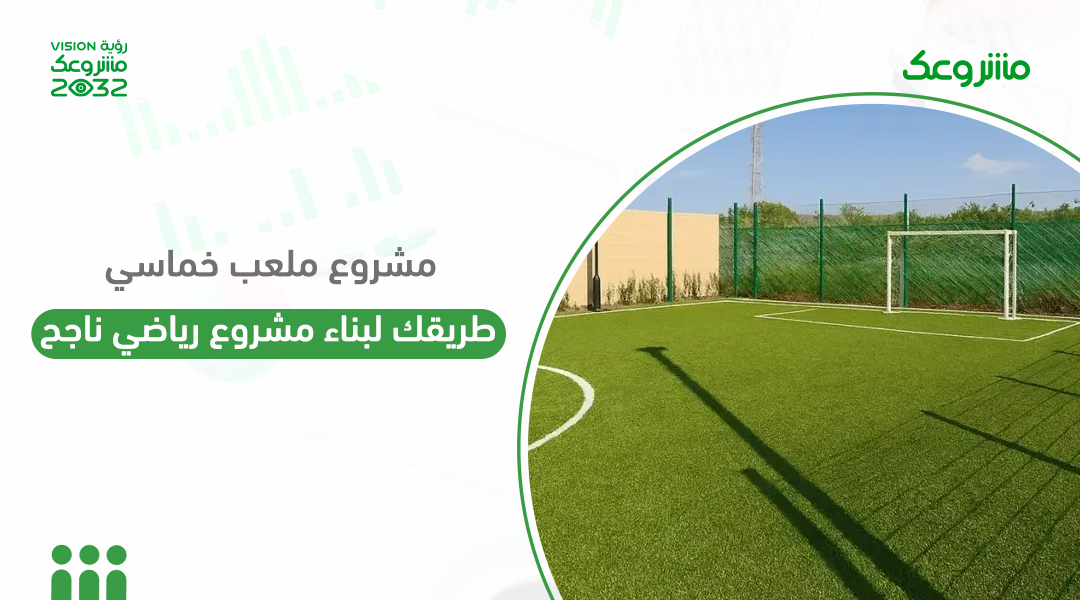
A five-a-side football field project is a profitable sports investment that involves establishing a small football field with standard dimensions (usually 20×40 meters or 18×38 meters, depending on the required specifications). The facility is equipped with high-quality artificial turf, protective netting, strong lighting, changing rooms, restrooms, and a small café or seating area. The field is intended to be rented by the hour to sports teams, amateurs, students, academies, and even companies for organizing internal tournaments or recreational events. This project enjoys very high demand in most Arab cities due to the widespread popularity of football as a recreational activity, ensuring quick revenue turnover and a relatively short return on investment when the location is carefully chosen and professional services are provided.
What are the main advantages of a five-a-side football field project?
High and continuous demand driven by the popularity of football across all age groups and social segments.
Steady daily cash flow through hourly rental systems for organized teams and amateurs.
Very low operating costs, consisting mainly of simple routine maintenance.
The project does not require a large area, significantly reducing the costs of land acquisition and construction.
High feasibility for implementation in major cities, residential neighborhoods, and villages alike.
Diversified income streams through selling food and beverages, organizing tournaments, and providing sports training services.
Fast return on investment, allowing capital recovery in a relatively short period.
Availability of government support and significant financial facilities, such as low-interest loans or partial fee exemptions.
Cost of a Five-a-Side Football Field Project
The cost varies depending on the following factors:
Purchase or lease of land in a strategic location suitable for the project.
Land leveling, preparation of the base, and installation of high-quality artificial turf.
Supply and installation of essential equipment (reinforced top and side nets, metal fences, goalposts, and high-powered LED floodlights).
Construction and equipping of service facilities (booking office, changing rooms, restrooms, player resting areas, spectator seating).
Initial expenses for purchasing sports equipment, tools, and operational supplies.
Official licensing, municipal permits, and required security or sports approvals.
Wages for engineering consultants, technicians, and specialized labor during implementation and startup.
Budget for marketing and promotional campaigns to attract teams and players from day one.
Initial operational expenses until revenue generation begins (salaries, electricity, water).
Feasibility Study for a Five-a-Side Football Field
Technical Feasibility Study
Choose a strategic location, ensuring adequate standard space (minimum 18×38 meters) near residential areas with young populations.
Determine the appropriate type of turf in accordance with international standards for height and density.
Supply and install essential equipment professionally: fixed goals, protective nets, metal fences, and LED lighting at 300–500 lux.
Design and implement supporting facilities (air-conditioned changing rooms, restrooms, reception areas for players and spectators).
Design and implement a full drainage system and irrigation system (if natural turf is used) to ensure readiness under all weather conditions.
Create a detailed periodic maintenance schedule and estimate annual maintenance costs (turf cleaning, rubber granule replenishment, lighting and facilities maintenance).
Apply the highest safety standards (anti-slip flooring, fire extinguishers, emergency lighting, safe entrances and exits).
Form a trained technical and administrative team, including an operations manager, maintenance technician, and reception staff to ensure professional service 24/7.
Conduct a comprehensive market analysis to identify target segments, their numbers, geographic distribution, booking habits, and preferences regarding timing and pricing.
Study direct and indirect competitors, analyzing rental prices, turf quality, operating hours, auxiliary services (kiosk, training), and competitor reputation through reviews and ratings.
Design a full promotional strategy combining brand building (name, logo, visual identity), continuous engagement with audiences via attractive content (match videos, highlights, offers), and loyalty programs (e.g., repeat booking discounts).
Select the most effective marketing channels for the target audience: digital marketing, field marketing, local partnerships, and geo-targeted paid ads.
Set a competitive pricing strategy considering cost, desired profit margin, competitor prices, and perceived value (turf quality, lighting, privacy, security cameras).
Organize regular tournaments and events (weekly, monthly, or seasonal) with different age groups and skill levels, offering prizes or certificates, with media documentation to enhance the field’s visibility.
Analyze seasonal demand, monitor market changes, and use this data to adjust pricing, operations, and marketing plans proactively.
Implement a system to measure customer satisfaction through short surveys after each booking (paper or digital), track social media feedback, and analyze return and cancellation rates to continuously improve services.
Design a clear organizational structure detailing roles, responsibilities, decision-making processes, and internal communication channels.
Develop a comprehensive electronic booking system (app) allowing customers to easily schedule appointments, with features like date/time display, automatic reminders, and online payments.
Implement precise hiring policies and specialized training programs for employees.
Apply health and safety procedures: CCTV, fire extinguishers, emergency lighting, and regular turf inspections.
Establish a modern accounting and management system to record revenues and expenses, analyze KPIs, and generate daily, weekly, and monthly reports for informed decision-making.
Build sustainable strategic relationships with suppliers, contractors, and service companies through clear contracts, emphasizing partnerships over transactional dealings.
Set periodic maintenance plans, logistics development, and facility expansion to ensure year-round readiness and consistent quality.
Design internal marketing programs and incentive systems (monthly performance bonuses, peak-hour allowances, personal development training) to enhance team spirit, commitment, and reduce employee turnover.
Read here: Feasibility Study Services by Mashroo3k
Important Guidelines for a Successful Five-a-Side Football Field Project
Select a location in the heart of densely populated neighborhoods, near universities or schools, with parking, clear entrances, and strong outdoor lighting.
Use high-quality, high-density artificial turf meeting international standards with rubber granules and silica sand for comfort, injury reduction, and durability.
Install professional LED lighting evenly distributed on high poles with an emergency backup system.
Add a strong audio system with speakers and microphones for music, commentary, and an exciting match atmosphere.
Equip air-conditioned changing rooms with lockers, seating, mirrors, showers (hot and cold), and clean restrooms.
Create a modern cafeteria with display fridges, coffee machines, and large screens to serve drinks and snacks.
Organize weekly/monthly tournaments with cash or trophy prizes to attract new teams and build a loyal customer base.
Implement an instant online booking system showing available times with automatic reminders.
Offer monthly subscription packages, early morning offers, and fixed weekly bookings at discounted rates.
Run daily targeted marketing campaigns on Instagram and TikTok with professional videos and aerial photos.
Follow a strict maintenance schedule: turf combing, granule replenishment, lighting checks, and facility cleaning.
Partner with academies, schools, and universities for a continuous revenue stream.
Monitor customer feedback daily and respond promptly to complaints.
Renew offers and events monthly to maintain excitement and attract new visitors continuously.
Key Requirements for Opening a Five-a-Side Football Field in Saudi Arabia
Provide a valid commercial registration with the activity listed.
Submit a building permit and proof of land use rights (ownership deed, lease contract, or investment agreement approved by the municipality).
Obtain approval from the supervising authority for the activity.
Fulfill technical and spatial requirements for the sports activity.
Fully comply with the Saudi Building Code, Civil Defense, and technical safety requirements for design, operation, and maintenance.
Use an approved engineering office for project design and operation to ensure compliance with standards.
Respect neighbors’ privacy by preventing openings facing adjacent properties.
Provide safe and accessible entrances and pathways meeting safety and accessibility standards.
Ensure project façades comply with local codes and official approvals.
Avoid exposed utilities to maintain aesthetics and organization.
Follow accessibility standards for people with disabilities and provide appropriate ramps.
Frequently Asked Questions About the Five-a-Side Football Field Project
Is the football field project profitable?
Yes, the five-a-side football field project is profitable because it relies on hourly rentals daily, generating a steady income with low operating costs.
What are the requirements for a five-a-side football field project?
One of the most important requirements for a five-a-side football field project is the presence ofA suitable plot of land, artificial or natural turf, lighting, fences and nets, facilities such as changing rooms and restrooms, playing equipment, and obtaining the necessary permits.
How to build a five-a-side football field?
A five-a-side football field can be established by selecting the location, preparing the ground, installing the turf, setting up the lighting and fences, constructing the facilities, fulfilling all technical and spatial requirements, and then operating the field.
What is the difference between a five-a-side and a six-a-side football field?
The difference between a five-a-side and a six-a-side football field is that a five-a-side field accommodates 5 players per team, making the area smaller, while a six-a-side field accommodates 6 players per team and is slightly larger in size.
How many meters does a five-a-side football field require
The required area for a five-a-side football field is approximately 22 × 42 square meters (around 924 square meters), although the area may be slightly smaller or larger in some specific cases.
What are the dimensions of a five-a-side football field?
The dimensions of a five-a-side football field are:A length ranging between 25 and 42 meters, a width ranging between 16 and 25 meters, and a goal measuring up to 3 meters in width × 2 meters in height
In conclusion of our article about the five-a-side football field project
The five-a-side football field project is a smart and profitable investment, combining high financial returns with low operating costs, supported by the immense popularity of football and continuous daily demand in every neighborhood and city. When implemented with a strategic location, high-quality facilities (premium turf, strong lighting, clean amenities), an easy booking system, and excellent service, the project quickly becomes a preferred destination for youth, amateurs, and organized teams, ensuring daily cash flow, rapid capital recovery, and sustainable profitability for many years.
Beyond the financial aspect, a five-a-side football field goes beyond being just a playing ground; it serves as a true social space that strengthens friendships, promotes physical fitness, and encourages young people to spend their time in a healthy and constructive manner. By organizing tournaments and events, and providing additional convenient services, the project becomes a comprehensive recreational platform that enriches the community while generating a stable income for its owner.
Contact us to request a feasibility study for a five-a-side football field project
The kebab restaurant project is one of the food-service ventures that combines strong demand for grilled meals with the opportunity to target a diverse customer base, including individuals, families, and lovers of traditional Middle Eastern cuisine. With growing competition in the restaurant sector, however, the project’s success is no longer determined by food taste alone. […]
A children’s toy store project is not limited to selling toys; it is built on understanding what attracts children and what families look for when choosing products that combine entertainment and educational value. With the wide variety of educational toys, skill-development games, recreational toys, and gifts available, the store has opportunities to meet the needs […]
A residential complex project is no longer simply an investment in a collection of real estate units. It has evolved into an integrated development model that combines comfortable living, diverse services, and long-term investment value. As cities expand and residents’ needs evolve, demand is growing for residential complexes that offer a comprehensive environment suited to […]
The veterinary clinic project comes at a time when animal care is no longer limited to treating illnesses or injuries, but has expanded to include health monitoring, vaccinations, routine checkups, and care for both pets and livestock. However, many animal owners face challenges in accessing specialized veterinary services that combine prompt response, high-quality care, and […]