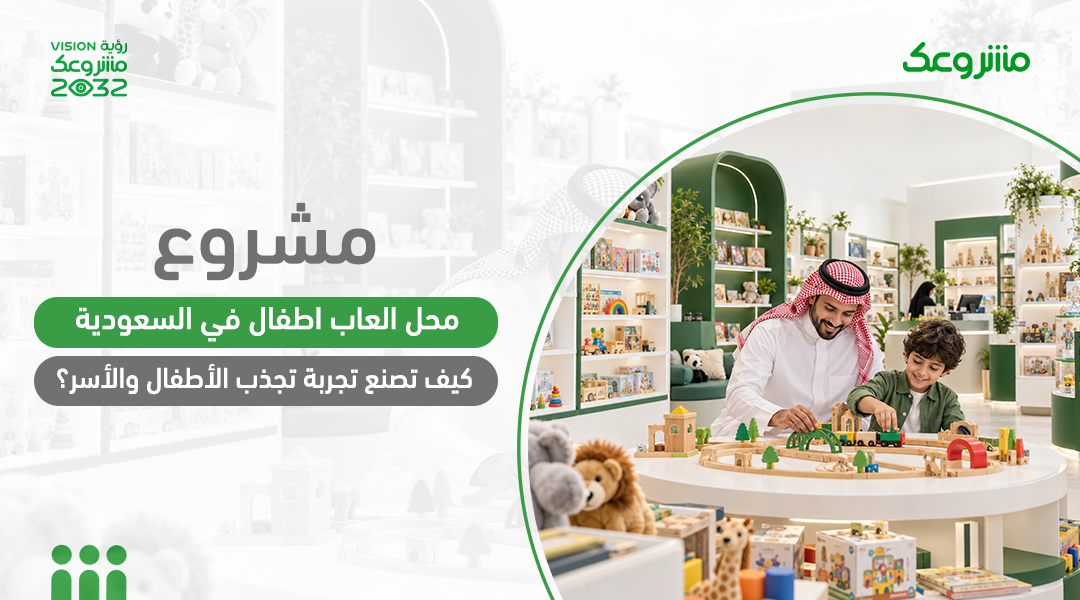
A children’s toy store project is not limited to selling toys; it is built on understanding what attracts children and what families look for when choosing products that combine entertainment and educational value. With the wide variety of educational toys, skill-development games, recreational toys, and gifts available, the store has opportunities to meet the needs of different age groups and offer a product range that appeals to diverse interests.
However, turning this variety into a sustainable business requires more than simply displaying products. Choosing the right location, identifying target customer segments, selecting toys with strong demand, working with reliable suppliers, and establishing appropriate pricing and marketing strategies all influence the project’s performance.
Sales channels can also be expanded through e-commerce and social media to reach customers beyond the store’s immediate area. Therefore, planning a children’s toy store project begins with analyzing the market and competition, followed by identifying the required equipment, products, costs, operational processes, and marketing strategies to build a clear project with room for growth and development.
The concept of a children’s toy store project is to establish a specialized retail store that offers and sells a diverse range of toys designed to meet the needs of children at different age stages, while taking into account their varying interests, abilities, and preferences. The store would offer educational toys that help develop thinking skills and abilities, construction and intelligence games, dolls and figurines, physical activity and recreational toys, as well as toys for gifts and special occasions.Read here: Top Entertainment Business Ideas That Achieve Sustainable Profits in 2025
Is a Children’s Toy Store Project Profitable?
The children’s toy store project is considered one of the commercial ventures worth studying and investing in, given the expected growth of the global toy market and the diversity of products that cater to children’s needs across different age groups. Forecasts indicate that the global toy market will reach USD 138.37 billion in 2026 and is expected to grow to USD 240.61 billion by 2034, at a compound annual growth rate (CAGR) of 7.16% during the period from 2026 to 2034.
These indicators highlight promising growth opportunities in the toy industry. However, the project’s success depends on carefully studying the target market’s needs, selecting suitable products, and setting competitive prices to ensure business success and enhance its ability to generate attractive returns.
The toy market in Saudi Arabia is experiencing steady growth, with its value increasing from USD 1.15 billion in 2025 to USD 1.20 billion in 2026. It is projected to reach USD 1.66 billion by 2034, registering a compound annual growth rate (CAGR) of 4.15% during the period from 2026 to 2034. Source: IMARC Group – Saudi Arabia Toys and Games Market.
These indicators present promising opportunities for a children’s toy store project, particularly when it differentiates itself by offering a diverse selection of toys suitable for different age groups, prioritizing product quality and safety standards, and providing competitive prices and seasonal promotions. In addition, creating a convenient shopping experience and delivering excellent customer service can strengthen customer loyalty.
Competitiveness can also be enhanced through online sales and fast delivery services, helping the store reach a wider customer base across the Saudi market.
Read here: Entertainment Market Report in the Kingdom of Saudi Arabia
Market analysis contributes to the development of a children’s toy store project by providing a clear understanding of customer needs and purchasing trends. It helps identify the most in-demand toy categories across different age groups, making it easier to select suitable products and establish competitive prices.
Furthermore, competitor analysis helps identify opportunities for differentiation, whether through product diversification, attractive promotional offers, or an improved shopping experience. It also supports selecting the right store location and determining the most effective marketing channels for reaching parents.
Analyzing market demand and projected sales also helps improve inventory management and minimize waste, ultimately supporting increased sales, stronger competitiveness, and sustainable business growth in the Saudi market.
Project costs vary depending on the location, store size, inventory volume, and operating model. They can generally be divided into investment costs and operating costs as follows:
Read here: Steps to Establish a Children’s Play Center Project: From Concept to Profit.
Read More:How Can You Generate Attractive Profits from a Children’s Amusement Park Project in Saudi Arabia?
The success of a children’s toy store project does not depend solely on having a wide range of products or choosing a prime location. Rather, it depends on understanding what motivates customers to make a purchase and how this behavior can be translated into consistent sales.
This is where the importance of a feasibility study comes in. It identifies the customer segments with the highest purchasing demand, the toys worth allocating a budget to, and the products that may experience declining sales despite their popularity. It also helps determine the appropriate store size and inventory levels to strike a balance between product variety and storage costs.
Furthermore, the study provides a realistic assessment of the competitive landscape and identifies opportunities for differentiation through educational toys, gifts, seasonal promotions, and online sales. It also evaluates whether projected revenues will be sufficient to cover financial obligations and generate an adequate return on investment.
In this way, decisions related to purchasing, pricing, and expansion are based on actual market data rather than guesswork, giving the project a greater opportunity for long-term sustainability and growth.
Read here: Feasibility Study (Definition, Objectives, Steps, Components, and Template)
A children’s toy store faces competition from specialized toy shops, large retail stores, and e-commerce platforms, making it an ongoing challenge to attract and retain customers. This can be addressed by diversifying the product range, offering new and distinctive toys, improving the shopping experience, and introducing suitable promotional offers and loyalty programs.
Children’s preferences change rapidly with the emergence of new toys, characters, and trends. Relying on a fixed product range may lead to declining demand for certain items. Therefore, it is important to monitor sales performance and market trends and regularly update the product selection.
Storing large quantities of toys with limited demand can affect cash flow and increase storage costs. This challenge can be minimized by analyzing sales data, identifying fast- and slow-moving products, and using promotional offers to clear stagnant inventory.
Expenses include rent, salaries, utilities, inventory purchases, and marketing. Increases in these costs may affect the project’s performance. They can be managed by establishing a clear budget, comparing supplier quotations, and regularly reviewing operating expenses.
Online platforms allow customers to compare products and prices and place orders conveniently. Therefore, the store needs to strengthen its digital presence by showcasing products online, providing convenient payment and delivery options, and leveraging social media platforms.
Children’s needs vary according to their ages, interests, and abilities. Poor product selection may result in weak sales. Therefore, the store should offer a diverse range of educational toys, entertainment toys, puzzles, construction games, and gifts while monitoring demand for each category.
Product quality and safety are essential factors when dealing with items intended for children. The project should work with reliable suppliers, inspect products, and ensure they meet applicable requirements and standards before displaying them for sale.
Read here: Everything You Need to Know About SWOT Analysis and How to Apply It
When considering a children’s toy store project, my biggest challenge was figuring out how to select a product range that caters to children’s different age groups and interests without facing the problem of excess inventory or purchasing toys that lack sufficient demand.
By monitoring the needs of families in the Saudi market and observing the diverse demand for educational toys, entertainment toys, skill-development games, and gifts, I found that the project offers multiple opportunities. However, turning these opportunities into a well-organized business requires a thorough study of the market, competition, location, and demand levels.
To address these challenges, I immediately contacted Mashroo3k Consulting, where the team helped me prepare a comprehensive feasibility study covering all the project’s market, technical, and financial aspects. The study identified the target customer segments and the most suitable product range, in addition to analyzing competitors, establishment and operating costs, and projected revenues.
The team also helped me develop a clear plan for setting up the store and organizing its products, as well as designing a marketing strategy that combines in-store sales with digital marketing, online sales, and delivery services.
With a clearer investment vision and improved store management practices, I was able to organize inventory more effectively, update the toy selection based on customer interests, and enhance product displays and marketing strategies. These improvements helped expand the customer base and boost sales.
My experience confirmed that a children’s toy store project requires a thorough understanding of the market, careful selection of products, suppliers, and location, as well as effective inventory management and marketing. These factors play an essential role in supporting the project’s stability and creating opportunities for further growth in the Saudi market.
Read here: How Can an Economic Feasibility Study Save Your Project from Failure?
A children’s toy store can offer a diverse range of products to meet the needs of different age groups, including educational toys, skill-development and intelligence games, construction and building sets, dolls, physical activity and entertainment toys, arts and crafts supplies, as well as gift items and toys suitable for special occasions.
A children’s toy store can expand its product range by offering complementary items such as school supplies, children’s stationery, coloring books, puzzles, board games, children’s accessories, school bags, lunch boxes, gift-wrapping supplies, and party decorations. These additions can help diversify revenue streams, increase average transaction value, and attract a wider customer base.
A range of complementary products can be added to a children’s toy store, such as drawing and coloring supplies, books and illustrated stories, gifts, party and birthday supplies, puzzles and construction games, as well as children’s bags and accessories.
When purchasing children’s toys, several key criteria should be considered, most notably the quality of materials, product safety, suitability for the child’s age and abilities, and the absence of hazardous components or substances. Toys should also comply with approved specifications and quality standards. It is advisable to select a diverse range of toys that combine entertainment with skill development, while ensuring supplier reliability and reviewing product information before offering items for sale.
Behind every toy a child chooses lies a business opportunity that requires a clear understanding of customer preferences and market demand. This highlights the importance of a children’s toy store project as a business idea that can be developed through product diversification, careful location selection, flexible inventory management, and leveraging an online store and social media platforms to reach a wider customer base.
By studying the market and competition and identifying the project’s requirements, costs, and projected revenues before launching the business, it becomes possible to establish a clearer and more adaptable operational model capable of responding to changing demand, thereby creating favorable conditions for the project’s growth and expansion in the Saudi market.

For inquiries or to request a feasibility study for a children’s toy store project.
The kebab restaurant project is one of the food-service ventures that combines strong demand for grilled meals with the opportunity to target a diverse customer base, including individuals, families, and lovers of traditional Middle Eastern cuisine. With growing competition in the restaurant sector, however, the project’s success is no longer determined by food taste alone. […]
Read moreA children’s toy store project is not limited to selling toys; it is built on understanding what attracts children and what families look for when choosing products that combine entertainment and educational value. With the wide variety of educational toys, skill-development games, recreational toys, and gifts available, the store has opportunities to meet the needs […]
Read moreA residential complex project is no longer simply an investment in a collection of real estate units. It has evolved into an integrated development model that combines comfortable living, diverse services, and long-term investment value. As cities expand and residents’ needs evolve, demand is growing for residential complexes that offer a comprehensive environment suited to […]
Read moreThe veterinary clinic project comes at a time when animal care is no longer limited to treating illnesses or injuries, but has expanded to include health monitoring, vaccinations, routine checkups, and care for both pets and livestock. However, many animal owners face challenges in accessing specialized veterinary services that combine prompt response, high-quality care, and […]
Read more
خصم 25% على خدمات مشروعك استفد من العرض الآن، فالفرصة متاحة لفترة محدودة فقط
سجّل بياناتك واحصل على خصم 25% الآن


