هذا النص هو مثال لنص يمكن أن يستبدل في نفس المساحة، لقد تم توليد هذا النص من مولد النص العربى، حيث يمكنك أن تولد مثل هذا النص أو العديد من النصوص الأخرى إضافة إلى زيادة عدد الحروف التى يولدها التطبيق.
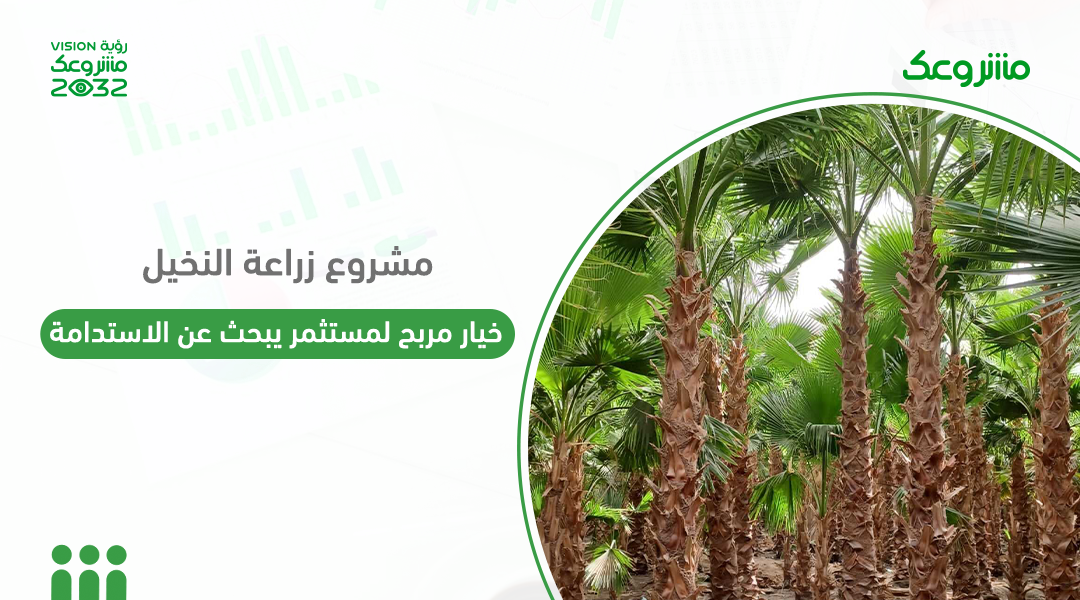
The date palm cultivation project is one of the most sustainable and authentic agricultural investments in the Arab region, combining a rich cultural heritage with lucrative economic returns. The date palm represents a comprehensive agricultural value chain, providing owners with premium dates of high nutritional and commercial value, alongside numerous by-products used in dozens of processing industries. With the growing global demand for high-quality dates and date-derived products, this project emerges as a golden investment opportunity that simultaneously enhances food security, generates high profitability, and creates positive environmental and social impact. This article provides a comprehensive guide based on professional steps to start a date palm cultivation project from scratch, covering the essence of the project, its advantages, and a detailed feasibility study addressing marketing, technical, and financial aspects. It also presents the best agricultural and managerial practices to ensure high productivity, outstanding export quality, and sustainable financial returns.
What Is a Date Palm Cultivation Project?
The date palm cultivation project is a strategic and sustainable venture aimed at producing premium dates and high-value derivatives by investing in desert lands, oases, or agricultural fields equipped with the latest irrigation and land preparation technologies. The success of the project depends on selecting high-yield, superior date palm varieties such as Majdool, Siwi, Khodry, and Hayani, among others, while implementing the best modern agricultural practices, including precise and regular irrigation, balanced scientific fertilization, integrated pest management programs, and professional pruning. These measures ensure healthy tree growth, high productivity, and exceptional export-quality dates.
This project is classified as a long-term, highly secure investment, with commercial production typically beginning between the third and fifth year and continuing efficiently for many decades, generating a stable and gradually increasing financial return over time. It is worth noting that the project offers extensive diversification opportunities through the establishment of modern packaging units and the production of value-added products such as date syrup, date paste, and stuffed dates. Additionally, optimal use of palm residues in the production of animal feed, organic fertilizers, and handicraft products further enhances the economic feasibility and ensures environmental sustainability.
Is the Date Palm Cultivation Project Profitable?
The date palm cultivation project is considered a highly profitable venture when professional standards are strictly followed. Success depends on selecting the most commercially demanded varieties globally, using certified and high-quality seedlings, implementing modern and precise irrigation systems, and applying well-planned fertilization and maintenance programs.
In Egypt specifically, one feddan (approximately 1.038 acres) can yield annual profits reaching millions of Egyptian pounds once full production begins from the fifth year onward. This is supported by the high market value of premium Egyptian dates both regionally and internationally. Egypt’s total cultivated area of date palms is 259,785 feddans, with over 16.9 million fruit-bearing trees, producing approximately 1.9 million tons annually.
However, guaranteed success and strong returns are primarily dependent on conducting a detailed feasibility study that considers:
Soil characteristics and land suitability
Water sources and irrigation needs
Construction and operational costs
Expected prices of selected date varieties
Marketing and export channels
Specialized agricultural guidance and appropriate financing
What Are the Key Advantages of a Date Palm Cultivation Project?
High and sustainable economic returns through continuous annual income from the sale of premium dates, with the potential for extensive exports and an increase in the country’s foreign currency earnings.
خCreates hundreds of direct and indirect job opportunities across all stages: cultivation, harvesting, packing, processing, transportation, and marketing.
Easy access to concessional financing from agricultural banks and development funds.
Significant increase in the value of agricultural land after a few years of date palm cultivation and full tree maturity.
Ability to diversify investment within the project itself (packing – processing – exporting – agri-tourism) without requiring substantial additional capital.
Very low project risk due to the exceptional resilience of date palms to harsh climatic conditions.
Effective contribution to comprehensive rural development and improving the living standards of families and local communities.
Full utilization of every part of the palm tree: dates for food and export, fronds and leaves for construction, furniture, handicrafts, fodder, and bioenergy.
A tangible, long-term asset that can be inherited by future generations while continuing to generate uninterrupted returns.
Very high productivity of commercial varieties, ensuring substantial and sustainable financial returns.
Select a sunny land with good drainage, low salinity, and a climate and soil suitable for the chosen date palm varieties.
Dig planting holes of appropriate size, disinfect the roots of the seedlings thoroughly, and add a mixture of decomposed organic fertilizer and natural phosphate to enhance soil fertility.
Purchase seedlings from licensed and certified nurseries, ensuring they are disease-free and selecting high-quality varieties with strong market demand.
Plant seedlings so that the trunk level is flush with the soil surface, leaving sufficient spacing between trees to ensure proper ventilation, light, and healthy growth.
Install a modern drip irrigation system equipped with efficient filters and storage tanks, with the option to integrate a smart system to control water quantity as needed.
Implement a precise and balanced fertilization program, including primary and secondary nutrients according to different growth stages, with an appropriate frequency throughout the year.
Follow a comprehensive preventive and treatment plan to control common pests and diseases, with regular monitoring and prompt intervention when necessary.
Conduct regular monitoring of tree growth, perform pollination, pruning, thinning, and accurately schedule harvest times to ensure the highest quality and yield.
The cost of a date palm cultivation project varies according to the following items:
Preliminary surveys and analyses: Soil testing, salinity measurement, water source evaluation, and an initial feasibility study.
Land preparation and purchase of certified seedlings: Typically 120–150 high-quality seedlings per hectare.
Installation of a complete drip irrigation network: Including filters, storage tanks, and an energy source.
Supporting infrastructure costs: Such as protective fencing against animals or wind, internal farm pathways, and light buildings (storage, worker housing, pump room).
Fertilizers and pest management: Organic and chemical fertilizers, pest control programs, and annual pruning.
Care and labor costs for the first few years before commercial production begins.
Agricultural insurance to cover climatic or biological risks.
Feasibility Study for a Date Palm Cultivation Project
Marketing Study
Analyze the local and global date market and identify the target audience for your products.
Calculate supply and demand, market gaps, and the project’s potential share in the market.
Analyze competitors to understand their strengths, weaknesses, pricing, and available opportunities to build a competitive advantage.
Examine consumer trends and preferences, such as demand for organic products, eco-friendly packaging, and transparency regarding product origin.
Study suitable distribution and marketing channels and monitor market changes.
Explore opportunities to add value to the product through smart packaging, customized packaging, or segmentation for different customer groups.
Develop an appropriate promotional plan for the products.
Include flexible scenarios to respond to market fluctuations, such as a drop in date prices during peak season, emergence of substitute products, or import restrictions in foreign markets.
Careful Site Selection: Choose the location based on climate, soil type, and the quality and quantity of available water.
Selection of Commercial Varieties: Acquire high-value commercial varieties from licensed nurseries, ensuring the seedlings are certified and disease-free.
Optimal Planting Timing: Determine the best planting season according to local climate conditions to maximize seedling adaptation and survival.
Planting Density and Land Planning: Define plot sizes, planting density, and the number of palms per acre, while accurately estimating water, labor, and equipment requirements.
Growth Management Plan: Design a phased management plan:
Years 1–3: Establishment phase
Years 4–5: Production onset
Year 6 onward: Peak production Include precise technical performance indicators for each phase.
Pollination Requirements: Determine pollination needs and methods, calculating the necessary quantities of pollen or male date flowers.
Post-Harvest Storage and Handling: Plan for proper post-harvest management, including shading, drying, temporary cooling, and sorting, especially for moist or semi-dry varieties requiring precise humidity and temperature control.
Agricultural Waste Management: Develop a plan to utilize agricultural by-products in secondary industries, such as organic fertilizers or handicrafts..
Accurate estimation of initial establishment costs (purchasing or leasing land, preparing it, acquiring certified seedlings, and installing an integrated irrigation system).
Annual Operational Costs: Estimating fixed and variable expenses, including labor wages, fertilizers, pest and disease control programs, maintenance, electricity, and water.
Revenue Projections: Forecasting annual income from the sale of dates and by-products (palm fronds, midribs, fiber) based on local and export market prices.
Financial Metrics: Calculating break-even points, capital payback periods, net present value (NPV), and internal rate of return (IRR).
Sensitivity Analysis: Assessing how changes in date prices or input costs affect overall financial performance.
Financing Costs: Studying loan options, interest rates, and repayment plans if agricultural financing or bank loans are used.
Long-Term Financial Planning: Developing a strategy for sustainability after full production, including expansion and reinvestment plans.
Profitability Analysis: Evaluating the impact of fixed and variable costs on net profit margins and creating multiple operational scenarios for informed decision-making.
Please read here: The Importance of Having a Financial Feasibility Study for Your Investment Project
Administrative Study
Organizational Structure: Design a clear organizational hierarchy defining departments, responsibilities, and reporting lines.
Comprehensive Management Plan: Prepare an integrated plan to manage labor, procurement, and inventory efficiently.
Production, Quality & Marketing Policies: Establish well-documented and structured policies covering production processes, quality control, and marketing strategies.
Quality Monitoring & KPIs: Implement a regular quality monitoring system with key performance indicators (KPIs) to ensure continuous measurement and improvement.
Training & Professional Development: Execute ongoing training programs for workers, engineers, and technicians to enhance skills and productivity.
Comprehensive Quality Control System: Develop a monitoring system covering all stages of cultivation, harvesting, and packaging to maintain high standards.
Integrated Management Information System (MIS): Design and implement an MIS to record data, track performance in real-time, and support decision-making.
Risk & Crisis Management Plan: Prepare a risk management strategy including operational and financial contingency scenarios to mitigate potential issues.
10 Expert Tips for the Success and Sustainability of a Date Palm Cultivation Project
Select an Ideal Location: Choose a hot, dry climate with deep, well-drained soil, sufficient irrigation water, and away from red palm weevil infestation zones.
Use Certified Seedlings: Rely only on seedlings from licensed nurseries, disease-free, strong-rooted, and with documented cultivar identity.
Prepare the Soil Properly: Plow deeply before planting, add decomposed organic manure, and apply chemical and organic amendments based on soil analysis.
Install Modern Drip Irrigation: Equip the system with meters and filters to ensure precise water distribution and conservation.
Follow a Scientific Fertilization Program: Apply balanced fertilization including macro and micronutrients, along with bio-stimulants, at appropriate growth stages.
Implement Integrated Pest & Disease Management: Monitor weekly and act promptly when necessary to control common pests and diseases.
Carry Out Annual Pruning and Artificial Pollination: Implement precise pollination and thinning operations to enhance date quality.
Train and Qualify the Workforce: Continuously educate laborers on modern cultivation, pollination, harvesting, and packaging techniques.
Pay Special Attention to Post-Harvest Handling: Include immediate cooling, sorting, cleaning, and packaging to meet export standards.
Adopt Modern Agricultural Technology: Utilize remote sensing, automated irrigation and fertilization, and smart farming systems to maximize production and reduce long-term costs.
Frequently Asked Questions About Date Palm Cultivation
Best Soil for Date Palms: Sandy loam or yellowish sedimentary soil with good drainage, low salinity, and 25–45% clay content.
Best Planting Time: End of winter to early spring (March–May) or late summer to early autumn (September–November), avoiding extreme heat or cold.
Requirements for Palm Growth: Full sunlight, well-drained soil, adequate irrigation, good root aeration, and balanced nutrients.
Seedling Requirements: Select superior seedlings (20–30 kg, 1–1.5 m tall, strong healthy roots), aged 3–4 years, disease-free, and plant immediately with organic fertilizer.
Fertilization Frequency: Typically 2–3 times per year with a balanced NPK fertilizer according to tree age and soil conditions.
Space per Palm Tree: Generally, 8–12 m² per tree depending on variety and planting method.
Yield per Tree: Varies by cultivar and care, usually 200–300 kg of dates per tree annually.
Palm Tree Lifespan: Up to 100 years, with peak production usually between years 8–15.
Investment Feasibility: Date palm cultivation is highly profitable, offering 30–40% annual ROI after full production (year 7–8), with capital payback in 5–8 years for professionally managed farms.
Conclusion: Date palm cultivation is more than a traditional agricultural activity; it’s a strategic long-term investment combining financial security, high profitability, and significant environmental and social impact. With careful planning, selection of high-quality varieties, modern irrigation, balanced fertilization, and effective crop management, the project can become a sustainable and lucrative source of income.
If you are looking for a genuine investment opportunity, the date palm cultivation project is the perfect golden choice. At “Mashroo3k” Consulting, with over 12 years of experience and an advisory network spanning 35 countries, we are fully prepared to provide a comprehensive feasibility study, along with technical and strategic support, to turn your investment vision into a reality with guaranteed financial returns.
For inquiries and to request a feasibility study for a date palm cultivation project
The kebab restaurant project is one of the food-service ventures that combines strong demand for grilled meals with the opportunity to target a diverse customer base, including individuals, families, and lovers of traditional Middle Eastern cuisine. With growing competition in the restaurant sector, however, the project’s success is no longer determined by food taste alone. […]
A children’s toy store project is not limited to selling toys; it is built on understanding what attracts children and what families look for when choosing products that combine entertainment and educational value. With the wide variety of educational toys, skill-development games, recreational toys, and gifts available, the store has opportunities to meet the needs […]
A residential complex project is no longer simply an investment in a collection of real estate units. It has evolved into an integrated development model that combines comfortable living, diverse services, and long-term investment value. As cities expand and residents’ needs evolve, demand is growing for residential complexes that offer a comprehensive environment suited to […]
The veterinary clinic project comes at a time when animal care is no longer limited to treating illnesses or injuries, but has expanded to include health monitoring, vaccinations, routine checkups, and care for both pets and livestock. However, many animal owners face challenges in accessing specialized veterinary services that combine prompt response, high-quality care, and […]