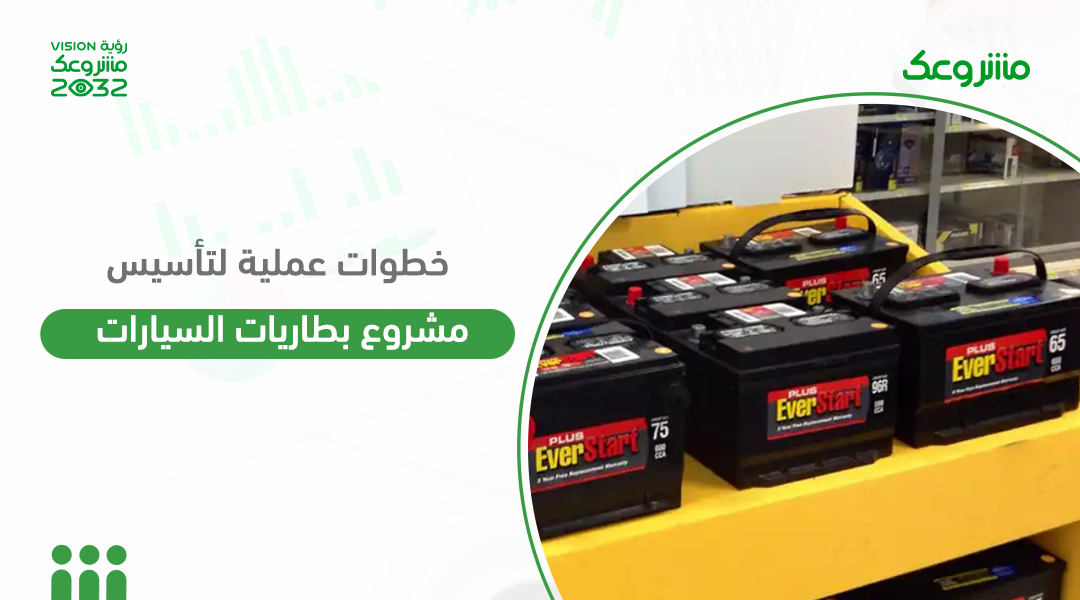
Practical Steps to Start a Car Battery Project - Mashroo3k Consulting
Published23 Dec 2025 0 comments 687 Observation
Practical Steps to Start a Car Battery Project

The car battery project represents an exceptional investment opportunity in an era of rapid transition toward sustainable mobility. Electric power has become the lifeblood of modern transportation, with the battery at the heart of every vehicle on the road. This project stands out as a stable and steadily growing economic sector, supported by increasing global demand and continuous technological advancements.
The project combines reliable traditional products, such as lead-acid and maintenance-free batteries (AGM and Gel), which maintain steady demand in conventional markets, with advanced solutions like lithium-ion batteries designed for hybrid and fully electric vehicles, representing the future of clean and efficient mobility.
This strategic diversity gives investors significant flexibility in building their business model—starting with low-risk, fast-return traditional production and gradually expanding into modern technologies, aligning with global trends toward green energy and emission reduction.
Since the battery is an essential component in all types of vehicles, the project enjoys constant and stable demand, with tremendous growth potential driven by innovation and offering sustainable long-term investment returns.

What is the car battery project?

The car battery project is a comprehensive investment activity aimed at meeting the growing demand for mobile energy sources by providing vehicle batteries of all types, ranging from conventional lead-acid and dry batteries to hybrid and electric car batteries that drive the future of the smart transportation sector. The project operates within a multi-faceted model that includes trade and distribution, local assembly, and may extend to manufacturing or recycling used batteries according to the highest environmental and technical standards.

This project is distinguished by its close connection to the vital transportation sector, which does not experience stagnation even during periods of economic slowdown, as the battery is one of the cyclical consumable components that require regular replacement, ensuring a continuous flow of revenue. This flexible model also supports the investor’s ability to expand gradually, diversify income sources, and capitalize on the accelerating global shift toward electric vehicles, making it a promising investment opportunity that combines operational stability, sustainable returns, and strategic positioning in the future energy and mobility value chain.

Is the car battery project profitable?

Yes, the car battery project is considered a highly successful and profitable venture, and there are strong statistical indicators supporting this success. The global car battery market reached USD 75.18 billion in 2024, with revenues expected to reach USD 151.39 billion by 2030, reflecting a compound annual growth rate of 6.57% during the period from 2024 to 2030. This steady growth is supported by increasing demand for both conventional and electric vehicles, alongside the global shift towards sustainable mobility and technological advancements in the battery sector. This makes investment in this sector an attractive opportunity, balancing stability with high long-term returns, and providing investors with the potential to expand into growing markets with limited risks.

Read here: Why the Car Accessories Project is an Investment Opportunity

What are the main features of the car battery project?

  • There is a consistent and stable demand for car batteries as a periodic consumer product, requiring regular replacement every 2-5 years, which ensures continuous sales regardless of economic fluctuations.
  • There is a variety of investment models, as one can start with trade and distribution, local assembly, full-scale manufacturing, or even recycling, providing flexible options depending on the available capital.
  • Opportunities for gradual and sustainable expansion, starting with conventional car batteries and then moving on to the production or distribution of electric and hybrid car batteries as the market grows.
  • Supporting the global transition to clean energy, with the expected rise in demand for electric vehicle batteries, opening new and promising rapidly growing markets. …
  • Fast and renewable financial returns, supported by a regular replacement cycle that ensures a continuous and recurring revenue stream.
  • Easy integration with supporting sectors such as car repair workshops, service centers, and spare parts distributors, thereby strengthening the commercial network.
  • Relatively moderate operating costs compared to complex industrial or high-tech projects.
  • The possibility of recycling used batteries, turning them into an additional source of income while adhering to environmental standards and sustainability.
  • Flexibility in targeting a diverse range of customer segments, from private car owners to corporate transport fleets and government institutions. …
  • Investment supported by national trends in many countries that promote energy efficiency and electric mobility through incentives, concessional loans, and customs exemptions.

Read here: Electric Vehicle Market Report in the Kingdom of Saudi Arabia

What are the main types of car batteries?

Car batteries are divided into several main types, which differ in terms of chemical composition, performance, maintenance requirements, and applications. The most notable among them are:

Lead-acid batteries

They are the most widespread and commonly used batteries in conventional cars, containing lead plates submerged in diluted sulfuric acid. They require regular maintenance (such as adding distilled water) and are considered low-cost, but their lifespan is relatively shorter.

Maintenance-Free Lead-Acid Batteries

It is a sealed type of lead-acid battery, requiring no maintenance or water addition. It is considered more resistant to vibrations and acid leaks, and it is also used in modern cars with complex electrical systems.

Batteries AGM

It is an advanced type of sealed battery, using fiberglass that absorbs the electrolyte, making it more efficient and safer, capable of withstanding deep charge and discharge cycles, charges faster, and is also used in vehicles equipped with start/stop engine systems. And luxury cars.

Gel Cell

It is a type of battery similar to batteries AGM However, it uses a gel-like material instead of liquid, and it has high resistance to vibrations and high temperatures. It is also sensitive to improper shipping conditions and is often used in specialized applications (such as wheelchairs or backup power systems).

Lithium-Ion Batteries

These batteries are mainly used in electric and hybrid vehicles. They are lightweight, have a high energy density, a long lifespan, and require no maintenance. However, they are more expensive compared to other types. They also support fast charging and provide consistent performance under varying operating conditions.

Read here: Car rental project, a profitable investment opportunity in the growing transportation sector

Feasibility Study of a Car Battery Project

The Marketing Study of the Project

  • Conduct a comprehensive study of the automotive battery market, including determining the supply and demand for batteries.
  • Market gap analysis in the automotive battery sector, and estimation of the potential market share that the project can capture.
  • Evaluation of direct and indirect competitors in the automotive battery sector, including their strengths and weaknesses.
  • إجراء تحليل SWOT To identify internal strengths and weaknesses, along with external opportunities and threats related to the car battery project.
  • Develop a systematic and organized promotional plan to market the products and services of a car battery project across various platforms.

Please read here: Marketing Feasibility Study: Its Definition, Importance, Preparation Method, and Key Tools

Technical Study of the Project

  • Analysis of the site of the car battery project, including the total area and its distribution across the various units, in addition to assessing the infrastructure available in the specified area.
  • Review of regulatory requirements and official licenses required to establish and operate a car battery business.
  • A detailed explanation of the steps for implementing the project, specifying the expected timeframe for each step.
  • Description of the operational mechanism of a car battery project, with a focus on the core production processes.
  • Assessing the project’s operational costs, with a focus on raw materials, tools, and necessary equipment.
  • Calculating consumption and expenditure rates related to assets and resources within the project.
  • Estimation of annual operating costs, with a detailed breakdown of wages and salaries.
  • Determining the number of workers required for the project, in addition to the wages and benefits provided to them.
  • Determining the expected production capacity of the car battery project, taking into account the operational capabilities for both operation and expansion.

Read here: 7 Essential Elements Underpinning the Technical Feasibility Study of Projects

The Financial Study of the Project

  • Clarification of the financing structure for the car battery project, specifying the available financing options such as self-financing, loans, or investment partnerships.
  • Providing detailed information about the capital invested in the project, including a breakdown of fixed capital (such as buildings and equipment) and working capital (such as raw materials and salaries).
  • Evaluation of the operating expenses for the car batteries project, including the daily and monthly costs related to production and distribution operations.
  • Review of the variable operating costs of a car battery project, such as the costs of raw materials, energy, and transportation.
  • Clarification of the fixed costs for a car battery project, including rents, fixed salaries, and regular maintenance.
  • Preparing the project’s basic financial statements, including the projected income statement, the balance sheet, and the projected cash flow statement.
  • Calculating the key financial indicators of the project, including the break-even point, the internal rate of return (IRR), the return on investment (ROI), the payback period, and the net present value (NPV).
  • Conducting a sensitivity analysis for the car battery project to assess the impact of changes in key variables on financial outcomes.

Read here: The Importance of Having a Financial Feasibility Study for Your Investment Project

The Administrative Study of the Project

  • Clarification of the workforce composition in the car battery project, specifying the number of personnel, their salaries, and the benefits provided to them.
  • Designing the organizational structure for a car battery project, including an explanation of the hierarchical sequence and the relationships between the various departments.
  • Preparing a detailed description of the jobs in the car battery project, including the job description for each position and its main responsibilities.
  • Analysis of the marketing, financial, and technical risks associated with the project, along with the formulation of a strategy to reduce and mitigate their impacts.
  • Develop a comprehensive final report for the car battery project, compiling all previous elements and providing specific recommendations to ensure its sustainability.

Please read here: How to Start a Mobile Car Wash Business? Steps That Ensure Your Success

Requirements for Starting a Car Battery Business in Saudi Arabia

When opening a car battery factory in Saudi Arabia, the following are a set of the most important requirements:

  • Full compliance with the provisions of the Saudi Building Code and all industrial, environmental, and health requirements issued by the relevant authorities.
  • The factory is designated exclusively for industrial and commercial purposes, with any residential or non-industrial use strictly prohibited.
  • Construction of open area floors and pavements with a slope not exceeding 2% towards the approved drainage networks.
  • Providing separate administrative areas, either closed or open, and independent areas designated for security guards.
  • Establish an independent gate for the movement of individuals, and separate gates for the movement of equipment and cargo, to ensure complete segregation and effective security regulation.
  • The design of walls, ceilings, and interior finishes uses fire-resistant materials that do not harbor insects or rodents.
  • Allocating secure and protected locations for control and security monitoring devices, out of reach of unauthorized personnel.
  • Design of oil and grease separation and storage systems in a manner that completely prevents their leakage into the sewage network.
  • The area of administrative offices shall not exceed 30% of the total factory area.
  • Providing adequate restroom facilities that comply with occupational health and safety standards.
  • Installation of fire barriers between different operating units to limit the spread of fires.
  • The use of false or exposed ceilings, iron structures, and metal panels is permitted, provided full compliance with structural safety requirements is maintained.
  • Painting all metal panels and iron structures to protect them from weather conditions and ensure structural durability.
  • Enclosing the site with an external wall at a height of no less than 2.5 meters, made of concrete, cement bricks, reinforced metal mesh, or a combination thereof.
  • Allocating berths or loading and unloading bays within the site boundaries, without encroaching on public roads.
  • Allow the accumulation of waste in a designated area within the side setbacks, at a distance of 10-20 meters from the front facade.
  • Providing adequate spaces for maneuvering fire-fighting vehicles in accordance with Civil Defense requirements, to ensure a swift response in emergency situations.
  • Compliance with the requirements for persons with disabilities in accordance with the Saudi Building Code and the Universal Accessibility Guide in the design of the external staircase, ramp, and pavements in terms of materials, slope, obstruction-free access, and ensuring these within the site boundaries.
  • All requirements and conditions stipulated in the Saudi Fire Protection Code must be adhered to.
  • It is permissible to provide a warehouse for medium- or low-risk materials at a rate not exceeding 25% of the licensed area or 150 m², with the possibility of increasing the capacity to 50%.
  • Occupational safety standards must be applied during implementation, including providing scaffolds and ladders, and adhering to the use of protective equipment.

For more information on factory requirements in Saudi Arabia, click here.

10 Tips to Ensure and Sustain a Car Battery Project

  • Select a strategically located industrial site near major transportation routes and sources of raw materials to reduce shipping and logistics costs.
  • Collaborate with reliable and internationally accredited suppliers to ensure the provision of high-quality raw materials such as lead, acids, and gel components at competitive prices and with regular supply.
  • Focus on producing a diverse range of conventional batteries while planning to manufacture lithium batteries for electric vehicles in the future.
  • Adhere to proper storage and industrial safety procedures, while maintaining appropriate temperature and humidity levels in warehouses to ensure the quality and shelf life of the final products.
  • Develop a strict quality control system throughout all stages of production, including periodic tests and international certifications to ensure product safety and gain the trust of customers and distributors.
  • The team has continuously trained on the latest manufacturing and industrial safety techniques to enhance production efficiency and reduce errors and accidents.
  • Implemented a marketing plan targeted at distributors, car companies, and maintenance workshops, utilizing digital channels and trade exhibitions to promote the quality of the local product.
  • Monitor global and local market dynamics, including changes in prices and modern technologies, to adjust production lines and maintain competitiveness.
  • Conduct periodic evaluations of financial and operational performance, focusing on cost management and efficiency improvement to ensure sustainable profitability.
  • Plan for future expansion by investing in new production lines, such as recycling used batteries or manufacturing electric vehicle batteries.

Frequently Asked Questions About the Car Battery Project

What is the normal lifespan of a car battery?

The normal lifespan of a car battery typically ranges from 3 to 5 years, depending on the type of battery and the conditions of use.

What is the difference between an AGM battery and a Gel battery?

Comparison ElementBattery AGMBattery GEL
MaintenanceCompletely maintenance-free, not capable of adding water. Completely maintenance-free; it does not require adding water.
Resilience to shocksExtremely high resistance to vibration and shocks.Excellent resistance (often slightly better due to the solid gel electrolyte).
Deep Discharge CapacityGood, suitable for high currents and rapid startup (such as car ignition). Excellent, it can withstand repeated and slow deep discharges for longer periods.
The appropriate temperatureExcellent performance in low temperatures (extreme cold).Better performance in high temperatures (hot climates).
LifespanApproximately 3-5 years (in general use and high currents).Approximately 4-7 years (longer with proper use in deep discharge). …
Common usageModern cars, boats, motorcycles, backup systems (UPS). Solar energy, electric wheelchairs, medical devices, hot regions.

What is the best type of car battery?

There is no single type that suits everyone, but AGM and Gel batteries are considered among the best options due to their shock resistance and long lifespan. Additionally, the choice of type depends on the car model, usage, and the climate in which the vehicle is used.

How much does a car battery store cost?

The cost of opening a car battery shop varies depending on the location and the scale of the business, and includes expenses such as rent, equipment, inventory, labor, and so on.

What are the prices of car batteries today?

Car battery prices vary according to type, size, and brand. We find that traditional lead-acid batteries are usually less expensive than batteries AGM وGel Or electric car batteries, as prices change daily according to the market and suppliers.

How can I determine if my battery is damaged?

There are several signs indicating battery damage, including difficulty starting the engine, dim lighting, acid leakage, or battery swelling. Voltage measuring devices can also be used to accurately check its condition and ensure its ability to hold a charge.

In conclusion of our article on the car battery project

It can be said that the car battery project represents a distinguished investment opportunity that combines stability with high profitability, supported by a continuous and regular demand for the product that surpasses economic fluctuations. The project enables the production of various types of batteries, ranging from traditional lead-acid batteries and maintenance-free AGM and Gel batteries to lithium batteries for electric and hybrid vehicles. This diversity in production lines is known to allow targeting multiple market segments, from owners of conventional cars to transport fleets and green projects, enabling the factory to gradually expand in line with global developments in the electric mobility sector. With proper planning, selecting reliable raw material suppliers, implementing strict quality standards, and establishing a strong distribution network with customers and distributors, the project becomes capable of achieving sustainable and rapidly renewable financial returns, with the possibility of integrating recycling activities to enhance environmental sustainability, making it an ideal strategic choice for ambitious investors seeking to build a strong and long-term industrial base.

For inquiries and to request a feasibility study for an automotive battery project

Keywords::

Car Battery Project


Similar Articles

How to Turn a Kebab Restaurant Project into a Distinctive Brand in Egypt?

The kebab restaurant project is one of the food-service ventures that combines strong demand for grilled meals with the opportunity to target a diverse customer base, including individuals, families, and lovers of traditional Middle Eastern cuisine. With growing competition in the restaurant sector, however, the project’s success is no longer determined by food taste alone. […]

Read more

Children’s Play Center Project in Saudi Arabia: How to Create an Experience That Attracts Children and Families?

A children’s toy store project is not limited to selling toys; it is built on understanding what attracts children and what families look for when choosing products that combine entertainment and educational value. With the wide variety of educational toys, skill-development games, recreational toys, and gifts available, the store has opportunities to meet the needs […]

Read more

Residential Complex Project in Saudi Arabia: An Investment That Creates Value Beyond Residential Units

A residential complex project is no longer simply an investment in a collection of real estate units. It has evolved into an integrated development model that combines comfortable living, diverse services, and long-term investment value. As cities expand and residents’ needs evolve, demand is growing for residential complexes that offer a comprehensive environment suited to […]

Read more

Veterinary Clinic Project in Egypt: A Promising Investment Opportunity in the Animal Care Sector

The veterinary clinic project comes at a time when animal care is no longer limited to treating illnesses or injuries, but has expanded to include health monitoring, vaccinations, routine checkups, and care for both pets and livestock. However, many animal owners face challenges in accessing specialized veterinary services that combine prompt response, high-quality care, and […]

Read more

Green Friday

فرصة لا تتكرر

GREEN FRIDAY

خصم 25% على خدمات مشروعك استفد من العرض الآن، فالفرصة متاحة لفترة محدودة فقط
سجّل بياناتك واحصل على خصم 25% الآن