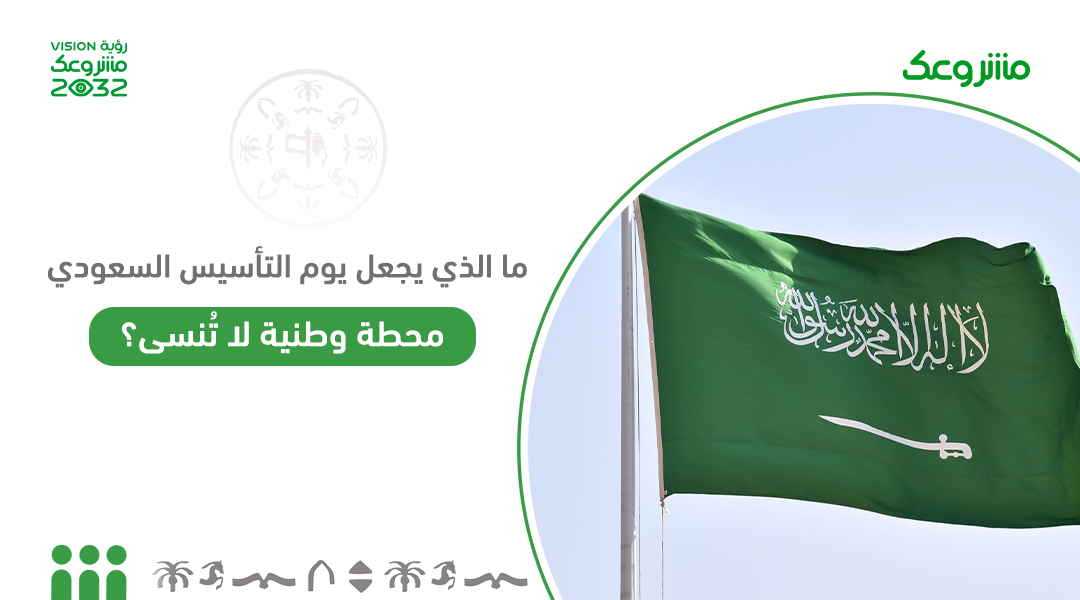
Saudi Founding Day embodies a deep sense of belonging to a historic land and a lasting civilizational heritage. It commemorates the historic moment when Imam Muhammad bin Saud – may God bless his soul – assumed leadership in Diriyah and laid the foundational pillars of the First Saudi State, establishing a political entity built on unity, stability, determination, and vision.
Founding Day is not merely an annual anniversary; it is a living memory that unites generations around the noble values instilled by the founding fathers in the heart of the Arabian Peninsula, serving as a continuous affirmation of the enduring national journey. This day connects the deep-rooted past with the aspirations of the present and the promise of the future, creating a cohesive tapestry that strengthens pride in the Saudi identity and raises the banner of loyalty to the nation and its wise leadership.
What is Saudi Founding Day
Saudi Founding Day is an official national occasion that commemorates the establishment of the First Saudi State in Diriyah, which was founded by Imam Muhammad bin Saud in 1139 AH / 1727 AD, marking the launch of a unified political entity in the Arabian Peninsula. This day is celebrated annually following a royal decree issued by the Custodian of the Two Holy Mosques, King Salman bin Abdulaziz – may God protect him – in January 2022, officially recognizing it as a national day to honor the deep historical roots of the Saudi state and to appreciate the efforts of the founding leaders.
When is Saudi Founding Day 2026
Saudi Founding Day is celebrated on February 22 each year. On this day, cities across the Kingdom transform into lively stages showcasing three centuries of history. The celebrations begin with the raising of the Saudi flag accompanied by the rhythms of the “Saudi Ardah,” where men wave their swords in pride. Streets are filled with heritage events featuring theatrical depictions of life in old Diriyah, displays of traditional crafts such as pottery and weaving, and homes adorned with green and white flags. The aroma of traditional dishes like Jareesh and Qursan fills every home, while children and adults wear traditional attire to participate in the celebrations.
Objectives of Saudi Founding Day
Role of Saudi Founding Day in Enhancing National Identity
How Saudi Founding Day Reflects Vision 2030 Principles of Building a Vibrant Society
Key Investment Sectors in Saudi Arabia for Saudi Founding Day
Industrial Sector
The industrial sector is a cornerstone of Saudi Arabia’s economy, showing remarkable growth due to government initiatives like the National Industrial Strategy and Vision 2030, which aim to diversify the economy and increase manufacturing’s contribution to GDP. The sector offers multiple investment opportunities in areas such as manufacturing, petrochemicals, food industries, and advanced technologies, supported by incentives including tax exemptions, financing facilities, and advanced infrastructure in industrial cities.
Promising Opportunities in the Industrial Sector:
Sector Indicators:
Distribution of Factories by Administrative Regions in Saudi Arabia
| Region | Number of Factories |
|---|---|
| Northern Borders Region | 62 |
| Al-Jouf Region | 103 |
| Tabuk Region | 126 |
| Hail Region | 159 |
| Al-Qassim Region | 621 |
| Madinah Region | 569 |
| Riyadh Region | 4,912 |
| Eastern Province | 2,892 |
| Makkah Region | 2,366 |
| Asir Region | 423 |
| Al-Bahah Region | 56 |
| Najran Region | 91 |
| Jazan Region | 209 |
Service Sector
The service sector forms a core pillar in Saudi Arabia’s economic transformation toward diversification and sustainability, in line with the goals of Vision 2030, which aims to reduce dependence on oil revenues and boost the contribution of non-oil growth. The role of this sector extends beyond being an engine of economic growth to include vital social dimensions such as creating quality job opportunities, reducing unemployment, and empowering youth and women in the labor market, positively impacting overall quality of life.
Moreover, the service sector enhances Saudi Arabia’s position as a global tourist destination and a leading regional logistics hub, increasing the attractiveness of the investment environment and raising the Kingdom’s international competitiveness. Some key investment opportunities in this sector include:
Service sector activities in Saudi Arabia are divided into five main categories: wholesale and retail trade and hotels and restaurants, transportation and storage, information and communications, financial, insurance, real estate, and business services, collective, social, and personal services, and government services. These activities have shown remarkable growth in their contribution to GDP:
These figures reflect strong growth in the service sector, supported by Vision 2030’s efforts to diversify the economy, promote domestic consumption, attract investments, and develop promising sectors such as tourism, logistics, and digital services, confirming its role as a key driver of sustainable growth and economic competitiveness in the Kingdom.
Agricultural Sector
The agricultural sector is a cornerstone of Vision 2030, with the Kingdom aiming to enhance food security and increase self-sufficiency in agricultural products through the adoption of modern technologies and expanded investment. Saudi Arabia’s agricultural sector is diverse, spanning smart farming, environmental sustainability, greenhouse projects, aquaculture, and more, making it highly promising for investment.
The government supports the sector technically and financially to reduce import dependence and boost local production. Key promising investment opportunities include:
Below are key statistical indicators encouraging entrepreneurs to invest in this vital sector:
Livestock:
Production:
Slaughtered livestock annually:
Imports & Exports:
Self-sufficiency rates:
Honey production:
Secondly: Plant and Aquatic Resources
Here is a breakdown of these figures:
| Type of Crops | Cultivated Area (hectares) | Production (tons) |
|---|---|---|
| Grains | 310,711.67 | 1,633,263.71 |
| Open-field Vegetables | 88,736 | 2,530,972 |
| Greenhouse Vegetables | 7,043 | 719,984 |
| Fodder | 198,567 | 3,802,019 |
| Trees (fruit-bearing & non-fruit) | 288,307 | 2,875,078 |
The healthcare sector is one of the most promising sectors for entrepreneurs and investors, due to its continuous development in infrastructure and medical technologies, alongside significant government support that fosters growth and sustainability. These advancements align with Saudi Vision 2030, which aims to improve the quality of healthcare, increase the private sector’s contribution to the sector’s development, and promote innovation in medical services. This opens the door to diverse investment opportunities, such as establishing hospitals, specialized centers and clinics, investing in digital health transformation, and producing pharmaceuticals and medical supplies. Undoubtedly, the healthcare sector in the Kingdom attracts both local and foreign capital. Some of the most promising opportunities in this sector include:
Here’s the translation of your health sector data for investors in Saudi Arabia:
Healthcare Investment Opportunities:
Key Statistical Indicators for the Healthcare Sector in Saudi Arabia:
Healthcare Workforce Density per 10,000 Population:
These figures highlight the sector’s capacity and potential for investment in healthcare services, medical staffing, and medical manufacturing in Saudi Arabia.
The education sector in Saudi Arabia is considered one of the most attractive for investment, due to significant government support and the official drive to develop the educational system. The demand for private educational institutions, including international schools, vocational training centers, and e-learning platforms, is increasing to meet the rising need for high-quality education. Digital transformation and modern technologies also present opportunities to launch innovative projects such as smart learning applications and virtual reality in education.
Moreover, investors in this sector benefit from regulatory and financial facilitation, making investment under its umbrella a promising opportunity with rewarding returns. According to reports from the Saudi Ministry of Education, the total number of students across all educational stages reached approximately 6.72 million. The reports also indicated that the number of public schools in the Kingdom is around 36,800, while the number of educational buildings is estimated at about 22,000.
Regarding educational staff, the total number of teachers in Saudi Arabia exceeds 513,000, of whom nearly 245,000 are in primary education. Additionally, the sector includes more than 106,300 administrative personnel working across schools at all educational levels nationwide. Some of the most promising investment opportunities in this sector include:
The recycling sector in the Kingdom of Saudi Arabia holds strategic importance, serving as a cornerstone for achieving environmental sustainability by reducing reliance on landfills and minimizing pollution and harmful emissions. This is especially critical when handling hazardous waste, such as medical and industrial waste, in a scientifically proper manner, which protects public health and preserves natural resources. Economically, this sector transforms waste from an environmental burden into a valuable resource that supports the circular economy, promotes investments in modern technologies and partnerships with the private sector, and contributes to diversifying income sources beyond traditional reliance on oil. Socially, it generates sustainable employment opportunities and raises environmental awareness, reflecting the Kingdom’s commitment to global sustainable development goals and solidifying its position as a leading nation in environmental preservation and the transition to a prosperous green future.
The Ministry of Environment, Water, and Agriculture in Saudi Arabia has unveiled an ambitious plan to develop the waste management sector, aiming to increase the recycling rate to 95%, compared to the current low rate of only 3–4% (one of the lowest globally), with the capacity to recycle around 100 million tons of waste annually. This plan is expected to contribute up to 120 billion SAR to the GDP and create more than 100,000 job opportunities for Saudi men and women, in line with the targets of Saudi Vision 2030 and the National Environmental Strategy, which includes over 65 initiatives with investments exceeding 55 billion SAR.
Below is the amount of municipal waste collected in the Kingdom according to the latest official statistics:
| Type of Waste | Weight (tons) |
|---|---|
| Paper and Cardboard | 1,459,484 |
| Textiles | 716,209 |
| Plastic | 2,131,669 |
| Glass | 622,953 |
| Metal | 950,970 |
| Inorganic Materials | 7,294,602 |
| Organic Materials | 8,131,832 |
| Total | 20,839,370 |
Tourism in Saudi Arabia stands out as a strategic economic pillar beyond oil revenues, supported by a rich and diverse tourism offering that spans cultural, religious, natural, and recreational experiences across various regions—from historic cities and heritage sites to beaches and mountains. The sector relies on a mix of active domestic tourism and a growing number of international visitors, with international tourists notably spending more than locals, indicating strong demand for premium services. This momentum translated into tangible numbers in the first half of 2025, with over 60.9 million visitors and spending exceeding 161.4 billion SAR, cementing Saudi Arabia’s position as a leading global tourism destination.
Key sector indicators include:
Frequently Asked Questions about Saudi Founding Day
Why was February 22 chosen as Founding Day?
February 22 was chosen as Founding Day because it marks the day Imam Muhammad bin Saud – may God bless him – assumed leadership in Diriyah in the latter half of 1139 AH. This corresponds to 30 Jumada II 1139 AH, or February 22, 1727 AD, marking the establishment of the First Saudi State.
What is the difference between National Day and Founding Day?
The difference lies in the historical event each commemorates: Saudi National Day, celebrated on September 23, marks the unification of the country and the founding of the modern Kingdom of Saudi Arabia in 1932 by King Abdulaziz bin Abdul Rahman Al Saud – may God bless him – after consolidating various regions under one flag. In contrast, Founding Day, celebrated on February 22, symbolizes the founding of the First Saudi State in 1727 (1139 AH) by Imam Muhammad bin Saud – may God bless him – in Diriyah, laying the foundations of the political entity, national unity, and cultural heritage that have endured for three centuries. It is an official national occasion to take pride in the historical depth and cultural heritage of the Kingdom.
Please read here: On the 95th Saudi National Day, the Kingdom renews its commitment to the path of progress in line with Vision 2030.
Saudi Arabia is experiencing an extraordinary national atmosphere that blends the remembrance of its rich history with the celebration of national identity. Festivities begin early in the morning with the raising of the Saudi flag in public squares, government institutions, and schools. This is followed by a variety of events across all cities, with the capital Riyadh and major regions witnessing impressive air shows and ceremonial parades, alongside musical concerts and national operettas performed by leading artistic groups. Historical and cultural exhibitions showcase the story of the First Saudi State and display traditional handicrafts such as pottery, weaving, and Sadu. Streets and squares are adorned in green and white, with the slogan “The Day We Began” prominently displayed. On a popular level, people wear traditional attire representing different regions of the Kingdom, families prepare local dishes like Jareesh and Marqooq in warm gatherings, poets compete with verses expressing love for the homeland, and Arabic coffee fires light up social gatherings, allowing Saudis to experience moments of pride and honor in their historical roots spanning over three centuries.
We recognize that Saudi Founding Day is more than a historical commemoration; it is a living celebration of the deep roots of national identity, and the values of determination, unity, and perseverance laid by Imam Muhammad bin Saud – may God bless his soul. It reminds us of the importance of preserving this rich heritage and cherishing it as a foundation for a prosperous future.
At Mashroo3k Consulting, we embody this spirit in our daily work, ensuring that every investment step is meticulously planned—from preparing feasibility studies and business plans, to financial analysis, performance evaluation, and market research, as well as organizational structuring and logistical support related to raw materials, machinery, and production lines.
Just as the Kingdom was built on solid foundations, we at Mashroo3k Consulting aim to ensure that the projects of its citizens are built on strong, reliable bases. We are fully prepared to provide the expertise needed to guarantee the success of your ventures and help build a promising investment future.

To get in touch regarding our offers for Saudi Founding Day
The kebab restaurant project is one of the food-service ventures that combines strong demand for grilled meals with the opportunity to target a diverse customer base, including individuals, families, and lovers of traditional Middle Eastern cuisine. With growing competition in the restaurant sector, however, the project’s success is no longer determined by food taste alone. […]
Read moreA children’s toy store project is not limited to selling toys; it is built on understanding what attracts children and what families look for when choosing products that combine entertainment and educational value. With the wide variety of educational toys, skill-development games, recreational toys, and gifts available, the store has opportunities to meet the needs […]
Read moreA residential complex project is no longer simply an investment in a collection of real estate units. It has evolved into an integrated development model that combines comfortable living, diverse services, and long-term investment value. As cities expand and residents’ needs evolve, demand is growing for residential complexes that offer a comprehensive environment suited to […]
Read moreThe veterinary clinic project comes at a time when animal care is no longer limited to treating illnesses or injuries, but has expanded to include health monitoring, vaccinations, routine checkups, and care for both pets and livestock. However, many animal owners face challenges in accessing specialized veterinary services that combine prompt response, high-quality care, and […]
Read more
خصم 25% على خدمات مشروعك استفد من العرض الآن، فالفرصة متاحة لفترة محدودة فقط
سجّل بياناتك واحصل على خصم 25% الآن


