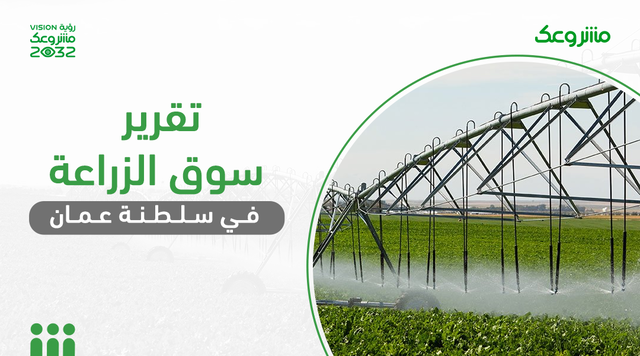
Agriculture in the Sultanate of Oman is considered one of the vital pillars of economic and social development, as it has been closely linked to Omani identity since ancient times and has served as a key source of food, income, and livelihoods. Despite the arid geography and the challenge of limited water resources, the Sultanate has succeeded in developing a diversified agricultural sector that relies on the cultivation of dates, citrus fruits, and vegetables, in addition to livestock farming, including camels, goats, cattle, and sheep.
Within the framework of Oman Vision 2040, the agricultural sector receives strategic attention aimed at achieving food security, improving the efficiency of natural resource utilization, and adopting modern technologies such as smart agriculture and efficient irrigation systems. It also focuses on strengthening value chains and agro-processing industries.
These integrated efforts have contributed to increasing productivity, improving the quality of local products, and enabling the Sultanate to enhance its export capacity and access regional and international markets with high value-added agricultural products.
The Sultanate of Oman launched Vision 2040 as a roadmap for economic and social development, aiming to achieve a diversified and sustainable knowledge- and innovation-based economy, with a strong focus on enhancing food security and relying on local resources. Agriculture in Oman holds a significant position within the objectives of the vision, which targets an annual agricultural growth rate of 4.5% to increase the sector’s contribution to 3.1% of the total GDP.
The vision also seeks to significantly strengthen agriculture and food security by raising food self-sufficiency from around 48% to 70%, and expanding cultivated land from 544 square kilometers to 1,044 square kilometers. Additionally, the strategies focus on encouraging the production of high-value crops, promoting sustainable water use to improve efficiency by 40%, and supporting the adoption of modern technologies, precision agriculture, and digital agricultural services.
The value added of agricultural activities in the Sultanate of Oman recorded notable growth in 2024, increasing at current prices from OMR 569 million in 2023 to OMR 623 million, achieving a growth rate of 9.5%. As a result, the sector’s contribution to GDP at current prices reached approximately 1.5%.
Similarly, the value added of agricultural activities at constant prices rose from OMR 549 million in 2023 to OMR 573 million in 2024, recording a growth rate of 4.37%, with the sector’s contribution to GDP at constant prices also standing at 1.5% during the same year.
The agricultural sector in the Sultanate of Oman recorded an increase in production across both plant and animal segments. Plant production rose from 3.685 million tons in 2023 to 3.935 million tons in 2024. Similarly, livestock production also witnessed growth, increasing from 456 thousand tons in 2023 to 496 thousand tons in 2024.
Accordingly, the total agricultural output in Oman (including both plant and animal production) increased from 4.141 million tons in 2023 to 4.431 million tons in 2024, reflecting continuous improvement in the performance of the Omani agricultural sector.
Read here: Discover the top 7 profitable agricultural projects.
Projections indicate continued growth in both plant and animal production volumes in the Sultanate of Oman during the period from 2026 to 2030. Total production is expected to increase from 5,075 thousand tons in 2026 (comprising 4,488 thousand tons of plant production and 587 thousand tons of animal production) to 5,432 thousand tons in 2027 (4,794 thousand tons plant and 639 thousand tons animal).
It is then expected to further rise to 5,815 thousand tons in 2028 (5,120 thousand tons plant and 695 thousand tons animal), followed by 6,224 thousand tons in 2029 (5,468 thousand tons plant and 756 thousand tons animal), and reaching 6,662 thousand tons in 2030 (5,839 thousand tons plant and 823 thousand tons animal).
These projections reflect steady and sustained growth in Oman’s agricultural sector across both plant and livestock production.
Please read here: Aeroponics: A Technological Revolution in Modern Agricultural Production
Read here: How does hydroponics contribute to improving crop productivity and conserving natural resources?

To communicate and learn more about Mashroo3k company and its services
The kebab restaurant project is one of the food-service ventures that combines strong demand for grilled meals with the opportunity to target a diverse customer base, including individuals, families, and lovers of traditional Middle Eastern cuisine. With growing competition in the restaurant sector, however, the project’s success is no longer determined by food taste alone. […]
Read moreA children’s toy store project is not limited to selling toys; it is built on understanding what attracts children and what families look for when choosing products that combine entertainment and educational value. With the wide variety of educational toys, skill-development games, recreational toys, and gifts available, the store has opportunities to meet the needs […]
Read moreA residential complex project is no longer simply an investment in a collection of real estate units. It has evolved into an integrated development model that combines comfortable living, diverse services, and long-term investment value. As cities expand and residents’ needs evolve, demand is growing for residential complexes that offer a comprehensive environment suited to […]
Read moreThe veterinary clinic project comes at a time when animal care is no longer limited to treating illnesses or injuries, but has expanded to include health monitoring, vaccinations, routine checkups, and care for both pets and livestock. However, many animal owners face challenges in accessing specialized veterinary services that combine prompt response, high-quality care, and […]
Read more
خصم 25% على خدمات مشروعك استفد من العرض الآن، فالفرصة متاحة لفترة محدودة فقط
سجّل بياناتك واحصل على خصم 25% الآن


