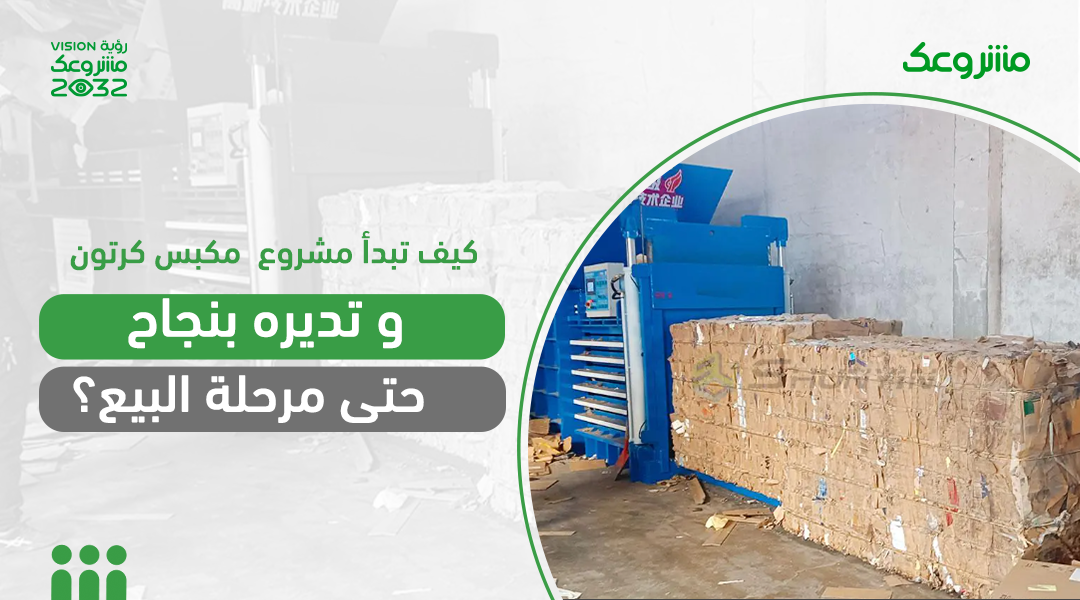
The cardboard baling project is no longer just a recycling activity; it has evolved into a smart investment opportunity that combines two complementary goals: achieving sustainable profits and making a real contribution to environmental protection.
With the growing industrial demand for recycled cardboard from factories and large companies, this project stands out as an excellent option within small industrial ventures, offering attractive returns, reasonable operating costs, ease of implementation, and reliable availability of raw materials.
In this article, we take you on a step-by-step journey to explore how to launch a cardboard baling project on solid foundations—from basic requirements, to cost structure, and finally to the key success factors that enable you to maximize returns and make the most of this promising market.
A cardboard baling project is one of the profitable small-scale ventures based on collecting waste cardboard from various sources such as shops, warehouses, and factories, then compressing it using a specialized machine into compact bales that are easy to store, transport, and sell to recycling factories.
The idea of the project relies on utilizing used cardboard instead of disposing of it. It is sorted, cleaned, and then baled to reduce its volume and increase its density, which raises its market value and makes it highly demanded by companies that use it as a raw material for manufacturing new products.
This project is characterized by easy operation and does not require extensive experience at the beginning. It also contributes to waste reduction and environmental sustainability, in addition to being a stable source of income due to the continuous availability of raw materials.
Please read here: Cardboard Recycling Project: A Green Investment with Sustainable Returns
Yes, according to a report published by Mordor Intelligence, the corrugated cardboard market is expected to reach USD 76.12 billion in 2025 and USD 80.83 billion in 2026, rising to approximately USD 105.96 billion by 2031, with a compound annual growth rate (CAGR) of 5.56% during the period from 2026 to 2031.
This reflects the growing demand for recycling and packaging materials, confirming that a cardboard baling project is a profitable investment opportunity when properly planned and managed.
Read here: Why is a cardboard project considered one of the best industrial projects in 2026?
The cost of a cardboard baling project varies depending on the size of the project, production capacity, and geographic location. However, it is generally divided into several main components, including the following:
Read here: How You Can Implement a Recycling Project
Tips to ensure the success and sustainability of a cardboard baling project
Read here: Discover how to turn waste into wealth through recycling
My ambition was never just about making a profit; I was looking for a business model that combines economic viability with real environmental impact—one that serves both the environment and society, and leaves a lasting effect beyond financial figures. The idea came to me when I witnessed the massive waste of cardboard materials in markets and industrial facilities. I began to ask myself: why can’t this waste become a real economic resource? From that question, the cardboard baling project was born. The vision was clear, but funding was the first obstacle; I had the idea and the initial plan, but I lacked the practical means to secure the capital needed to start.
Here, the role of “Mashroo3k Consulting” was crucial, as they helped me build a customized financing file for the Saudi Industrial Development Fund. It included a precise definition of capital requirements, a realistic operational plan, and financial projections that made the project attractive to funding institutions. It was not just paperwork, but a fully integrated logical case presented in the language of numbers.
The fund, in turn, provided flexible financing options that covered working capital, supply chains, and operational needs, enabling me to launch the project with confidence and on solid financial foundations.
Today, after a year of actual operation, that idea has turned into a tangible industrial reality; the factory is operating efficiently, and the compressed cardboard is reaching a wide network of companies and retailers, with every ton processed representing a real step toward a smaller carbon footprint and greater sustainable returns.
The price of a ton of baled (compressed) cardboard in Saudi Arabia currently ranges approximately between 600 and 800 Saudi riyals per ton, and it may increase slightly depending on the quality of the cardboard and the quantity.
Yes, a cardboard selling project is considered profitable, as it can generate a good profit margin, especially when cardboard is purchased at low prices and then sold after sorting and baling. Profit rates can reach attractive levels with expansion and proper organization of operations.
A cardboard factory is one of the profitable long-term industrial projects, especially with the increasing demand for packaging materials. However, it requires higher capital investment and stronger operational management compared to a cardboard baling project.
The best type depends on the size of the project; however, in general, the hydraulic baler is considered the best in terms of power, efficiency, and productivity, especially for medium and large-scale projects.
There are several types of cardboard balers, the most important of which are the manual baler (suitable for small projects), the semi-automatic baler, the hydraulic baler (the most commonly used and efficient), and the fully automatic baler (for large-scale projects).
A cardboard baling project is an investment option that combines what is rarely found together; it features a simple operational structure and reasonable setup costs, along with inexhaustible market demand. With the continuous availability of raw materials and ease of operation, it provides a solid foundation for building a project that grows gradually and generates increasing returns.
However, real success does not stop at the moment of launch; it is shaped daily through sound management, seizing expansion opportunities at the right time, and continuously improving operational performance. Therefore, if you are looking for a project that balances profitability with environmental responsibility, a cardboard baling project is not just a starting point—it is a gateway to a more mature and sustainable investment model.

For contact and to request a feasibility study for a cardboard baling project
The kebab restaurant project is one of the food-service ventures that combines strong demand for grilled meals with the opportunity to target a diverse customer base, including individuals, families, and lovers of traditional Middle Eastern cuisine. With growing competition in the restaurant sector, however, the project’s success is no longer determined by food taste alone. […]
Read moreA children’s toy store project is not limited to selling toys; it is built on understanding what attracts children and what families look for when choosing products that combine entertainment and educational value. With the wide variety of educational toys, skill-development games, recreational toys, and gifts available, the store has opportunities to meet the needs […]
Read moreA residential complex project is no longer simply an investment in a collection of real estate units. It has evolved into an integrated development model that combines comfortable living, diverse services, and long-term investment value. As cities expand and residents’ needs evolve, demand is growing for residential complexes that offer a comprehensive environment suited to […]
Read moreThe veterinary clinic project comes at a time when animal care is no longer limited to treating illnesses or injuries, but has expanded to include health monitoring, vaccinations, routine checkups, and care for both pets and livestock. However, many animal owners face challenges in accessing specialized veterinary services that combine prompt response, high-quality care, and […]
Read more
خصم 25% على خدمات مشروعك استفد من العرض الآن، فالفرصة متاحة لفترة محدودة فقط
سجّل بياناتك واحصل على خصم 25% الآن


