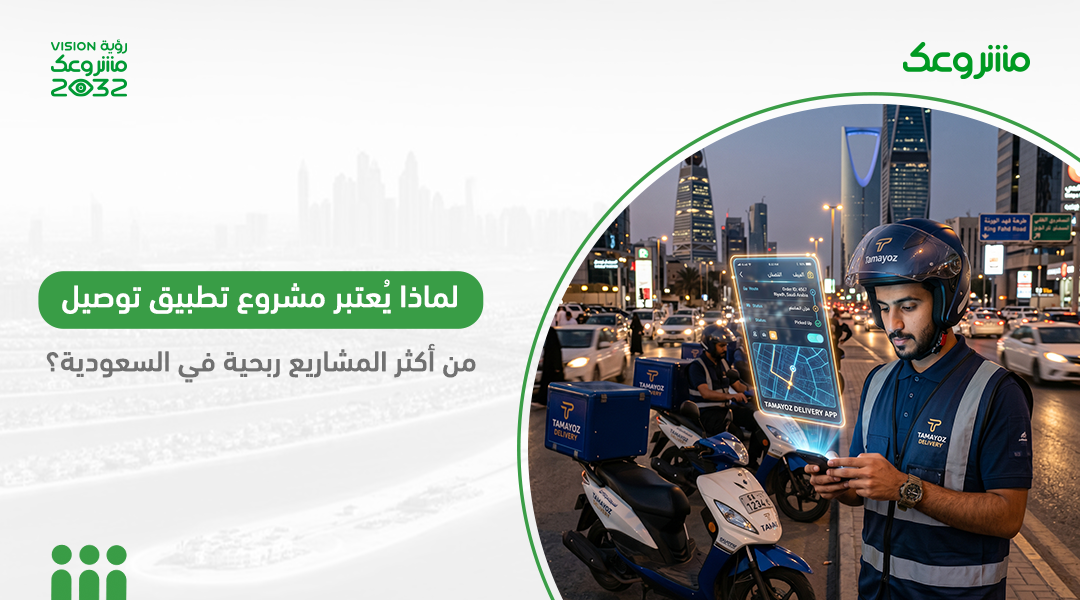
A delivery app project is considered today one of the fastest-growing and most widely adopted ventures in the modern era, as reliance on digital solutions has become an integral part of our daily lives—whether for ordering food, shopping, or accessing various services at high speed.
With the fundamental shift in consumer behavior toward fast and smart services, this type of project stands out as a promising investment opportunity that combines rising demand, strong scalability, and the potential to generate substantial returns.
It is also worth noting that success in this highly competitive sector is not limited to simply launching an application. Rather, it requires in-depth market research, well-structured strategic planning, and professional execution that ensures sustainability, differentiation, and the ability to withstand and grow within an increasingly competitive environment.
A delivery app project is an integrated digital platform (whether a mobile application or a website) that acts as an effective intermediary between customers and providers of products or services. The project aims to enable users to order a wide range of needs, including food, clothing, electronics, and various other goods and services, which are delivered to their locations within a specified time frame.
This model operates by connecting three main parties: the customer placing the order, the service provider (such as restaurants or stores), and the delivery courier responsible for transportation and fulfillment.
Thanks to rapid technological advancement and the increasing reliance on digital solutions, this modern business model has become widely adopted, as it provides an ideal solution that saves time and effort while ensuring fast and efficient access to products and services.
Yes, global economic indicators confirm that the delivery app project is currently classified as one of the most promising investment opportunities in terms of viability and growth potential. This is clearly reflected in the numbers; the global delivery app market reached approximately USD 73.65 billion in 2024, a figure that strongly highlights the scale of the global shift in demand for this sector.
This upward trajectory is expected to continue steadily, with the market projected to grow from USD 81.54 billion in 2025 to over USD 225.77 billion by 2035, achieving a compound annual growth rate (CAGR) of 10.72% during the forecast period.
Please read here: Goods Transport Project: A Promising Investment Opportunity in Saudi Arabia’s Logistics Sector
Investing in a delivery app project offers a range of competitive advantages that place it among the most viable and attractive investment opportunities in today’s economic landscape, especially with the rapid shift toward the digital economy and the growing global demand for delivery services. The main advantages include:
Daily and routine consumer reliance on delivery services ensures a continuously active user base, providing stable demand and consistent revenue streams throughout the year.
The ability to expand into new markets, cities, and regions with high flexibility and speed, without the need to restructure the core business model or significantly increase physical assets.
Diversified revenue streams such as order commissions, delivery fees, subscriptions, and in-app advertising.
Lower operational costs compared to traditional businesses, as the project is primarily based on a digital platform.
The ability to manage and operate core processes remotely, relying on a lean organizational structure without the need for large offices or costly infrastructure.
Easy platform updates and the ability to add new services, gradually transforming the app into a comprehensive platform while continuously improving user experience based on data analytics and customer behavior.
The use of digital marketing tools and data analytics to promote the brand and achieve wide reach and strong engagement at relatively low and controlled marketing costs.
High investment returns and exceptional profit margins once the business model is established, as revenues scale significantly with the growth of the user base and repeated daily orders, supported by low marginal operating costs per transaction.
Please read here: Best Projects in Saudi Arabia: Your Guide to Investment Opportunities Aligned with Vision 2030
A team of specialized developers experienced in building smart applications (Android/iOS) and websites, with expertise in modern programming languages and advanced frameworks to ensure high performance and technical stability.
A comprehensive admin dashboard to manage the entire order lifecycle in real time, track users and drivers, manage payments, and generate analytical reports to support decision-making.
Reliable cloud hosting that ensures fast response times, automatic scaling during peak loads, and encrypted data security with guaranteed system uptime.
Integration with approved local and international payment gateways to provide multiple payment options (credit cards, e-wallets, bank transfers, and cash on delivery), while complying with global security standards.
Integration of interactive maps and geolocation services to track orders in real time, optimize driver routes, and accurately locate customers and service providers.
A specialized UI/UX design team to create visually appealing interfaces and smooth user experiences that ensure easy navigation, fast order completion, and higher user retention rates.
A set of various smart devices and operating systems for performance testing, compatibility checks, and bug detection before launch to ensure application quality and security.
A dedicated customer service dashboard integrated with automated responses to ensure quick handling of complaints and inquiries, improving customer satisfaction.
Advertising campaign management platforms and user behavior analytics tools to precisely target customers and optimize return on marketing investment.
Advanced database management systems to store and process large volumes of user, order, and financial transaction data, while ensuring the highest standards of privacy and data protection.
Please read here: E-commerce Projects… How to Start? And What Are the Fastest Ways to Profit?
The cost of a delivery app project varies depending on the size of the application, the target market scope, the number of required technical features, and the level of quality in design and development. The costs can be divided into several main categories as follows:
Technical development costs, which include designing and programming the application. These vary based on the complexity of features such as real-time tracking, multiple service categories, and user experience quality.
Technical infrastructure costs, including servers, databases, and cloud hosting, to ensure efficient, fast, and secure app performance.
Payment system integration costs, such as payment gateways, e-wallets, and billing systems for managing in-app financial transactions.
Design and user experience (UI/UX) costs, which involve creating a professional and user-friendly interface to attract customers and enhance usability.
Operational and platform management costs, including order management, customer support, complaint handling, and daily system operations.
Marketing costs, covering advertising campaigns, digital marketing, and brand building to increase the number of users and drivers.
Maintenance and continuous development costs, including app updates, bug fixes, and the addition of new features to maintain the project’s competitiveness.
What are the key practical steps to launch a delivery app project?
Clearly define the nature of the project—whether it is a food delivery app only, or a comprehensive platform that includes delivery from stores, pharmacies, and various other services.
Conduct in-depth research of the local market to understand the actual demand for delivery services, analyze user behavior, and study existing competitors while identifying gaps that can be leveraged to create a competitive advantage.
Request a comprehensive feasibility study that includes estimating the total development and operational costs, calculating expected return on investment, and determining the break-even point to ensure the project is economically viable, sustainable, and profitable.
Precisely define your target market segment, whether individuals, restaurants, stores, or pharmacies, in order to design services and user experience that match their real needs.
Prepare the technical infrastructure of the application, including front-end and back-end development, admin dashboards, and order tracking systems, to ensure a smooth and fast user experience.
Integrate essential technical tools such as electronic payment systems, GPS location services, and push notification systems to ensure efficient app operation.
Complete all legal procedures and required licenses for officially operating the delivery platform, ensuring compliance with regulations and protecting the project from future issues.
Develop a detailed business plan covering app development stages, launch, and user base expansion, with a clear timeline for each implementation phase.
Launch a pilot version of the application to test performance, identify technical issues and user experience gaps, and improve the system before the official release.
Build a professional brand identity for the app, including its name, logo, and color scheme, to enhance user trust and give the project a distinctive market presence.
Continuously monitor service quality, track driver performance and customer satisfaction, and maintain a fast and responsive support system to handle complaints and issues.
Develop expansion strategies for geographic growth and additional services after achieving stability and market traction, aligned with demand growth.
| Potential Risk | Impact | Ways to Overcome |
|---|---|---|
| Strong market competition | Difficulty attracting customers at the beginning | Provide a clear competitive advantage such as faster delivery, lower commissions, or a better user experience |
| Weak demand during launch phase | Slow growth in orders | Launch strong marketing campaigns and offer discounts and promotions to attract early customers |
| Technical issues in the app | Service downtime or poor user experience | Thoroughly test the app before launch and maintain a continuous technical support and maintenance team |
| Delivery delays or poor driver performance | Low customer satisfaction | Carefully select and train drivers, and implement a performance monitoring and evaluation system |
| High operating costs | Low profitability | Manage costs wisely and start in a limited geographic area before gradually expanding |
| Problems with electronic payments | Loss of customer trust | Use reliable payment gateways and offer multiple payment options |
| Difficulty building a stable customer base | Unstable revenue | Focus on continuous marketing, loyalty programs, and regular offers |
| Legal or regulatory risks | Project suspension or disruption | Obtain necessary licenses and comply with local regulations |
| Weak coordination between parties (customer – service provider – driver) | Order errors and delivery delays | Use an integrated management system that connects all parties in real time |
| Driver loss or high turnover rate | Operational capacity shortage | Improve incentive systems andPotential Risk Impact Ways to Overcome Strong market competition Difficulty attracting customers at the beginning Provide a clear competitive advantage such as faster delivery, lower commissions, or a better user experience Weak demand during launch phase Slow growth in orders Launch strong marketing campaigns and offer discounts and promotions to attract early customers Technical issues in the app Service downtime or poor user experience Thoroughly test the app before launch and maintain a continuous technical support and maintenance team Delivery delays or poor driver performance Low customer satisfaction Carefully select and train drivers, and implement a performance monitoring and evaluation system High operating costs Low profitability Manage costs wisely and start in a limited geographic area before gradually expanding Problems with electronic payments Loss of customer trust Use reliable payment gateways and offer multiple payment options Difficulty building a stable customer base Unstable revenue Focus on continuous marketing, loyalty programs, and regular offers Legal or regulatory risks Project suspension or disruption Obtain necessary licenses and comply with local regulations Weak coordination between parties (customer – service provider – driver) Order errors and delivery delays Use an integrated management system that connects all parties in real time Driver loss or high turnover rate Operational capacity shortage Improve incentive systems and provide a flexible and attractive working environment for drivers provide a flexible and attractive working environment for drivers |
Read here: 9 Essential Steps Before Starting a Delivery Service Project
For more information about providing delivery services through electronic platforms (854669), click here.
One of our clients from Jeddah shares his experience with us:
“When I decided to launch a delivery app project, I strongly believed in the potential of this sector and the vast opportunities it offers, especially with the increasing reliance on applications and fast services. However, once I got into the actual details of the project, I discovered that it was more complex than I had expected, whether in terms of cost estimation or project management and operations.”
With the many challenges, I began to feel hesitant and considered stepping back from the project, as I did not have a clear vision of the implementation steps or the real chances of success. During that period, one of my acquaintances advised me to contact “Mashroo3k Consulting,” and that step became a turning point for me.
From the very first meeting, I felt the team’s professionalism and extensive expertise. After I provided them with the necessary data, they prepared a comprehensive feasibility study covering the technical, operational, marketing, and financial aspects. They also presented a clear overview of demand levels, costs, and expected returns, in addition to the potential risks and how to manage them.
They also helped me prepare the project’s financing file in a professional way, and I was able to obtain the necessary funding from the Social Development Bank. Today, thank God, the application is operating successfully and achieving excellent results, and the idea that was once just a dream has become a real project with a promising future.
The investment cost of developing a delivery app varies significantly depending on the project’s strategic scope and the required feature set. The overall budget includes several key components, most notably full technical development costs, user interface and experience design, cloud infrastructure and server setup, payment gateway integration, as well as marketing and launch expenses.
From a financial perspective, there is a clear positive correlation between the level of technical complexity and the number of innovative features within the app, and the amount of capital required. This makes it essential to prepare an accurate feasibility study and initial budget to determine the optimal cost in line with financial goals and the targeted return on investment.
To start the project, you first need to define the app idea and the type of services offered, then conduct a feasibility study. After that, design and develop the application, build a network of drivers and partners, and launch it in a pilot phase before the official release, along with implementing a strong marketing plan.
Yes, delivery services can be very profitable if managed properly, especially with the increasing demand for fast services. Profitability depends on the number of orders, commission rates, operational efficiency, and marketing effectiveness.
When analyzing the most profitable sectors in the delivery industry, food delivery and essential consumer goods delivery rank at the top, supported by daily consumption patterns and continuous demand that ensures stable and high-frequency revenue streams.
Yes, in most countries, a delivery service project requires official licenses from the relevant authorities, in addition to registering the business activity and complying with regulations related to e-commerce and transport services.
We can conclude that a delivery app project is one of the most promising ventures at present, due to its direct connection to consumers’ daily needs and its reliance on the rapidly growing global digital transformation.
However, success in this field is not achieved merely by launching an application. It depends on a deep understanding of the market, delivering an exceptional user experience, and building a flexible business model capable of competition and continuous development.
If the project is properly planned and investment is directed toward quality, marketing, and ongoing improvement, a delivery app can evolve from a simple idea into a successful, sustainable business that generates strong long-term returns.

For contact and to request a feasibility study for a delivery app project
The kebab restaurant project is one of the food-service ventures that combines strong demand for grilled meals with the opportunity to target a diverse customer base, including individuals, families, and lovers of traditional Middle Eastern cuisine. With growing competition in the restaurant sector, however, the project’s success is no longer determined by food taste alone. […]
Read moreA children’s toy store project is not limited to selling toys; it is built on understanding what attracts children and what families look for when choosing products that combine entertainment and educational value. With the wide variety of educational toys, skill-development games, recreational toys, and gifts available, the store has opportunities to meet the needs […]
Read moreA residential complex project is no longer simply an investment in a collection of real estate units. It has evolved into an integrated development model that combines comfortable living, diverse services, and long-term investment value. As cities expand and residents’ needs evolve, demand is growing for residential complexes that offer a comprehensive environment suited to […]
Read moreThe veterinary clinic project comes at a time when animal care is no longer limited to treating illnesses or injuries, but has expanded to include health monitoring, vaccinations, routine checkups, and care for both pets and livestock. However, many animal owners face challenges in accessing specialized veterinary services that combine prompt response, high-quality care, and […]
Read more
خصم 25% على خدمات مشروعك استفد من العرض الآن، فالفرصة متاحة لفترة محدودة فقط
سجّل بياناتك واحصل على خصم 25% الآن


