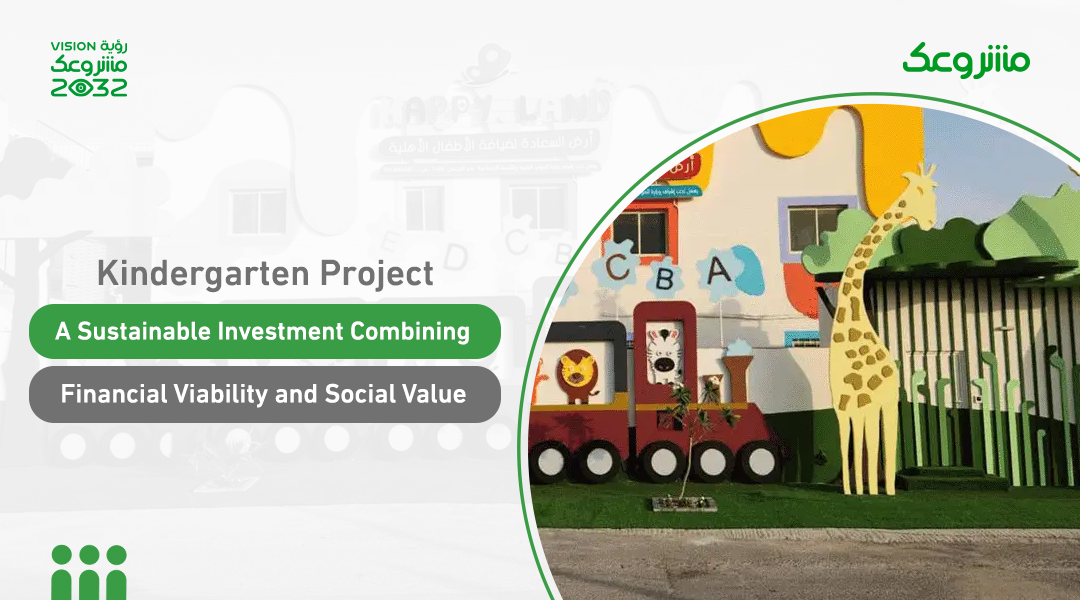
The kindergarten project is more than just a promising investment opportunity; it is an educational mission that contributes to shaping a child’s personality and developing their abilities during the most critical early stages of life. With increasing parental awareness of the importance of providing a safe, stimulating, and innovative learning environment for their children, this type of project has become one of the activities witnessing steady and growing demand.
However, its success is not achieved merely by securing a suitable location. It requires careful planning and a comprehensive vision that begins with selecting a strategic site, extends to equipping classrooms and facilities according to the highest safety and quality standards, and continues with designing educational and recreational programs that combine learning and enjoyment.
In this context, this article provides a complete guide to establishing a successful kindergarten project by reviewing the essential setup requirements, highlighting key factors of competitiveness and excellence, and analyzing expected costs to support well-informed decisions that achieve both educational and financial returns.
A kindergarten project is one of the vital educational ventures that focuses on caring for children in the pre-school stage by providing balanced educational and recreational programs that help develop their cognitive, social, and behavioral skills within a safe and well-prepared environment suited to their age needs.
The project is based on providing equipped classrooms, engaging learning activities, and interactive games that enhance learning in a simple and attractive way, helping children acquire basic knowledge and skills during their early years.
A kindergarten project is considered one of the successful and consistently in-demand businesses, especially with the growing awareness among families of the importance of early education and its role in building a child’s personality and developing their abilities from the earliest stages of life.
Yes, global economic indicators confirm that the kindergarten project is currently classified as one of the most promising investment opportunities. This is clearly reflected in the figures, as the global childcare market reached approximately USD 373.61 billion in 2025, rising to USD 389.91 billion in 2026.
These numbers clearly demonstrate the significant growth in global demand for this sector. The upward trend is expected to continue steadily, with the market projected to exceed USD 548.71 billion by 2034, achieving a compound annual growth rate (CAGR) of 4.36% during the forecast period (2026–2034).
There are many factors that make a kindergarten project a promising and sustainable investment opportunity, the most important of which are:
Read here: 8 successful small business ideas for women
The cost of establishing a kindergarten project varies significantly depending on the kindergarten’s size, geographic location, and the level of equipment and educational services provided. The main costs include:
Read here: Practical steps to establish a daycare project
| Challenge | How to Avoid It | Mashroo3k’s Role |
|---|---|---|
| Difficulty in choosing the right location | – Study population density and the presence of family communities.- Evaluate demographic characteristics (income levels and age groups).- Analyze birth rates and population growth trends. | – Conducts comprehensive site evaluations based on population density and demographic composition.- Analyzes infrastructure and proximity to residential communities.- Assesses potential environmental and security risks. |
| High startup and setup costs | Develop a clear financial plan and prioritize spending according to project needs. | Mashroo3k provides a detailed financial feasibility study outlining expected costs and financing plans. |
| Obtaining licenses and permits | Comply with government requirements from the outset and prepare all necessary documentation. | Mashroo3k offers specialized legal consultations and provides a complete overview of licensing procedures within its feasibility study. |
| Shortage of qualified educational staff | – Establish strict standards for academic and educational qualifications.- Assess personal skills and the ability to work with children.- Verify candidates’ passion for early childhood education.- Evaluate their ability to create a stimulating learning environment. | – Designs a comprehensive organizational structure that clearly defines roles and responsibilities.- Identifies the required educational, administrative, and support positions. |
| Weak marketing at the launch stage | Use content marketing on social media platforms and invest in paid advertising campaigns. | Mashroo3k develops a comprehensive marketing strategy to attract the target audience and increase enrollment. |
| Intense market competition | Offer distinctive educational services and programs. | Mashroo3k provides market and competitor analyses to help identify and build a strong competitive advantage. |
| Ensuring children’s safety | Implement strict safety and security standards throughout the kindergarten. | Mashroo3k provides operational guidelines and standards to ensure a safe environment based on best practices. |
| Low enrollment in the early stages | Offer opening promotions and build strong relationships with the local community. | Mashroo3k helps develop marketing strategies that attract families and increase registration rates. |
| Managing daily operations | Use professional management systems and organize workflows efficiently. | Mashroo3k provides operational solutions and effective management models to support project success. |
I am S.K. from Jeddah. Some time ago, I had the idea of opening a kindergarten that would provide a suitable educational environment where children could learn and enjoy themselves at the same time. However, when I started seriously considering the project, I encountered challenges I had not expected. The biggest challenge was figuring out how to properly plan the project from the beginning, as well as the financing aspect, which left me confused and unsure where to start.
I did a lot of research and asked my friends about a reliable company that could help me launch the project the right way. They all recommended Mashroo3k Consulting. Honestly, from the very first interaction, I felt that my project was in safe hands. They prepared a comprehensive feasibility study covering all aspects of the project—marketing, technical, financial, and administrative—in a clear and well-organized manner that helped me understand my project better and move forward with a structured plan, free from guesswork and uncertainty.
After that came the financing stage, which was the biggest obstacle for me. Here too, they did not fall short—they arranged suitable financing solutions for me, which eventually enabled me to obtain funding from the Social Development Bank, and I was able to officially start my project in reality.
Today,the kindergarten is operating successfully and steadily. Every day, we welcome children, and I get to see with my own eyes the dream I always had—a child learning while being happy and engaged. This achievement was possible first and foremost by the grace of God, and then thanks to the professional support and guidance provided by Mashroo3k Consulting, who were with me every step of the way.
Please read here: Best Projects in Saudi Arabia: Your Guide to Investment Opportunities Aligned with Vision 2030
Opening a kindergarten requires compliance with an integrated set of regulatory, educational, and health standards that collectively ensure a safe and suitable environment for receiving and raising children.
These requirements begin with obtaining official licenses from the relevant government authorities and completing all legal documentation necessary to establish the activity on a sound legal basis. They then extend to preparing the kindergarten facility in accordance with approved safety standards, including providing adequate space that ensures freedom of movement and activities, ensuring proper ventilation and suitable lighting in classrooms and play areas, and using furniture and equipment specifically designed to suit children’s needs and ensure their safety.
In addition, the requirements include providing complete infrastructure such as child-appropriate restrooms, as well as effective safety systems such as fire extinguishers and security monitoring systems. This framework is further completed by recruiting qualified teaching staff with solid experience in early childhood education, along with designing balanced educational and developmental programs that take into account age differences and meet the developmental needs of each stage.
The Ministry of Education sets a number of clear requirements that must be met by a kindergarten teacher. Foremost among these is obtaining an academic qualification of no less than a bachelor’s degree in Early Childhood Education, Special Education, Educational Psychology, or an equivalent related specialization approved by the relevant authorities. In most cases, the teacher is also required to be a Saudi national in accordance with the Saudization requirements applied in the education sector. In addition, she must pass the approved professional competency examinations, such as the teachers’ test supervised by the Education and Training Evaluation Commission, and obtain a professional teaching license from the Ministry of Education before commencing employment.
Furthermore, the teacher must be free from infectious diseases and provide a medical fitness certificate, in addition to having good conduct and behavior and possessing the ethical qualifications necessary to work with this sensitive age group. Moreover, some private educational institutions now require, in addition to the above, a certain level of proficiency in the English language and knowledge of modern teaching methods and international curricula such as the Montessori method and others, reflecting the growing competitiveness of the early childhood education market in the Kingdom.
The fundamentals of kindergarten teaching are based on an integrated set of educational principles that focus on the holistic development of children during this sensitive stage of life. Learning through play is at the forefront of these approaches, as it is considered the most effective way to capture children’s attention and help them absorb concepts naturally and enjoyably.
Teaching also places special emphasis on developing children’s language and social skills through storytelling, dialogue, and group activities that encourage communication and self-expression. In this context, educational concepts are introduced gradually in a manner that aligns with children’s abilities and cognitive development levels.
Attention is also given to enhancing sensory and motor skills through interactive activities such as drawing, coloring, and various movement-based exercises. Equally important is providing a safe and stimulating learning environment that encourages children to explore and interact with those around them.
At the same time, individual differences and the unique needs of each child are taken into consideration, while simple and flexible assessment methods based on observation and continuous monitoring are employed instead of traditional examinations, which are not suitable for this age group.
A good kindergarten teacher is considered an outstanding educational role model, combining a range of qualities and skills that enable her to work effectively and professionally with children during this sensitive stage of development. Among the most important of these qualities are patience and emotional calmness, which allow her to deal wisely with children’s changing behaviors without losing composure.
She also possesses a genuine love for children and the ability to support them emotionally and educationally, creating a safe and encouraging learning environment. In addition, an exceptional teacher has strong communication skills that enable her to simplify complex information and present it in an enjoyable and easy-to-understand manner for children.
Creativity is another key characteristic, as it helps her design educational activities that combine learning and play, stimulating children’s curiosity and maintaining their attention. Flexibility and the ability to adapt to changing situations are also essential traits in this profession.
Furthermore, she demonstrates a strong sense of responsibility and remains constantly attentive to children’s safety and basic needs. There is no doubt about the importance of being organized and capable of managing the classroom efficiently, while also possessing a deep understanding of child development at its various stages and keeping up with modern approaches to early childhood education.
We can confidently say that a kindergarten project remains an exceptional investment model that successfully balances strong financial returns with a meaningful humanitarian mission. It is built on a continuously growing base of families seeking quality, safety, and distinction for their children during the most important and formative stages of their lives.
It is also important to highlight that well-structured planning, the smart selection of a suitable geographic location, and the adoption of innovative teaching methods that combine effective learning with engaging experiences are the true pillars of this project. These elements stimulate a child’s curiosity and encourage discovery, forming the foundation for long-term operational stability and sustainable growth, far from market fluctuations and risks of stagnation that affect many other types of businesses.

For inquiries and to request a feasibility study for a kindergarten project
The kebab restaurant project is one of the food-service ventures that combines strong demand for grilled meals with the opportunity to target a diverse customer base, including individuals, families, and lovers of traditional Middle Eastern cuisine. With growing competition in the restaurant sector, however, the project’s success is no longer determined by food taste alone. […]
Read moreA children’s toy store project is not limited to selling toys; it is built on understanding what attracts children and what families look for when choosing products that combine entertainment and educational value. With the wide variety of educational toys, skill-development games, recreational toys, and gifts available, the store has opportunities to meet the needs […]
Read moreA residential complex project is no longer simply an investment in a collection of real estate units. It has evolved into an integrated development model that combines comfortable living, diverse services, and long-term investment value. As cities expand and residents’ needs evolve, demand is growing for residential complexes that offer a comprehensive environment suited to […]
Read moreThe veterinary clinic project comes at a time when animal care is no longer limited to treating illnesses or injuries, but has expanded to include health monitoring, vaccinations, routine checkups, and care for both pets and livestock. However, many animal owners face challenges in accessing specialized veterinary services that combine prompt response, high-quality care, and […]
Read more
خصم 25% على خدمات مشروعك استفد من العرض الآن، فالفرصة متاحة لفترة محدودة فقط
سجّل بياناتك واحصل على خصم 25% الآن


