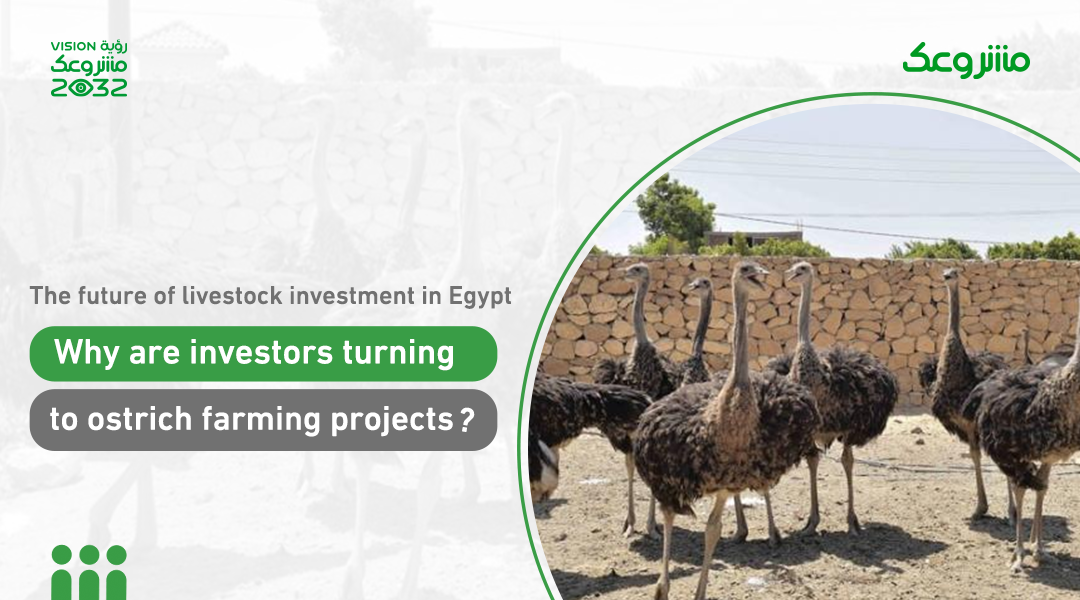
The ostrich farming project is considered one of the promising agricultural and investment projects that has gained increasing attention in recent years, due to the diversity of its products and their high economic value. The returns are not limited to meat production only, but also include leather, feathers, and eggs, which creates multiple income sources and enhances the potential for achieving substantial profits. The project is also characterized by its ability to adapt to different environmental conditions, in addition to the growing demand for its products in both local and global markets. However, its success requires careful planning, selecting suitable breeds, and providing proper healthcare and balanced nutrition, along with preparing a comprehensive feasibility study that evaluates the technical, financial, and marketing aspects, helping investors make well-informed decisions that reduce risks and enhance chances of success and sustainability.
An ostrich farming project is an agricultural and production-based project that relies on raising ostriches in properly equipped farms according to suitable technical standards. The goal is to produce and market a variety of economically valuable products such as meat, eggs, leather, and feathers.
This project is considered a promising investment due to its multiple income sources and the high demand for its products in many markets. It also offers the potential for expansion as production increases, making it an attractive option for investors interested in the agricultural and livestock sectors.
Read here: Discover the top 7 profitable agricultural projects.
Global market indicators suggest that ostrich farming is one of the promising projects in terms of economic viability and profitability, supported by the increasing demand for ostrich meat as an alternative protein source that is gaining global popularity. The ostrich meat market was valued at around 399.9 million USD in 2025 and is expected to continue growing at a compound annual growth rate (CAGR) of 6.7% from 2026 to 2034, reaching approximately 729.4 million USD by 2034.
This reflects expanding investment opportunities in the sector and confirms that the project has strong potential to generate attractive returns, especially when modern farming methods, effective management, and good marketing strategies are applied.
Investors are turning to ostrich farming projects because of the many investment advantages the project offers, including the following:
Please read here: Profitable Projects in Villages: Successful Investment Ideas with Low Operating Costs
The cost of an ostrich farming project varies significantly depending on the size of the project, the number of birds, the level of facilities and equipment, the location, and the planned production capacity. The main cost components include:
Read here: Discover the Best Small Project That Fits Your Resources
Starting an ostrich farming project requires careful planning to achieve the best results and minimize risks. Its success depends on selecting suitable breeds, providing an appropriate farming environment, and managing the project efficiently. The key steps include:
Learn how to implement a profitable sheep farming project in 2026
An ostrich farming project offers several products that can generate significant profits, including:
Please read here: Quail Farming Project: A Smart Investment with Returns Beyond Expectations
| Operational Challenge | How to Address It |
|---|---|
| High feed costs | Contract with wholesale suppliers or prepare balanced feed mixtures that reduce costs without affecting quality. |
| Diseases and mortality rates | Implement a regular preventive veterinary program and adhere to vaccination schedules and routine farm hygiene practices. |
| Lack of management and farming experience | Hire specialists or obtain proper training before starting the project. |
| Market fluctuations and marketing difficulties | Develop a diversified marketing strategy that includes agreements with traders, restaurants, and leather manufacturers rather than relying on a single sales channel. |
| Large space requirements | Choose suitable locations outside urban areas at lower costs or efficiently utilize underused land. |
| High initial operating costs | Divide the investment into phases, start with a limited number of birds, and expand gradually. |
| Limited awareness of ostrich products in some markets | Launch marketing and awareness campaigns highlighting the nutritional and economic value of ostrich products. |
The success of an ostrich farming project can be measured through a set of indicators that reflect operational efficiency, management quality, and the project’s ability to achieve its goals. The most important indicators include:
Read here: How to Achieve Financial Success by Investing in Successful Small Projects
| Element | Details |
|---|---|
| Strengths | – Multiple income sources from meat, eggs, leather, and feathers. – High economic value of ostrich products compared to many other birds. – Increasing demand for ostrich meat as a healthy protein source. – Potential for good returns with effective management and marketing. – Ostriches can adapt to climate conditions in many regions. |
| Weaknesses | – High initial setup and farm preparation costs. – Need for technical expertise in ostrich farming and management. – Longer production cycle compared to some poultry projects. – Requirement for large spaces to ensure proper farming conditions. – Production is affected if feeding and health programs are weak. |
| Opportunities | – Continuous global growth in demand for ostrich meat and products. – Export opportunities for meat and leather to international markets. – Expansion of industries based on ostrich leather and feathers. – Increasing awareness of healthy, low-fat, low-cholesterol food. – Access to government support and funding programs for agricultural projects. |
| Threats | – Spread of diseases that may affect flock health. – Rising feed and input costs. – Price fluctuations due to supply and demand changes. – Competition from other animal protein sources. – Economic changes or regulations affecting operating and marketing costs. |
I entered the ostrich farming industry in Egypt fully aware of its promising potential, but I did not anticipate the scale of the challenges I would face from day one. Before the project could even get off the ground, I found myself confronted with two major obstacles that nearly derailed it at its inception: the absence of a well-structured operational plan capable of addressing potential risks, and a shortage of the financial liquidity needed to cover both capital and operating costs.
Faced with this reality, the smartest decision was to seek specialized expertise rather than rely on intuition. I therefore turned to Moshroo3k Consulting, which developed a clear roadmap for the project through a comprehensive feasibility study. The study addressed the technical aspects with professional precision, including determining the required farm area, veterinary care protocols, and ostrich feed conversion rates. It also extended to market analysis, targeted distribution channels, and the development of a robust administrative and financial structure designed to ensure long-term sustainability.
As for the financing challenge, the company did not stop at providing advice; it took the initiative to design practical financing solutions, prepared the project file according to the requirements of supporting institutions, and paved the way for securing the necessary funding from the Micro, Small and Medium Enterprise Development Agency (MSMEDA).
As a result, the project moved from a stage of stagnation to actual production and stable operation, transforming into a sustainable productive business that achieved its targeted returns. This success was made possible through the integrated technical and financial support provided by the experts at Moshroo3k throughout every stage of the project’s establishment.
The ostrich farming cycle typically lasts between 10 and 14 months until the birds reach market or slaughter weight, depending on the feeding program, management practices, and the quality of the breed used.
The cycle begins with either the hatching stage or the purchase of chicks, followed by the growth and fattening phase, which requires careful monitoring to achieve optimal weight gain. In some cases, ostriches may require a longer period if they are raised under a less intensive farming system or in suboptimal operating conditions.
Proper nutrition and effective health management play a key role in shortening the production cycle and improving overall productivity.
The price of ostrich meat per kilogram in Egypt currently ranges approximately between EGP 380 and EGP 450 per kg. Prices vary depending on the location, the type of cut (such as fillet, steak, or other parts of the carcass), and the level of market demand.
Prices may also rise or fall based on production costs, the selling season, and the quality of the meat offered. Ostrich meat is generally considered a high-value meat product compared to many other types of meat.
The African Black Ostrich is considered the best breed for farming, as it is the most widely used in commercial projects due to its ease of handling, rapid growth rate, and strong ability to produce high-quality meat and leather. It is also known for its relatively calm temperament compared to other ostrich breeds, making it highly suitable for intensive farming operations.
Another notable breed is the Blue-Neck Ostrich, which is characterized by its large size and high productivity. However, it requires greater expertise in management and care. There is also the Red-Neck Ostrich, which is more tolerant of harsh environmental conditions but is less commonly used in investment projects because of its aggressive nature and the challenges associated with raising it.
Therefore, the African Black Ostrich remains the best and safest choice for achieving stable economic returns and long-term success in ostrich farming.
An ostrich typically lays between 6 and 10 eggs per month during the production season. However, this number can vary depending on factors such as breed, age, nutrition quality, and farming conditions.
Ostrich egg production is not constant throughout the year; it is concentrated in specific breeding seasons. Under suitable environmental conditions and proper care, a female ostrich can produce an average of 40 to 60 eggs per year.
The price of an ostrich egg in Egypt varies depending on its use and quality. A table egg (for consumption) usually costs around 150 to 200 Egyptian pounds.
However, a fertilized egg used for hatching is much more expensive, ranging from about 1,000 to 1,200 Egyptian pounds or more, depending on its quality and source.
Prices are also affected by supply and demand, the production season, and market conditions at the time of sale.
The price of an adult ostrich in Egypt is approximately between 8,000 and 15,000 Egyptian pounds for birds ready for breeding or production. This value may increase or decrease depending on several factors such as age, health condition, and breed, as well as the level of productivity—whether for hatching or fattening. Ostriches with higher productivity or those ready for breeding are usually more expensive compared to younger birds or those with lower production efficiency.
We can conclude that the ostrich farming project represents a distinctive investment opportunity for those looking to enter the livestock production sector with a project characterized by multiple income sources and promising growth potential. However, achieving success in this field requires careful planning and a comprehensive study of the project’s requirements, costs, and marketing opportunities.
Hence, the importance of seeking support from specialized experts such as “Mosharka Consulting Company” emerges, as it provides professional feasibility studies that help investors make informed decisions, reduce risks, and enhance the chances of success, ensuring the establishment of an ostrich farming project on sound and sustainable investment foundations.

To contact and request a feasibility study for an ostrich farming project
The kebab restaurant project is one of the food-service ventures that combines strong demand for grilled meals with the opportunity to target a diverse customer base, including individuals, families, and lovers of traditional Middle Eastern cuisine. With growing competition in the restaurant sector, however, the project’s success is no longer determined by food taste alone. […]
Read moreA children’s toy store project is not limited to selling toys; it is built on understanding what attracts children and what families look for when choosing products that combine entertainment and educational value. With the wide variety of educational toys, skill-development games, recreational toys, and gifts available, the store has opportunities to meet the needs […]
Read moreA residential complex project is no longer simply an investment in a collection of real estate units. It has evolved into an integrated development model that combines comfortable living, diverse services, and long-term investment value. As cities expand and residents’ needs evolve, demand is growing for residential complexes that offer a comprehensive environment suited to […]
Read moreThe veterinary clinic project comes at a time when animal care is no longer limited to treating illnesses or injuries, but has expanded to include health monitoring, vaccinations, routine checkups, and care for both pets and livestock. However, many animal owners face challenges in accessing specialized veterinary services that combine prompt response, high-quality care, and […]
Read more
خصم 25% على خدمات مشروعك استفد من العرض الآن، فالفرصة متاحة لفترة محدودة فقط
سجّل بياناتك واحصل على خصم 25% الآن


