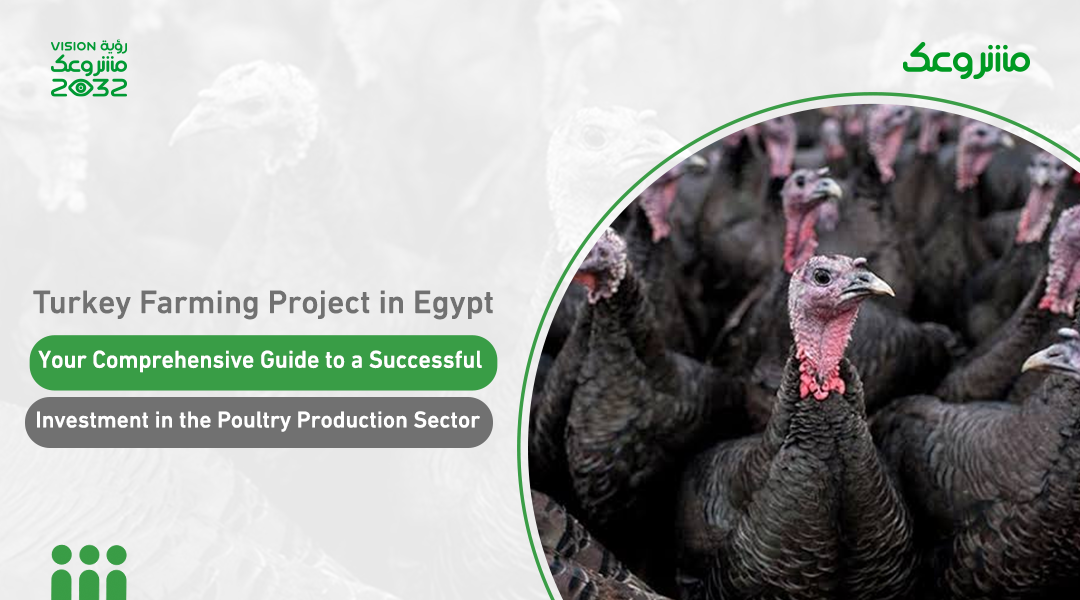
The Turkey Farming Project is one of the most promising agricultural ventures, attracting growing interest amid the continuous rise in demand for turkey meat. This increasing demand is driven by its high nutritional value, distinctive taste, and the growing health awareness among consumers. Moreover, the project represents an attractive investment opportunity due to its expanding market potential and the ability to generate rewarding returns when implemented according to sound scientific and managerial practices.
The success of a turkey farming project depends on careful planning, selecting suitable breeds, providing a healthy rearing environment, and adhering to proper nutrition and veterinary care programs. These factors contribute to maximizing production rates while minimizing mortality losses.
In this article, we explore the key success factors of a turkey farming project, its implementation requirements, major cost components, and the primary factors affecting profitability. We also highlight the importance of preparing a professional feasibility study that enables investors to make informed decisions, reduce investment risks, and maximize their chances of achieving long-term success.
A Turkey Farming Project is an agricultural and livestock production venture that involves raising and managing turkeys in accordance with sound technical and biosecurity practices to produce high-quality meat for the market. The project is designed to meet the growing demand from consumers, restaurants, and poultry retailers for premium turkey products.
The success of a turkey farming project depends on selecting suitable breeds, providing an optimal rearing environment, and adhering to well-structured nutrition and veterinary care programs. These practices help maximize productivity, reduce mortality rates, and achieve sustainable, profitable returns for investors.
Read here: Discover the top 7 profitable agricultural projects.
Yes. Global economic indicators confirm that a Turkey Farming Project represents a promising investment opportunity with growing commercial potential. This growth is driven by a significant shift in consumer preferences toward healthier, lean-protein diets, as well as the increasing demand for turkey meat and its wide range of value-added products.
The strength of this sector is reflected in recent market data. The global turkey meat market was valued at approximately USD 13.16 billion in 2025, and industry forecasts indicate continued steady growth over the coming years. The market is projected to reach approximately USD 19.97 billion by 2034, expanding at a compound annual growth rate (CAGR) of 4.74% throughout the forecast period.
These positive market trends highlight the strong investment potential of turkey farming, particularly for investors who adopt efficient production practices, implement effective cost management strategies, and align their operations with evolving consumer demand.
Read Here: Why Is Investing in a Butcher Shop Project a Profitable Investment Opportunity?
Investors prefer Turkey Farming Projects for several reasons that make them a promising investment opportunity, including:
Please read here: The future of livestock investment in Egypt: Why are investors turning to ostrich farming projects?
The cost of a turkey farming project depends on several key factors, such as the project size, number of birds, type of breeds, and level of equipment used. The main cost items include the following:
Selecting the appropriate breed contributes to improving the efficiency of a turkey farming project and achieving the best production results. The following criteria can be considered when making the selection:
Please read here: Duck Farming Project: Expert Economic Tips to Ensure Profitability and Sustainability
Please read here: Profitable Projects in Villages: Successful Investment Ideas with Low Operating Costs
Please read here: Poultry Farming Project from A to Z: Advantages, Profits, and Success Factors
Infectious diseases are among the most significant challenges that can affect turkey production, as they may lead to increased mortality rates and reduced growth performance, negatively impacting project profitability. This challenge can be minimized by adhering to vaccination programs, conducting regular veterinary examinations, and implementing effective biosecurity measures within the farm.
Feed represents a significant portion of operating costs, and any increase in feed prices directly affects production costs and profit margins. To overcome this challenge, it is recommended to establish contracts with reliable suppliers, purchase feed in appropriate quantities when prices are stable, and reduce waste during feeding operations.
Turkey prices may fluctuate due to changes in supply and demand levels or seasonal market conditions, which can affect revenues. This challenge can be addressed by selecting appropriate selling periods and establishing relationships with multiple buyers to ensure stable marketing and sales operations.
These costs include electricity, water, labor, medications, and maintenance expenses. Increasing these costs can negatively affect profitability. They can be controlled by optimizing resource consumption, regularly monitoring expenses, and improving operational efficiency within the farm.
Using low-quality turkey breeds can result in slow growth, higher feed consumption, and an increased risk of diseases. To avoid this challenge, turkey poults should be purchased from certified and reputable hatcheries to ensure obtaining high-performance breeds with strong production capabilities.
Extreme temperatures, whether high or low, can directly affect the health and growth performance of turkeys and increase their susceptibility to diseases. This challenge can be overcome by equipping poultry houses with appropriate ventilation, heating, and cooling systems to maintain a stable and healthy rearing environment.
A lack of experience can lead to poor decisions regarding feeding, flock management, and veterinary care, negatively affecting productivity and profitability. This challenge can be addressed by consulting industry specialists, providing proper training for farm personnel, and staying up to date with the latest turkey farming and management practices.
Before launching my Turkey Farming Project, I was aware of the growing demand for turkey meat, which made it an attractive investment opportunity. However, once implementation began, I realized that the project’s success depended not only on strong market demand but also on careful planning and professional management throughout every stage of the operation.
At the outset, I faced several challenges, including uncertainty about the appropriate production capacity, difficulty in accurately estimating costs and projected revenues, and administrative issues related to organizing workflows, assigning responsibilities, monitoring daily performance, and making timely operational decisions. It became clear that achieving the project’s objectives and ensuring its long-term sustainability required a comprehensive, scientifically prepared feasibility study.
Therefore, I partnered with Mashroo3k Consulting, which prepared a comprehensive feasibility study covering the project’s market, technical, financial, and administrative aspects. The study provided a clear roadmap for implementing and managing the project efficiently. In addition, the company’s team of experts helped organize the administrative structure, define roles and responsibilities, and establish effective monitoring and control systems, which significantly enhanced operational efficiency and resource utilization.
Thanks to this specialized support, the project became more organized and stable, production quality improved, and operational performance increased. This enabled me to meet market demand more effectively, strengthen the project’s profitability, and build the business on well-planned foundations that support sustainable growth and long-term success.
The fattening period for meat turkeys typically ranges from 16 to 24 weeks. The exact duration depends on factors such as the breed, production system, feed quality, and the level of veterinary care provided. Female turkeys generally reach their target market weight within 16 to 20 weeks, while male turkeys require a longer growing period, usually up to 24 weeks, to achieve their higher market weights.
Female turkeys typically begin laying eggs during the breeding season, which usually occurs in the spring. In commercial farming operations, the laying period can be extended through proper lighting programs and effective flock management. During the active laying season, a hen generally produces one egg every one to two days. Annual egg production varies depending on the breed and management conditions, but commercial turkey breeds typically lay between 75 and 125 eggs per year, while local breeds or birds raised under inadequate nutrition and management generally produce fewer eggs.
Turkey meat is highly valued for its exceptional nutritional profile. It is rich in high-quality protein, which is essential for building and maintaining muscle, and contains less fat than many other types of meat, making it an excellent choice for healthy diets. Turkey meat is also a good source of B vitamins and essential minerals such as iron, zinc, and selenium, which support the immune system, promote energy production, and help maintain overall health.
The Bronze, Broad Breasted White, and Bourbon Red are among the best turkey breeds for farming. The Broad Breasted White is the preferred choice for commercial meat production due to its rapid growth rate and high market weight. The Bronze breed is valued for its hardiness and excellent production performance, while the Bourbon Red is well known for its superior meat quality and its ability to adapt to various farming systems.
The production cycle for meat turkey farming typically ranges from 16 to 24 weeks, depending on the breed, production system, and target market weight. Female turkeys generally reach their ideal market weight within 16 to 20 weeks, while male turkeys usually require 20 to 24 weeks to achieve their larger target weights. Feed quality, veterinary care, and environmental conditions have a direct impact on the length of the production cycle, growth performance, and overall production efficiency.
In conclusion, a Turkey Farming Project is considered one of the most promising investment opportunities in the livestock and poultry sector, driven by the growing demand for turkey meat and the potential to generate attractive returns when managed according to sound scientific and economic principles.
The success of the project depends on preparing a comprehensive feasibility study, selecting high-quality turkey breeds, providing a healthy rearing environment, implementing effective nutrition and veterinary care programs, and managing operational costs and marketing activities efficiently.
Therefore, careful planning and a well-defined investment strategy are the foundation of building a sustainable turkey farming business capable of achieving long-term growth, strengthening its competitive position, and generating stable, profitable returns.

Contact us to request a feasibility study for a Turkey Farming Project.
The kebab restaurant project is one of the food-service ventures that combines strong demand for grilled meals with the opportunity to target a diverse customer base, including individuals, families, and lovers of traditional Middle Eastern cuisine. With growing competition in the restaurant sector, however, the project’s success is no longer determined by food taste alone. […]
Read moreA children’s toy store project is not limited to selling toys; it is built on understanding what attracts children and what families look for when choosing products that combine entertainment and educational value. With the wide variety of educational toys, skill-development games, recreational toys, and gifts available, the store has opportunities to meet the needs […]
Read moreA residential complex project is no longer simply an investment in a collection of real estate units. It has evolved into an integrated development model that combines comfortable living, diverse services, and long-term investment value. As cities expand and residents’ needs evolve, demand is growing for residential complexes that offer a comprehensive environment suited to […]
Read moreThe veterinary clinic project comes at a time when animal care is no longer limited to treating illnesses or injuries, but has expanded to include health monitoring, vaccinations, routine checkups, and care for both pets and livestock. However, many animal owners face challenges in accessing specialized veterinary services that combine prompt response, high-quality care, and […]
Read more
خصم 25% على خدمات مشروعك استفد من العرض الآن، فالفرصة متاحة لفترة محدودة فقط
سجّل بياناتك واحصل على خصم 25% الآن


