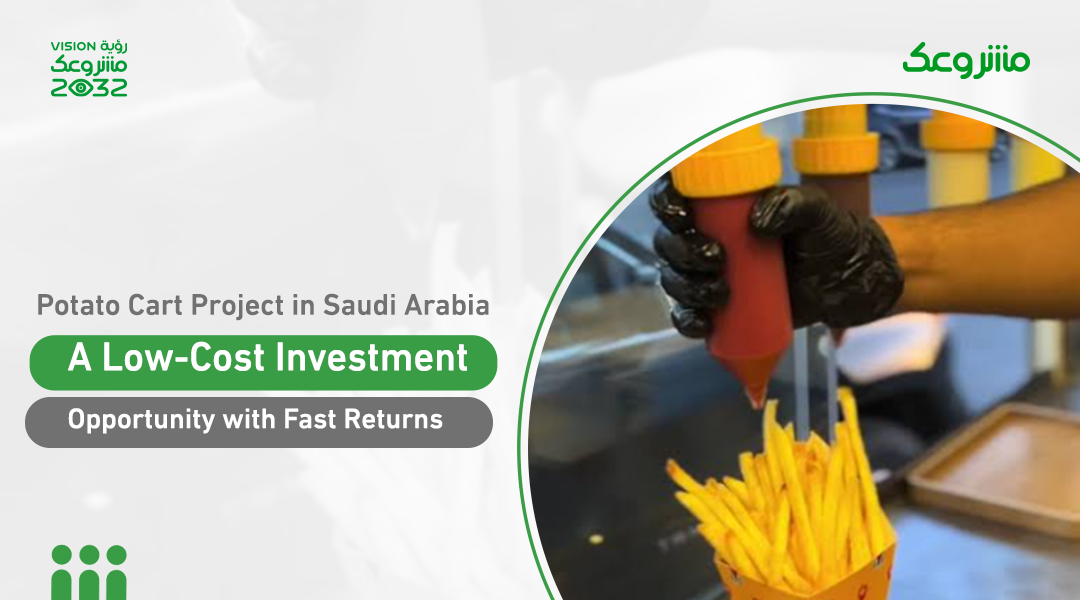
The Potato Cart Project is considered one of the small businesses that has gained widespread popularity due to its low cost, ease of operation, and continuous demand for its products among various customer segments. With the increasing demand for fast food, this project has become a suitable investment opportunity for those looking to start a business with reasonable capital and achieve profitable returns.
However, the success of the project does not depend solely on owning a cart; it also requires proper planning, selecting the right location, providing the necessary equipment, and maintaining quality and hygiene standards.
In this context, we will explore everything you need to know about the Potato Cart Project, starting from its concept and requirements, through costs and success factors, and reaching the importance of preparing a professional feasibility study that helps you launch a successful and sustainable project with confidence.
A Potato Cart Project is a small business that relies on preparing and selling fried and baked potatoes with a variety of toppings and sauces through a mobile cart or kiosk located in high-traffic areas such as markets, parks, universities, and commercial districts.
The project is characterized by its low startup costs, ease of operation, and high demand for its products, making it a suitable business opportunity for beginners and those seeking to generate good income with limited capital.
Read Here: Food Truck Project – A Profitable Investment Opportunity in the Food Industry
Yes, a Potato Cart Project is considered one of the promising food business opportunities, supported by the continuous growth of the mobile food truck market and the increasing demand for affordable fast-food options.
According to recent market research, the global mobile food truck market reached approximately USD 4.41 billion in 2025 and is expected to grow from USD 4.71 billion in 2026 to around USD 6.46 billion by 2031, achieving a compound annual growth rate (CAGR) of 6.52%.
This growth reflects the rising demand for this business model, making investment in a Potato Cart Project a promising opportunity to achieve profitable returns, especially when selecting a strategic location, offering high-quality products, and implementing an effective operational and marketing plan.
Read Here: 20 Small Business Ideas That Can Generate Huge Profits in 2026
The Potato Cart Project offers several advantages that make it an attractive investment option, including the following:
Read Here: The Best Successful Food Business Project in the Arab Gulf Countries
Please read here: Mobile Food Truck Project: Costs, Steps, and Key Success Factors
The Potato Cart Project requires providing a set of essential equipment and preparations to ensure efficient operation of the project, including the following:
Read here: How to Start Investing in Successful Small Saudi Projects
The cost of a Potato Cart Project depends on several basic factors, including the following:
The success of a Potato Cart Project depends on a set of factors that contribute to attracting customers and achieving sustainable profits, including the following:
Read here: How to Achieve Financial Success by Investing in Successful Small Projects
Choosing the right location is one of the most important factors for the success of a Potato Cart Project. The best location can be selected by considering the following:
Please read here: Projects with a Future in Arab Countries: Key Investment Opportunities
The Potato Cart Project is not limited to offering only French fries; products can be diversified to increase sales and attract a wider range of customers. Some of the most popular products that can be sold include the following:
A Potato Cart Project may face several challenges during operation; however, handling them properly contributes to achieving stability and growth. The most notable challenges include the following:
Potato carts and stores are widespread in many areas, increasing the level of competition. This challenge can be overcome by offering high-quality products, innovating with flavors and toppings, and providing fast service and a unique customer experience.
Choosing an Unsuitable Location
Selecting a low-traffic location may lead to fewer customers and lower sales. To avoid this, the area should be carefully studied, and a strategic location should be selected near markets, universities, or parks.
Rising Raw Material Prices
Fluctuations in the prices of potatoes, oils, and toppings can affect operating costs and profit margins. This impact can be reduced by working with reliable suppliers and managing inventory efficiently to minimize waste.
Low Demand During Certain Periods
Sales may decline during some seasons or times of the day, affecting revenues. Demand can be stimulated by offering promotional deals, introducing new products, and maintaining continuous marketing through social media.
Increased Raw Material Waste
Poor storage or preparing quantities exceeding actual demand can increase costs. This can be reduced through daily sales planning, proper storage of raw materials, and continuous inventory monitoring.
Unexpected Equipment Failures
Fryer or equipment breakdowns may interrupt operations and result in lost sales. This can be avoided by conducting regular equipment maintenance and replacing damaged parts promptly.
Maintaining Product Quality
Poor-quality ingredients or failure to follow preparation standards may affect customer satisfaction. Therefore, fresh raw materials should be used, cleanliness standards should be maintained, and consistent product quality should be ensured every time.
Weak Project Marketing
Limited promotion may restrict project growth despite having quality products. This can be overcome by building a distinctive brand identity for the cart, engaging with customers through social media platforms, and offering promotions that encourage repeat purchases.
When I decided to launch a Potato Cart Project in Jeddah, I initially believed that success depended only on selecting a suitable location and offering a good product. However, I quickly realized that the success of the project required careful planning and professional management of every detail, starting from market analysis and cost estimation to organizing operations and developing an effective marketing plan.
Therefore, I sought the assistance of Mashroo3k Consulting, where the team prepared a comprehensive feasibility study covering the marketing, technical, financial, and administrative aspects. This study provided me with a clear vision of the project requirements and helped me make well-informed decisions before starting the implementation.
The company’s experts also provided me with practical consultations that contributed to selecting the appropriate equipment, organizing the operational process, and improving workflow efficiency. They also helped develop solutions to the operational challenges I faced during the initial stages, which had a direct impact on service quality and speed of delivery to customers.
The support was not limited to that; it also included preparing a marketing plan aimed at reaching customers effectively, along with developing a competitive pricing strategy and a financial plan that helped me manage expenses, monitor performance, and achieve the best utilization of available resources.
Thanks to the recommendations included in the feasibility study and the continuous consulting support provided by Mashroo3k Consulting team, the project became more organized and efficient. The quality of operational processes improved, and all decisions became based on accurate data and a clear plan, which contributed to enhancing the project’s success opportunities and ensuring sustainable growth.
Yes, the Potato Selling Project is considered a profitable business when it is properly planned and implemented, due to the continuous demand for potatoes as one of the most popular fast-food products.
The project’s profitability depends on several factors, most notably selecting a high-traffic location, offering high-quality products, setting competitive prices, focusing on customer service, and effectively managing costs and marketing activities.
Additionally, diversifying the product menu and introducing new flavors and toppings can contribute to increasing sales and achieving a sustainable return on investment.
The profit of one feddan of potatoes cannot be determined at a fixed value, as it varies from one season to another based on several factors, including feddan productivity, crop selling price, cultivation and harvesting costs, seed quality, fertilizer and pesticide prices, as well as labor and transportation expenses.
In general, one feddan of potatoes can generate a good return when cultivation is managed efficiently, the appropriate variety is selected, proper agricultural practices are followed, and the crop is marketed at the right time to achieve the best possible price.
The cost of potato cultivation depends on several factors that vary according to the cultivated land area, seed type, production input prices, and the agricultural region. The main cost components include purchasing seeds, land preparation, fertilizers, pesticides, irrigation operations, and labor costs, in addition to harvesting, transportation, and storage expenses when required. Since the prices of these factors change from one season to another, an accurate cost estimation requires considering the specific conditions of each agricultural project.
Potatoes require a balanced fertilization program that includes organic fertilizers to improve soil fertility, nitrogen fertilizers to support vegetative growth, phosphate fertilizers to encourage root development and tuber formation, and potassium fertilizers that contribute to improving potato quality, increasing tuber size, and enhancing storage ability.
For the best results, it is recommended to develop a fertilization program based on soil analysis and crop requirements, while following the agricultural guidelines suitable for the cultivated region.
Potato production can be increased by following a set of proper agricultural practices that enhance plant growth and improve crop quality. The most important practices include selecting certified and high-quality seeds, preparing the soil properly before planting, applying a balanced fertilization program that meets the plant’s requirements, providing regular irrigation without overwatering or under-irrigation, and controlling pests and diseases at early stages.
In addition, adhering to suitable planting dates and selecting varieties that match climatic conditions contribute to improving yields. Regular crop monitoring and the application of modern agricultural recommendations also help increase productivity and achieve the best returns from potato cultivation.
We conclude that the Potato Cart Project represents a distinctive investment opportunity for anyone seeking a small business that combines low costs with the potential to achieve profitable returns when properly planned and executed.
The success of the project depends on studying market needs, selecting the right location, providing high-quality products, and managing operations efficiently. To ensure a strong start and minimize potential risks, preparing a comprehensive feasibility study remains the most important step before launching the project, as it helps you make well-informed investment decisions and transform your idea into a successful business capable of growth and sustainability.

To request a feasibility study for a Potato Cart Project
The kebab restaurant project is one of the food-service ventures that combines strong demand for grilled meals with the opportunity to target a diverse customer base, including individuals, families, and lovers of traditional Middle Eastern cuisine. With growing competition in the restaurant sector, however, the project’s success is no longer determined by food taste alone. […]
Read moreA children’s toy store project is not limited to selling toys; it is built on understanding what attracts children and what families look for when choosing products that combine entertainment and educational value. With the wide variety of educational toys, skill-development games, recreational toys, and gifts available, the store has opportunities to meet the needs […]
Read moreA residential complex project is no longer simply an investment in a collection of real estate units. It has evolved into an integrated development model that combines comfortable living, diverse services, and long-term investment value. As cities expand and residents’ needs evolve, demand is growing for residential complexes that offer a comprehensive environment suited to […]
Read moreThe veterinary clinic project comes at a time when animal care is no longer limited to treating illnesses or injuries, but has expanded to include health monitoring, vaccinations, routine checkups, and care for both pets and livestock. However, many animal owners face challenges in accessing specialized veterinary services that combine prompt response, high-quality care, and […]
Read more
خصم 25% على خدمات مشروعك استفد من العرض الآن، فالفرصة متاحة لفترة محدودة فقط
سجّل بياناتك واحصل على خصم 25% الآن


