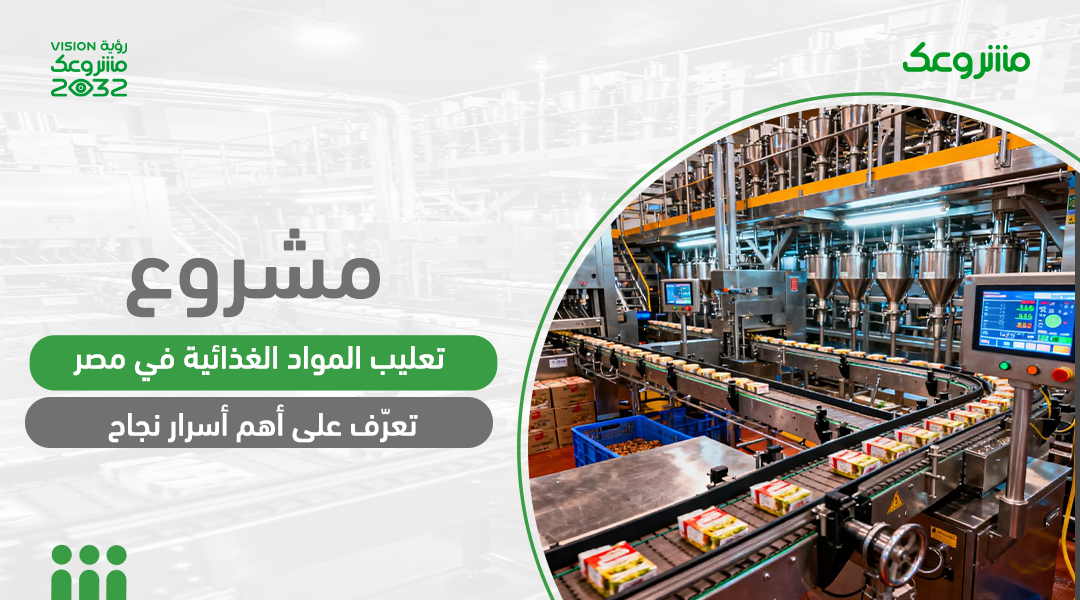
Food canning is considered one of the promising industrial projects that is receiving increasing attention, driven by the growing demand for packaged food products that offer convenience in use and storage while preserving product quality and extending shelf life. The project benefits from diverse consumer needs and a broad customer base, including individuals, restaurants, stores, and various points of sale, providing multiple opportunities for growth and expansion.
Compliance with quality and food safety standards is also a key factor in building consumer trust and strengthening competitiveness in the market. Therefore, the success of a food canning project depends on preparing an accurate feasibility study, selecting the appropriate location and equipment, sourcing high-quality raw materials, implementing efficient operating systems, and developing a suitable marketing strategy that ensures access to customers and generates attractive returns.
A food canning project is an industrial activity specialized in processing, preserving, and packaging food products in suitable containers to maintain their quality and safety, extend their shelf life, and facilitate storage, transportation, and distribution. The project may include canning a wide variety of products, such as vegetables, fruits, legumes, sauces, pickles, and other food products, depending on the type of activity and the production line used.
The canning process involves several stages, beginning with preparing and sorting the raw materials, followed by cleaning, processing, and preparation. The products are then filled into containers and securely sealed, followed by inspection and quality control procedures to ensure compliance with quality and food safety standards. The project aims to meet the needs of consumers and various markets by providing safe, high-quality food products that are easy to handle and distribute.
Sugar Packaging Project in Egypt: Your Path to a Successful Production Project in the Food Industry
Yes, a food canning project represents a strategic investment opportunity with proven economic viability, driven by the accelerating global shift toward modern lifestyles, the pressing need to strengthen food security, and the growing demand for convenient food products with extended shelf lives.
The strength and vitality of this sector are reflected in reliable market indicators. The global canned food market increased from USD 135.41 billion in 2025 to USD 142.26 billion in 2026. Studies expect this upward momentum to continue, with the total market projected to reach USD 211.15 billion by 2034, registering a compound annual growth rate (CAGR) of 5.06% during the forecast period (2026–2034).
Food Packaging Project: Your Gateway to a Stable Consumer Market and Sustainable Returns
Many investors choose to invest in food canning projects due to the various investment advantages they offer, most notably the following:
A market study is one of the most important stages in preparing a feasibility study for a food canning project, as it helps determine market demand, customer characteristics, and the products most in demand, in addition to identifying competitors and prevailing price levels. The study focuses on a number of key elements:
Market Study for a Project: The Foundation for Investment Planning and Selecting the Most Profitable Opportunities
Food Oil Packaging Project in Egypt: A Detailed Guide to Starting a Successful Investment
The costs of a food canning project vary depending on the project size, type of products, targeted production capacity, and the required level of equipment and facilities. The main cost items include:
Fluctuations in raw material prices may affect production costs and profit margins. This can be addressed by contracting with multiple suppliers and entering into long-term purchasing agreements to secure more stable prices.
The project faces competition from both local and international brands. This can be addressed by offering high-quality products, attractive packaging, and competitive prices, while focusing on building a strong brand.
Failure to comply with health and safety requirements may result in product rejection or loss of customer trust. This can be overcome by implementing strict quality control systems and complying with applicable standards and specifications.
Operating costs include energy, labor, maintenance, and packaging materials. These costs can be reduced by improving operational efficiency, using energy-efficient equipment, and managing resources effectively.
Weak distribution may limit product reach and sales growth. This can be overcome by building a strong network of distributors, partnering with retail chains, and leveraging e-commerce sales channels.
Improper storage or transportation may lead to reduced product quality and increased waste. This can be minimized by providing suitable storage facilities, maintaining proper storage conditions, and using appropriately equipped transportation.
Sales of certain products may decline as customer preferences change. This can be addressed through regular market studies, product development, and the introduction of new products that meet evolving market needs.
The licensing process may take time or require compliance with multiple requirements. This can be addressed by adhering to regulations from the outset and seeking assistance from specialized entities to ensure that all legal and regulatory requirements are properly fulfilled.
When I decided to invest in a food canning project, I was aware that the sector was experiencing growing demand due to the continuous demand for packaged food products. However, the implementation phase revealed several challenges that were difficult to overcome without professional planning. I faced difficulties in determining the appropriate investment size, selecting suitable production lines and equipment, accurately estimating operating costs, developing an effective marketing plan, and determining the production capacity that matched market needs.
Therefore, I sought the assistance of Mashroo3k Consulting, which prepared a comprehensive feasibility study covering the marketing, technical, financial, and administrative aspects of the project. The company provided an accurate analysis of the market and competitors, helped me select the appropriate equipment, organized the operational stages, and developed an integrated system for quality and production management. This enabled me to overcome the technical issues that were hindering the project’s operations and affecting its efficiency.
The company also supported me in preparing the financing file and fulfilling the requirements necessary to obtain financing from the Micro, Small and Medium Enterprise Development Agency (MSMEDA). This provided the liquidity needed to complete the project’s preparations and commence operations according to a well-planned strategy.
Thanks to this specialized support, the project began operating more efficiently, its production capacity increased, product quality improved, its customer base expanded, and it became more competitive in the food canning market.
The cost of a food packaging project varies depending on the project size, production capacity, type of targeted products, and level of equipment used. The cost typically includes preparing the project premises, purchasing packaging lines and equipment, providing raw materials and packaging materials, obtaining the necessary licenses, as well as labor, operating, and marketing costs.
A food products project is a commercial or industrial activity aimed at producing, packaging, processing, distributing, and selling food products to meet consumer needs, whether the products are fresh, processed, or canned. The project encompasses a wide range of activities, including food manufacturing, canning, packaging, and preservation, while complying with quality and food safety standards to ensure that safe, high-quality products reach the market.
Yes, food products projects are considered among the most successful and stable types of businesses due to their connection to consumers’ daily needs and the continuous demand for food products across various markets. These projects also offer a diverse range of products that can be provided and allow businesses to target multiple customer segments, in addition to opportunities for expansion in local and export markets when quality standards are properly maintained.
Egypt’s food industry encompasses a wide range of activities that meet local market needs and support exports. Some of the most prominent include the dairy and dairy products industry, vegetable oil production, sugar manufacturing, bakery and confectionery production, fruit and vegetable canning, juice and beverage manufacturing, pasta production, meat, poultry, and fish processing, as well as the production of jams, sauces, and pickles, in addition to food packaging and processing.
A food canning project represents an investment opportunity that combines stable demand with the potential for sustainable growth when professionally planned. The success of the project depends on accurately studying the market, selecting the right products, complying with quality and food safety standards, and developing an effective operational and marketing plan.
If you are looking to minimize risks and make investment decisions based on accurate data, preparing a comprehensive feasibility study is the first step toward establishing a competitive project capable of achieving attractive returns.

Contact Us to request a feasibility study for a food canning project
The kebab restaurant project is one of the food-service ventures that combines strong demand for grilled meals with the opportunity to target a diverse customer base, including individuals, families, and lovers of traditional Middle Eastern cuisine. With growing competition in the restaurant sector, however, the project’s success is no longer determined by food taste alone. […]
Read moreA children’s toy store project is not limited to selling toys; it is built on understanding what attracts children and what families look for when choosing products that combine entertainment and educational value. With the wide variety of educational toys, skill-development games, recreational toys, and gifts available, the store has opportunities to meet the needs […]
Read moreA residential complex project is no longer simply an investment in a collection of real estate units. It has evolved into an integrated development model that combines comfortable living, diverse services, and long-term investment value. As cities expand and residents’ needs evolve, demand is growing for residential complexes that offer a comprehensive environment suited to […]
Read moreThe veterinary clinic project comes at a time when animal care is no longer limited to treating illnesses or injuries, but has expanded to include health monitoring, vaccinations, routine checkups, and care for both pets and livestock. However, many animal owners face challenges in accessing specialized veterinary services that combine prompt response, high-quality care, and […]
Read more
خصم 25% على خدمات مشروعك استفد من العرض الآن، فالفرصة متاحة لفترة محدودة فقط
سجّل بياناتك واحصل على خصم 25% الآن


