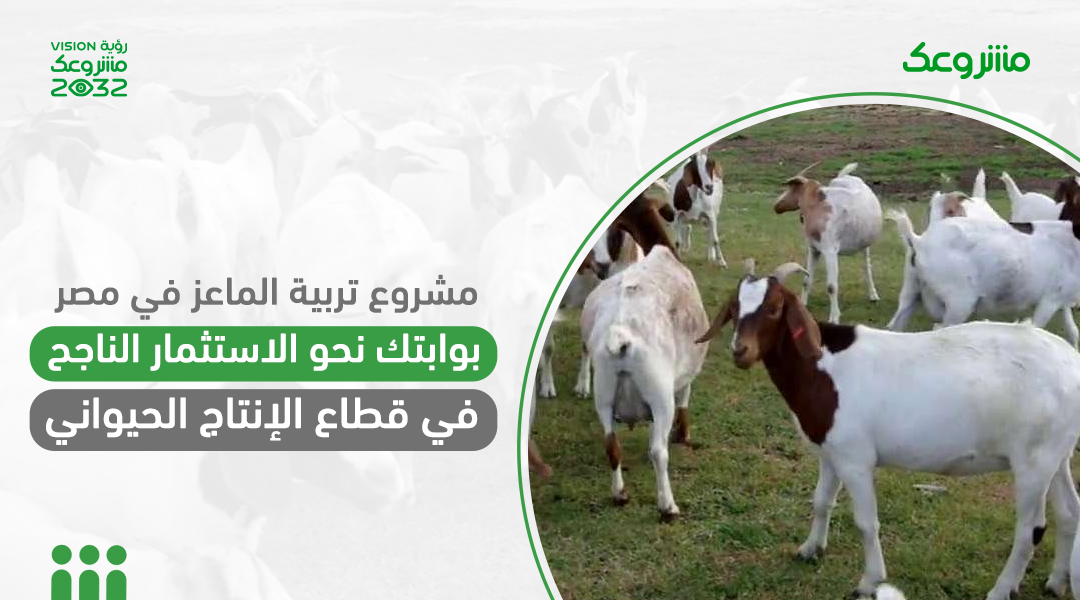
The goat farming project is considered one of the most prominent agricultural and livestock projects that has maintained its investment appeal over the years, thanks to its operational flexibility and multiple sources of returns. Goats are animals that can easily adapt to various environmental conditions, and their relatively low breeding costs compared to many other livestock projects make them a suitable option for small-scale investors and those seeking to enter the agricultural sector.
With the growing demand for goat products, including meat, milk, and dairy products, along with increasing awareness of their nutritional value, this industry has promising opportunities for growth and profitability. The success of the project does not depend solely on providing goats, but rather on sound planning, selecting suitable breeds, and providing proper healthcare and balanced nutrition.
In this article, we explore everything you need to know about the goat farming project, starting with the concept and establishment requirements and extending to the key success factors and ways to achieve the best investment returns.
The goat farming project is a livestock production activity aimed at generating economic value from goats through the effective management of breeding, reproduction, and production cycles to maximize the utilization of available resources. The project relies on raising selected breeds according to the intended purpose, whether for meat or dairy production or for expanding the sale of goats and offspring. It also requires the application of modern feeding, housing, and veterinary care practices to increase production rates and improve herd efficiency, making it a project capable of generating stable returns with strong growth potential as the business expands.
Read here: Discover the top 7 profitable agricultural projects.
Yes, the goat farming project is considered one of the livestock ventures with high economic feasibility, as confirmed by global indicators showing continued growth in goat product markets. In the meat sector, the global goat meat market was valued at approximately USD 248.05 billion in 2025, with expectations that it will increase to around USD 254.99 billion by the end of 2026 and continue growing to reach nearly USD 317.2 billion by 2035, achieving an estimated compound annual growth rate (CAGR) of approximately 2.8% during the period from 2025 to 2035.
As for the goat milk products market, it was valued at approximately USD 12.98 billion in 2023 and is expected to continue growing at an accelerated pace, reaching around USD 17.95 billion by 2030, with a compound annual growth rate (CAGR) of 4.7% during the forecast period. These figures reflect the growing demand for various goat products, including meat, milk, and dairy products, enhancing the project’s investment appeal and making it a promising opportunity capable of generating stable and sustainable returns over the long term.
Investing in a goat farming project offers several advantages that make it one of the promising ventures in the livestock sector, most notably:
Read Here: Why Is Investing in a Butcher Shop Considered a Profitable Investment Opportunity?
The startup cost of a goat farming project varies depending on several key factors, including the project size, the number of goats to be purchased initially, the selected breed, the level of facilities and equipment required, and the farm’s location. The main cost components can be outlined as follows:
Learn how to implement a profitable sheep farming project in 2026
| Challenges | How to Overcome Them |
|---|---|
| Disease outbreaks within the herd | Adhere to a regular vaccination program and ensure continuous veterinary monitoring. |
| High feed costs | Rely on diverse feed sources, minimize waste, and improve feeding management. |
| Lack of breeding experience | Provide continuous training or seek the assistance of goat farming experts. |
| Low production quality (meat or dairy) | Select high-quality breeds and improve feeding and care practices. |
| Difficulty marketing and selling products | Develop an early marketing plan and establish contracts with traders and reliable sales outlets. |
| Market price fluctuations | Diversify income sources by selling offspring, dairy products, and meat. |
| Environmental and housing issues | Prepare suitable barns with proper ventilation and hygiene. |
| Limited liquidity at the beginning of the project | Start with a limited number of goats and expand gradually based on profits. |
| Element | Details |
|---|---|
| Strengths | High demand for goat meat and dairy products. Diverse income sources (meat, milk, offspring, and hides). Lower breeding costs compared to some other livestock. Goats’ ability to adapt to different climatic conditions. Relatively fast production cycle and continuous herd growth. |
| Weaknesses | Requires expertise in breeding and healthcare. Risk of disease outbreaks in the absence of veterinary monitoring. Fluctuating feed prices and their impact on costs. Requires careful management to ensure productivity. |
| Opportunities | Growing demand for natural and healthy products. Potential to expand into dairy processing and related products. Export opportunities to international markets. Government support for agricultural and livestock projects in some countries. Potential to develop the project into a large-scale commercial farm. |
| Threats | Competition from other livestock projects. Rising feed and operating costs. Risks of animal diseases and epidemics. Market changes and fluctuations in demand and prices. |
My experience with the goat farming project in Cairo began after deciding to enter one of the livestock sector projects with the aim of investing capital in an organized and scalable manner. At the beginning of implementation, I faced several challenges, most notably the difficulty of developing an accurate project plan in terms of selecting suitable breeds, determining the scale of operations, and establishing the management approach, in addition to the financing challenge, which represented a major obstacle to getting started.
During this stage, I sought the support of experts at Mashroo3k Consulting, where the team prepared a comprehensive feasibility study covering the marketing, technical, financial, and administrative aspects. This helped me gain a clearer understanding of the project and make more accurate and realistic decisions.
The company also helped overcome the financing challenge by providing structured solutions and connecting the project with suitable financing entities, such as the Micro, Small and Medium Enterprises Development Agency. This contributed to securing the financing required to begin implementation.
As a result, the project became more stable and operationally ready, with a clear operating plan and a greater ability to achieve sustainable production based on well-studied foundations.
The best goat breed for farming depends on the project’s objective. For dairy production, Saanen and Damascus goats are suitable due to their high milk yield and quality, while Boer goats are considered among the best breeds for meat production due to their rapid growth and high-quality meat. Local goats are suitable for small-scale projects due to their high adaptability and low breeding costs, while Nubian goats are known for their ability to tolerate heat while providing good milk production, making them a balanced option that combines several advantages.
Goats typically give birth once or twice a year, depending on the breed, breeding conditions, and quality of nutrition and healthcare. The gestation period lasts approximately five months, followed by a short recovery period before the next breeding cycle. Under ideal conditions, the interval between births can be approximately 6–7 months, making it possible to achieve two births per year, particularly with good breeds, balanced nutrition, and proper farm management.
The daily feed intake of goats varies depending on age, size, and production purpose (meat or milk). Adult goats generally require the equivalent of 3–4% of their body weight per day in dry matter, which is approximately 2–4 kilograms of feed depending on the type, whether green feed such as alfalfa and grasses or concentrated feed and nutritional supplements. Young goats require smaller quantities according to their body weight. Clean water must also be available at all times to ensure good health, normal growth, and improved productivity.
The price of local goats in Egypt today varies depending on weight, age, location, and market conditions. However, the average price ranges from approximately EGP 5,000 to EGP 12,000 per head. Prices may increase during seasons such as holidays or for larger goats or those with higher productivity.
The required space for raising goats depends on the number of goats and the breeding system used, whether open or semi-intensive. As a general guideline, each goat requires approximately 1.5–2 square meters inside the barn as a minimum, in addition to an outdoor area for movement that may range from 3–5 square meters or more per goat, depending on the breeding system. The more spacious the area and the better the ventilation and hygiene, the more positively this will affect herd health and productivity.
Goats begin production upon reaching sexual maturity, which typically occurs between 6 and 10 months of age, depending on the breed, nutrition, and care. However, from an economic and health perspective, it is preferable to avoid early breeding and wait until the female reaches 12–18 months of age and attains an appropriate body weight, generally equivalent to 60–70% of her mature adult weight. This ensures that she is capable of pregnancy and productive performance without negatively affecting her growth or health. After the first kidding, the female begins producing milk and enters a regular production cycle that can continue for several years with proper care.
The goat farming project can be considered one of the promising investment ventures in the livestock sector, as it combines relatively reasonable startup costs compared to other livestock projects with a recurring source of income generated with each production cycle, whether from meat, milk, or even hides and wool in some breeds.
The success of this project does not depend solely on providing capital, but is closely linked to selecting suitable breeds, properly managing feeding and healthcare, and providing an appropriate breeding environment in terms of space and ventilation. With an accurate feasibility study and sound planning from the outset, any investor can transform a limited number of goats into a productive and stable herd that provides a steady source of income with the potential for expansion over time.
If you are looking for a project that combines well-planned costs with attractive returns in the agricultural and livestock sector, a goat farming project may be the right step to begin your investment journey.

For inquiries and to request a feasibility study for a goat farming project
The kebab restaurant project is one of the food-service ventures that combines strong demand for grilled meals with the opportunity to target a diverse customer base, including individuals, families, and lovers of traditional Middle Eastern cuisine. With growing competition in the restaurant sector, however, the project’s success is no longer determined by food taste alone. […]
Read moreA children’s toy store project is not limited to selling toys; it is built on understanding what attracts children and what families look for when choosing products that combine entertainment and educational value. With the wide variety of educational toys, skill-development games, recreational toys, and gifts available, the store has opportunities to meet the needs […]
Read moreA residential complex project is no longer simply an investment in a collection of real estate units. It has evolved into an integrated development model that combines comfortable living, diverse services, and long-term investment value. As cities expand and residents’ needs evolve, demand is growing for residential complexes that offer a comprehensive environment suited to […]
Read moreThe veterinary clinic project comes at a time when animal care is no longer limited to treating illnesses or injuries, but has expanded to include health monitoring, vaccinations, routine checkups, and care for both pets and livestock. However, many animal owners face challenges in accessing specialized veterinary services that combine prompt response, high-quality care, and […]
Read more
خصم 25% على خدمات مشروعك استفد من العرض الآن، فالفرصة متاحة لفترة محدودة فقط
سجّل بياناتك واحصل على خصم 25% الآن


