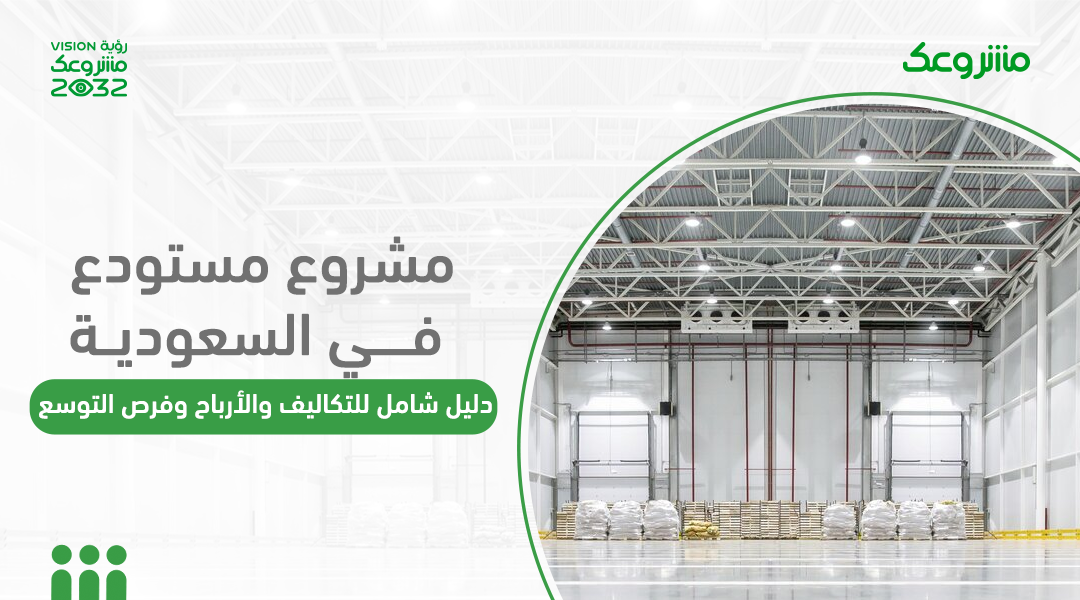
Warehouse Project in Saudi Arabia: A Comprehensive Guide to Costs, Profits, and Expansion Opportunities. - Mashroo3k
Published06 Jul 2026 0 comments 109 Observation
Warehouse Project in Saudi Arabia: A Comprehensive Guide to Costs, Profits, and Expansion Opportunities.

A warehouse project is considered one of the promising investment opportunities witnessing increasing demand amid the continuous growth of commercial and industrial activities and the significant expansion of the e-commerce sector. As companies’ need for safe and efficient storage solutions to manage inventory and supply chains continues to grow, warehouses have become an essential element in the success of many businesses and the continuity of their operations. This project offers the potential to achieve attractive returns when properly planned, starting with selecting the right location and equipping the warehouse with the necessary equipment, through to implementing the best management and operational practices. In this context, we explore everything you need to know about a warehouse project, from its importance, advantages, and establishment requirements to the expected costs and success factors that can help you build a strong and sustainable investment project.

What Is a Warehouse Project?

A warehouse project is a logistics project that aims to provide safe and organized spaces for storing goods, products, and raw materials, ensuring their quality is maintained and facilitating their management until they are distributed or sold. The project serves many sectors, such as trade, industry, import and export, e-commerce, and distribution companies, by providing storage, inventory management, receiving and delivery, order preparation, and shipping services. The success of the project depends on selecting a strategic location close to transportation networks and target markets, equipping the warehouse with modern storage and handling systems, and implementing effective inventory management systems that enhance operational efficiency and reduce waste.

Read Here: Best Projects in Saudi Arabia: Your Guide to Investment Opportunities Aligned with Vision 2030.

Is a Warehouse Project Profitable?

Global market indicators suggest that a warehouse project is considered one of the promising investment opportunities, driven by the continuous growth of the logistics services sector and the increasing demand for modern storage services. It reached… Warehouse and Storage Market Size approximately USD 713.06 billion globally in 2025, and is expected to rise to USD 765.23 billion in 2026, achieving a compound annual growth rate (CAGR) of 7.3%. Forecasts also indicate that this growth will continue, with the market expected to reach USD 1,037.33 billion by 2030, at a CAGR of 7.9%. This reflects the expanding investment opportunities in the sector and confirms that investing in a warehouse project can generate attractive returns when the right location is selected, advanced operational infrastructure is provided, and storage operations are managed efficiently.

Read here: The Best Investment Opportunities for Building a Successful Business.

The Importance of a Warehouse Project in the Saudi Market

The importance of a warehouse project in the Saudi market is significant and continuously growing, given the vital role it plays in supporting the commercial and industrial sectors and meeting the increasing storage needs. The key aspects of this importance can be outlined as follows:

  • Supporting the growth of the logistics services sector in line with the objectives of Saudi Vision 2030.
  • Meeting the growing demand for storage services across various economic sectors.
  • Supporting the expansion of e-commerce and improving the efficiency of storage and distribution operations.
  • Improving inventory management and reducing waste and operating costs.
  • Accelerating supply and distribution operations and enhancing supply chain efficiency.
  • Providing secure storage solutions that meet the needs of companies and factories.
  • Supporting import and export activities through advanced storage services.
  • Capitalizing on the continuous growth of logistics and industrial zones in the Kingdom.
  • Enhancing companies’ competitiveness by improving operational efficiency.
  • Diversifying revenue sources by offering multiple storage and logistics services.
  • Keeping pace with the expansion of government and private investments in the transportation and logistics services sector.
  • Achieving stable investment returns due to the growing demand for modern warehouses.

Read Here: Freight Transportation Project: A Promising Investment Opportunity in the Saudi Logistics Services Sector.

Key Advantages That Make a Warehouse Project a Successful Investment

  • High demand for storage services with the expansion of commercial and industrial activities.
  • A diverse target customer base, including companies, factories, wholesalers, and retailers.
  • Stable revenues from long- and short-term storage contracts.
  • The possibility of expanding by adding logistics services that generate additional revenue streams.
  • Lower asset damage rates when effective management and maintenance systems are implemented.
  • Supporting the growth of e-commerce and increasing the need for storage and distribution centers.
  • Operational flexibility to meet the needs of various economic sectors.
  • The possibility of leveraging modern technologies to improve warehouse management efficiency.
  • Higher occupancy opportunities in locations near ports and industrial areas.
  • Contributing to improving supply chain efficiency and accelerating distribution operations.
  • The project’s potential for geographic expansion as business volume and demand grow.
  • Alignment with the logistics sector development objectives in the Kingdom of Saudi Arabia.

Read Here:How to Find the Best Investment in Saudi Arabia? A Smart Investor’s Guide to Promising Opportunities.

Investment and Operating Costs of a Warehouse Project

The investment and operating costs of a warehouse project vary depending on the size of the project, its location, and the nature of its services. They can be outlined as follows:

Investment Costs

  • Purchasing or leasing the land designated for the warehouse.
  • Constructing the building or preparing the warehouse according to the required specifications.
  • Installing storage systems such as shelving and pallets.
  • Purchasing logistics equipment such as forklifts and carts.
  • Installing security, safety, and surveillance systems.
  • Licensing and legal permit costs.
  • Inventory management systems and operational technologies.

Operating Costs

  • Employee and administrative staff salaries.
  • Electricity, water, and telecommunications bills.
  • Regular maintenance of the building and equipment.
  • Insurance for the warehouse and its contents.
  • Transportation and distribution costs if logistics services are provided.
  • Daily operating and administrative expenses.

How to Choose the Right Location for a Warehouse Project?

Choosing the right location for a warehouse project is one of the most important success factors, as it directly affects operational efficiency, cost reduction, and the speed of goods distribution. The ideal location can be determined through a set of key criteria that should be carefully considered, including the following:

  • Proximity to major roads and transportation networks to facilitate shipping and distribution operations.
  • Choosing a location near industrial or commercial areas with high demand for storage services.
  • Availability of sufficient space to allow for future expansion of the project.
  • Easy access to the site for trucks, suppliers, and customers.
  • Ensuring good infrastructure, including electricity, water, and telecommunications.
  • Choosing an area suitable for the nature of the stored goods in terms of security and environmental conditions.
  • Evaluating the cost of renting or purchasing the land compared to the expected return on the project.
  • Compliance with the regulatory and municipal requirements for warehouses in the target area.

Warehouse Project Market Study

Conducting a market study for a warehouse project is an essential step to understanding the demand for storage services and identifying opportunities for success in this sector, especially with the growing commercial activities and e-commerce. This study is based on analyzing several key aspects that help investors make an informed decision before starting the project, including the following:

  • Analyzing market size and studying the growth rates of the storage and logistics services sector.
  • Identifying target customers such as e-commerce companies, factories, importers, and distributors.
  • Analyzing customer needs in terms of space, storage duration, and additional services.
  • Studying competitors and evaluating their strengths, weaknesses, pricing levels, and services offered.
  • Analyzing supply and demand to identify investment gaps and available opportunities.
  • Selecting a suitable location near major roads, ports, industrial areas, and markets.
  • Determining appropriate pricing for storage services to achieve competitiveness and profitability.
  • Analyzing future trends such as the growth of e-commerce and increasing demand for modern warehouses.
  • Studying regulatory factors and requirements related to establishing and operating warehouses.
  • Preparing sales forecasts and estimating occupancy rates and expected revenues during the first years.

Equipment and Facilities Required for a Warehouse Project

The success of a warehouse project largely depends on providing the appropriate equipment and facilities that ensure efficient storage, ease of operation, and the safety of goods. The most important of these facilities and equipment include the following:

  • Shelving systems to organize goods and efficiently utilize vertical space.
  • Material handling equipment such as forklifts and hand carts for moving and handling goods the warehouse.
  • Suitable and load-bearing flooring to ensure safe movement داخل the warehouse and support heavy equipment.
  • Proper lighting systems to facilitate sorting and storage operations and reduce errors.
  • Ventilation and cooling systems, especially when storing materials that require specific environmental conditions.
  • Security and safety systems such as surveillance cameras, alarm devices, and fire protection systems.
  • Inventory management systems to accurately track goods and organize inbound and outbound operations.
  • Packaging and packing equipment such as packaging materials, numbering machines, and barcode machines.

Steps to Establish a Warehouse Project in Saudi Arabia

Establishing a successful warehouse project requires following a set of organized steps that ensure the project is launched professionally and minimize operational and financial risks. The most important steps include the following:

  • Conducting a comprehensive feasibility study to determine the project’s financial, technical, and market feasibility.
  • Studying the target market to understand demand volume, competitors, and target segments in the area.
  • Selecting a suitable location near major roads and industrial or commercial areas.
  • Equipping the warehouse by establishing the infrastructure and providing the necessary shelving systems and equipment.
  • Obtaining the required licenses by completing the legal procedures and permits needed to operate the warehouse.
  • Hiring suitable personnel such as warehouse supervisors, workers, and administrative staff.
  • Implementing inventory management systems to ensure organized goods storage and accurate tracking.
  • Developing a clear operational plan covering the processes of receiving, storing, and distributing goods.
  • Marketing the warehouse services to attract customers from companies, stores, and factories.

Challenges Facing a Warehouse Project and How to Overcome Them

Challenges
How to Overcome Them with Mashroo3k Company
Choosing an unsuitable location
Mashroo3k Company helps analyze locations and select the most suitable one based on an accurate market study.
High investment costs
Preparing a detailed feasibility study to accurately determine costs and develop a suitable financing plan.
Weak inventory management
Designing professional warehouse operating and inventory management systems.
Lack of trained workforce
Developing an organizational structure and identifying the appropriate workforce requirements and costs.
Weak technological infrastructure
Implementing modern Warehouse Management Systems (WMS).
High competition
Market and competitor analysis and developing a competitive pricing strategy.
Licensing and procedural issues
Providing regulatory consulting to facilitate obtaining licenses correctly and quickly.
Weak marketing planning
Preparing a marketing plan targeting companies and stores in need of logistics services.

Success Factors for a Warehouse Project

  • Relying on modern inventory management systems to ensure accurate tracking of goods and organized operations.
  • Providing high-quality operating equipment and facilities that facilitate storage and transportation operations.
  • Properly training employees to improve performance efficiency and reduce operational errors.
  • Implementing safety and security standards داخل the warehouse to protect goods and workers.
  • Organizing receiving and delivery operations professionally and efficiently to meet customer needs.
  • Maintaining a high level of cleanliness and organization inside the warehouse to improve operational efficiency.
  • Diversifying the services provided, such as storage, packaging, and inventory management, to increase revenue sources.
  • Focusing on customer service and building long-term relationships with companies and clients.
  • Using modern technological solutions such as barcodes and smart tracking systems.
  • Implement clear operating policies that reduce waste and increase resource efficiency.

How Can I Increase the Profitability of a Warehouse Project?

The profitability of a warehouse project can be increased by improving operational efficiency, expanding revenue sources, and enhancing the quality of services provided through a range of effective strategies, the most important of which are as follows:

  • Increase warehouse occupancy rates by targeting diverse sectors and reducing periods of vacant space.
  • Diversify storage services by providing dry, refrigerated, and frozen storage according to customer needs.
  • Offer value-added services such as packing, packaging, sorting, labeling, and inventory management.
  • Target e-commerce companies that require fast storage and order fulfillment solutions.
  • Sign long-term contracts with companies and factories to ensure stable cash flows
  • Invest in Warehouse Management Systems (WMS) to improve operational efficiency and reduce errors and costs.
  • Optimize space utilization by using high-rise shelving and modern storage technologies.
  • Provide transportation and distribution services in cooperation with shipping companies or through an in-house fleet.
  • Adopt a flexible pricing policy that aligns with storage volume, contract duration, and additional services.
  • Build strategic partnerships with suppliers and logistics service providers to increase customer flow.
  • Focus on service quality and responsiveness to retain existing customers and increase referral rates.
  • Implement digital marketing campaigns targeting companies and investors seeking reliable storage solutions.
  • Monitor operational performance indicators such as occupancy rate, storage costs, and inventory turnover to continuouslyimprove profitability.
  • Reduce energy consumption and operating costs by using energy-efficient lighting solutions and smart operating systems.
  • Expand into integrated logistics services such as returns management and order fulfillment to increase revenue streams.

SWOT Analysis for a Warehouse Project

Strengths

  • High demand for storage services with the growth of e-commerce.
  • The possibility of generating recurring revenues from long-term contracts.
  • A variety of services that can be offered alongside storage.
  • Reduced product damage rates when effective management systems are implemented.
  • Scalability through the addition of new spaces or services.
  • Support for the logistics sector as part of the objectives of Saudi Vision 2030.
  • The ability to serve multiple sectors through a single warehouse.
  • Reliance on technology systems that enhance operational efficiency.

(Weaknesses)

  • High costs of constructing and equipping warehouses.
  • The need for adequate working capital during the initial stages.
  • High maintenance, operating, and energy costs.
  • Dependence on high occupancy rates to achieve profitability.
  • The need for qualified personnel to manage inventory and operations.
  • Exposure of profits to fluctuations during periods of seasonal demand decline.
  • The ongoing need to upgrade systems and equipment.
  • High insurance costs for buildings and inventory.

(Opportunities)

  • Continuous expansion of e-commerce and logistics services.
  • Increased investments in industrial and economic zones
  • Growing demand for refrigerated and frozen storage services.
  • The possibility of forming partnerships with shipping and distribution companies.
  • Expansion into order fulfillment and inventory management services.
  • Leveraging smart technologies and automation.
  • Increased demand for modern, highly efficient warehouses.
  • The possibility of geographic expansion into new cities and regions.

(Threats)

  • Increased competition among storage service providers.
  • Fluctuations in economic conditions and their impact on demand.
  • Rising land, rental, and energy prices.
  • Changes in regulations and regulatory requirements.
  • Risks of fires or natural disasters if safety measures are not in place.
  • Competitors developing storage technologies at a faster pace.
  • Price reductions due to intense competition.
  • Disruptions in global supply chains and their impact on storage demand.

My Experience with a Warehouse Project

My experience with a warehouse project in the Kingdom of Saudi Arabia began after noticing the rapidly growing demand for storage services and recognizing the scale of investment opportunities offered by the logistics sector. Despite my confidence in the project’s feasibility, I initially faced several challenges, the most significant of which were preparing an accurate implementation plan, realistically determining the investment and operating costs, in addition to the difficulty of securing the financing required to start the project. To overcome these challenges, I sought the assistance ofMashroo3k Consulting Companywhich undertook the preparation of a comprehensive feasibility study covering the marketing, technical, financial, and administrative aspects, and provided a clear overview of market demand, available opportunities, and optimal operating mechanisms, giving me the confidence to make the investment decision based on well-studied foundations. The company’s team also helped me develop an integrated financing plan that aligned with the requirements of financing institutions, which facilitated the procedures for obtaining suitable financing from Social Development BankThanks to these steps, the project was launched according to a clear and well-organized plan, with more efficient resource management and an accurate understanding of the expected costs and returns, which enhanced the project’s chances of success and achieving its objectives from the early stages.

Read here: How do SME financing programs drive the economic transformation journey in the Kingdom?

Frequently Asked Questions About a Warehouse Project

How Does a Warehouse Project Work?

The warehouse project operates by receiving goods from suppliers or companies and then storing them in an organized and secure manner inside the warehouse according to a classification system that facilitates access to them when needed. After that, inventory movement is recorded through modern management systems that accurately track inbound and outbound operations. When customer orders are received, they are prepared through sorting and packaging, then shipped and distributed using the appropriate means of transportation, ensuring efficient management of goods and fast order fulfillment within an organized supply chain.The Difference Between a Warehouse and a Storage Facility?

Item

Warehouse
Storage Facility

Definition

A simple place for storing goods for a short or medium period
A larger and more organized facility for storing and managing goods

Size
Usually a smaller space
A larger space that may consist of several sectionsPurpose
Storing goods and making them available when neededProfessionally managing inventory within the supply chain
Equipment
Relatively simple equipmentAdvanced systems such as high-bay racking and inventory management systems
Technologies UsedOften without advanced digital systemsRelies on Warehouse Management Systems (WMS) and tracking systems
Workforce


A limited number of workers
A specialized team covering management, operations, and logistics
Usage

Internal use by companies or small stores
Serves multiple companies and organizations on a commercial basis

Level of Organization
Basic organization
Highly structured and precise organization according to logistics standards

What Are the Types of Warehouses?

Warehouses vary according to the nature of the activity and the products being stored. They include general warehouses that provide storage services to different customers, private warehouses operated by companies, refrigerated and frozen warehouses for storing temperature-sensitive products, as well as distribution warehouses, e-commerce warehouses, bonded warehouses, industrial warehouses, and smart warehouses that rely on automated systems to improve inventory management efficiency and accelerate operational processes.

What Are the Responsibilities of a Warehouse Worker?

A warehouse worker is responsible for receiving and inspecting goods and ensuring that they comply with the required specifications. They then arrange and store products in designated areas according to the approved storage system. Responsibilities also include preparing orders by sorting and packing products, assisting with loading and unloading shipments, continuously updating inventory records, maintaining warehouse cleanliness, and complying with safety procedures to ensure efficient operations and minimize operational errors.

In Conclusion, Our Article on the Warehouse Project

We can conclude that a warehouse project is one of the key investment opportunities with promising growth potential, driven by the continuous expansion of commercial activities and the growing need for efficient storage and inventory management services.
With proper planning, an appropriate location, and the necessary equipment and facilities, the project can generate attractive returns and achieve long-term sustainability. Therefore, carefully studying all technical, financial, and operational aspects before launching the project is essential to ensuring its success and strengthening its competitiveness in a rapidly evolving market with increasing demand for modern storage solutions.

Contact Us to Request a Feasibility Study for a Warehouse Project

Keywords::

Warehouse Project


Similar Articles

How to Turn a Kebab Restaurant Project into a Distinctive Brand in Egypt?

The kebab restaurant project is one of the food-service ventures that combines strong demand for grilled meals with the opportunity to target a diverse customer base, including individuals, families, and lovers of traditional Middle Eastern cuisine. With growing competition in the restaurant sector, however, the project’s success is no longer determined by food taste alone. […]

Read more

Children’s Play Center Project in Saudi Arabia: How to Create an Experience That Attracts Children and Families?

A children’s toy store project is not limited to selling toys; it is built on understanding what attracts children and what families look for when choosing products that combine entertainment and educational value. With the wide variety of educational toys, skill-development games, recreational toys, and gifts available, the store has opportunities to meet the needs […]

Read more

Residential Complex Project in Saudi Arabia: An Investment That Creates Value Beyond Residential Units

A residential complex project is no longer simply an investment in a collection of real estate units. It has evolved into an integrated development model that combines comfortable living, diverse services, and long-term investment value. As cities expand and residents’ needs evolve, demand is growing for residential complexes that offer a comprehensive environment suited to […]

Read more

Veterinary Clinic Project in Egypt: A Promising Investment Opportunity in the Animal Care Sector

The veterinary clinic project comes at a time when animal care is no longer limited to treating illnesses or injuries, but has expanded to include health monitoring, vaccinations, routine checkups, and care for both pets and livestock. However, many animal owners face challenges in accessing specialized veterinary services that combine prompt response, high-quality care, and […]

Read more

Green Friday

فرصة لا تتكرر

GREEN FRIDAY

خصم 25% على خدمات مشروعك استفد من العرض الآن، فالفرصة متاحة لفترة محدودة فقط
سجّل بياناتك واحصل على خصم 25% الآن