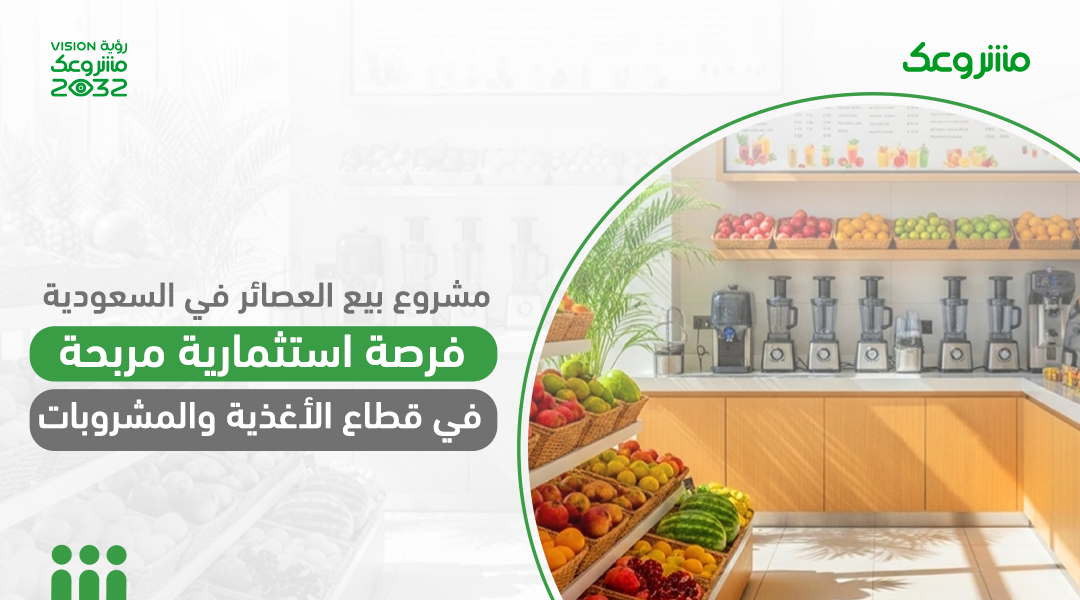
The juice sales project is considered one of the most attractive investment opportunities in the food and beverage sector, driven by the growing demand for natural juices and healthy beverages of various types. As consumers become increasingly aware of the importance of healthy food choices, this project has emerged as a promising opportunity for investors seeking to enter a market with stable growth rates and significant expansion potential.
The success of a juice sales project depends not only on offering high-quality products, but also on proper planning, selecting an appropriate location, and developing an effective marketing strategy that ensures reaching target customers and generating attractive returns.
In this article, we explore the key factors behind the success of a juice sales project, the requirements for establishing it, and the factors that can help investors achieve the best possible investment results.
A juice sales project is a food and beverage business focused on preparing and serving fresh juices and natural beverages made from various types of fruits and vegetables, whether through a specialized shop, kiosk, or mobile cart. The project targets a broad segment of consumers seeking healthy and refreshing beverages, particularly as awareness of the importance of healthy nutrition continues to grow.
The project is relatively easy to operate and offers a wide variety of products, including fresh juices, cocktails, smoothies, and other cold beverages, helping attract customers and increase sales. It is also considered a promising business opportunity due to the consistent demand for juices across different seasons and occasions.
Please read here: Natural Juice Project in Saudi Arabia: A Gateway to a Successful Investment in the Healthy Food Sector
Yes, global economic indicators suggest that the juice sales project is currently one of the most attractive sectors for investment, a trend clearly supported by market data. The global juice market recorded notable growth, increasing from USD 142.10 billion in 2025 to USD 146.94 billion in 2026, reflecting significant changes in global consumption patterns and demand.
Market studies expect this positive momentum to continue, with the market projected to reach USD 173.75 billion by 2031, registering a compound annual growth rate (CAGR) of 3.41% over the forecast period from 2026 to 2031.
Read here: Food Market Report in Saudi Arabia
A juice sales project is considered a sustainable investment opportunity due to its numerous investment advantages, most notably the following:
The success of a juice sales project largely depends on selecting the right location, as the location plays a key role in attracting customers and increasing sales. The most important location selection criteria include:
The cost of a juice sales project varies depending on the project size, location, and level of equipment and fit-out. However, the main cost items can be outlined as follows:
Read here: Discover the Best Small Project That Fits Your Resources
Read here: How to Start a Small Business and Ensure Its Profitability in 2026
Read here: How do you start small industrial projects and achieve long-term financial sustainability?
| Challenges | How to Overcome Them |
|---|---|
| Intense market competition | Offer higher-quality products, introduce distinctive flavors, and enhance the customer experience within the shop. |
| Rising and fluctuating prices of fruits and raw materials | Contract with reliable suppliers and purchase appropriate quantities when prices are lower. |
| Perishability of fruits and raw materials | Manage inventory on a daily basis and purchase fresh quantities according to demand. |
| Lower demand during certain seasons | Offer promotions and discounts and expand the product menu to suit different seasons. |
| Rising operating costs | Control expenses, improve operational efficiency, and minimize waste. |
| Difficulty differentiating the project from competitors | Build a strong brand identity and focus on marketing and customer service. |
| Shortage of trained staff | Provide proper employee training and recruit individuals with relevant industry experience. |
| Product waste | Monitor daily sales closely and prepare quantities based on actual demand. |
You can achieve a significant increase in the profits of a juice sales project by implementing a range of smart strategies that boost sales, improve operational efficiency, and enhance customer satisfaction. The most important include:
Read here: How to Achieve Financial Success by Investing in Successful Small Projects
| Element | Details |
|---|---|
| Strengths | Consistently high demand for fresh juices and refreshing beverages.Ability to start the project with moderate capital compared with other businesses.A diverse product range with the flexibility to introduce new flavors and varieties.Fast capital turnover due to daily sales.Simple operations with relatively limited administrative complexity. |
| Weaknesses | High reliance on fresh, perishable ingredients.Product quality is directly affected by the skill level of employees.Limited differentiation from competitors if the business does not innovate.Fluctuating costs due to changes in fruit and raw material prices. |
| Opportunities | Growing health awareness and increasing demand for natural beverages.Potential for expansion through new branches or mobile juice carts.Opportunities to expand delivery services and online ordering platforms.Introducing innovative products such as smoothies and healthy juices.Partnering with gyms, restaurants, and cafés to increase sales. |
| Threats | Intense competition in the juice and beverage market.Continuous fluctuations in fruit and raw material prices.Ease of entry for new competitors into the market.Seasonal changes that may affect demand levels.Rising operating costs, including rent, electricity, and labor expenses.Rapid changes in consumer preferences. |
The journey did not begin as a passing idea; rather, it stemmed from a genuine observation of the growing demand for juice businesses in the Saudi market, which motivated me to move forward. However, the establishment phase revealed challenges I was not fully prepared for, most notably the lack of detailed planning, the difficulty of objectively assessing the project’s feasibility, and the financing obstacle that stood between me and launching the business.
At this turning point, reaching out to Mashroo3k Consulting proved to be a decision that changed the course of the entire project. A specialized team prepared a comprehensive feasibility study covering the marketing, technical, financial, and administrative aspects, giving me a deeper and clearer vision and enabling me to make decisions based on solid scientific foundations rather than assumptions.
The company’s role did not stop at planning; it extended to the financing stage, where they provided well-considered solutions that helped open the door to securing financing from the Social Development Bank. As a result, the project was launched according to a clear and well-structured plan.
Today, the project is moving forward steadily and sustainably, generating tangible operating returns and achieving consistent growth. All of this was the result of one sound decision: seeking expert guidance before taking the first step.
Opening a juice shop requires meeting a set of essential requirements to ensure that the business operates legally and successfully. First, the necessary licenses and permits must be obtained from the relevant authorities to conduct the commercial activity. The shop should also be located in a suitable area that complies with health and safety requirements and permits food and beverage activities.
The premises must be equipped according to general hygiene standards, with access to clean water and an adequate drainage system. In addition, food safety requirements must be followed when storing and preparing juices. The shop should also be equipped with appropriate machinery and tools, and trained staff should be hired. Compliance with municipal and health regulations is essential to ensure product quality and consumer safety.
A juice shop requires a range of essential equipment and supplies to ensure efficient operations and high-quality products. These include electric blenders with different capacities for preparing juices, refrigerators for storing fruits and fresh ingredients, and an ice-making machine to ensure a continuous supply of ice.
The shop also needs fruit cutting and peeling tools, serving cups and containers in different sizes, as well as suitable lids and straws. Clean and well-equipped worktables, airtight storage containers for ingredients, and an accurate scale for measuring ingredients are also essential. In addition, cleaning and sanitizing supplies are necessary to maintain appropriate hygiene standards and ensure the quality of the final product.
Yes, selling fruit juice can be a profitable business when implemented correctly and based on careful planning. It relies on a product with consistent daily demand, particularly in hot climates and densely populated areas. The project also benefits from the relatively low cost of essential ingredients such as fruits, water, and sugar compared with the final selling price, which can generate healthy profit margins.
Furthermore, the ability to diversify the product range by offering fresh juices, smoothies, and cocktails helps attract different customer segments and increase sales volume. However, profitability largely depends on selecting the right location, maintaining product quality, controlling costs, and implementing effective marketing strategies.
Read Here: Best Successful Small Projects for Youth in 2026
Packaging juice for sale involves a series of organized steps to ensure quality, food safety, and product appeal. The process begins by preparing fresh juice and filtering it thoroughly to remove any impurities. It is then allowed to cool before packaging to help preserve its quality.
Next, suitable containers are used, such as bottles or food-grade, tightly sealed plastic cups, ensuring that they are properly sanitized before use. The juice is filled in standardized quantities using measuring tools to ensure consistent serving sizes. The containers are then sealed tightly to prevent air exposure and preserve the juice’s flavor.
Finally, labels containing the product name and, where applicable, the production and expiration dates are added. The juice is then stored in a refrigerator or freezer, depending on the type of product, to maintain its freshness until the time of sale.
The cost of opening a juice shop varies depending on the location, project size, and level of equipment and fit-out. In general, the cost can be divided into several main categories. For small projects, the initial capital may be relatively low, covering shop rent, basic equipment such as blenders and refrigerators, essential tools, and the cost of purchasing the first batch of fruits and operating supplies.
For medium-sized or professionally equipped projects, the investment cost is higher due to expenses related to décor, modern equipment, point-of-sale systems, initial marketing, and employee salaries.
The best-selling juices in the market are generally those that combine good taste, nutritional value, and strong customer demand. Fresh orange juice is among the most popular choices due to its refreshing taste and nutritional benefits. Mango juice is also highly popular, particularly during the summer, while strawberry juice is well known for its distinctive flavor and appealing appearance.
Pomegranate juice is another popular healthy option, as it is rich in antioxidants, while lemon and mint juice is one of the most refreshing beverages for hot weather. Blended juices and cocktails are also important, such as mango and orange blends or strawberry and banana combinations, as they offer greater variety and cater to different tastes.
In conclusion, a juice sales project represents a promising investment opportunity that combines strong demand with a diverse customer base, creating the potential to generate attractive returns when properly planned and implemented. The success of this project depends primarily on conducting an accurate market study, selecting a suitable strategic location, and offering high-quality products that align with customers’ needs and evolving consumption trends.
Implementing effective marketing strategies, together with efficient operational management, also helps strengthen the project’s competitive position and support its long-term sustainability. With continuous development and an expanded range of services, a juice sales project can achieve sustainable growth and establish a strong presence in a market with increasing expansion opportunities.

For more information and to request a feasibility study for a juice sales project, contact us today
The kebab restaurant project is one of the food-service ventures that combines strong demand for grilled meals with the opportunity to target a diverse customer base, including individuals, families, and lovers of traditional Middle Eastern cuisine. With growing competition in the restaurant sector, however, the project’s success is no longer determined by food taste alone. […]
Read moreA children’s toy store project is not limited to selling toys; it is built on understanding what attracts children and what families look for when choosing products that combine entertainment and educational value. With the wide variety of educational toys, skill-development games, recreational toys, and gifts available, the store has opportunities to meet the needs […]
Read moreA residential complex project is no longer simply an investment in a collection of real estate units. It has evolved into an integrated development model that combines comfortable living, diverse services, and long-term investment value. As cities expand and residents’ needs evolve, demand is growing for residential complexes that offer a comprehensive environment suited to […]
Read moreThe veterinary clinic project comes at a time when animal care is no longer limited to treating illnesses or injuries, but has expanded to include health monitoring, vaccinations, routine checkups, and care for both pets and livestock. However, many animal owners face challenges in accessing specialized veterinary services that combine prompt response, high-quality care, and […]
Read more
خصم 25% على خدمات مشروعك استفد من العرض الآن، فالفرصة متاحة لفترة محدودة فقط
سجّل بياناتك واحصل على خصم 25% الآن


