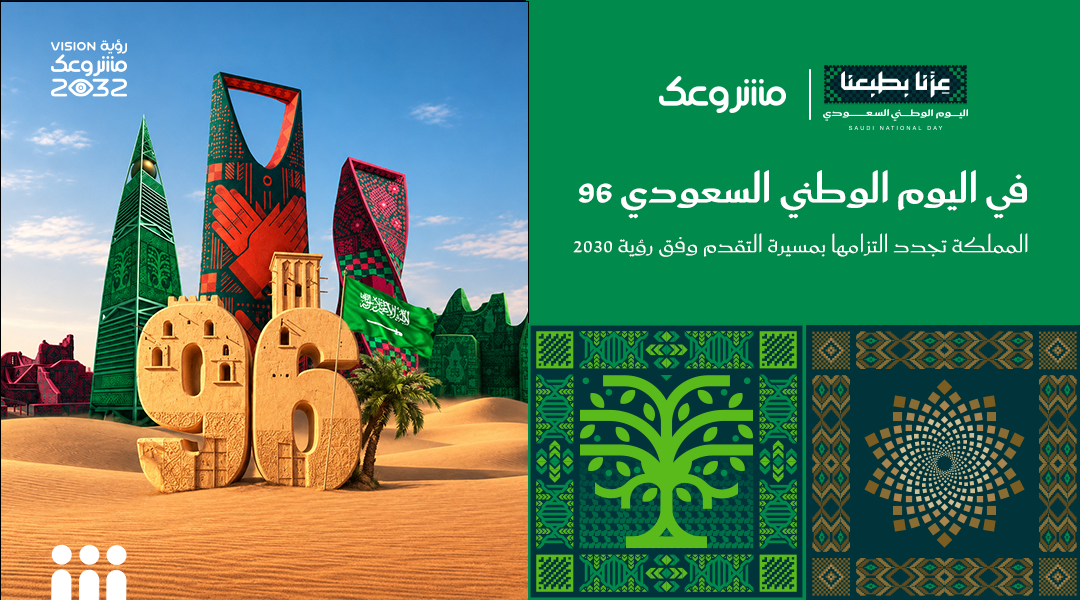
Saudi National Day 96 represents a promising milestone for reaffirming the Kingdom’s position as a leading and attractive investment destination for local and global capital. It provides a strategic opportunity to highlight the economic and legislative achievements the Kingdom has made under Saudi Vision 2030, which have contributed to improving the business environment and strengthening confidence in the Saudi market as one of the largest and fastest-growing markets in the region.
Under this ambitious vision, initiatives aimed at diversifying the economy and opening new horizons for promising sectors are accelerating, including renewable energy, tourism, and advanced industries. This creates strategic opportunities for investors seeking sustainable and attractive returns.
Saudi National Day is also becoming a symbol of the integration between comprehensive national development and the rapidly evolving investment landscape. National celebrations serve as a media and economic platform for highlighting achievements and exploring future prospects built on innovation, global partnerships, and sustainable development.
There is no doubt that investing in the Kingdom is no longer a traditional option; it has evolved into a strategic pathway for investors seeking to play an active role in building a modern, resilient, and globally competitive economy founded on strong principles of diversification, sustainability, and innovation.
Saudi National Day 96 is a deeply significant national occasion that embodies pride in national identity and a strong sense of belonging, while reaffirming the continuity of the Kingdom’s development and achievements, which it continues to pursue with confidence and determination. On this day, the Saudi people celebrate with a profound sense of loyalty and belonging, expressing their pride in the comprehensive progress their country has achieved across various fields, elevating its position among leading nations worldwide.
The occasion highlights the strength of the present and the ambition for the future under Saudi Vision 2030, which has laid the foundations for a far-reaching strategic transformation, opening unprecedented horizons for economic growth, cultural development, and digital transformation, while strengthening the Kingdom’s position as an influential force at both the regional and international levels. It is a day when citizens renew their commitment and determination to move forward confidently toward a brighter future that combines authenticity and modernity, transforming national ambitions into tangible achievements and writing new chapters in the Kingdom’s journey of progress and prosperity, ensuring that Saudi Arabia remains a model of sustainable development and renewed ambition.
The Saudi people celebrate National Day on September 23 each year, commemorating the unification of the Kingdom of Saudi Arabia by the founding King Abdulaziz bin Abdulrahman Al Saud, may Allah have mercy on him. On this day in 1932, he announced the establishment of the Kingdom under a unified name, bringing the regions of the Arabian Peninsula together under one flag of unity and sovereignty.
This day represents a defining milestone in the nation’s history, reminding generations of the remarkable journey of nation-building and the challenges that were overcome to establish a unified state with a clear identity and stable political entity. Through the wisdom of its leadership, the Kingdom achieved stability and then confidently advanced toward successive stages of development and progress.
Therefore, National Day is not merely a festive occasion; it is an annual milestone for renewing loyalty to the nation, recalling the values of unity, determination, and sacrifice upon which the Kingdom was built, and reaffirming the commitment to continuing the journey of development and achievement under the Kingdom’s wise leadership.
On Saudi National Day 96, the Kingdom does not simply celebrate the anniversary of its founding; it also transforms this occasion into a strategic milestone for assessing its progress and redirecting its efforts toward broader horizons and greater goals. It is a national moment in which pride in the history of previous generations is transformed into a driving force for shaping a future worthy of the Kingdom’s position, the ambitions of its people, and the vision of its leadership.
This year, we are not only celebrating the founding King who unified the land and brought the people together, nor the generation that built and established the foundations of the modern state. We are also celebrating a generation of transformation and progress—a generation redefining the economy, diversifying sources of income, unlocking the potential of people and places, and turning visions into tangible realities.
Today, we celebrate a profound strategic transformation that is measured not by the passage of years, but by the scale of change being embedded in the global economic landscape and strengthening the Kingdom’s position as an influential global power. We celebrate Vision 2030 as it takes shape in reality through empowering young people, unlocking women’s potential and enhancing their participation, and building a new economy that does not depend on a single resource or commodity, but instead places people at its center—their minds, ambitions, creativity, and determination.
Celebration today, therefore, is not merely a traditional ritual or an occasion of decorations and festivities. It is an expression of national commitment: every training program developed, every small enterprise launched, every investment decision made, and every digital service introduced represents another building block in the future we aspire to create—a nation that knows no impossibility, accepts nothing less than the highest achievements, and derives its pride from its identity, ambition, and vision.
At the heart of this ambitious national journey, the Kingdom is moving steadily and confidently toward achieving unprecedented strategic objectives. These objectives go beyond economic growth alone to establish Saudi Arabia as a regional and global hub for energy, technology, tourism, culture, and innovation. The Kingdom is confidently reshaping the foundations of its prosperity, demonstrating to the world that it is not merely the heir to a rich history, but also a creator of an exceptional future.
Saudi Arabia’s gross domestic product (GDP) increased significantly between 2016 and 2025, rising from SAR 2,584,798 million in 2016 to SAR 4,775,830 million in 2025. This represents an increase of approximately SAR 2,191,032 million, equivalent to a growth rate of approximately 84.8% over nine years.
This rapid growth reflects the major economic transformations Saudi Arabia has undergone under Vision 2030, including the diversification of national income sources and the expansion of non-oil sectors, in addition to benefiting from improved oil prices during certain years within the period. These factors contributed to strengthening the Saudi economy and enhancing its position among the world’s largest economies.
Foreign direct investment inflows into Saudi Arabia recorded notable growth, with cash inflows reaching SAR 121,943 million in 2025, compared with SAR 80,016 million in 2024. This represents an increase of SAR 41,927 million, or approximately 52.4%.
This significant increase reflects growing investor confidence in the Saudi economy and its investment environment, amid the Kingdom’s ongoing structural and regulatory reforms under the objectives of Vision 2030. It also reflects the diversity of investment opportunities available across various sectors, further strengthening the Kingdom’s position as an attractive destination for foreign capital in the region.
Saudi Arabia’s non-oil exports recorded notable growth in 2025, increasing by 15% to reach SAR 624 billion (approximately USD 166 billion), compared with SAR 543 billion in 2024, representing an increase of SAR 81 billion.
The share of non-oil exports in the Kingdom’s total exports also increased to 44%, compared with 39% in the previous year, marking a new record. This development reflects the Kingdom’s efforts to diversify its sources of income and reduce reliance on oil, in line with the objectives of Vision 2030 to build a more diversified and sustainable national economy.
Saudi Arabia’s inflation rate has gradually declined in recent years, falling from 3.13% in 2021 to 2.03% in 2025. It is expected to stabilize at 2% by the end of 2030.
This decline reflects the effectiveness of the economic and financial policies adopted by the Kingdom to control inflation and maintain price stability, contributing to greater confidence in the national economy and creating a stable economic environment that supports sustainable growth.
Saudi Arabia’s exports were valued at USD 310,626,324 thousand in 2025, compared with imports valued at USD 252,212,097 thousand, resulting in a trade surplus of USD 58,414,227 thousand, based on the following formula: Trade Balance = Exports − Imports.
This confirms the Kingdom’s continued achievement of a positive trade surplus, although the surplus declined compared with the previous year (2024), when it reached USD 73,329,991 thousand.
The total amount of waste recorded from various economic activities and households in Saudi Arabia reached approximately 135.1 million tons in 2024, compared with 111.4 million tons in 2023. This significant increase reflects the growth of economic activity and the expansion of waste monitoring and reporting.
Agriculture, forestry, and fishing accounted for the largest share of recorded waste among economic activities, at 46.9 million tons, followed by construction at approximately 32.2 million tons, and households at 20.5 million tons. Manufacturing industries generated approximately 18.3 million tons of waste during the same year.
In terms of recycling, the amount of waste that was reused or recycled reached 33.9 million tons, representing 25.0% of the total recorded waste in 2024. Agriculture, forestry, and fishing led economic activities in this area, accounting for 64.8% of the total amount of waste that was reused or recycled. This highlights the sector’s significant potential to support the circular economy in the Kingdom.
As part of efforts to develop the sector, the Ministry of Environment, Water and Agriculture announced an ambitious plan to increase the recycling rate to 95%. This is expected to contribute approximately SAR 120 billion to GDP, support environmental sustainability by recycling around 100 million tons of waste annually, and create more than 100,000 job opportunities for Saudi men and women. These efforts are aligned with the objectives of Saudi Vision 2030 to build a more sustainable and competitive economy.
Read here: How Can You Implement a Recycling Project?
The food and beverage sector in Saudi Arabia is experiencing notable and sustained growth. According to data from Mordor Intelligence, the market was valued at USD 36.35 billion in 2025 and is expected to reach USD 38.38 billion in 2026, growing to approximately USD 50.38 billion by 2031, at a compound annual growth rate (CAGR) of 5.59% between 2026 and 2031. These figures reflect the growing investment opportunities in this vital sector, which is considered one of the key non-oil economic pillars of the Kingdom, particularly in light of Vision 2030’s efforts to diversify national income sources.
The importance of the food and beverage sector stems from several strategic factors. It is directly linked to food security, which the Kingdom considers a top priority within its development agenda. The sector also plays an active role in creating employment opportunities and supporting local supply chains, from agriculture and production to manufacturing, distribution, and retail.
The sector also benefits from demographic changes, including population growth and a high proportion of young people, as well as changing consumption patterns toward ready-to-eat and healthy foods, innovative beverages, and the growing reliance on delivery services and e-commerce. It is also a major attraction for foreign direct investment, particularly with the rapid growth of the tourism and hospitality sectors, making it an important driver of economic diversification and long-term sustainability.
Read Here: Best Projects in Saudi Arabia: Your Guide to Investment Opportunities Aligned with Vision 2030.
The implementation of the National Industrial Strategy represents a major milestone in Saudi Arabia’s economic development, as it aims to strengthen the role of the industrial sector as a key pillar for achieving the objectives of Vision 2030. The sector contributed SAR 331 billion to GDP in 2020 and is expected to increase significantly to SAR 895 billion by 2030, and then to SAR 1.414 trillion by 2035, reflecting an ambitious strategic vision for comprehensive industrial growth and transformation.
In terms of exports, the value of industrial exports reached SAR 169 billion in 2020 and is expected to rise sharply to SAR 557 billion by 2030 and SAR 892 billion by 2035. This growth is expected to enhance the competitiveness of Saudi products in global markets and strengthen the Kingdom’s position as a major exporter.
At the infrastructure level, the number of factories in the Kingdom reached 13,000 in 2025, with ambitious plans to increase this number to 23,000 factories by 2033 and then to 36,000 factories by 2035. This strategic expansion aims to establish Saudi Arabia as a leading regional and global industrial hub.
The importance of the industrial sector lies in its role as a key driver of economic diversification and in reducing reliance on oil as the primary source of national income. It also plays an active role in creating high-quality employment opportunities for Saudi talent and supporting the transfer of knowledge and technology to the local economy.
Furthermore, the sector contributes to strengthening the Kingdom’s industrial and supply security by supporting self-sufficiency in many essential products and creating broad opportunities for innovation and industrial entrepreneurship. This industrial expansion also serves as an important driver for attracting foreign direct investment and strengthening regional supply chains, supporting the Kingdom’s position as a global logistics and industrial hub connecting the continents of Asia, Africa, and Europe.
Read here: What Are the Objectives of Saudi Arabia’s National Industrial Strategy?
Saudi Arabia has set ambitious goals to develop the tourism sector through the National Tourism Strategy, launched in 2019 as part of Saudi Vision 2030. The strategy aimed to attract 100 million tourists or visits annually by 2030, while increasing tourism’s contribution to gross domestic product (GDP) to approximately 10% and strengthening the sector’s role in diversifying the economy and creating employment opportunities.
The Kingdom surpassed this target ahead of schedule, receiving approximately 109.34 million tourists in 2023. In 2024, the number increased to approximately 115.9 million tourists, while total tourism expenditure reached SAR 283.8 billion.
The sector continued to grow in 2025, with the total number of domestic and inbound tourists reaching approximately 122.6 million, representing an increase of nearly 5.8% compared with the previous year. Total tourism expenditure also rose to approximately SAR 303.7 billion, marking an annual increase of 7%.
Domestic tourists accounted for approximately 93.3 million visitors, with spending reaching SAR 127.1 billion, while the number of international inbound tourists reached approximately 29.3 million, generating around SAR 176.6 billion in spending.
These indicators reflect the growing importance of tourism as one of the key sectors supporting economic diversification and advancing the objectives of Saudi Vision 2030.
The healthcare sector in Saudi Arabia receives significant strategic attention as part of the objectives of Saudi Vision 2030, which seeks to build an integrated and efficient healthcare system that meets the highest international standards. In recent years, the sector has witnessed significant expansion in healthcare infrastructure, both in terms of hospitals and medical centers and in the specialized workforce, including physicians, nurses, pharmacists, and technicians. This development reflects the government’s commitment to enhancing the quality of healthcare services provided to citizens and residents, achieving comprehensive healthcare coverage, and improving the efficiency of the healthcare system to make it more sustainable and better equipped to meet population growth and future health challenges. The following are the key indicators that illustrate the scale and main characteristics of this vital sector:
Read here:Saudi Arabia Healthcare Sector Report
The e-commerce market in Saudi Arabia was valued at USD 27.96 billion in 2025 and is expected to grow to USD 31.29 billion in 2026, reaching approximately USD 54.87 billion by 2031, at a compound annual growth rate (CAGR) of 11.92% over the forecast period. These figures reflect the strong upward trajectory of the sector, driven by increasing internet and smartphone penetration and growing consumer confidence in online shopping.
The importance of the e-commerce sector lies in its role as one of the key drivers supporting digital transformation under the objectives of Saudi Vision 2030. It contributes to diversifying the national economy and reducing reliance on traditional sectors. The sector also creates broad opportunities for entrepreneurs and small and medium-sized enterprises to reach a wider customer base at lower costs, while enhancing the efficiency of supply chains and logistics services through the expansion of shipping, delivery, and electronic payment solutions.
In addition, the sector’s rapid growth is contributing to the creation of high-quality employment opportunities in digital marketing, technology, and logistics, while attracting increasing levels of domestic and foreign investment. This further strengthens the Kingdom’s position as a promising digital market in the Middle East.
Read here: E-Commerce Projects:How Do You Get Started, and What Are the Shortest Paths to Profit?
The agricultural sector in Saudi Arabia represents one of the key strategic pillars of Saudi Vision 2030, which aims to diversify national income sources and reduce reliance on oil. Despite the natural challenges facing the sector, such as limited water resources and the harsh desert climate, the Kingdom has made significant progress in developing agricultural production through substantial investments in modern technologies and smart farming.
Agricultural activities in the Kingdom are diverse, including date cultivation, with Saudi Arabia being one of the world’s largest producers and exporters of dates. The sector also includes the production of vegetables and fruits in greenhouses, livestock and poultry farming, and dairy production, which has experienced significant growth driven by major companies operating in the industry.
The Saudi government is placing increasing emphasis on food security as a national priority by supporting farmers, encouraging overseas agricultural investment to secure supplies of strategic crops, and adopting modern irrigation technologies and sustainable farming practices to preserve limited natural resources.
| Type | Cultivated Area (Hectares) | Production (Tons) |
|---|---|---|
| Fruit | 289,292 | 2,923,500 |
| Cereal Crops | 317,634 | 1,649,575 |
| Open-Field Vegetables | 90,213 | 2,790,305 |
| Protected Vegetables | 7,650 | 795,824 |
| Type | Number of Animals |
|---|---|
| Sheep | 22,017,774 |
| Goats | 7,688,568 |
| Cattle | 510,380 |
| Camels | 2,235,295 |
| Horses | 61,500 |
| Traditional Birds and Poultry | 3,075,357 |
Read here: How to start investing in successful small projects in Saudi Arabia?
The services sector in the Kingdom of Saudi Arabia is one of the most dynamic and diverse economic sectors, contributing a significant share of the non-oil gross domestic product (GDP) and forming a fundamental pillar of the economic diversification plans underpinning Saudi Vision 2030. This sector encompasses multiple activities, most notably trade and retail, tourism and hospitality, transport and logistics, financial and banking services, communications and information technology, in addition to health and educational services. All of these areas have witnessed remarkable development in recent years, driven by a wave of economic and legislative reforms that have opened the door to local and foreign investment.
Data for the year 2025 reflect the substantial contribution of this sector to the national economy, as government activities topped the list of service activities with a contribution of SAR 668,096 million, reflecting the pivotal role played by the state in providing essential services and managing public sector facilities. Financial, insurance, real estate, and business services also ranked highly with a contribution of SAR 628,716 million, expressing the accelerating growth witnessed by the financial and real estate sectors amid regulatory reforms and the expansion of banking and investment services. Wholesale and retail trade, restaurants, and hotels contributed SAR 586,758 million, reflecting the revitalization of commercial and tourism activity and the prosperity of the hospitality sector as a result of major tourism projects and the increase in entertainment and cultural events across the various regions of the Kingdom.
As for the transport, storage, and communications sector, its contribution reached SAR 276,753 million, driven by the expansion of logistics infrastructure and the development of communications and information technology services, while collective, social, and personal services contributed SAR 182,122 million, reflecting the growing demand for various community services. With the total of these activities combined, the contribution of the services sector amounted to approximately SAR 2,342,445 million, equivalent to approximately 49.06% of the Kingdom’s GDP of SAR 4,775,830 million — a proportion that highlights the considerable economic weight of this sector and its capacity to absorb further investments and create quality job opportunities, thereby reinforcing its position as one of the most important supporting pillars for achieving the Kingdom’s economic diversification objectives.
Read Here: Best Successful Small Projects for Youth in 2026
| Comparison Point | Saudi National Day | Founding Day |
|---|---|---|
| Date | 23 September of each year | 22 February of each year |
| Occasion | The unification of the Kingdom of Saudi Arabia by King Abdulaziz Al Saud in 1932 | The establishment of the first Saudi State by Imam Muhammad bin Saud in 1727 |
| Historical Beginning | The announcement of the establishment of the Kingdom under its current name, “the Kingdom of Saudi Arabia” | Laying the first foundations of the Saudi State in Diriyah |
| First Official Celebration | Celebrations began in 1934, and it later became an official holiday | It was declared an official holiday for the first time in 2022 |
| Capital at the Time of Establishment | Riyadh (after unification) | Diriyah (the capital of the first Saudi State) |
Saudi National Day 2026, corresponding to the 96th anniversary of the unification of the Kingdom of Saudi Arabia, carries the slogan “Our pride is in our nature”(Our pride is in our nature) making this slogan continue for the second consecutive year, in a step that reflects the desire of those organizing the celebrations to instill its deep meanings in the hearts of the nation’s people. This slogan expresses the authentic national identity rooted in the conscience of the Saudi citizen, which stems from the ancient values and traditions inherited by generations, confirming that pride and glory in belonging are not a passing slogan, but rather an authentic nature and daily behavior that the citizen practices with complete spontaneity.
The Kingdom of Saudi Arabia celebrates Saudi National Day on September 23 each year, commemorating the unification of the various regions of the Kingdom under the name “Kingdom of Saudi Arabia” on this day in 1351 AH, corresponding to 1932 AD, by the founding King Abdulaziz bin Abdulrahman Al Saud, may Allah have mercy on him.
After years of effort and struggle, King Abdulaziz succeeded in unifying the various regions and emirates of the Arabian Peninsula, including Najd, the Hejaz, Asir, and Al-Ahsa, among others, under one flag and a unified political entity. This decades-long journey began with the recapture of Riyadh in 1902.

To communicate and learn more about Mashroo3k company and its services
The kebab restaurant project is one of the food-service ventures that combines strong demand for grilled meals with the opportunity to target a diverse customer base, including individuals, families, and lovers of traditional Middle Eastern cuisine. With growing competition in the restaurant sector, however, the project’s success is no longer determined by food taste alone. […]
Read moreA children’s toy store project is not limited to selling toys; it is built on understanding what attracts children and what families look for when choosing products that combine entertainment and educational value. With the wide variety of educational toys, skill-development games, recreational toys, and gifts available, the store has opportunities to meet the needs […]
Read moreA residential complex project is no longer simply an investment in a collection of real estate units. It has evolved into an integrated development model that combines comfortable living, diverse services, and long-term investment value. As cities expand and residents’ needs evolve, demand is growing for residential complexes that offer a comprehensive environment suited to […]
Read moreThe veterinary clinic project comes at a time when animal care is no longer limited to treating illnesses or injuries, but has expanded to include health monitoring, vaccinations, routine checkups, and care for both pets and livestock. However, many animal owners face challenges in accessing specialized veterinary services that combine prompt response, high-quality care, and […]
Read more
خصم 25% على خدمات مشروعك استفد من العرض الآن، فالفرصة متاحة لفترة محدودة فقط
سجّل بياناتك واحصل على خصم 25% الآن


