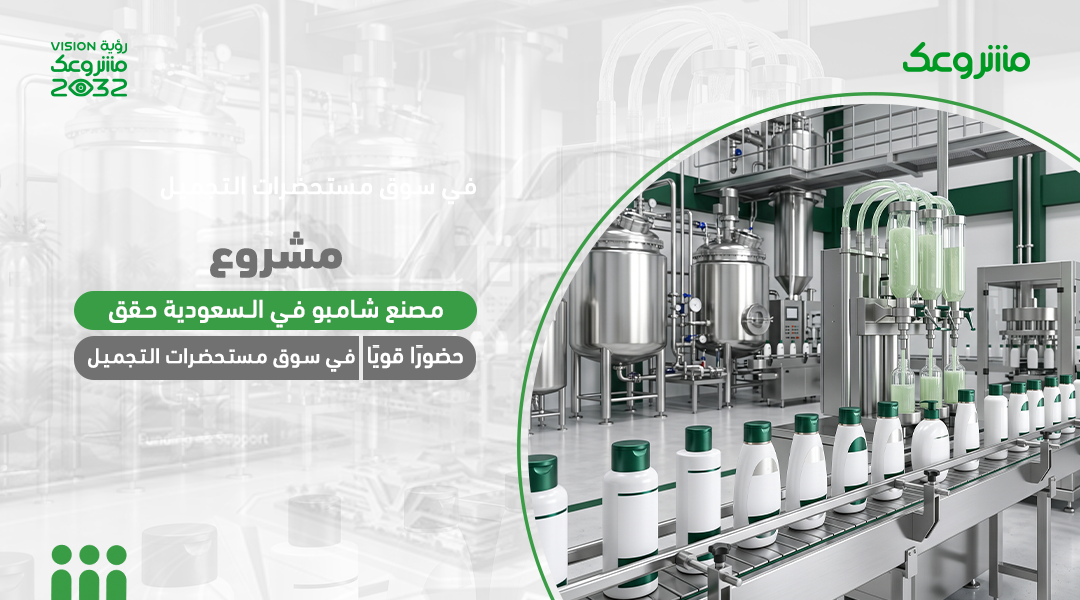
Shampoo Factory Project in Saudi Arabia: Establishing a Strong Presence in the Cosmetics Market - Mashroo3k
Published13 Sep 2026 0 comments 78 Observation
Shampoo Factory Project in Saudi Arabia: Establishing a Strong Presence in the Cosmetics Market

A shampoo factory project is considered a promising industrial venture due to the consistent demand for hair care products and the diverse needs of consumers. With the continued growth of the cosmetics and personal care market, the project offers a promising investment opportunity, particularly given the ability to produce a variety of shampoo products designed for different hair types and target customer segments.
The success of the factory requires thorough market research, a clear understanding of customer preferences, and a strong focus on product quality and safety, along with the development of innovative formulations that keep pace with the latest market trends. The project’s long-term sustainability also depends on building a clear competitive advantage, selecting effective distribution and marketing channels, and setting prices that align with market conditions.
Therefore, it is essential to understand the requirements for establishing the factory, the necessary equipment, production and operating costs, marketing strategies, and projected profits in order to assess the project’s feasibility and make a well-informed investment decision that supports sustainable grow

What Is a Shampoo Factory Project?

A Shampoo Factory Project is an industrial business specialized in manufacturing hair cleansing and care products by producing different types of shampoo according to specific formulations and specifications designed to meet consumer needs, such as moisturizing shampoo, anti-dandruff shampoo, and products formulated for dry or oily hair.
The project relies on safe and effective raw materials that undergo mixing, homogenization, filling, and packaging processes, along with quality control procedures to ensure that the products comply with approved specifications. The factory can also develop and manufacture its own brand and distribute its products through pharmacies, retail stores, cosmetics shops, and e-commerce platforms, allowing it to reach a diverse range of customer segments.

Is a Shampoo Factory Project Worth Investing In?

Yes, a shampoo factory project is considered a promising investment opportunity with strong profit potential, driven by the continued demand for hair care products. According to recent statistics, the global shampoo market was valued at USD 38.23 billion in 2025 and is projected to grow from USD 40.32 billion in 2026 to USD 63.79 billion by 2034, registering a compound annual growth rate (CAGR) of 5.90% over the forecast period.

Why Are Investors Interested in a Shampoo Factory Project?

  • High demand for shampoo and hair care products.
  • Frequent product purchases, supporting consistent sales.
  • A wide variety of shampoo types, allowing for a diverse product range.
  • The ability to target different consumer segments.
  • Multiple sales channels, including retail stores, pharmacies, distributors, and e-commerce platforms.
  • The opportunity to establish a private brand for the factory and build a customer base.
  • The ability to easily add new hair care products to the production line.
  • The flexibility to develop formulations, product sizes, and packaging according to market needs.
  • Opportunities to expand into new regions and markets.
  • The ability to work with wholesalers and distributors and broaden market reach.
  • The potential to increase production capacity as demand for products grows.
  • The ability to build a competitive advantage through product quality, packaging, and pricing.

Read More: Detergents and Cosmetics Project: A Highly Sought-After Investment Opportunity in the Market

Practical Steps to Start a Shampoo Factory Project

  • Determine the types of shampoo and other products the factory will offer.
  • Conduct market research and identify target customers, competitors, and the products in highest demand.
  • Determine the appropriate production volume and operating capacity for the factory.
  • Select a suitable factory location and facility size for production lines and storage.
  • Obtain the licenses, permits, and approvals required for the business.
  • Prepare the factory and production, storage, and filling areas in accordance with applicable requirements.
  • Select and purchase the machinery and equipment required for shampoo manufacturing, mixing, and filling.
  • Partner with reliable suppliers to provide raw materials and packaging materials.
  • Hire skilled workers and technicians with experience in manufacturing, operations, and quality control.
  • Develop product formulations and conduct the necessary tests to ensure product quality.
  • Operate the production line and conduct trial batches before launching the products.
  • Design product packaging and labels and develop a distinctive brand identity.
  • Determine suitable sales and distribution channels to reach target customers.
  • Implement marketing campaigns and promote products in target markets.
  • Monitor sales and customer satisfaction and continuously develop products in line with changing market needs.

Read here: How to start successful Saudi projects from scratch?

What is the cost of establishing a shampoo factory project in Saudi Arabia?

The cost of establishing a shampoo factory project varies according to the size of the factory, the production capacity, the types of products targeted, and the level of equipment. The cost usually includes several main items, including the following:

  • The cost of purchasing or renting and equipping the factory site.
  • The cost of shampoo manufacturing and mixing lines and equipment.
  • The cost of filling and packaging machines and labeling.
  • The cost of electricity, water, ventilation, and safety equipment.
  • The cost of raw materials and initial production supplies.
  • The cost of containers, bottles, and packaging materials.
  • The cost of licenses and necessary approvals.
  • Salaries and wages of labor, technicians, and management.
  • Operating, maintenance, transportation, and storage costs.
  • Marketing costs, brand building, and product launch.
  • Working capital to cover expenses during the first operating period.

How to choose a suitable site for a shampoo factory project

  • Choosing a suitable industrial area for the nature of the activity.
  • The site’s proximity to main roads and transportation networks.
  • The availability of water, electricity, and sanitation sources.
  • Providing sufficient space for production, storage, and future expansion.
  • Ease of access for supply and distribution trucks to the factory.
  • Proximity to target markets and distribution outlets.
  • The availability of appropriate security, safety, and ventilation requirements.
  • The availability of labor and necessary services in the area.
  • Ensuring that the site complies with the requirements and licenses specific to the industrial activity.

What equipment is needed to establish a shampoo factory project?

  • Raw material storage tanks.
  • Shampoo mixing and preparation tanks and equipment.
  • Homogenization machines to ensure the homogeneity of the formula.
  • Pumps for transferring materials and liquids.
  • Finished product storage tanks.
  • Shampoo filling machine for containers.
  • Cap sealing machine.
  • Labeling and data placement machine.
  • Packaging and container preparation machine.
  • Quality inspection and control equipment.
  • Scales and precise measuring tools.
  • Cleaning and sterilization systems and equipment.
  • Safety and protection equipment inside the factory.
  • Shelves and storage means for raw materials and finished products.

How are the production stages carried out in a shampoo factory project?

  • Preparing the raw materials according to the specified formula and specifications.
  • Purifying the water used in the manufacturing process.
  • Weighing the raw materials accurately according to the formula ratios.
  • Mixing the ingredients inside the manufacturing tanks gradually.
  • Adding the active substances and auxiliary elements according to the type of shampoo.
  • Adjusting the consistency and pH to reach the required specifications.
  • Adding perfumes, colors, and additional ingredients according to the formula.
  • Homogenizing the mixture to obtain a homogeneous and stable product.
  • Conducting quality tests to ensure the product matches the specifications.
  • Transferring the shampoo to the filling tanks after passing the tests.
  • Filling the shampoo into containers in the specified sizes.
  • Sealing the containers and placing the labels and product data.
  • Packaging the containers and placing them in cartons in preparation for storage and distribution.

Read More: Soap Project: How to Build a Brand Around Natural Products

How are the products of a shampoo factory project marketed?

  • Identifying the target audience and their needs for hair care products.
  • Building a distinctive commercial identity for the products.
  • Designing attractive packaging that shows the product’s characteristics and advantages.
  • Creating brand pages on social media platforms.
  • Providing educational and introductory content that explains the characteristics and benefits of shampoo products.
  • Collaborating with influencers and content creators in the field of hair care.
  • Providing products through stores, pharmacies, and cosmetics shops.
  • Contracting with distributors and wholesalers to expand the scope of reach.
  • Creating an online store to sell products and reach new customers.
  • Offering promotions and bundles that encourage customers to try the products.
  • Participating in specialized exhibitions and events to build business relationships.
  • Following up on customer opinions and developing products according to market needs.

Read More: From Manufacturing to Marketing: A Practical Plan for Launching a Sustainable Liquid Soap Project

SWOT analysis for a shampoo factory project

  • High demand for hair care products.
  • Diversity of shampoo products and the possibility of targeting different segments.
  • The possibility of building a brand specific to the factory.
  • The ability to develop products and add new formulas.
  • Multiple sales and distribution channels.

Weaknesses

  • The need for appropriate investments and equipment to start production.
  • Dependence on the quality and availability of raw materials.
  • The need for specialized technical personnel.
  • High marketing costs when launching a new brand.
  • The difficulty of building customer trust at the beginning of the project.

Opportunities

  • Expansion in the personal care products market.
  • Developing customized products for different hair types.
  • Benefiting from the growth of e-commerce.
  • Expanding distribution through pharmacies, stores, and distributors.
  • The possibility of entering new markets in the future.

Threats

  • Strong competition from local and international brands.
  • Changes in the prices of raw materials and production supplies.
  • Rapidly changing consumer preferences.
  • Strict quality and safety requirements for products.
  • The emergence of new products and brands in the market.

How can the risks of a shampoo factory project be overcome?

The risks that a shampoo factory project may face can be reduced through a set of practical measures, the most important of which are:

  • Adhering to quality and safety standards in the manufacturing and testing of shampoo products.
  • Choosing reliable raw materials and ensuring they comply with the required specifications.
  • Conducting periodic tests on products before launching them in the markets.
  • Diversifying products to meet the needs of different customer segments.
  • Studying the market and competitors continuously and monitoring changes in consumer preferences.
  • Building a strong brand and paying attention to the quality of the container and packaging.
  • Diversifying distribution channels among stores, pharmacies, and e-commerce.
  • Developing a plan for periodic maintenance of machines and equipment to avoid production stoppage.
  • Training workers on manufacturing methods and safe handling of raw materials.
  • Preparing an accurate feasibility study to estimate costs, revenues, and risks before starting the project.

Read More: Beauty Tools Project in Saudi Arabia: Success Strategies in the Cosmetics Market

My Experience with a Shampoo Factory Project

My journey with the Shampoo Factory Project was more than just an investment idea. It began with actual market expansion and the continued development of the project to keep pace with the growing demand for hair care products in Saudi Arabia. As the project grew, I began considering ways to improve the factory’s efficiency and increase its production capacity in line with market needs and available expansion opportunities.
However, the development phase revealed a number of technical challenges that were not easy to address. I faced several questions regarding the most suitable equipment, the appropriate production capacity, the layout of production lines, and the organization of material and product flows within the factory, in addition to quality, storage, and utility requirements. As these details became increasingly interconnected, I realized that making technical decisions without proper planning could negatively affect operational efficiency and increase project costs.

Therefore, I decided to seek the support of a specialized consulting firm and immediately contacted Mashroo3k Consulting to benefit from its technical feasibility study service. The consulting team helped me assess the project’s technical requirements and accurately determine the appropriate technology and equipment, production capacity, factory size, production line layout, as well as operational and utility requirements.
After implementing the recommendations, the overall picture became much clearer. The factory’s organization and workflow improved, production became more efficient and stable, and most importantly, I gained a clearer technical foundation that enables me to develop the project with greater confidence and prepare for its next stages of expansion.

Read here: How do you turn your idea into a profitable and sustainable economic project?

Read More: Economic Feasibility Study: Definition, Importance, Objectives, and Its Role in Risk Assessment

Frequently asked questions about a shampoo factory project

What are the proportions for making shampoo?

The proportions for making shampoo vary according to the type of product, the formula, and the required characteristics, but they are mainly based on purified water, detergents and surface-active agents, and moisturizing and thickening agents, in addition to preservatives, pH regulators, perfumes, and colors. Oils, extracts, and active ingredients can also be added according to the type of shampoo. The proportions of each ingredient are precisely determined through a specialized formula, with quality, stability, and safety tests conducted before launching the product in the markets.

What are the materials that shampoo is made from?

Shampoo is usually made from purified water, detergents, moisturizing agents, thickeners and stabilizers, pH regulators, preservatives, perfumes, and colors. Other ingredients may also be added to it, such as oils, plant extracts, or active substances that suit the hair type and the purpose of the product. These ingredients and their proportions vary according to the shampoo formula and the required characteristics.

What are the best types of shampoo for hair?

The best types of shampoo for hair vary according to the nature of the hair and its needs; dry hair is suited to moisturizing shampoo, while oily hair needs formulas that help cleanse the scalp and regulate oils. As for damaged hair, it is suited to a shampoo that contains moisturizing and nourishing ingredients. A shampoo specially designed for colored, curly, or sensitive hair can also be chosen, while taking into account the product ingredients and choosing a formula suitable for frequent use.

What is the best natural shampoo without chemicals?

There is no shampoo without chemicals in the scientific sense, because all substances are made up of chemical substances. However, a natural shampoo can be chosen with a formula that contains plant ingredients and natural extracts while avoiding ingredients that do not suit the hair’s needs. When choosing, it is preferable to read the list of ingredients and make sure that the product is suitable for the hair type and scalp, especially if there is an allergy or irritation.

And at the end of our discussion about a shampoo factory project

We find that investing in this activity is not limited to establishing a production line only, but depends on building an integrated project capable of meeting market requirements and competing in the personal care products sector. The diversity of shampoo types and consumer needs provides wide scope for developing different products and targeting multiple segments. Hence comes the importance of proper planning, choosing the appropriate products, ensuring manufacturing quality, and putting in place effective distribution and sales mechanisms. With good management and keeping up with market movement and customer preferences, the project can turn into an industrial activity capable of expansion and building a brand with a strong presence in the market.

To contact us and request a feasibility study for a Shampoo Factory Project.


Similar Articles

How to Turn a Kebab Restaurant Project into a Distinctive Brand in Egypt?

The kebab restaurant project is one of the food-service ventures that combines strong demand for grilled meals with the opportunity to target a diverse customer base, including individuals, families, and lovers of traditional Middle Eastern cuisine. With growing competition in the restaurant sector, however, the project’s success is no longer determined by food taste alone. […]

Read more

Children’s Play Center Project in Saudi Arabia: How to Create an Experience That Attracts Children and Families?

A children’s toy store project is not limited to selling toys; it is built on understanding what attracts children and what families look for when choosing products that combine entertainment and educational value. With the wide variety of educational toys, skill-development games, recreational toys, and gifts available, the store has opportunities to meet the needs […]

Read more

Residential Complex Project in Saudi Arabia: An Investment That Creates Value Beyond Residential Units

A residential complex project is no longer simply an investment in a collection of real estate units. It has evolved into an integrated development model that combines comfortable living, diverse services, and long-term investment value. As cities expand and residents’ needs evolve, demand is growing for residential complexes that offer a comprehensive environment suited to […]

Read more

Veterinary Clinic Project in Egypt: A Promising Investment Opportunity in the Animal Care Sector

The veterinary clinic project comes at a time when animal care is no longer limited to treating illnesses or injuries, but has expanded to include health monitoring, vaccinations, routine checkups, and care for both pets and livestock. However, many animal owners face challenges in accessing specialized veterinary services that combine prompt response, high-quality care, and […]

Read more

Green Friday

فرصة لا تتكرر

GREEN FRIDAY

خصم 25% على خدمات مشروعك استفد من العرض الآن، فالفرصة متاحة لفترة محدودة فقط
سجّل بياناتك واحصل على خصم 25% الآن