هذا النص هو مثال لنص يمكن أن يستبدل في نفس المساحة، لقد تم توليد هذا النص من مولد النص العربى، حيث يمكنك أن تولد مثل هذا النص أو العديد من النصوص الأخرى إضافة إلى زيادة عدد الحروف التى يولدها التطبيق.
A toothpaste manufacturing business is considered one of the promising industrial ventures with consistent demand, as toothpaste is an essential product that people cannot do without in their daily lives. With growing interest in oral and dental care, the market has seen significant diversification in toothpaste products, creating opportunities for investors to introduce new products that meet the needs of different consumer segments. The success of the business is not limited to the manufacturing process alone. It also depends on selecting the right raw materials, providing the necessary equipment, complying with quality and safety standards, and developing an effective marketing strategy. Therefore, conducting a feasibility study for a toothpaste manufacturing business is an important step before getting started, as it helps determine the expected investment, operating costs, market demand, as well as potential returns and available investment opportunities. So, does this business represent a profitable investment opportunity? And what are its key requirements? We explore all of this in detail in the following sections.
What Is the Idea Behind a Toothpaste Manufacturing Business?
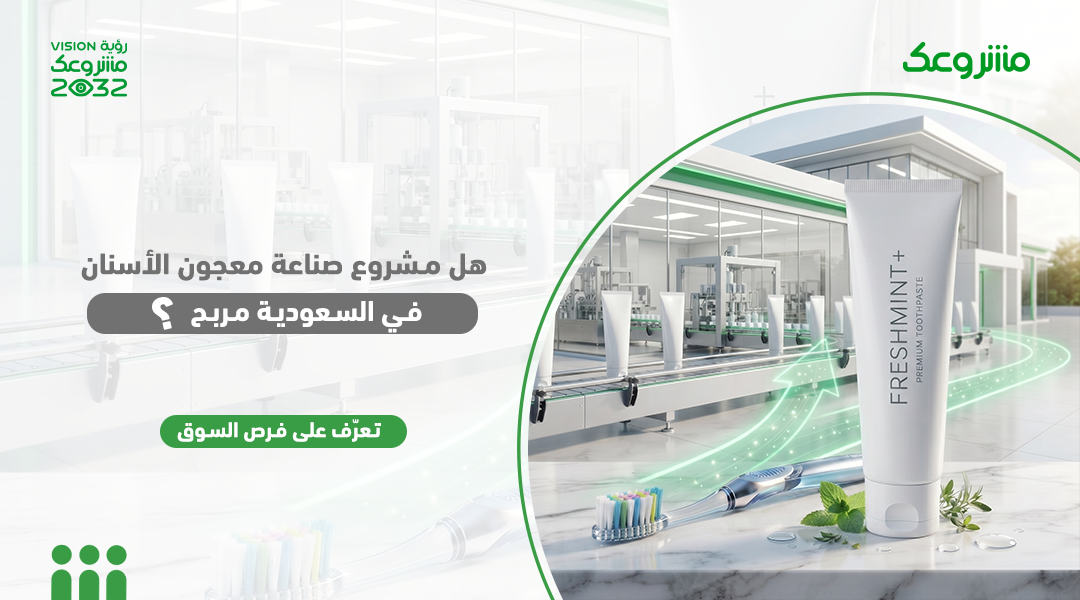
The idea behind a toothpaste manufacturing business is to establish a specialized factory that produces toothpaste in various types and formulations, such as anti-cavity toothpaste, teeth-whitening toothpaste, and toothpaste designed for children, then package it in suitable containers and distribute it to the market. The business relies on using safe, specification-compliant raw materials, such as abrasives, humectants, flavoring agents, binders, and active ingredients, while implementing strict quality control and product safety procedures. Toothpaste can be marketed through pharmacies, personal care stores, supermarkets, and e-commerce platforms.
Is a Toothpaste Manufacturing Business Profitable?
Yes, a toothpaste manufacturing business is considered one of the highly profitable ventures in the industrial sector. According to some statistics, the global toothpaste market was valued at USD 20.14 billion in 2025 and is expected to grow from USD 21.01 billion in 2026 to USD 33.27 billion by 2034, registering a compound annual growth rate (CAGR) of 5.92% during the forecast period.
Steps to Start a Toothpaste Manufacturing Business
Prepare a feasibility study for the business to determine market demand, investment requirements, costs, and expected revenues.
Study the market and competitors and identify the available product types, prices, and customer needs.
Determine the project location and choose a suitable space that aligns with the nature of the business and operational requirements.
Obtain the necessary licenses and permits to manufacture oral and dental care products.
Determine the types of toothpaste the business will produce based on market needs and the target customer segment.
Select suitable raw materials and ensure their quality and compliance with the required specifications and standards.
Provide the production lines and equipment required for mixing, homogenization, filling, and packaging.
Prepare the factory in accordance with production, hygiene, safety, and manufacturing quality requirements.
Hire specialized staff to operate the equipment and oversee production and quality control processes.
Conduct quality tests on raw materials and finished products to ensure their safety and compliance with specifications.
Design the packaging and brand identity to help distinguish the product and attract consumers.
Develop a marketing and distribution plan to reach customers and establish effective sales channels.
Start production gradually, monitor the product’s market performance, and continuously improve it based on customer feedback and actual results.
Raw Materials Required for a Toothpaste Manufacturing Business
Abrasives that help clean the teeth and remove deposits and surface stains.
Humectants that maintain the moisture of the toothpaste and prevent it from drying during storage and use.
Binders and thickeners that help achieve the appropriate consistency and maintain the uniformity of the toothpaste formulation.
Purified water, which is used in the toothpaste formulation and helps combine the various ingredients.
Cleansing and foaming agents that help distribute the toothpaste and clean the teeth during use.
Flavoring agents that provide the product with a suitable taste and aroma, such as refreshing flavors.
Sweeteners used to improve the product’s taste without necessarily relying on sugar.
Preservatives that help maintain product quality and prevent microbial growth in accordance with the formulation and applicable requirements.
Active ingredients that vary depending on the type and purpose of the toothpaste, such as ingredients used to help prevent cavities or support oral health.
Packaging materials, including toothpaste tubes, caps, labels, and outer packaging used to protect and market the product.
Key Equipment and Machinery for a Toothpaste Manufacturing Business
Water treatment tanks and equipment to provide suitable water for the manufacturing process.
Industrial mixers and homogenizers for mixing toothpaste ingredients and achieving a uniform formulation.
Preparation and storage tanks for holding raw materials and products during different manufacturing stages.
Grinding and dispersion machines to help distribute certain ingredients uniformly throughout the formulation.
Material transfer pumps for moving raw materials and toothpaste between tanks and production stages.
Toothpaste filling machines for filling the product into tubes or containers in specified quantities.
Tube sealing machines for securely sealing containers after filling.
Labeling machines for applying product information and brand labels to the containers.
Packaging and final packing machines for preparing products in their outer packaging for storage and distribution.
Quality control equipment and tools for testing raw materials and finished products and monitoring the required properties.
Cleaning and sanitization equipment to maintain the cleanliness of production areas and equipment in accordance with manufacturing requirements.
Suitable shelving and storage systems for keeping raw materials and finished products organized and safe.
Occupational safety equipment, such as personal protective equipment, fire-fighting systems, and safety facilities throughout the factory.
Production Stages of a Toothpaste Manufacturing Business
Receive and inspect raw materials to ensure they meet the required specifications.
Store raw materials in suitable conditions that preserve their quality.
Weigh the ingredients according to the specified formulation for each type of toothpaste.
Prepare and purify the water used in the manufacturing process.
Prepare liquid and soluble ingredients.
Add raw materials to the mixers according to the specified manufacturing sequence.
Thoroughly mix the ingredients to achieve a homogeneous formulation.
Add active ingredients, flavoring agents, sweeteners, and colors according to the product type.
Use homogenizers to achieve the appropriate consistency and texture of the toothpaste.
Inspect the finished product and ensure that it meets the required specifications.
Fill the toothpaste into designated tubes or containers.
Apply labels, product information, and the brand identity to the containers.
Store the finished product under suitable conditions to preserve its quality.
Distribute the products to sales outlets and target markets.
How Much Does a Toothpaste Manufacturing Business Cost in Saudi Arabia?
The cost of a toothpaste manufacturing business in Saudi Arabia varies from one project to another depending on the factory size, production capacity, and level of equipment and facilities. The key factors affecting the cost include:
The cost of purchasing or leasing land and the factory premises.
The cost of purchasing and installing toothpaste production lines.
The cost of mixers, homogenizers, and manufacturing tanks.
The cost of filling, sealing, and packaging equipment.
The cost of setting up a quality control laboratory.
The cost of containers, tubes, and packaging materials.
The cost of the required licenses, permits, and fees.
Labor, recruitment, and training costs.
Electricity, water, utilities, and operating costs.
Equipment and production line maintenance costs.
Storage, transportation, and distribution costs.
Marketing and advertising expenses and brand-building costs.
The level of automation and technologies used in the production line.
The quality of equipment and raw materials used in manufacturing.
The cost of developing and testing product formulations.
Working capital required to cover expenses during the initial operating period.
Market Study for a Toothpaste Manufacturing Business
Analyze the level of demand for toothpaste in the Saudi market.
Study target customer segments and their different consumer needs.
Identify the most in-demand types of toothpaste, such as whitening toothpaste, anti-cavity toothpaste, and products for gum care and sensitive teeth.
Analyze competitors and existing brands in the market.
Study the prices of competing products and the different price segments.
Identify competitors’ strengths and weaknesses and use these insights to develop the product.
Study distribution channels such as pharmacies, retail stores, personal care shops, and e-commerce platforms.
Analyze consumer trends toward specialized and natural products, as well as products supported by clear and credible claims.
Identify the project’s competitive advantage in terms of quality, price, formulation, and packaging.
Study opportunities for expanding into new products and target markets.
Estimating the target market share and developing an appropriate strategy for entering the market and competing effectively.
Success Indicators for a Toothpaste Manufacturing Business in the Saudi Market
High demand for oral and dental care products.
Achieving stable and growing sales.
Ensuring that the product complies with the specifications and quality and safety standards approved in Saudi Arabia.
Offering a diverse range of products that meet the needs of different consumer segments.
Maintaining consistent quality in formulation, texture, taste, and product effectiveness.
Competing effectively in terms of quality, price, and packaging.
Building a brand that earns consumers’ trust.
Expanding sales outlets, pharmacies, retail stores, and e-commerce platforms.
Achieving continuous growth in production and sales volumes.
Maintaining low rates of product returns and complaints.
Continuously developing products and innovating in formulations and packaging to meet market needs.
Maintaining operational efficiency while reducing waste and production costs.
Building the capacity to expand into local and international markets in the future.
Achieving an appropriate return on investment and maintaining sustainable project cash flows.
Continuously monitoring market indicators and changes in consumer behavior.
How to Choose the Best Location for a Toothpaste Manufacturing Business
Choose a location near major roads and transportation networks to facilitate the movement of raw materials and finished products.
Ensure the availability of essential utilities such as electricity, water, sewage, and telecommunications.
Choose a site within an industrial zone or an area where industrial activities are permitted.
Locate the factory near raw material suppliers to reduce transportation costs and speed up supply.
Ensure easy access for trucks and transport vehicles to the factory for loading and unloading products.
Choose a suitable area that can accommodate production lines, storage areas, filling and packaging facilities, and administrative offices.
Provide sufficient space to allow for future expansion and increased production capacity.
Ensure the availability of suitable ventilation and air-conditioning systems for the nature of the manufacturing processes.
Avoid locations that may affect product quality due to sources of pollution or waste.
Take into account the safety, health, and environmental requirements applicable to factories.
Assess the cost of purchasing or leasing the site in relation to the project’s investment budget.
Choose a location that provides easy access to target markets and distribution centers.
Ensure that the location complies with the requirements of regulatory authorities and industrial licensing requirements in Saudi Arabia.
SWOT Analysis of a Toothpaste Manufacturing Business
Strengths
High demand for toothpaste as an essential daily-use product.
The ability to diversify products and formulations according to consumer needs.
Multiple sales and distribution channels, including pharmacies, retail stores, and e-commerce platforms.
The potential to build a competitive local brand.
Opportunities to expand into manufacturing other oral and dental care products.
Weaknesses
High costs of establishing and equipping the factory and production lines.
The need to strictly comply with quality and safety standards.
Dependence on raw materials and ingredients with specific specifications.
The need for specialized technical staff in manufacturing and quality control processes.
Difficulty building trust in a new brand during the early stages of the business.
Opportunities
Growth in the oral and dental care products market.
Increasing consumer interest in oral health and dental care.
The ability to develop specialized products for different customer segments and needs.
Expansion of e-commerce distribution and reaching new customers.
Opportunities to enter new markets and expand into exports.
Capitalizing on demand for high-quality local products with competitive standards.
Threats
Strong competition from local and international brands.
Fluctuations in the prices of raw materials and production supplies.
Changes in product manufacturing and registration requirements and standards.
Rising operating, energy, and transportation costs.
Changes in consumer preferences and the emergence of new products and formulations.
Difficulty competing on price with large companies that benefit from high-volume production.
My Experience with a Toothpaste Manufacturing Business
With the continued expansion of the personal care sector and the growing demand for medical and consumer products in Saudi Arabia, I decided to invest in establishing a toothpaste manufacturing business. However, actual operations presented me with several complex challenges, most notably unclear investment planning, difficulties in securing financing, and administrative obstacles resulting from the absence of a clear organizational structure, overlapping authorities, and weak operational monitoring and control mechanisms. To address these challenges, I contacted Mashroak Consulting, which prepared a comprehensive feasibility study that clearly defined the financial and organizational roadmap and provided a comprehensive administrative restructuring plan that helped organize the distribution of tasks and manage workflow. This complete package enabled me to meet the financing requirements ofthe Saudi Industrial Development Fund and obtain the required support. As a result, it helped resolve the administrative challenges, ensure the stability of the production lines, and improve the project’s operational efficiency, allowing it to operate at a higher and more efficient capacity.
Frequently Asked Questions About a Toothpaste Manufacturing Business
What Ingredients Is Toothpaste Made From?
Toothpaste is made from a combination of ingredients that vary depending on the product type and formulation. These typically include purified water, abrasives for cleaning the teeth, humectants to maintain the toothpaste’s consistency, binders and thickeners to prevent the ingredients from separating, as well as cleansing and foaming agents, flavoring agents, sweeteners, and preservatives. Active ingredients such as fluoride may also be added depending on the product’s purpose and approved formulation.
What Is a Healthy Alternative to Toothpaste?
Some natural alternatives, such as miswak, can be used as an option for cleaning the teeth. However, miswak is not considered an equivalent substitute for fluoride toothpaste when it comes to preventing cavities. Therefore, it is preferable to use fluoride toothpaste and brush the teeth regularly, while miswak can be used as an additional oral care method.
What Is the Best Natural Toothpaste?
The best natural toothpaste is one that combines simple, safe ingredients with fluoride. Being labeled as natural does not necessarily mean that a toothpaste is better for dental health. The American Dental Association recommends using fluoride toothpaste to help prevent cavities. Some products are classified as natural and have also received the Association’s approval, including certain fluoride-containing varieties of Tom’s of Maine.
What Is Natural Fluoride?
Natural fluoride is the fluorine compound that occurs naturally in the environment. It is found in varying amounts in rocks, soil, water, and some foods. Fluoride is important for dental health because it helps strengthen tooth enamel and increase its resistance to cavities. It can enter the body through natural sources such as drinking water and certain foods, and it is also added to some oral care products, such as toothpaste, to benefit from its cavity-prevention properties.
In Conclusion: A Toothpaste Manufacturing Business
A toothpaste manufacturing business represents an industrial venture with good growth opportunities, particularly given the continued demand for oral and dental care products and the diversity of consumer needs. The success of the business depends on several factors, most notably selecting suitable raw materials and equipment, complying with quality and safety standards, studying the market and competitors, and focusing on marketing and building a competitive brand.
A comprehensive feasibility study also helps determine the required investment, estimate operating costs and expected revenues, and assess the project’s economic feasibility before implementation. Therefore, proper planning and a thorough assessment of all technical, financial, and marketing aspects provide an important foundation for turning the business idea into a successful and sustainable industrial venture.
To get in touch and request a feasibility study for a toothpaste manufacturing business
The kebab restaurant project is one of the food-service ventures that combines strong demand for grilled meals with the opportunity to target a diverse customer base, including individuals, families, and lovers of traditional Middle Eastern cuisine. With growing competition in the restaurant sector, however, the project’s success is no longer determined by food taste alone. […]
A children’s toy store project is not limited to selling toys; it is built on understanding what attracts children and what families look for when choosing products that combine entertainment and educational value. With the wide variety of educational toys, skill-development games, recreational toys, and gifts available, the store has opportunities to meet the needs […]
A residential complex project is no longer simply an investment in a collection of real estate units. It has evolved into an integrated development model that combines comfortable living, diverse services, and long-term investment value. As cities expand and residents’ needs evolve, demand is growing for residential complexes that offer a comprehensive environment suited to […]
The veterinary clinic project comes at a time when animal care is no longer limited to treating illnesses or injuries, but has expanded to include health monitoring, vaccinations, routine checkups, and care for both pets and livestock. However, many animal owners face challenges in accessing specialized veterinary services that combine prompt response, high-quality care, and […]