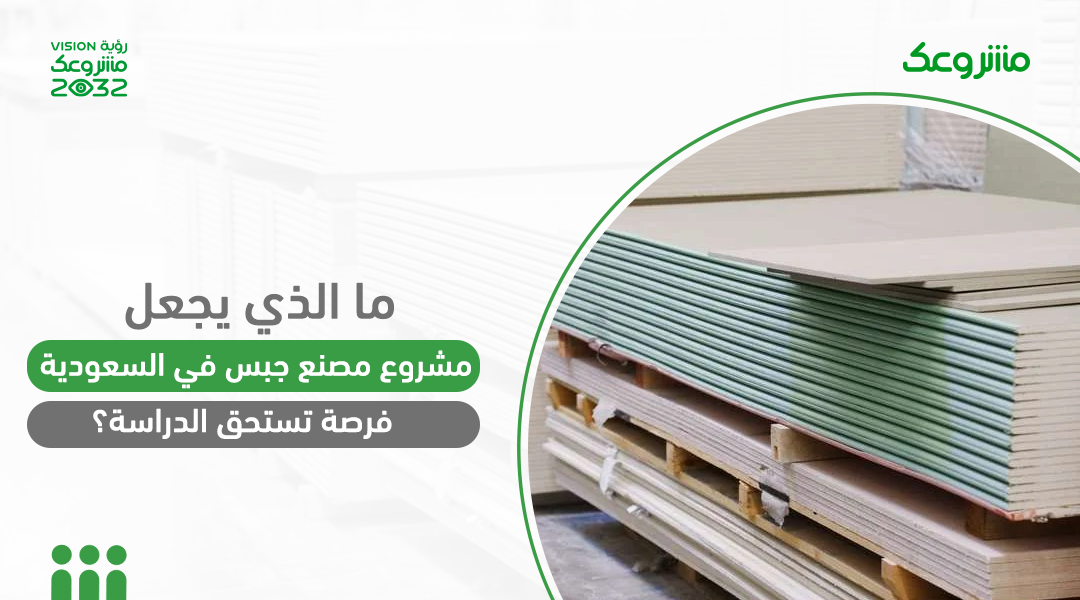
The gypsum factory project stands out as an industrial investment directly linked to construction activity and urban development, given the widespread use of gypsum products in finishing, decoration, and the preparation of residential and commercial units. The nature of these products and their wide range of applications create opportunities to offer a diverse product portfolio that meets the needs of different sectors.
However, the project’s success does not depend solely on the level of demand. It also depends on the ability to establish an integrated operating system that starts with selecting the right products and raw materials, determining the appropriate production capacity, and choosing suitable equipment, then ensuring consistent manufacturing quality and reaching customers through effective distribution channels.
Therefore, careful planning is an essential step before implementation. It helps assess the market, identify the project’s technical, operational, and financial requirements, and develop a competitive production model capable of supporting sustainable growth.
A gypsum factory is an industrial project specializing in the production and manufacturing of gypsum products in various forms and applications. It relies on gypsum raw materials that are processed through specific production stages and transformed into finished products that meet the needs of the construction, finishing, and interior decoration sectors.
The factory can offer a diverse range of products, such as gypsum boards, gypsum used in finishing works, and decorative gypsum products, according to the requirements of different customers and projects.
The project relies on specialized equipment and machinery for crushing, grinding, mixing, drying, forming, and packaging processes, along with strict quality control procedures to ensure that the products meet the required specifications and standards.
Read Here: White Cement Factory Project in Saudi Arabia: A Profitable Investment in the Construction Sector
Yes, a gypsum factory project is considered one of the most promising industrial investments, offering strong profitability potential. According to recent statistics, the global gypsum market was valued at USD 16.9 billion in 2025. It is expected to grow from USD 17.7 billion in 2026 to USD 32.5 billion by 2033, representing a compound annual growth rate (CAGR) of 9.1% from 2026 to 2033.
Read here: Construction and Building Sector Report in Saudi Arabia
A gypsum factory project is considered a promising investment opportunity due to its wide range of investment advantages, including:
Read Here: How to Start a Construction Equipment Rental Project in 2026
Read Here: How to Start a Concrete Block Factory in Saudi Arabia and Succeed in the Construction Market?
The cost of a gypsum factory project varies depending on several factors, most importantly the factory size, target production capacity, and type of gypsum products. The main cost items include:
Changes in the prices of gypsum raw materials, additives, and packaging supplies may increase production costs. Therefore, it is advisable to work with multiple suppliers, monitor prices regularly, and identify suitable alternative sources of supply.
Some stages of gypsum manufacturing require significant energy consumption, and higher energy costs can increase operating expenses. This can be mitigated by using energy-efficient equipment and continuously monitoring consumption rates.
The failure of a piece of equipment may disrupt production and delay order deliveries. Therefore, the factory should implement a preventive maintenance program, conduct regular inspections, and maintain a stock of essential spare parts.
Raw material issues or manufacturing errors may result in gypsum products that do not meet the required specifications. This can be addressed by inspecting raw materials, monitoring production processes, and conducting regular tests on finished products.
The factory may face competition from local manufacturers and products already available in the market. Competitiveness can be strengthened by maintaining product quality, offering a diverse product range, meeting delivery schedules, and providing excellent customer service.
Demand for gypsum products may be affected by activity in the construction sector and real estate projects. Diversifying products, customers, and target markets can therefore help reduce reliance on a single source of sales.
Some gypsum products may be affected by moisture or improper storage conditions. Therefore, the factory should provide dry, well-ventilated warehouses and organize storage and handling operations in a way that preserves product quality.
A shortage of technical expertise may reduce operational efficiency and increase errors. This can be addressed by recruiting qualified workers and providing continuous training in equipment operation, quality control, and safety procedures.
Transporting raw materials and finished products over long distances may increase costs and affect competitiveness. These costs can be reduced by selecting a suitable location, optimizing distribution routes, and efficiently managing transportation operations.
Read here: Feasibility Study (Definition, Objectives, Steps, Components, and Template)
Read here: All the secrets to profiting from a building materials store project.
Amid the unprecedented urban development and continued expansion of the construction sector in Saudi Arabia, with global statistics indicating growing demand for gypsum products, I decided to move forward with developing my existing gypsum factory, relying on high production capacity and substantial operational capabilities. However, I soon encountered complex market challenges that threatened the stability of my project, including declining sales, a lack of clarity regarding the most in-demand products, difficulties in identifying expansion markets, and insufficient accurate data on competitors, their pricing, and the reasons behind customers’ preference for them.
Faced with this uncertainty, I realized that the solution lay in making informed decisions based on research and analysis rather than assumptions. I therefore turned to Mashroak Consulting to begin a transformation journey through its comprehensive Market Study service. The study provided me with an accurate analysis of current and projected supply and demand, a deep understanding of the preferences and needs of my target audience, and a detailed assessment of competitors, their competitive advantages, and pricing strategies. It also relied on field surveys and questionnaires to identify customer perceptions and market gaps.
These efforts resulted in a well-structured timeline for launching my products, along with promotional and sales development strategies, as well as a clear assessment of future risks and key success factors. As a result, the crisis was successfully resolved, and my factory was transformed into a highly organized and productive investment operation that is now moving forward with confidence and achieving sustainable growth in the Saudi market.
The factory price of gypsum board varies depending on the type, specifications, thickness, and dimensions of the board, as well as the quality of the raw materials used, production costs, and order volume. Prices are also affected by transportation and distribution costs, market conditions, and the level of competition.
The price per square meter of gypsum varies depending on the type of gypsum used, the quality of the raw materials, the design, and the level of finishing, in addition to labor and installation costs and the project location. Prices also vary between traditional gypsum, gypsum board, and moisture- or fire-resistant types. Therefore, there is no standard price per square meter.
Neither can be considered universally better, as the choice depends on the nature of the project and the intended use. Traditional gypsum is suitable for conventional designs, decorative details, and applications requiring manual work and customized finishes. Gypsum board, on the other hand, offers faster installation, lighter weight, and greater versatility. It is also available in different types with specific properties, such as moisture and fire resistance. Therefore, the appropriate type should be selected based on the nature of the space, the required design, intended use, and available budget.
It cannot be said that gypsum is generally stronger than cement, as each material has different properties and applications. Cement offers greater strength and durability, as well as better load-bearing capacity and resistance to external conditions, making it suitable for structural elements and construction works. Gypsum, on the other hand, is lightweight, easy to shape, and quick to install, making it primarily suitable for finishing works, interior decoration, ceilings, and partitions. Therefore, the choice between the two depends on the intended use and the project’s technical requirements.
White and blue gypsum mainly differ in terms of their properties and intended applications. White gypsum is typically used for interior finishing and decorative works, while blue gypsum often refers to gypsum boards designed for applications requiring enhanced technical properties, such as moisture or fire resistance, depending on the specific board type and its specifications.
In conclusion, a gypsum factory project is an industrial investment that combines product diversity with a wide range of applications, creating strong opportunities for growth and expansion as the construction and finishing sectors continue to develop. However, achieving strong results requires a clear vision that begins with market research and product selection and extends to cost planning, operations, marketing, and risk management.
This is where Mashroak Consulting can help you turn your factory idea into a comprehensive investment plan by assessing the various aspects of the project and analyzing its opportunities and challenges. This provides you with a clearer foundation for making informed investment decisions and preparing to launch your project with confidence.

For more information or to request a feasibility study for a gypsum factory project
The kebab restaurant project is one of the food-service ventures that combines strong demand for grilled meals with the opportunity to target a diverse customer base, including individuals, families, and lovers of traditional Middle Eastern cuisine. With growing competition in the restaurant sector, however, the project’s success is no longer determined by food taste alone. […]
Read moreA children’s toy store project is not limited to selling toys; it is built on understanding what attracts children and what families look for when choosing products that combine entertainment and educational value. With the wide variety of educational toys, skill-development games, recreational toys, and gifts available, the store has opportunities to meet the needs […]
Read moreA residential complex project is no longer simply an investment in a collection of real estate units. It has evolved into an integrated development model that combines comfortable living, diverse services, and long-term investment value. As cities expand and residents’ needs evolve, demand is growing for residential complexes that offer a comprehensive environment suited to […]
Read moreThe veterinary clinic project comes at a time when animal care is no longer limited to treating illnesses or injuries, but has expanded to include health monitoring, vaccinations, routine checkups, and care for both pets and livestock. However, many animal owners face challenges in accessing specialized veterinary services that combine prompt response, high-quality care, and […]
Read more
خصم 25% على خدمات مشروعك استفد من العرض الآن، فالفرصة متاحة لفترة محدودة فقط
سجّل بياناتك واحصل على خصم 25% الآن


