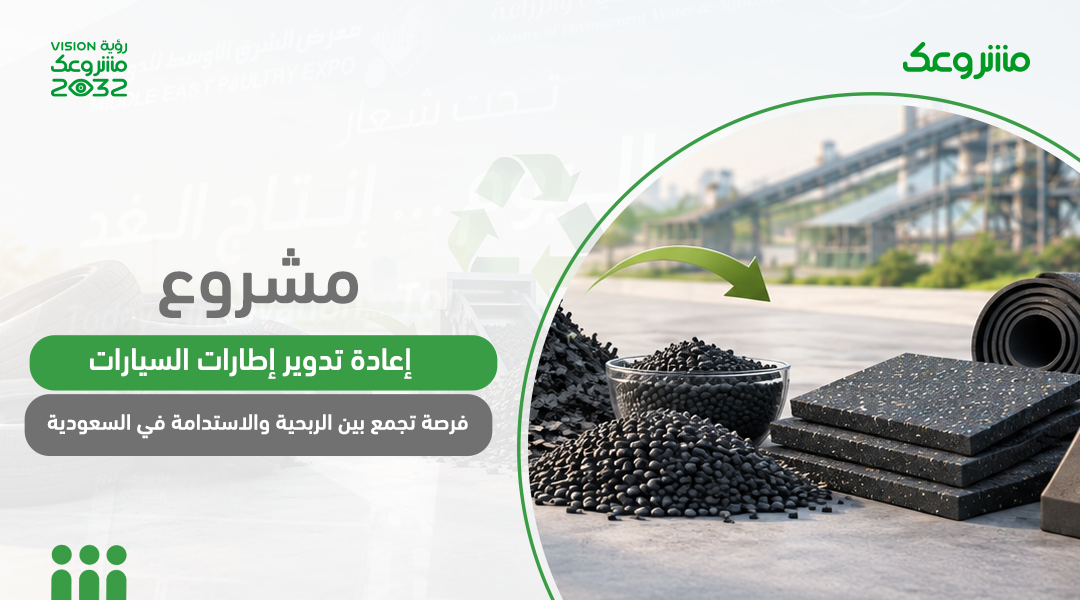
Car Tire Recycling Project: From Waste Tires to High-Value Products - Mashroo3k
Published18 Oct 2026 0 comments 148 Observation
Car Tire Recycling Project: From Waste Tires to High-Value Products

The car tire recycling project represents an industrial initiative that combines the economic utilization of waste with improved resource efficiency, particularly in light of the growing volume of end-of-life tires that require effective solutions for proper handling and reuse.
The project involves processing damaged and discarded tires and converting them into materials and products that can be used in various industrial and construction applications, such as recycled rubber, materials for sports field surfaces, and other rubber products.
This activity also creates opportunities to develop production processes based on modern recycling technologies, increasing the added value of waste and reducing the loss of reusable materials.
However, evaluating the project’s feasibility depends not only on the availability of used tires but also on the demand for the resulting products, the availability of suitable equipment, the project location, production capacity, and marketing channels. Therefore, conducting a feasibility study is an essential step in assessing the project’s technical, marketing, and financial aspects before implementation.

What Is the Concept Behind the Car Tire Recycling Project?

The car tire recycling project involves collecting used and damaged tires from various sources and processing them through specialized treatment and manufacturing operations to transform waste that is difficult to dispose of into reusable materials and products for a wide range of applications.
The process typically begins with sorting and preparing the tires, removing non-rubber components, and then shredding and grinding them into different sizes according to the intended end product. The resulting rubber can be used to manufacture rubber granules and powder, sports field and walkway flooring, and various rubber products. Other components, such as steel wires, can also be separated and recovered for use in suitable applications.

Read here:The best recycling project ideas to boost the growth of the circular economy

Does the Car Tire Recycling Project Offer Real Profit Opportunities?

Yes, the car tire recycling project offers genuine profit opportunities, as statistics indicate that the global tire recycling market was valued at USD 6.4 billion in 2025. The market is projected to grow from USD 6.64 billion in 2026 to USD 8.93 billion by 2034, registering a compound annual growth rate (CAGR) of 3.77% over the forecast period.

Reasons Investors Are Attracted to the Car Tire Recycling Project

The car tire recycling project is attracting growing interest from investors because it combines waste utilization with the production of materials used in a wide range of industrial and commercial applications. The key factors driving this interest include the following:

  • The availability of used tires as a raw material that can be collected from multiple sources.
  • The variety of products that can be obtained through recycling processes.
  • The wide range of applications for recycled rubber across different sectors.
  • The ability to recover and utilize tire components, such as rubber and metal wires.
  • Growing interest in solutions that reduce waste and improve resource efficiency.
  • Support for circular economy initiatives and material reuse instead of disposal.
  • The potential to upgrade production lines and introduce new products in response to market needs.
  • The availability of multiple sources for used tire supplies, including tire shops, maintenance workshops, and transportation companies.
  • The opportunity to establish partnerships with organizations that handle end-of-life tires to secure a consistent supply.
  • The diversity of target markets for recycled products, enabling the project to develop multiple sales and distribution channels.
  • The potential to leverage modern technologies to improve the efficiency of cutting, grinding, and separation processes while enhancing the quality of finished products.

Read Here: Why Is Demand for the Car Tire Sales Project Increasing?

How Does the Car Tire Recycling Project Support the Circular Economy in Saudi Arabia?

The car tire recycling project contributes to supporting the circular economy in the Kingdom of Saudi Arabia. through converting used tires into materials with economic value that can be utilized in various industries, including rubber flooring, road paving, and other industrial applications.
The importance of this sector is increasing in light of the growth opportunities reflected in the Saudi market. Its revenues reached USD 58.6 million in 2025 and are projected to reach USD 71.4 million by 2033, registering a compound annual growth rate (CAGR) of 2.66% over the period from 2026 to 2033.
This trend strengthens investment opportunities in tire recycling, contributing to waste reduction, the conservation of raw materials, and the support of local industries. It also aligns with the Kingdom’s commitment to environmental sustainability and improving waste management efficiency under Saudi Vision 2030.

Steps to Implement a Car Tire Recycling Project

  • Prepare a comprehensive feasibility study to determine costs, investment opportunities, and expected market demand.
  • Select a suitable industrial location with sufficient space for operations and storage.
  • Obtain the necessary industrial and environmental licenses and permits in the Kingdom of Saudi Arabia.
  • Identify the appropriate production lines and equipment for tire shredding, rubber grinding, and component separation.
  • Establish contracts with used tire suppliers to ensure a continuous supply of raw materials.
  • Recruit qualified technical and administrative staff to operate the equipment and manage daily operations.
  • Implement tire sorting, shredding, and processing operations to produce recycled rubber granules or powder.
  • Inspect the quality of finished products and ensure compliance with the required specifications.
  • Develop a marketing plan targeting factories, construction companies, and customers interested in recycled rubber products.
  • Monitor operational and financial performance and improve production processes to enhance efficiency and reduce waste.

Read here: How You Can Implement a Recycling Project

Cost of a Car Tire Recycling Project in Saudi Arabia

The cost of a car tire recycling project in Saudi Arabia varies significantly depending on the target production capacity, recycling technology, factory size, level of automation, and final products to be manufactured. The main cost items to consider include the following:

  • The cost of purchasing or leasing and preparing the factory site.
  • The costs of constructing and equipping buildings, warehouses, and tire reception areas.
  • The cost of the recycling line and cutting, grinding, separation, and sorting equipment.
  • The cost of control, ventilation, safety, and fire protection systems.
  • The costs of industrial utilities, connections, and energy.
  • The costs of obtaining licenses and regulatory and environmental approvals.
  • The cost of collecting and transporting used tires from suppliers.
  • Salaries for workers, technicians, and management staff.
  • Maintenance, spare parts, and operating expenses.
  • Packaging, storage, transportation, and marketing costs.
  • The working capital required to cover expenses during the initial operating phase.

Equipment Required for a Car Tire Recycling Project

  • A steel wire removal machine for extracting steel wire from tires.
  • A tire cutting machine for cutting tires into strips and preliminary pieces.
  • A tire shredding machine for reducing tires to smaller sizes.
  • A grinding mill for processing rubber into granules or powder.
  • Systems for separating metal wires from rubber.
  • Equipment for separating fibers and textile materials contained in tires.
  • Screens and sieves for classifying rubber granules by size.
  • Conveyor belts for transporting tires and materials between production stages.
  • Dust extraction and collection units for managing dust generated during grinding.
  • Packaging equipment for finished products.
  • An industrial scale for weighing raw materials and finished products.
  • Material handling and lifting equipment for moving tires and materials within the factory.
  • Safety equipment, fire protection systems, and protective systems for workers and machinery.

Success Factors for a Car Tire Recycling Project

  • Establishing a stable supply network to ensure a continuous flow of used tires.
  • Selecting final products based on customer needs rather than equipment production capacity alone.
  • Controlling the size and purity of rubber granules to meet the specifications required for each application.
  • Implementing a strict quality control system throughout all processing and production stages.
  • Maximizing the recovery of tire components and minimizing processing waste.
  • Training the operating team to handle equipment, improve production efficiency, and reduce breakdowns.
  • Conducting regular machinery maintenance to prevent production line stoppages and supply disruptions.
  • Researching target customers in advance and establishing supply contracts or agreements wherever possible.
  • Diversifying the customer base rather than relying on a single sector to absorb production.
  • Monitoring prices of competing materials and alternative products to understand changes that may affect competitiveness.
  • Complying with environmental standards and safety procedures in storage and operating areas.
  • Using operational data to measure productivity, waste, energy consumption, and processing costs.
  • Gradually developing products to meet emerging applications that can accommodate recycled rubber.

SWOT Analysis of a Car Tire Recycling Project

Strengths

  • The ability to convert used tires into marketable materials and products.
  • The wide range of potential applications for recycled rubber.
  • The opportunity to generate added value from multiple components within each tire.
  • The diversity of sources from which end-of-life tires can be obtained.
  • The project’s flexibility in developing products to meet the requirements of target industries.

Weaknesses

  • The need for sufficient investment in processing lines and specialized equipment.
  • Production efficiency may be affected by the condition, quality, and consistency of incoming tires.
  • The need for adequate space to store tires before processing.
  • The importance of regular maintenance in ensuring continuous production line operation.
  • The need for workers with technical and operational skills relevant to the nature of the business.

Opportunities

  • The expanding range of applications for materials derived from tire recycling across several industries.
  • The potential to develop new, higher-value products from recycled rubber.
  • Opportunities to expand partnerships with organizations that collect used tires.
  • The ability to benefit from circular economy initiatives and efforts to reduce resource waste.
  • The potential to expand production capacity or introduce additional production lines and products in the future.

Threats

  • Fluctuations in the prices of competing products and alternative raw materials.
  • The entry of new businesses into the tire recycling market.
  • The difficulty of maintaining consistent product quality when used tires come from different sources.
  • Rising energy, transportation, and maintenance costs and their impact on operating expenses.
  • Changes in environmental and regulatory requirements that may necessitate updates to operating procedures or equipment.

Read here: Everything You Need to Know About SWOT Analysis and How to Apply It

Challenges of a Car Tire Recycling Project

  • Securing a regular supply of used tires, particularly when relying on scattered or inconsistent sources.
  • Variations in incoming tires in terms of sizes, types, and degree of damage, which may affect the consistency of processing operations.
  • High industrial setup requirements due to the need for a production line capable of efficiently carrying out cutting, grinding, and separation processes.
  • Maintaining consistent product quality, particularly when producing rubber granules or powder with specific sizes and specifications.
  • Managing tire inventory efficiently to prevent large quantities from accumulating on-site and creating additional storage and safety requirements.
  • High energy consumption during certain cutting and grinding stages, making equipment efficiency and operational management important factors in controlling expenses.
  • Handling separated wires, fibers, and other materials in an organized manner to ensure their recovery or disposal in accordance with applicable requirements.
  • Maintaining equipment readiness, as breakdowns or delayed maintenance can interrupt production and increase costs.
  • Establishing a stable market for recycled products, particularly when competing with conventional raw materials or products manufactured from virgin materials.
  • Keeping up with environmental and regulatory requirements related to tire collection, processing, storage, and facility operations.
  • High transportation costs when collecting tires from distant areas or distributing products to remote markets, making effective supply chain and distribution network planning essential.

My Experience with a Car Tire Recycling Project

I never expected that noticing the accumulation of used tires would lead to an industrial project with growth potential in the Saudi market. I started my car tire recycling project with limited resources, aiming to make use of damaged tires and transform them into materials and products suitable for various applications. As operations began, I focused on building a supply network to secure used tires and improving sorting, cutting, and grinding processes.

Over time, I began to notice growing demand for recycled products, which made me realize that the project had a genuine opportunity for expansion. However, this increased demand revealed a new challenge: the existing production capacity was no longer sufficient to capitalize on the opportunities available to the project. I therefore needed to develop the production line, add more efficient equipment, and increase the capacity to receive and process larger quantities of tires.

Translate the headings and bullet points consistently

I realized then that increasing demand for the project’s products alone was not enough to move forward with a new phase of expansion. I needed a specialized firm to help me translate the project’s needs into a clear plan and a comprehensive investment proposal. Therefore, I turned to Mashroo3k Consulting, where the team assessed the project’s current status, identified its expansion requirements, and professionally analyzed its technical, operational, and financial aspects.
With this support, I began upgrading equipment, increasing production capacity, and improving tire processing stages, alongside enhancing operational methods and quality standards. As these steps were implemented, the project became better equipped to handle larger quantities of tires and meet customer needs.

Frequently Asked Questions About the Car Tire Recycling Project

What Are the Production Stages for Recycled Tire Products?

The production of recycled tire products involves several interconnected stages. It begins with collecting used tires and sorting them according to type and condition, followed by cleaning, preparation, and removal of unwanted components. The tires are then cut and shredded into smaller pieces before being ground into granules or powder of the required sizes. Next, the rubber is separated from metal wires and fibers using specialized equipment. The rubber is then screened and classified according to size and quality. Finally, it is packaged and stored in preparation for marketing or use in manufacturing other products.

Read here:Discover how to turn waste into wealth through recycling

What Products Can Be Obtained from Car Tire Recycling?

The car tire recycling project produces a variety of materials and products, depending on the processing technologies and production line used. The most notable outputs include rubber granules and rubber powder, which are used in a wide range of applications, as well as rubber sheets and pieces that can be incorporated into certain industrial products. Steel wires embedded in tires can also be recovered and sold as metal scrap. In addition, fibers and textiles can be separated during processing and handled according to their available applications. Recycled rubber can also be used to manufacture flooring products, rubber mats, and other components, depending on the material’s quality and the specifications required by the market.

What Raw Materials Are Required for a Car Tire Recycling Project?

The primary raw material for a car tire recycling project is used and damaged tires collected from tire shops, maintenance workshops, transportation companies, and various other supply sources. Suitable tires are selected based on the type of products targeted. The project also requires packaging materials, as well as operating and maintenance supplies. Other tire components, such as steel wires and textile fibers, are separated during processing for recovery or handling according to their available applications.

In conclusion, our article on the car tire recycling project…

We can conclude that the car tire recycling project represents an opportunity to establish an industrial business that utilizes available waste and transforms it into products with diverse applications, combining environmental benefits with economic value. However, turning this idea into a viable and scalable project requires a thorough market study, identification of the most in-demand products, selection of appropriate technologies and equipment, and the development of a clear plan for operations, marketing, and cost management. Advance planning also helps identify potential challenges and develop practical solutions to address them, enhancing the project’s ability to remain sustainable and expand in line with market requirements. This highlights the importance of preparing a comprehensive feasibility study that identifies opportunities and challenges and provides a clear vision of the project before implementation, enabling investment decisions to be made based on accurate data and thorough analysis.

For inquiries or to request a feasibility study for a car tire recycling project, please contact us.


Similar Articles

How to Turn a Kebab Restaurant Project into a Distinctive Brand in Egypt?

The kebab restaurant project is one of the food-service ventures that combines strong demand for grilled meals with the opportunity to target a diverse customer base, including individuals, families, and lovers of traditional Middle Eastern cuisine. With growing competition in the restaurant sector, however, the project’s success is no longer determined by food taste alone. […]

Read more

Children’s Play Center Project in Saudi Arabia: How to Create an Experience That Attracts Children and Families?

A children’s toy store project is not limited to selling toys; it is built on understanding what attracts children and what families look for when choosing products that combine entertainment and educational value. With the wide variety of educational toys, skill-development games, recreational toys, and gifts available, the store has opportunities to meet the needs […]

Read more

Residential Complex Project in Saudi Arabia: An Investment That Creates Value Beyond Residential Units

A residential complex project is no longer simply an investment in a collection of real estate units. It has evolved into an integrated development model that combines comfortable living, diverse services, and long-term investment value. As cities expand and residents’ needs evolve, demand is growing for residential complexes that offer a comprehensive environment suited to […]

Read more

Veterinary Clinic Project in Egypt: A Promising Investment Opportunity in the Animal Care Sector

The veterinary clinic project comes at a time when animal care is no longer limited to treating illnesses or injuries, but has expanded to include health monitoring, vaccinations, routine checkups, and care for both pets and livestock. However, many animal owners face challenges in accessing specialized veterinary services that combine prompt response, high-quality care, and […]

Read more

Green Friday

فرصة لا تتكرر

GREEN FRIDAY

خصم 25% على خدمات مشروعك استفد من العرض الآن، فالفرصة متاحة لفترة محدودة فقط
سجّل بياناتك واحصل على خصم 25% الآن