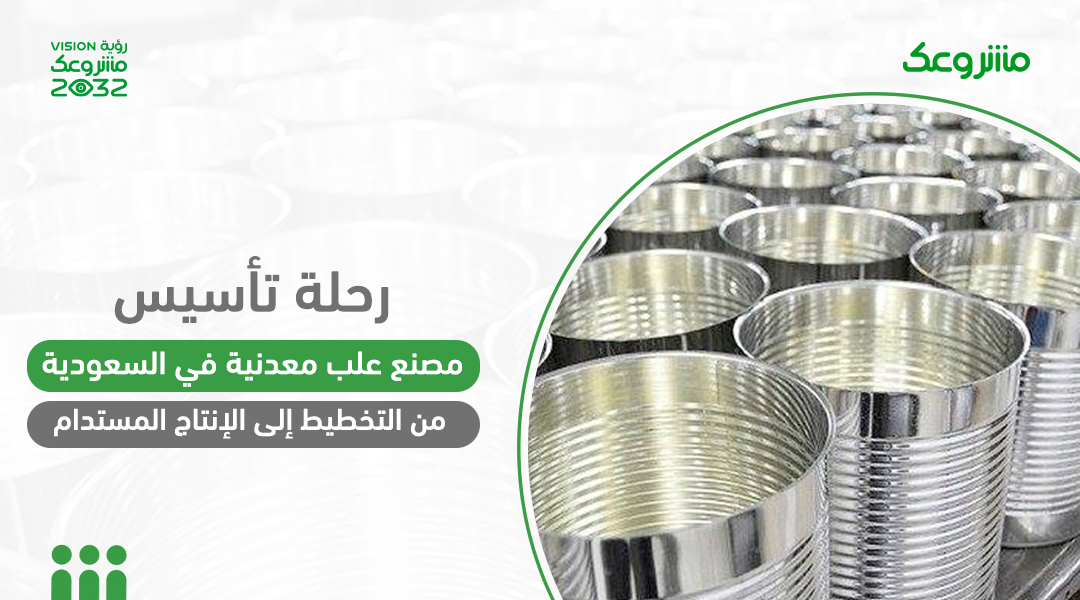
The Journey of Establishing a Metal Can Factory in Saudi Arabia: From Planning to Sustainable Production - Mashroo3k
Published13 Oct 2026 0 comments 63 Observation
The Journey of Establishing a Metal Can Factory in Saudi Arabia: From Planning to Sustainable Production

Establishing a metal can factory presents a distinctive investment opportunity in the Saudi market, driven by the growing needs of paint manufacturers for containers that combine durability, ease of storage, and effective product protection. Metal cans used for paint packaging can withstand storage and transportation conditions and can be manufactured in various sizes, shapes, and designs to meet the diverse requirements of paint companies.
With Saudi Arabia’s focus on strengthening the industrial sector and increasing local content, specialized projects manufacturing metal paint cans can benefit from the growth of local supply chains and the expanding range of industrial opportunities. Therefore, proper preparation for a metal paint can factory begins with understanding market and customer needs, identifying suitable raw materials and production lines, studying operational and marketing requirements, and evaluating costs, growth opportunities, and competition. These aspects are explored in detail in the following sections.

What Is the Concept of a Metal Can Factory Project?

The concept of a metal can factory project involves establishing an industrial facility specializing in manufacturing metal containers to meet the needs of paint companies and manufacturers. The production process involves cutting, forming, and printing metal sheets, assembling and sealing the components, and then inspecting the cans to ensure their quality and durability.

The project also allows for the production of containers in various sizes and designs according to customer requirements. In addition, leftover metal can be recovered and recycled to minimize waste and improve resource efficiency, supporting more sustainable production processes and strengthening the factory’s competitiveness.

Is a Metal Can Factory Project Profitable?

Yes, a metal can factory is considered one of the industrial projects with strong profit potential, as indicated by the latest statistics. The global metal can market was valued at USD 79.22 billion in 2025 and is projected to grow from USD 84.38 billion in 2026 to USD 139.87 billion by 2034, registering a compound annual growth rate (CAGR) of 6.52% over the forecast period.

Why Is There Growing Demand for a Metal Can Factory Project in the Saudi Market?

A metal can factory project benefits from growing demand in the Saudi market due to several advantages, including the following:

  • Rising demand for metal packaging across multiple sectors.
  • A wide range of applications for metal cans.
  • The ability to produce cans in various sizes, shapes, and designs.
  • The opportunity to target factories, companies, and wholesalers as customers.
  • Strong opportunities to localize packaging manufacturing and reduce reliance on imports.
  • The potential to expand production capacity in the future.
  • Opportunities to enter export markets across the region.
  • Benefits from the continued development of Saudi Arabia’s industrial sector.
  • The ability to implement automation and modern technologies across production lines.
  • The recyclability of metal products, supporting sustainability initiatives.
  • Multiple opportunities to establish supply and procurement contracts with factories and commercial establishments.
  • The ability to diversify revenue streams by producing different types of cans and targeting various sectors.

Market Analysis for a Metal Can Factory Project

  • Growth in Saudi Arabia’s paints and coatings sector.
  • Increasing demand for metal containers used in paint packaging.
  • The link between demand for paint cans and growth in the construction and real estate development sectors.
  • Expansion of industrial and commercial projects that support demand for paints.
  • A large number of paint companies and manufacturers as potential customers.
  • Diverse paint manufacturers’ requirements in terms of can sizes and designs.
  • Opportunities to localize paint can manufacturing and reduce dependence on imported products.
  • Intensifying competition among metal can suppliers in the market.
  • The potential to compete through manufacturing quality, dimensional accuracy, and fast delivery.
  • Opportunities to establish long-term supply contracts with paint manufacturers.
  • Opportunities to expand into new industrial zones and markets within the Kingdom.
  • The potential to increase sales by developing products in line with customer requirements.

Read here: Market Research for a Project: The Foundation of Investment Planning and Identifying the Most Profitable Opportunities

Key Cost Components of a Metal Can Factory Project in Saudi Arabia

  • The cost of purchasing or leasing and preparing the factory site.
  • The cost of constructing and equipping production halls and warehouses.
  • The cost of purchasing metal can production lines.
  • The cost of machines for cutting, forming, and welding.
  • The cost of printing, coating, and drying equipment.
  • The cost of electrical, water, and ventilation systems.
  • The cost of quality control, inspection, and safety systems.
  • The cost of equipment installation, operation, and testing.
  • The cost of purchasing raw materials and production supplies.
  • The cost of labor, training, and qualification.
  • The cost of licenses, insurance, and administrative expenses.
  • The cost of equipment transportation, shipping, and installation.
  • The cost of marketing and distribution.
  • The working capital required to commence operations.

Essential Equipment and Facilities for a Metal Can Factory Project

  • An integrated production line for manufacturing metal paint cans.
  • Metal sheet cutting and shearing machines.
  • Presses for forming can bodies.
  • Machines for rolling and shaping can sides.
  • Machines for welding and sealing can bodies.
  • Machines for attaching can bottoms and lids.
  • Metal lid forming equipment.
  • Printing machines for preparing and decorating the exterior surfaces of cans.
  • Coating, varnishing, and internal protection equipment.
  • Drying ovens and curing equipment.
  • Equipment for inspecting weld and seal quality.
  • Devices for testing can leakage and durability.
  • Air compressors and compressed air systems.
  • Cranes and material-handling equipment for transporting raw materials and finished products.
  • Shelving and storage facilities for metal sheets and finished cans.
  • Ventilation, safety, and fire protection systems.

How to Start a Metal Can Factory Project

  • Identify the types of metal cans to be manufactured and the sectors the factory will serve.
  • Study market demand, competitors, and potential customers in the Saudi market.
  • Determine the appropriate production capacity based on market needs.
  • Select a suitable industrial site that meets the requirements of the business activity.
  • Obtain the licenses and approvals required to operate the industrial facility.
  • Define product specifications and the raw materials to be used in manufacturing.
  • Select production lines and equipment that match the target production capacity.
  • Equip the factory with production halls, warehouses, utilities, and safety systems.
  • Recruit qualified technical and administrative personnel to operate the project.
  • Conduct trial runs and test product quality before commencing commercial production.
  • Develop an effective marketing and distribution strategy to reach target factories and companies.
  • Monitor operating costs and production quality, and improve products to meet market requirements.

Raw Materials Required for a Metal Can Factory Project

  • Tin-plated steel sheets for manufacturing can bodies and lids.
  • Metal sheets suitable for forming can bottoms and other packaging components.
  • Printing inks designed for metal surfaces.
  • Exterior coatings and varnishes for finishing and protection.
  • Interior coatings suitable for cans used to package paints.
  • Welding materials used to assemble can components.
  • Sealing and insulation materials to ensure airtight and secure packaging.
  • Cleaning and surface preparation materials for metal sheets before printing and coating.
  • Packaging materials to protect cans during storage and transportation.

Specifications of the Best Production Line for a Metal Can Factory Project

  • A high level of automation to reduce manual intervention and improve production efficiency.
  • High cutting and forming precision to ensure consistent can dimensions.
  • The ability to manufacture paint cans in various sizes and capacities.
  • Integrated stages for cutting, forming, welding, and sealing.
  • High-quality welding to ensure can durability and prevent leakage.
  • The ability to achieve consistent quality in printing and exterior finishing.
  • A suitable system for coating and protecting metal surfaces.
  • An appropriate production speed while maintaining product quality.
  • Automated inspection systems to detect defects throughout the manufacturing process.
  • Efficient use of raw materials and energy while minimizing waste.
  • Ease of operation, control, and routine maintenance.
  • Availability of spare parts and technical support from the supplier.
  • The ability to upgrade the production line and increase its capacity in the future.

Read Here: The Role of Artificial Intelligence in Improving Production Line Efficiency

Production Stages of a Metal Can Factory Project

  • Receiving and inspecting metal sheets to ensure that the raw materials meet the required quality standards and specifications before manufacturing begins.
  • Cleaning and preparing raw materials by treating the sheets and preparing their surfaces for cutting, forming, and printing operations.
  • Cutting metal sheets precisely according to the specified dimensions and measurements for each type of can.
  • Forming the sheets to produce can bodies, bottoms, and lids in the required dimensions.
  • Printing the brand name, product information, and exterior designs on the can surfaces.
  • Applying suitable coating and protective layers to enhance the appearance of the cans and protect their surfaces.
  • Assembling the can bodies and joining their components using appropriate welding and sealing techniques.
  • Securing the final components and ensuring that the containers are properly sealed and durable.
  • Inspecting dimensions, welds, and seals to ensure that the cans are free from defects and leaks.
  • Cleaning and preparing the cans, then packaging them in a way that preserves their quality during storage and transportation.
  • Storing finished products under appropriate conditions and preparing them for delivery to paint companies and manufacturers.

Requirements for Selecting the Best Location for a Metal Can Factory Project

  • Choosing a site within an approved industrial zone that is suitable for the nature of the business.
  • Proximity to target customers and factories manufacturing food, beverages, and industrial products.
  • Easy access to major roads, transportation networks, and logistics services.
  • Availability of an adequate electricity supply to operate production lines and equipment.
  • Access to water, drainage, and other essential utilities required for operations.
  • Sufficient space for the factory, production lines, warehouses, and loading areas.
  • Allocating suitable areas for storing raw materials and finished products.
  • Easy access for trucks and vehicles transporting raw materials and finished products.
  • Proximity to raw material and supply sources to reduce transportation costs.
  • Availability of security, safety, fire protection, and ventilation systems.
  • Potential for future expansion and the addition of new production lines.
  • Compliance with the environmental and regulatory requirements applicable in Saudi Arabia.

Key Factors That Determine the Profitability of a Metal Can Factory Project

  • Strong demand for paint cans and stable market requirements support sales growth.
  • Diversifying the customer base and securing contracts with more paint manufacturers reduces reliance on a limited number of clients.
  • Improving production line efficiency and making effective use of available capacity helps increase output and sales.
  • The prices of metal sheets, printing inks, and coatings directly affect can manufacturing costs.
  • Reducing scrap and waste during cutting, forming, and welding helps lower production costs.
  • Manufacturing durable, securely sealed cans that meet required specifications strengthens customer confidence and supports long-term contracts.
  • Setting competitive prices that deliver an appropriate profit margin while maintaining market competitiveness.
  • Controlling labor, energy, maintenance, and transportation costs helps improve profit margins.
  • Maintaining consistent engagement with paint manufacturers and attracting new customers supports sales growth.
  • Procuring raw materials in appropriate quantities and avoiding excessive inventory helps optimize working capital.
  • Offering a variety of sizes and designs tailored to customer requirements creates additional sales and expansion opportunities.

How a Metal Can Factory Project Supports the Circular Economy

A metal can factory specializing in paint packaging supports the concept of a circular economy by making efficient use of metal resources, minimizing manufacturing waste, and recycling scrap materials to produce new materials. These practices help reduce raw material consumption, limit industrial waste, and improve resource efficiency, thereby strengthening environmental sustainability and supporting Saudi Arabia’s industrial sector in adopting more efficient and sustainable production practices.

This can be achieved by sorting tinplate and aluminum offcuts generated during metal sheet cutting and sending them to specialized recycling facilities. Additional measures include optimizing raw material consumption, improving energy efficiency, and safely handling waste generated during printing and coating operations. These practices align with Saudi Arabia’s efforts to promote the circular economy and improve industrial waste management, as outlined by the National Center for Waste Management.

Read Here: Metal Recycling Project in Saudi Arabia: How Can Waste Be Turned into a Source of Income?

My Experience with a Metal Can Factory Project

With the continuous growth of the paint market in Saudi Arabia, I decided to expand my existing factory, which specializes in manufacturing metal paint cans. The factory had a production capacity capable of meeting market demand, but expansion proved more challenging than I had expected. We struggled to reach paint manufacturers and target customers, relied on a limited number of clients, faced price competition, and had a weak marketing and digital presence.
I realized that product quality and production capacity alone were not enough to achieve growth. Therefore, I turned to Mashroo3k Consulting for its promotional plan service to develop a clear strategy to address these challenges and improve the factory’s market reach.

The specialists at Mashroo3k Consulting began by analyzing the factory’s current position, the market, and competitors, while identifying target customers. They then developed a comprehensive promotional plan focused on expanding the customer base and establishing consistent channels for attracting new companies. The plan also highlighted the quality, specifications, and competitive advantages of the factory’s metal cans to address price competition and strengthen the value offered to customers. In addition, they worked to enhance the factory’s marketing and digital presence and select the most effective channels for reaching industrial customers.

Following the implementation of the recommendations, we adopted a more structured approach to reaching and engaging with customers. The factory began expanding its customer base and strengthening its market presence, with a greater ability to compete and generate new sales opportunities. Today, we have a clearer marketing direction, and our expansion in the Saudi market is guided by a more organized and targeted strategy.

Read Here:Why Do Companies Need a Promotional Plan?

Frequently Asked Questions About a Metal Can Factory Project

What Are the Best Types of Metal Cans to Manufacture?

A metal can factory can produce cans for food and beverages, paints, oils and lubricants, chemicals and industrial materials, as well as gift tins, confectionery tins, and customized packaging. Product selection depends on market demand and target customer requirements, with opportunities to diversify sizes, shapes, and designs to expand the customer base.

What Products Can Be Packaged in Metal Cans?

Metal cans can be used to package a wide range of products, most notably canned foods, beverages, confectionery and biscuits, oils and lubricants, paints and coatings, certain chemicals and industrial products, as well as promotional items and gifts. The type of can and its internal protective coating depend on the nature of the product, its preservation requirements, and packaging safety standards.

What Specifications Should Metal Cans Meet?

Metal cans should be durable, resistant to rust and corrosion, securely sealed, and have safe interior and exterior surfaces. The materials used must be suitable for the products being packaged. Dimensions and thickness should be precise, with no defects or sharp edges, and the cans should withstand transportation and storage without damage. For cans intended for food and beverages, materials and coatings suitable for food contact must be used, in compliance with the applicable standards and requirements in Saudi Arabia.

What Is the Difference Between Metal Cans and Plastic Containers?

Metal cans offer high durability and effective protection against light, air, and external factors. They are also highly recyclable, making them suitable for food, beverages, paints, and industrial products. Plastic containers, on the other hand, are lightweight, easy to mold, and available in a wide range of designs. They are often more flexible in use and weigh less during transportation. The choice between the two depends on the nature of the product, preservation requirements, storage duration, and manufacturing and transportation costs.

Conclusion: The Journey of Establishing a Metal Can Factory

A metal can factory project has strong growth potential in Saudi Arabia, supported by the broad range of industries that require reliable packaging solutions and the diverse applications of metal products. The project’s opportunities increase when it focuses on manufacturing quality, the ability to meet customer needs through varied sizes and designs, and production flexibility, while building long-term supply relationships with target companies and factories.

Although investment size and the selection of suitable equipment and technologies are important factors, market knowledge and efficient operations management remain essential to establishing a genuine competitive advantage. Therefore, careful planning from the outset gives investors a clearer understanding of market demand, costs, operational capabilities, and growth opportunities, paving the way for launching a factory that can compete effectively and capitalize on opportunities in Saudi Arabia’s industrial sector.

Contact Us to Request a Feasibility Study for a Metal Can Factory Project.

Keywords::

Metal Can Factory


Similar Articles

How to Turn a Kebab Restaurant Project into a Distinctive Brand in Egypt?

The kebab restaurant project is one of the food-service ventures that combines strong demand for grilled meals with the opportunity to target a diverse customer base, including individuals, families, and lovers of traditional Middle Eastern cuisine. With growing competition in the restaurant sector, however, the project’s success is no longer determined by food taste alone. […]

Read more

Children’s Play Center Project in Saudi Arabia: How to Create an Experience That Attracts Children and Families?

A children’s toy store project is not limited to selling toys; it is built on understanding what attracts children and what families look for when choosing products that combine entertainment and educational value. With the wide variety of educational toys, skill-development games, recreational toys, and gifts available, the store has opportunities to meet the needs […]

Read more

Residential Complex Project in Saudi Arabia: An Investment That Creates Value Beyond Residential Units

A residential complex project is no longer simply an investment in a collection of real estate units. It has evolved into an integrated development model that combines comfortable living, diverse services, and long-term investment value. As cities expand and residents’ needs evolve, demand is growing for residential complexes that offer a comprehensive environment suited to […]

Read more

Veterinary Clinic Project in Egypt: A Promising Investment Opportunity in the Animal Care Sector

The veterinary clinic project comes at a time when animal care is no longer limited to treating illnesses or injuries, but has expanded to include health monitoring, vaccinations, routine checkups, and care for both pets and livestock. However, many animal owners face challenges in accessing specialized veterinary services that combine prompt response, high-quality care, and […]

Read more

Green Friday

فرصة لا تتكرر

GREEN FRIDAY

خصم 25% على خدمات مشروعك استفد من العرض الآن، فالفرصة متاحة لفترة محدودة فقط
سجّل بياناتك واحصل على خصم 25% الآن