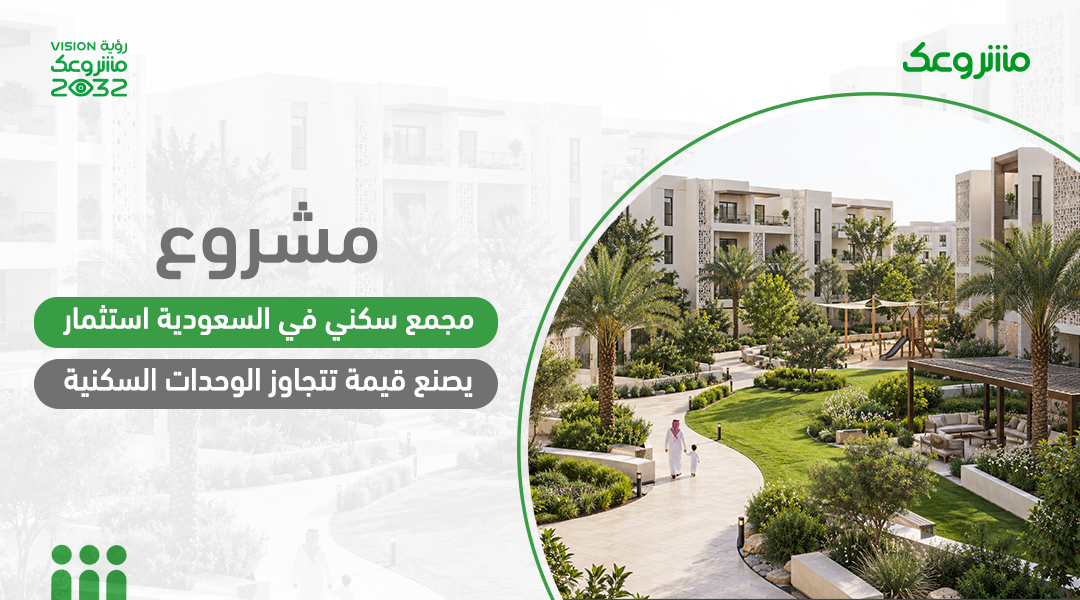
Residential Complex Project in Saudi Arabia: An Investment That Creates Value Beyond Residential Units - Mashroo3k
Published29 Oct 2026 0 comments 137 Observation
Residential Complex Project in Saudi Arabia: An Investment That Creates Value Beyond Residential Units

A residential complex project is no longer simply an investment in a collection of real estate units. It has evolved into an integrated development model that combines comfortable living, diverse services, and long-term investment value. As cities expand and residents’ needs evolve, demand is growing for residential complexes that offer a comprehensive environment suited to modern lifestyles while providing residents with greater privacy and comfort.
However, turning this opportunity into a viable and scalable project requires more than selecting a plot of land or designing residential units. Success depends on evaluating the location, analyzing market demand, identifying the target customer segment, planning facilities and services, and assessing expected costs and returns. The development’s architectural identity, marketing strategy, and management approach also play an important role in enhancing its appeal and competitiveness.
Therefore, a feasibility study is an essential step in understanding the market, evaluating opportunities and risks before making an investment decision, and developing a clear vision for a project capable of meeting residents’ needs while achieving the investor’s objectives.

Read also: Best Projects in Saudi Arabia: Your Guide to Investment Opportunities Aligned with Vision 2030

What Is a Residential Complex Project?

A residential complex project is an integrated real estate development that comprises a group of residential units within a unified urban master plan, supported by a range of facilities and services designed to meet residents’ needs and provide a more comfortable and well-organized living environment. The complex may include apartments, villas, or a mix of different residential unit types, alongside green spaces, parking areas, recreational facilities, and commercial or community services, depending on the nature of the project and its target market.
The complex is designed to make efficient use of the available land while maintaining a balance between residential units, services, and shared facilities. It also represents an investment opportunity through the sale or rental of residential units.

Read also: [Investing in a Residential Apartment Project Step by Step: A Comprehensive Guide to Achieving Stable Returns]

Is a Residential Complex Project Worth Investing In?

A residential complex project is considered a promising real estate investment opportunity worth careful consideration, given the positive growth outlook for the global residential real estate market. Statistics indicate that the market’s value increased from USD 10.90 trillion in 2025 to USD 11.60 trillion in 2026, and is projected to reach USD 15.53 trillion by 2031, representing a compound annual growth rate (CAGR) of 6.05% over the 2026–2031 period. These indicators highlight the sector’s growth potential and reinforce the importance of evaluating investment in residential complexes in light of market needs and expected demand.

Read here: Construction and Building Sector Report in Saudi Arabia

Key Advantages of Investing in a Residential Complex Project

Investing in a residential complex project offers several advantages that make it a real estate venture with strong growth potential, particularly as cities develop and residents’ needs become more diverse. The key advantages include:

  • Meeting demand for residential units by offering a variety of options that suit the needs of individuals and families.
  • Generating investment returns through the sale or rental of residential units over the short and long term.
  • Diversifying income streams by combining residential units with commercial and service facilities within the complex.
  • Increasing the value of real estate assets as the surrounding area develops and infrastructure and services improve.
  • Capitalizing on a strategic location by selecting areas close to major roads and essential facilities.
  • Strengthening competitiveness by offering modern designs and integrated facilities that meet residents’ expectations.
  • Enabling future expansion by developing the project in phases according to market demand and available financing.
  • Achieving relative investment stability through ownership of real estate assets that can be sold or leased.

Read here: Why Residential Apartment Projects Are the Ideal Investment Choice

Market Analysis for a Residential Complex Project in Saudi Arabia

A market analysis for a residential complex project aims to assess the real estate market in the target area and identify the level of demand for residential units, customer profiles, and their needs, while examining population and urban growth rates and the factors influencing market activity. It also involves analyzing competing residential developments in terms of location, unit designs, sizes, prices, services, and facilities, as well as identifying their strengths and weaknesses that can inform the project’s development.

The study also includes evaluating the proposed location and its proximity to roads, services, and essential facilities, in addition to analyzing the current housing supply and competing projects expected to enter the market. The findings help identify the target customer segment, suitable residential unit types, and services that enhance the complex’s appeal. They also support the development of a pricing and marketing strategy aligned with market conditions, enabling more informed investment decisions before project implementation.

Main Cost Components of a Residential Complex Project in Saudi Arabia

The cost of a residential complex project is distributed across several key components, which vary depending on the project’s location and area, the number and design of residential units, and the targeted finishing standards and services. The main cost components include:

  • The cost of purchasing or leasing the land and preparing it for development.
  • Design and engineering consultancy costs, including the preparation of plans and technical studies.
  • Licensing, permitting, and regulatory fees associated with the project.
  • Construction and building costs, including structural work, finishing, and architectural work.
  • Infrastructure network costs, such as water, sewage, electricity, and telecommunications.
  • The costs of constructing and equipping facilities and services within the complex, according to the project’s nature.
  • Landscaping costs, including green spaces, walkways, and parking areas.
  • Security, safety, surveillance, and access control system costs.
  • Marketing and promotional expenses for residential units and customer acquisition.
  • Administrative and operating expenses throughout the development and operational phases.
  • Financing costs if external funding sources are used.
  • A contingency and risk allowance to cover potential increases in construction material prices or unforeseen work.

Practical Steps to Establish a Residential Complex Project

  • Conduct market research and identify the investment opportunity by analyzing demand, competitors, and target customers.
  • Select a suitable location based on population density, accessibility, and the availability of services and infrastructure.
  • Prepare a feasibility study to evaluate the project’s market, technical, and financial aspects and analyze potential risks.
  • Develop the complex’s master plan and determine the layout of residential units, facilities, services, and open spaces.
  • Obtain the necessary licenses and approvals in accordance with the applicable regulations and requirements in the Kingdom.
  • Prepare architectural and engineering designs in collaboration with specialized engineering firms and consultants.
  • Prepare the site and begin construction according to a clear timeline and defined implementation phases.
  • Develop the infrastructure, facilities, and services and connect them to the required systems and networks.
  • Complete finishing work and equip the residential units to suit the target customer segment and the project’s positioning.
  • Develop a marketing plan that begins with promoting the project and highlighting its advantages and continues through the sale or lease of the units.
  • Launch the residential complex and manage its facilities, while monitoring maintenance, services, and residents’ experience to ensure sustainable operations.

How Does a Feasibility Study Contribute to the Success of a Residential Complex Project?

  • Assessing the viability of the investment concept and its suitability for the needs of the target market.
  • Analyzing the real estate market to identify demand levels, target customer segments, and competitive trends.
  • Selecting a suitable location based on the area’s characteristics, surrounding services, and accessibility.
  • Defining the project’s components in terms of residential unit types, sizes, facilities, and services.
  • Estimating investment and operating costs and identifying the project’s financial requirements.
  • Analyzing expected revenues based on the sales or rental model and the types of residential units.
  • Assessing potential risks and developing appropriate alternatives to address challenges.
  • Supporting financing decisions by providing a clear financial overview of the project’s funding requirements.
  • Developing an appropriate marketing strategy to reach target customers.
  • Defining implementation phases and preparing a practical project timeline.
  • Measuring the project’s financial indicators and assessing its ability to achieve the targeted returns.

Read here: Feasibility Study (Definition, Objectives, Steps, Components, and Template)

Equipment and Machinery Required for a Residential Complex Project

  • Excavation and site preparation equipment, such as excavators, loaders, and dump trucks.
  • Concrete pouring equipment, including concrete mixers, concrete pumps, and vibrators.
  • Lifting and transportation equipment, such as tower cranes and mobile cranes.
  • Construction and finishing equipment used in building structures and residential units.
  • Electrical and plumbing equipment and tools for installing internal utility networks.
  • Equipment for installing water, sewage, and infrastructure networks throughout the complex.
  • Landscaping equipment for preparing green spaces, walkways, and parking areas.
  • Security and surveillance systems, such as CCTV cameras and access control systems.
  • Firefighting and safety systems in accordance with project requirements and applicable regulations.
  • Operational and maintenance equipment and facilities required to manage the complex after construction is completed.
  • Cleaning equipment and waste management systems to maintain facilities and shared spaces.
  • Building and facility management systems for monitoring operations, energy consumption, security, and various services.

Key Success Indicators for a Residential Complex Project

The success of a residential complex project can be measured through a set of practical indicators that reflect its ability to achieve its objectives and remain competitive, rather than relying solely on sales volume. The most important indicators include:

  • Residential occupancy rate and the pace at which available units are sold or leased.
  • Resident satisfaction with the quality of residential units, services, facilities, and the overall living experience within the complex.
  • A low complaint rate and prompt responses to maintenance and service requests.
  • Facility management efficiency and its ability to maintain the quality of shared spaces and services.
  • Tenant retention rate and the project’s ability to attract residents for extended periods.
  • Appreciation in residential property values as a result of development quality, location, and the services provided.
  • Demand for new residential units, measured by comparing reservations and inquiries with available supply.
  • Adherence to construction and development schedules while minimizing delays that could affect costs or customer confidence.
  • Efficient resource utilization and reduced waste in operational and maintenance activities.
  • A strong real estate reputation, reflected in customer reviews, recommendations, and positive feedback.
  • The ability to generate sustainable revenue from residential units and the complex’s associated services and facilities.
  • The project’s potential for expansion and further development, including the addition of new phases or services in response to changing market needs.

How to Choose the Right Location for a Residential Complex Project

Selecting the right location is one of the most influential decisions affecting the future of a residential complex project. Therefore, the decision should not be based solely on land price, but on a range of criteria that determine the project’s appeal and development potential. The most important include:

  • Examining population density in the area and projected changes in population.
  • Analyzing residential demand patterns and identifying the types of units attracting the greatest interest.
  • Ensuring convenient access to the site through major roads and transportation networks.
  • Proximity to essential services, such as schools, hospitals, and shopping centers.
  • Availability of infrastructure, including water, electricity, sewage, and telecommunications networks.
  • Ensuring that the land area is suitable for the project’s scale and proposed master plan.
  • Assessing the land’s characteristics and suitability for construction and development.
  • Reviewing planning and urban development regulations and confirming that the land can be developed for its intended use.
  • Analyzing surrounding real estate developments to assess competition and identify untapped opportunities.
  • Evaluating the area’s future prospects and identifying potential residential, commercial, and service developments that could enhance the site’s value over time.
  • Selecting a location that offers residents privacy and a high quality of life while taking noise, congestion, and surrounding conditions into account.
  • Comparing land acquisition costs with development costs and expected returns to reach a balanced investment decision.

What Are the Potential Risks Facing a Residential Complex Project?

  • Declining demand for certain types of residential units due to designs or prices that do not align with market needs.
  • Rising construction and finishing costs, which may affect the project’s allocated budget.
  • Delays in construction work due to contractor, supply, or site-related issues.
  • Difficulty marketing residential units due to intense competition or an ineffective marketing strategy.
  • Financing and liquidity challenges that may slow development phases or postpone certain activities.
  • Changes in planning regulations and requirements that may necessitate design or implementation adjustments.
  • Construction quality issues that may affect customer satisfaction and future maintenance costs.
  • Rising operating and maintenance costs, particularly in complexes offering multiple facilities and services.
  • Changes in residents’ preferences that may make certain services or unit designs less attractive over time.
  • Location-related risks, such as inadequate infrastructure, limited accessibility, or insufficient surrounding services.
  • Challenges in managing the complex and maintaining consistent standards of security, cleanliness, maintenance, and service quality.
  • Delays in collecting sales proceeds or rental payments, which may put pressure on the project’s cash flows.

SWOT Analysis of a Residential Complex Project

Strengths

  • A variety of residential units, allowing the project to target multiple customer segments.
  • On-site facilities and services that enhance convenience and reduce residents’ need to travel frequently outside the complex.
  • The opportunity to establish a distinctive architectural identity that increases the project’s appeal.
  • Multiple revenue models through the sale or rental of residential units.
  • The ability to manage facilities and services through a unified operating system.

Weaknesses

  • High capital requirements compared with smaller real estate projects.
  • Extended development and construction periods, resulting in ongoing financing needs.
  • Multiple project phases, which increase management and monitoring complexity.
  • Exposure to fluctuations in construction, finishing, and service costs.
  • The need for a specialized team to manage development, operations, and marketing.

Opportunities

  • Developing residential units and services that meet the needs of target customer segments.
  • Capitalizing on urban expansion and the development of new communities in different areas.
  • Using smart technologies to manage buildings, security, energy, and services.
  • Establishing partnerships with service providers and commercial and recreational businesses.
  • Developing the project in phases according to demand levels and the performance of previous phases.

Threats

  • Intensifying competition as new residential projects enter the market.
  • Changes in construction material and service costs during the implementation period.
  • Changes in customer preferences and residential requirements over time.
  • Delays in obtaining certain approvals or completing regulatory procedures.
  • Changes in real estate market conditions that may affect purchasing or rental decisions.

Read here: Everything You Need to Know About SWOT Analysis and How to Apply It

My Experience with a Residential Complex Project

With the rapid expansion of real estate activity in the Kingdom of Saudi Arabia and growing demand for integrated residential complexes, I saw a residential complex project as a promising investment opportunity. I began developing the project to capitalize on the opportunities offered by the market. However, as the project progressed into more advanced development stages and expenditure items multiplied, I started facing several financial challenges that made it difficult to maintain a clear overall picture. The most significant challenges included tracking cash flows across the construction and development phases, accurately allocating financial resources among different project components, and organizing financial obligations and expenses in line with the expected timing of revenue from selling or leasing the residential units.

As the project continued to expand, I realized that addressing these challenges without a structured approach could undermine capital management efficiency and limit my ability to plan for the upcoming phases. Therefore, I sought financial restructuring services from Mashroo3k Consulting. The restructuring process included analyzing the project’s financial position, reviewing funding sources and financial obligations, organizing cash flows, and reallocating resources according to spending priorities and development phases. It also involved establishing clearer mechanisms for monitoring expenses and revenues and improving liquidity management.

Following the implementation of the new financial restructuring plan, I gained a clearer understanding of the project’s cash flows and improved my ability to plan financial obligations and fund the various development phases. Financial decisions also became more structured and based on clear data. This helped establish a more flexible financial foundation that supports the continuity of the residential complex project and prepares it for future stages of development and growth.

Read here: Financial Structuring and Its Role in Enhancing Companies’ Financial Stability and Growth

Read also: [Why Is Restructuring Essential to Your Organization’s Success, and How Can You Implement It?]

Frequently Asked Questions About a Residential Complex Project

What Is a Residential Complex?

A residential complex is a real estate development comprising a group of residential units within an integrated master plan, supported by shared facilities and services such as parking areas, green spaces, security, maintenance, and recreational areas. It is designed to provide residents with an organized and comprehensive living environment.

What Types of Residential Units Does a Residential Complex Project Offer?

A residential complex project offers a variety of residential units to meet the needs of different target customer segments. These may include apartments of various sizes, detached villas, townhouses, twin houses, as well as duplexes, penthouses, and luxury residential units.

What Are the Steps Involved in Constructing a Residential Building?

The construction of a residential building involves several stages, beginning with selecting the land and assessing the site, followed by preparing architectural designs and engineering plans and obtaining the necessary permits. Next, site preparation, excavation, and foundation work are carried out, followed by construction of the structural framework and installation of electrical, plumbing, and air-conditioning systems. The process then moves on to insulation, interior and exterior finishing, and the construction of entrances, facilities, and external areas. Finally, the building undergoes a final inspection to ensure it is ready for handover and occupancy.

What Services and Facilities Does a Residential Complex Project Need?

A residential complex project requires a range of services and facilities to ensure residents’ comfort and maintain operational quality. These vary according to the project’s size and target customer segment. Key requirements include water, electricity, sewage, and telecommunications networks; parking areas; green spaces and gardens; children’s playgrounds; and sports and recreational facilities.

The complex also needs security, guarding and surveillance services, cleaning and maintenance services, and firefighting and safety systems. Depending on the project’s needs, it may also include commercial and service facilities such as shops, restaurants, and cafés, helping create an integrated residential environment for its residents.

In Conclusion: Our Article on the Residential Complex Project

This makes it clear that the project’s potential extends far beyond constructing residential units and offering them for sale or rent. Its true value lies in the ability to build an integrated community that meets residents’ needs and keeps pace with developments in the real estate market.
The project’s success, however, depends on the accuracy of its planning, selecting the right location, understanding the target market, and identifying the facilities and services that give the development a clear competitive advantage. This is where the importance of a comprehensive feasibility study comes in. It helps assess the scale of the investment opportunity, identify technical and operational requirements, analyze the market and competitors, and support more informed decisions before committing capital.
If you are planning to launch a residential complex project and seeking a well-informed investment vision, the first step is to understand every aspect of the project and transform your idea into an actionable plan with the potential for growth.

Contact Us to Request a Feasibility Study for a Residential Complex Project.


Similar Articles

How to Turn a Kebab Restaurant Project into a Distinctive Brand in Egypt?

The kebab restaurant project is one of the food-service ventures that combines strong demand for grilled meals with the opportunity to target a diverse customer base, including individuals, families, and lovers of traditional Middle Eastern cuisine. With growing competition in the restaurant sector, however, the project’s success is no longer determined by food taste alone. […]

Read more

Children’s Play Center Project in Saudi Arabia: How to Create an Experience That Attracts Children and Families?

A children’s toy store project is not limited to selling toys; it is built on understanding what attracts children and what families look for when choosing products that combine entertainment and educational value. With the wide variety of educational toys, skill-development games, recreational toys, and gifts available, the store has opportunities to meet the needs […]

Read more

Residential Complex Project in Saudi Arabia: An Investment That Creates Value Beyond Residential Units

A residential complex project is no longer simply an investment in a collection of real estate units. It has evolved into an integrated development model that combines comfortable living, diverse services, and long-term investment value. As cities expand and residents’ needs evolve, demand is growing for residential complexes that offer a comprehensive environment suited to […]

Read more

Veterinary Clinic Project in Egypt: A Promising Investment Opportunity in the Animal Care Sector

The veterinary clinic project comes at a time when animal care is no longer limited to treating illnesses or injuries, but has expanded to include health monitoring, vaccinations, routine checkups, and care for both pets and livestock. However, many animal owners face challenges in accessing specialized veterinary services that combine prompt response, high-quality care, and […]

Read more

Green Friday

فرصة لا تتكرر

GREEN FRIDAY

خصم 25% على خدمات مشروعك استفد من العرض الآن، فالفرصة متاحة لفترة محدودة فقط
سجّل بياناتك واحصل على خصم 25% الآن