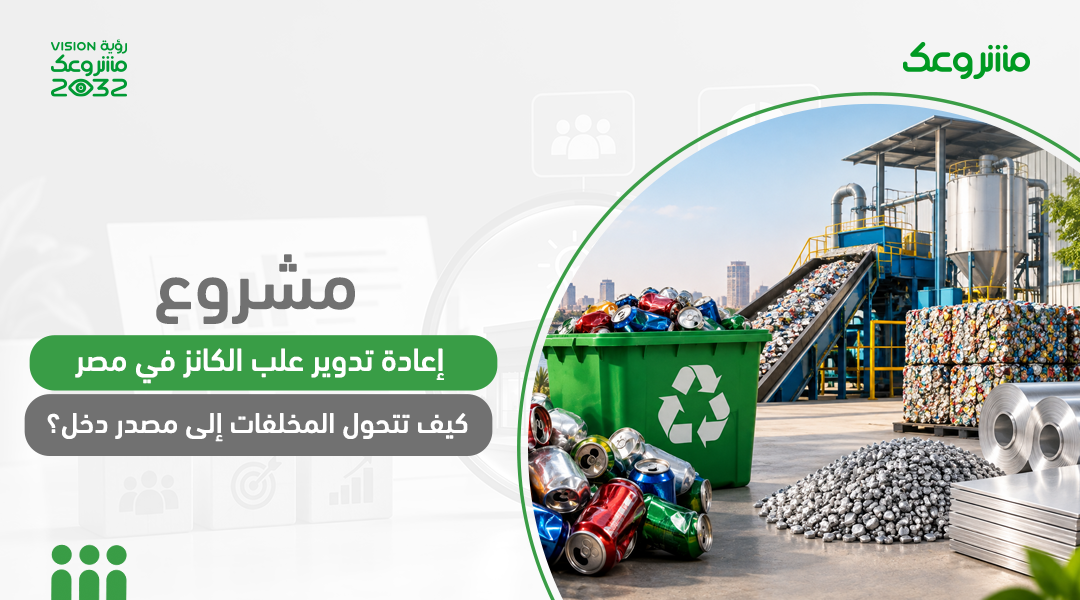
The aluminum can recycling project is an industrial venture that offers an opportunity to make use of aluminum waste and convert it into reusable raw materials for various industries. This helps generate economic value from used containers instead of disposing of them. The project is becoming increasingly important as interest in recycling, waste reduction, and efficient resource utilization continues to grow.
In the Egyptian market, the project can be implemented by collecting used aluminum cans from various sources, then sorting, compressing, preparing, and processing them according to the production line and target products. The resulting materials can then be supplied to factories and businesses that use aluminum in their manufacturing processes.
Investing in this sector requires careful planning to ensure a reliable supply of raw materials, select suitable equipment, determine production capacity, and assess operating costs, market demand, and competition. Therefore, preparing a comprehensive feasibility study is essential for evaluating the project’s technical, marketing, and financial aspects and identifying its prospects for success and profitability before implementation.
The concept behind an aluminum can recycling project is to collect used aluminum beverage cans, sort, clean, and prepare them, then melt them using specialized furnaces and equipment to produce aluminum ingots that can be reused in various industries.
The project relies on sourcing used cans from a variety of places, such as households, restaurants, cafés, companies, and waste collection centers, ensuring a continuous supply of the raw materials needed for operations.
After the processing and production stages are completed, the resulting aluminum ingots are supplied to factories for use in manufacturing new products, such as automotive components, household utensils, and metal products.
The project’s importance lies in transforming waste into an economically valuable resource and reducing reliance on extracting primary aluminum raw materials. This makes it a potential investment opportunity that requires careful planning to ensure operational efficiency, product quality, and the ability to compete in the market.
Yes, an aluminum can recycling project is considered a promising industrial investment opportunity, supported by recent statistics.The global beverage cans market was valuedat USD 30.79 billion in 2025 and is projected to grow from USD 32.87 billion in 2026 to USD 55.47 billion by 2034, registering a compound annual growth rate (CAGR) of 6.76% over the forecast period.
The success of an aluminum can recycling project in Egypt requires studying market size and growth trends, as well as identifying sources of used cans and assessing demand for recycled aluminum from factories and various industrial sectors. Forecasts indicate… The Aluminum Can Market in EgyptThe growth rate reached 0.13% in 2025 and remained at the same level in 2026 before gradually increasing to 0.17% by 2029. These indicators help provide an overview of market trends. However, it is also necessary to study competitors, the purchase prices of used cans, processing costs, and the selling prices of recycled aluminum to identify available investment opportunities and determine the project’s ability to generate sustainable economic returns.
The cost of an aluminum can recycling project in Egypt varies depending on production capacity, facility size, equipment specifications, and the type of production line. Costs can be divided into the following categories:
An aluminum can recycling project contributes to strengthening the circular economy by recovering the value of used containers and converting them into raw materials for manufacturing new products instead of disposing of them as waste. This helps extend the life cycle of aluminum, reduce the consumption of natural resources, and minimize waste, while also creating economic opportunities in can collection, sorting, transportation, processing, and supply to factories.
This approach is particularly important given the energy efficiency of aluminum recycling. The International Aluminium Institute (IAI) states that recycling aluminum requires only around 5% of the energy needed to produce primary aluminum, representing energy savings of up to 95%.
Thus, the project combines economic value creation from waste with reduced environmental impact, supporting the principles of sustainability and resource efficiency.
Read here:Best Recycling Project Ideas to Promote the Growth of the Circular Economy.
A feasibility study helps reduce the risks of an aluminum can recycling project by evaluating its technical, marketing, and financial aspects before implementation. This enables investors to make informed decisions based on reliable data rather than inaccurate estimates.
Market research helps determine demand for recycled aluminum and identify competitors and potential customers. Meanwhile, the technical study supports the selection of suitable equipment, determination of production capacity, assessment of operational requirements, and identification of reliable sources of used aluminum cans.
The financial study helps estimate initial investment costs, operating expenses, expected revenues, and the break-even point, making it easier to identify potential losses or cash flow shortages at an early stage.
Furthermore, a feasibility study helps identify potential challenges, such as fluctuations in aluminum prices, irregular supplies of recyclable materials, and rising energy and maintenance costs, while developing appropriate strategies to address them. This strengthens the project’s prospects for success, financial stability, and long-term sustainability in the market.
Read here: How Can an Economic Feasibility Study Save Your Project from Failure?
Read here: Everything You Need to Know About SWOT Analysis and How to Apply It
The primary raw materials used in an aluminum can recycling project are used metal containers, particularly beverage cans made of aluminum. These are collected from households, restaurants, cafés, shops, and waste collection centers. Other inputs include materials and operating supplies used to clean and prepare the cans before melting, as well as molds required to shape molten aluminum into ingots. Depending on the production line and processing system, the project may also require certain auxiliary materials. The cans must be sorted, and foreign materials and impurities removed before entering the manufacturing stages to maintain the quality of the final product and improve recycling efficiency.
Aluminum beverage cans can be converted into a variety of products after being collected, sorted, cleaned, melted, and reshaped. One of the project’s main outputs is aluminum ingots, which can be supplied to factories for use in manufacturing new products. Recycled aluminum can also be used to produce certain household items, metal containers, automotive parts and components, and various other metal products, depending on the purity of the raw material and the specifications required by each industry.
The price per kilogram of aluminum cans in Egypt fluctuates continuously depending on scrap market conditions, the available quantity, the cleanliness of the cans, and the presence of impurities. Prices may also vary depending on whether the cans are sold by individuals, collection centers, or scrap dealers. In addition, prices are affected by changes in global and local aluminum prices, as well as collection and transportation costs.
We find that its value goes beyond the disposal of metal waste. It extends to transforming a wasted resource into economically valuable raw materials that can be used in various industries. With used aluminum cans available in significant quantities and obtainable from multiple sources, organizing collection, sorting, and recycling operations becomes essential to building a project capable of meeting market demand.
However, turning this opportunity into a viable business requires a clear understanding of raw material availability, production capacity, equipment requirements, target customers, and expected costs and returns under Egyptian market conditions. Therefore, a feasibility study is an essential step before implementation. It helps analyze the project’s technical, marketing, and financial aspects and identifies the requirements and challenges that must be addressed, establishing a clearer foundation for implementation and growth.

For inquiries and to request a feasibility study for an aluminum can recycling project.
The kebab restaurant project is one of the food-service ventures that combines strong demand for grilled meals with the opportunity to target a diverse customer base, including individuals, families, and lovers of traditional Middle Eastern cuisine. With growing competition in the restaurant sector, however, the project’s success is no longer determined by food taste alone. […]
Read moreA children’s toy store project is not limited to selling toys; it is built on understanding what attracts children and what families look for when choosing products that combine entertainment and educational value. With the wide variety of educational toys, skill-development games, recreational toys, and gifts available, the store has opportunities to meet the needs […]
Read moreA residential complex project is no longer simply an investment in a collection of real estate units. It has evolved into an integrated development model that combines comfortable living, diverse services, and long-term investment value. As cities expand and residents’ needs evolve, demand is growing for residential complexes that offer a comprehensive environment suited to […]
Read moreThe veterinary clinic project comes at a time when animal care is no longer limited to treating illnesses or injuries, but has expanded to include health monitoring, vaccinations, routine checkups, and care for both pets and livestock. However, many animal owners face challenges in accessing specialized veterinary services that combine prompt response, high-quality care, and […]
Read more
خصم 25% على خدمات مشروعك استفد من العرض الآن، فالفرصة متاحة لفترة محدودة فقط
سجّل بياناتك واحصل على خصم 25% الآن


