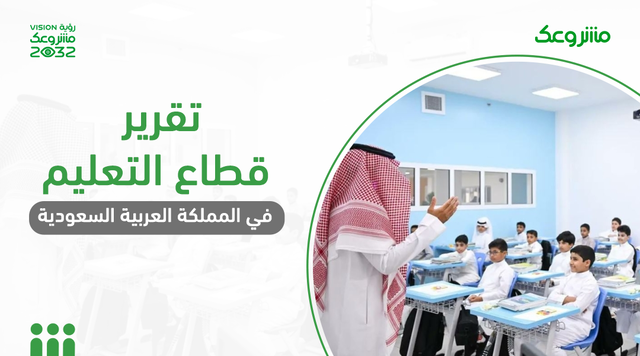
The education sector in Saudi Arabia is undergoing an unprecedented qualitative transformation, reflecting an ambitious vision to build a modern educational system capable of keeping pace with future demands. This development comes within the framework of Saudi Vision 2030, which places education at the heart of the development process as the primary driver for building a knowledge-based economy founded on innovation and human capital development.
With the rapid expansion of educational infrastructure and the growing number of students across all levels, the sector is experiencing a significant shift in terms of quality and diversity. There is also an increasing reliance on digital education and advanced technologies, alongside a strengthened role for the private sector in supporting the educational ecosystem.
This report aims to provide a comprehensive overview of the state of education in the Kingdom, highlighting its key developments and indicators, while analyzing future growth opportunities that will shape this vital sector and its role in supporting sustainable development
Read here: The comprehensive guide to establishing a private school project from A to Z in 2026
The education sector recorded the issuance of 41 investment licenses in the second quarter of 2024, representing an 86% increase compared to the same period in 2023. This reflects growing investor interest and an improved investment environment within the sector.
The sector recorded a significant increase in foreign direct investment (FDI), rising by 335% in 2022, with continued attraction of international investors, particularly in digital education and private education fields.
In 2022, the Kingdom allocated approximately SAR 140 billion to the education sector (around USD 37.5 billion), reflecting the state’s strong support for developing educational infrastructure and enhancing development programs.
Saudi Vision 2030 aims to increase the contribution of small and medium-sized enterprises (SMEs) in the education sector from 20% to 35% of GDP by 2030, through supporting entrepreneurship and educational initiatives.
The education sector in Saudi Arabia has undergone significant transformations in recent years, in line with the objectives of Saudi Vision 2030, which aims to diversify income sources and stimulate investment in key sectors, including education.
Education is considered a fundamental pillar in building a knowledge-based economy driven by innovation and human capital development, making the investment environment in this sector increasingly attractive to both local and international investors.
The educational system in the Kingdom is also witnessing notable expansion, with more than 6 million students enrolled in general education and around 1.7 million students in higher education. This reflects the growing demand for educational services.
In light of this growth, there is increasing demand for private and international schools, as well as a continued expansion of digital education and future skills programs. These developments align with the evolving needs of the labor market and contribute to improving the quality of educational outcomes.
Among the key objectives are:
The education sector is witnessing a significant increase in demand for programs that focus on practical skills and specializations required in the labor market. This is because such programs directly contribute to improving employment opportunities, supporting economic growth, and enhancing the competitiveness of countries.
Many countries are working to develop their education systems through clear national strategies, such as Saudi Vision 2030, which aims to modernize curricula, strengthen the role of the private sector, and build a knowledge- and innovation-based economy.
The spread of new projects and technology companies contributes to increasing the demand for specialized skills in fields such as technology and innovation. This, in turn, pushes educational institutions to develop advanced training programs that meet these evolving requirements.
Universities and educational platforms are moving toward offering flexible programs and micro-credentials based on advanced technologies such as artificial intelligence, with the aim of improving learning quality and providing an educational experience that is more aligned with learners’ needs and the labor market.
Please read here:Educational Robotics Project in Saudi Arabia: A Guide to Opportunities, Costs, and Success Secrets
The increasing awareness among individuals of the importance of continuously developing skills to keep pace with rapid technological advancements contributes to supporting the growth of the education market and increasing long-term demand for specialized training programs.
The education market in Saudi Arabia has been experiencing rapid growth in recent years. In 2025, the market size reached approximately USD 29,264 million (equivalent to SAR 109,738 million), driven by increasing focus on developing educational infrastructure and expanding investment in modern educational technologies.
This growth is expected to continue, reaching around USD 32,793 million (SAR 122,973 million) by 2026, supported by the expansion of digital education and rising demand for advanced learning services.
Projections also indicate a significant surge in market size, reaching approximately USD 72,767 million (SAR 272,875 million) by 2033. This reflects the strong performance of the education sector and its key role in supporting the Kingdom’s economic and knowledge transformation.
The global educational services market has witnessed significant growth in recent years, with the market size expected to rise from USD 3,727.49 billion in 2025 to approximately USD 3,983.39 billion in 2026, at a compound annual growth rate (CAGR) of 6.9%. This growth is driven by increasing demand for modern education solutions and the expansion of digital learning technologies.
Forecasts also indicate the continuation of this strong growth trend, with the market expected to reach USD 5,295.43 billion by 2030, at a CAGR of 7.4%. This reflects the rapid shift toward flexible learning models and e-learning, as well as increased global investment in educational technology, further strengthening education as one of the fastest-growing and most stable economic sectors worldwide.
Read Here: Everything You Need to Know About SWOT Analysis and How It Is Applied

To communicate and learn more about Mashroo3k company and its services
The kebab restaurant project is one of the food-service ventures that combines strong demand for grilled meals with the opportunity to target a diverse customer base, including individuals, families, and lovers of traditional Middle Eastern cuisine. With growing competition in the restaurant sector, however, the project’s success is no longer determined by food taste alone. […]
Read moreA children’s toy store project is not limited to selling toys; it is built on understanding what attracts children and what families look for when choosing products that combine entertainment and educational value. With the wide variety of educational toys, skill-development games, recreational toys, and gifts available, the store has opportunities to meet the needs […]
Read moreA residential complex project is no longer simply an investment in a collection of real estate units. It has evolved into an integrated development model that combines comfortable living, diverse services, and long-term investment value. As cities expand and residents’ needs evolve, demand is growing for residential complexes that offer a comprehensive environment suited to […]
Read moreThe veterinary clinic project comes at a time when animal care is no longer limited to treating illnesses or injuries, but has expanded to include health monitoring, vaccinations, routine checkups, and care for both pets and livestock. However, many animal owners face challenges in accessing specialized veterinary services that combine prompt response, high-quality care, and […]
Read more
خصم 25% على خدمات مشروعك استفد من العرض الآن، فالفرصة متاحة لفترة محدودة فقط
سجّل بياناتك واحصل على خصم 25% الآن


