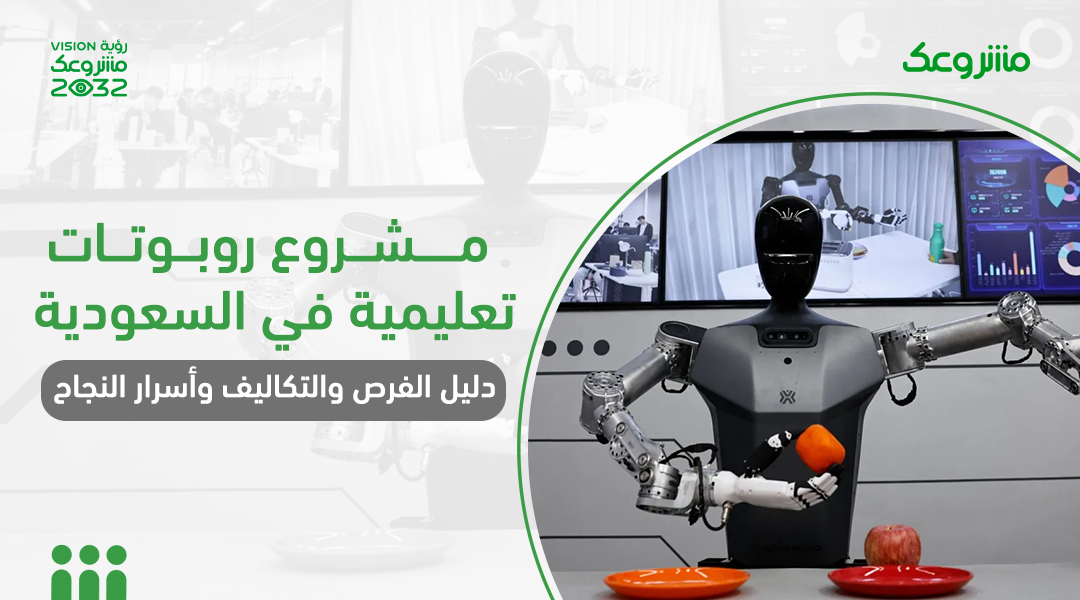
An educational robotics project in Saudi Arabia is today considered one of the most prominent investment opportunities that combines innovation with a real impact on the future of generations. With the Kingdom’s strong focus on developing the education system, robots are no longer just technological tools; they have become interactive educational instruments that contribute to developing students’ creativity, problem-solving abilities, and teamwork skills.
In this context, educational robots emerge as an effective partner for schools in Saudi Arabia, supporting modern curricula and complementing the teacher’s role by delivering an engaging, hands-on learning experience that enhances students’ understanding of scientific and technical concepts.
These projects also align with the objectives of Saudi Vision 2030, which aims to prepare a digitally skilled generation capable of competing globally.
An educational robotics project is an innovative technological initiative that focuses on designing, manufacturing, or assembling smart robots used as interactive learning tools. Its aim is to develop traditional learning methods and transform them into a more engaging and effective educational experience.
The project targets schools, universities, training centers, and parents who are interested in developing their children’s skills in programming, electronics, artificial intelligence, and applied sciences.
It also relies on providing educational robots with different specifications suitable for various age groups, ranging from early-stage children to university students, along with educational software and training kits that help learners acquire programming and automation skills in a practical, hands-on way.
Yes, a robotics project is considered a profitable and promising investment opportunity, driven by the rapid growth of the global robotics market, fueled by increasing reliance on technology and artificial intelligence, as well as the expansion of robotics applications across various sectors such as education, industry, and services.
Market indicators confirm the strength of this trend; the global robotics market is estimated at around USD 88.27 billion in 2026, compared to approximately USD 73.64 billion in 2025, with projections indicating it could reach about USD 218.56 billion by 2031.
The market is also expected to record a compound annual growth rate (CAGR) of 19.86% during the period from 2026 to 2031, reflecting expanding demand and increasing investment opportunities in this sector.
Read here: Saudi Arabia Artificial Intelligence Market Report.
Advantages of investing in a robotics project
Below are the key advantages that make investing in an educational robotics project in Saudi Arabia a promising opportunity that combines innovation with sustainable returns in the educational technology sector:
Equipment and technologies required to start a robotics project
What are the startup costs of a robotics project?
The cost of an educational robotics project varies depending on the project size, service scope, and geographic location. However, in general, it can be divided into several main categories:
| Potential Risks | How to Overcome Them |
|---|---|
| High startup costs and equipment purchase expenses | Prepare a detailed financial study and start gradually with limited capabilities to reduce expenses |
| Weak demand at the beginning of the project | Implement a strong marketing plan and effectively target the right customers |
| Strong market competition | Offer innovative products, competitive pricing, and value-added services |
| Technical failures or manufacturing defects | Conduct regular testing and apply strict quality standards before delivery |
| Lack of technical expertise within the team | Hire specialized professionals or provide continuous training for staff |
| Legal issues or missing licenses | Obtain all necessary permits and comply with relevant regulations |
| High maintenance and technical support costs | Establish a preventive maintenance plan and reduce breakdowns through quality control |
| Changing market needs and rapid technological development | Continuously monitor trends and update products regularly |
15 Tips to Ensure the Success and Sustainability of a Robotics Project
A robotics project is considered a promising investment opportunity because it comes at a time when the Kingdom of Saudi Arabia is undergoing a major transformation toward digital education and modern technologies. This aligns directly with Saudi Vision 2030, which places the development of education and the building of an advanced knowledge-based economy among its top priorities.
The Kingdom is heavily investing in preparing a generation equipped with future skills such as programming, artificial intelligence, and innovation. Here, educational robots play an effective role in supporting this direction within schools and educational centers, as they are not only used as teaching tools but also as interactive platforms that help students gain practical understanding and develop critical thinking and problem-solving skills.
In addition, the growing interest of the Saudi Ministry of Education in integrating modern technologies into curricula and adopting interactive learning methods is creating increasing demand for innovative educational solutions such as robotics. This makes the project a strong investment opportunity due to the expanding market, the rising adoption of smart technologies in schools, and ongoing government support for technical education and innovation.
Please read here: Best Artificial Intelligence Projects in 2025.. Discover them with your project
I aspired to enter the technical education field by launching an educational robotics project in the Kingdom of Saudi Arabia. However, at the beginning, I faced two major challenges: the lack of a clear plan and the difficulty of securing operational capital, which led to delaying the actual implementation of the project for some time.
After contracting with “Mashroo3k Consulting Company,” the project’s direction changed significantly. A specialized team prepared a comprehensive feasibility study covering all essential aspects; starting with the marketing side based on analyzing local demand and identifying target opportunities, passing through the technical aspect which included preparing the educational environment according to safety and quality standards, and reaching the financial aspect which focused on cash flow analysis, break-even point, and profitability forecasts, in addition to the administrative aspect that focused on structuring human resources and organizing operational procedures.
The company also helped me overcome the financing barrier by preparing a professional funding file aligned with the requirements of financial institutions, which resulted in final approval from the Social Development Bank. Thanks to this integrated support, the project was transformed from a struggling idea into a fully operational educational entity, running efficiently and achieving its objectives within a well-defined timeframe and budget.
What is the definition of robots?
Robots are smart devices or systems programmed to perform specific tasks automatically or semi-automatically. They can receive data from the surrounding environment through sensors, process it using control units and specialized software, and then execute commands such as movement, interaction, or performing specific functions.
What are the most famous robots in the world?
The most famous robots in the world vary between humanoid interactive robots, industrial robots, and service robots. Among the most notable is Sophia, one of the most well-known social robots capable of speaking and interacting with humans.
There is also ASIMO, developed by Honda, which is designed to walk and move in a human-like manner.
Additionally, robots from Boston Dynamics, such as Atlas and Spot, are among the most advanced in terms of movement and balance, and are widely used in industrial and research applications.
Furthermore, intelligent industrial robots produced by companies like KUKA are extensively used in factories and production lines around the world.
Types of Robots
Robots are used in many vital fields such as industry, where they contribute to carrying out production processes with high precision and speed. In the medical field, they assist in performing delicate surgical operations and diagnosing diseases.
They are also used in education to train students in programming and artificial intelligence in an interactive way. In addition, robots are integrated into daily services such as cleaning and delivery.
They are further utilized in military and exploratory fields to perform dangerous tasks or reach areas that are difficult for humans to access. This makes robots an important tool for developing various sectors and improving efficiency and performance quality.
Robots consist of several core components that work together to perform required tasks. These include the control unit, which acts as the brain that processes commands and manages the robot’s operations, as well as sensors that enable the robot to perceive its surrounding environment, such as light, distance, and motion.
They also include motors that give the robot the ability to move or execute physical actions, along with a power source that supplies electricity to operate its various parts. In addition, robots rely on software that programs their behavior and defines how they interact with tasks and their environment.
We can say that an educational robotics project in Saudi Arabia is more than just a modern investment idea; it is an investment in the future itself. It combines profitability with supporting the educational process and aligns with the Kingdom’s direction toward innovation and digital transformation.
With schools increasingly adopting interactive learning solutions, robotics is emerging as a key partner in developing students’ skills and preparing them for a technology-driven world.
Therefore, entering this field today provides a real opportunity to stand out in a promising market and contribute to shaping a more aware and creative generation. Every step in this project not only generates financial returns but also leaves a lasting educational impact that extends for years to come.

For inquiries and to request a feasibility study for a robotics project
The kebab restaurant project is one of the food-service ventures that combines strong demand for grilled meals with the opportunity to target a diverse customer base, including individuals, families, and lovers of traditional Middle Eastern cuisine. With growing competition in the restaurant sector, however, the project’s success is no longer determined by food taste alone. […]
Read moreA children’s toy store project is not limited to selling toys; it is built on understanding what attracts children and what families look for when choosing products that combine entertainment and educational value. With the wide variety of educational toys, skill-development games, recreational toys, and gifts available, the store has opportunities to meet the needs […]
Read moreA residential complex project is no longer simply an investment in a collection of real estate units. It has evolved into an integrated development model that combines comfortable living, diverse services, and long-term investment value. As cities expand and residents’ needs evolve, demand is growing for residential complexes that offer a comprehensive environment suited to […]
Read moreThe veterinary clinic project comes at a time when animal care is no longer limited to treating illnesses or injuries, but has expanded to include health monitoring, vaccinations, routine checkups, and care for both pets and livestock. However, many animal owners face challenges in accessing specialized veterinary services that combine prompt response, high-quality care, and […]
Read more
خصم 25% على خدمات مشروعك استفد من العرض الآن، فالفرصة متاحة لفترة محدودة فقط
سجّل بياناتك واحصل على خصم 25% الآن


