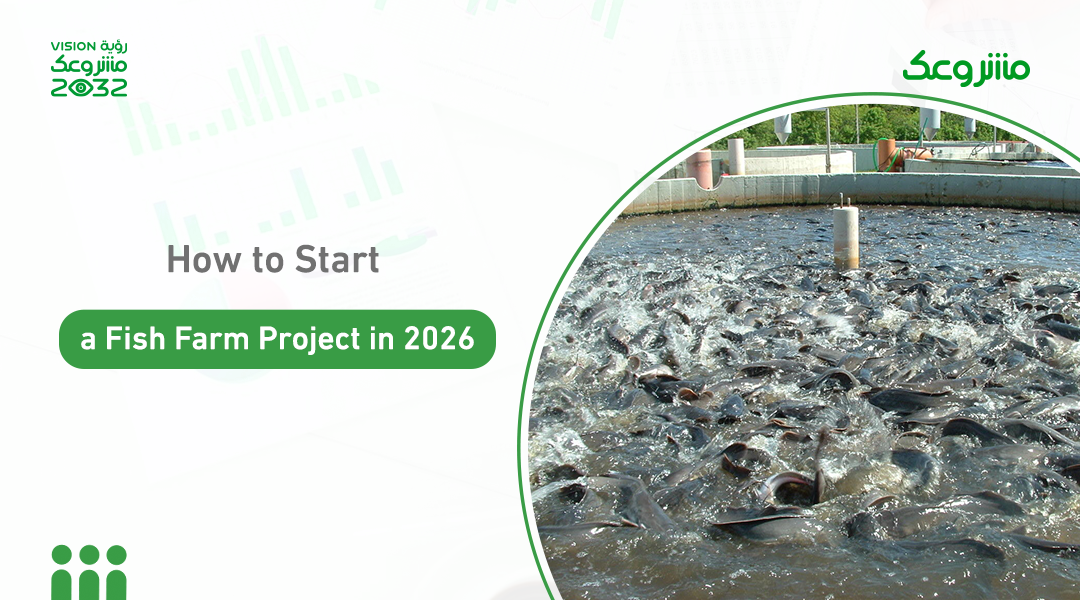
How to Start a Fish Farm Project in 2026 - Mashroo3k Consulting
Published12 Nov 2025 0 comments 2844 Observation
How to Start a Fish Farm Project in 2026

The fish farm project represents a promising investment opportunity in the aquaculture sector, which is witnessing rapid growth driven by rising local and global demand for fresh and nutritious fish. This project combines profitable economic returns with sustainable development, as it provides a stable income source while supporting food security. It also allows for diversifying fish species produced and adopting modern technologies in feeding, breeding, and water recycling systems—enhancing both production efficiency and quality.
The project targets various market segments, including restaurants, retail stores, central markets, and individuals seeking healthy and natural food options. With precise planning and professional management, the success of a fish farm is not limited to achieving strong short-term profits; it also contributes to the long-term sustainability of natural resources and reducing waste, paving the way for wider opportunities in expansion and innovation.

What Is a Fish Farm Project?

A fish farm project involves establishing a controlled unit—such as ponds or tanks—for breeding fish with the aim of producing commercial fish to meet market demand. The project relies on providing suitable environmental conditions, monitoring water quality, ensuring balanced fish nutrition, and managing the fish breeding cycle to achieve sustainable productivity. Aquaculture also involves precise control over feeding, growth, and fish health to increase production and ensure long-term economic returns.

What Are the Key Advantages of a Fish Farm Project?

  • It relies on closed systems (such as RAS) to recycle 95% of the water, reducing consumption and making it ideal for arid regions.
  • It achieves high-density production in small areas (less than 500 m² for several tons per year), compared to hectares required in traditional farms.
  • The controlled environment allows precise management of water and air quality, ensuring healthy growth and reducing the need for antibiotics.
  • The project supports the cultivation of multiple species (tilapia, mullet, sea bream, bass) with production plans, reducing risks and diversifying income.
  • It integrates operations (feeding, aeration, monitoring) with smart remote systems, reducing errors and improving operational accuracy.
  • Advanced technologies reduce labor to a small team (technicians and supervisors), lowering operational costs.
  • Strict biosecurity measures (isolation, sterilization) protect against diseases and minimize sudden investment losses.
  • A controlled production cycle allows for multiple annual harvests and a steady supply for long-term contracts with traders.

Is a Fish Farm Project Profitable?

A fish farm project can be highly profitable if implemented correctly, with revenues typically starting to appear a few months after operations begin. Profits depend on key factors such as production volume, the type of fish produced, management quality, and control over operational costs. The project can achieve substantial financial returns after recovering construction and operational costs, especially when environmental, health, and marketing standards are strictly followed. Adhering to quality standards and focusing on market demands are essential for ensuring the project’s continuity, future growth, and sustainable financial returns.

The global aquaculture market is estimated at approximately USD 325.6 billion in 2025, and it is expected to rise to USD 417.8 billion by 2030, achieving a compound annual growth rate (CAGR) of 5.1% during the forecast period (2025–2030).

Read Here: Fish Farming Project – A Promising Investment Opportunity

How to Start a Fish Farm Project

  1. Conduct a comprehensive market study to identify the most in-demand fish species in the local market, considering competitors and prevailing prices.
  2. Choose a strategic location with clean, uncontaminated water, close to natural water sources or electricity and fuel networks to facilitate daily operations and reduce costs.
  3. Secure necessary funding through banks or government entities to cover all major costs such as initial construction, equipment purchase, and initial operations for several months.
  4. Design and build ponds or tanks with precise specifications suitable for the chosen fish species and targeted production volume.
  5. Purchase high-quality fish fingerlings from trusted suppliers and start the breeding process gradually, monitoring density and initial feeding to ensure high survival rates.
  6. Provide balanced and nutrient-rich feed appropriate for each growth stage, and regularly monitor water quality (temperature, oxygen, pH).
  7. Hire a professional, trained team to manage the project efficiently.
  8. Implement strict health and environmental measures, such as regular pond sterilization and disease checks, to ensure fish safety and high quality.
  9. Develop a detailed marketing plan including appropriate sales channels for local markets or export to neighboring countries.
  10. Monitor operational and production costs daily and monthly, keeping accurate records and continuously improving processes based on data.

Feasibility Study for a Fish Farm Project

A feasibility study is one of the most important strategic steps that enables investors to evaluate the project from technical, financial, marketing, and administrative perspectives. It determines the potential for profitable returns and typically includes:

Technical Study

  • Choose a suitable location with clean and stable water.
  • Design ponds or tanks appropriate for the type and quantity of production.
  • Install aeration and water circulation systems to maintain environmental quality.
  • Provide quality measurement equipment, such as oxygen meters and thermometers.
  • Select healthy fingerlings that meet standards.
  • Choose appropriate feed types and feeding schedules.
  • Implement disease prevention and health programs for fish.
  • Monitor production cycles, harvesting schedules, and marketing.

Read Here: Key Points on Which the Technical Feasibility Study for Projects is Based

Marketing Study

  • Analyze fish demand in local and regional markets.
  • Identify target customer segments (retail markets, restaurants, distributors).
  • Study competitors and analyze their strengths and weaknesses.
  • Select fish species according to market demand and growth rate.
  • Determine effective distribution channels.
  • Develop a marketing plan to attract customers and strengthen brand growth.
  • Analyze pricing and determine competitive prices to ensure profitability.
  • Explore export opportunities to potential international markets.

Read Here: Marketing Feasibility Study – Its Definition, Importance, Preparation Method, and Key Tools

Financial Study

  • Estimate initial investment costs (ponds, equipment, infrastructure).
  • Calculate monthly operational costs (labor, feed, electricity, maintenance).
  • Forecast revenues based on production volume and prices.
  • Calculate break-even point and expected payback period.
  • Prepare an annual budget for the fish farm project.
  • Estimate profits and depreciation over the years.
  • Study financing requirements and potential sources of funding.
  • Develop a financial risk management plan to address price fluctuations or rising feed and fingerling costs.

Read Here: Financial Feasibility Study for Entrepreneurs (Definition, Objectives, and Components)

Administrative Study

  • Define an organizational structure with clear responsibilities.
  • Select a trained and specialized team for fish farming.
  • Establish an internal control system to monitor operations and product quality.
  • Develop clear operational policies and procedures.
  • Monitor decision-making authority effectively.
  • Schedule regular meetings to evaluate performance and implement improvements.
  • Provide periodic training programs for staff and management.
  • Plan supplier and customer relationship management.

Fish Farming Indicators in Saudi Arabia

In 2023, the total marine catch in Saudi Arabia reached approximately 214.6 thousand metric tons, with freshwater aquaculture accounting for around 47.4 thousand metric tons and saltwater aquaculture around 92.4 thousand metric tons. This brings the total aquaculture production in Saudi Arabia to approximately 139.9 thousand metric tons.

Read Here: Agricultural Sector Market Report in Saudi Arabia

Licensing Procedures for Fish Farms in Saudi Arabia

  • Submit a detailed project description along with national ID or passport for foreign investors.
  • Provide proof of financial solvency via a bank certificate.
  • Submit a copy of land ownership or a certified 10-year lease agreement.
  • For inland water projects, provide proof that the aquaculture project is part of an existing agricultural project.
  • Complete all required documents and verify accuracy.
  • Submit initial technical and economic feasibility studies.
  • Present a visual summary of the feasibility study before a technical committee.
  • Obtain security approval from the Border Guard for marine projects.
  • Issue preliminary site test approvals for marine projects.
  • Submit an environmental feasibility study.
  • Submit the final technical and economic feasibility study.
  • Obtain construction and operational licenses for the fish farm.

10 Tips for a Successful and Sustainable Fish Farm

  1. Choose a site with clean, high-quality water.
  2. Select fish species suitable for local environmental conditions and market demand.
  3. Use high-quality, nutritionally balanced feed.
  4. Continuously monitor water quality, including chemical and biological factors.
  5. Maintain cleanliness and regularly disinfect equipment to prevent diseases.
  6. Ensure adequate oxygen levels and efficient aeration.
  7. Conduct regular health checks and intervene early in case of disease.
  8. Train staff on modern breeding and farm management techniques.
  9. Plan breeding and sales cycles according to market demand.
  10. Utilize government support and available training programs for sustainable development.

Frequently Asked Questions

What is the cost of establishing a fish farm?
Depends on factors like farm size, pond type, aeration and feeding equipment, labor, fingerlings, feed, infrastructure, daily operations, and technology used.

What is the best fish feed?
Balanced feed containing proper amounts of animal and plant protein, such as fish meal, cornmeal, and soybean meal.

Which fish grow fastest?
Tilapia and white fish (e.g., mullet) are fastest-growing and adapt quickly to farming conditions.

What are the basic requirements of a fish farm?
Ponds or tanks, feeding and aeration systems, environmental monitoring equipment, fingerlings, and feed.

What do farmed fish eat?
Farmed fish are fed specially formulated feed with 30–50% protein (fish or soybean meal), 10–20% fats and carbohydrates (oils and grains), and essential vitamins and minerals. Feed is given daily as pellets or powder at 2–5% of fish body weight.

How long is a fish farming cycle?
Varies by species, typically between 4 and 7 months.

Conclusion

A fish farm project is one of the most promising agricultural ventures, combining economic feasibility with environmental sustainability. It not only provides a protein-rich food source but also supports food security and creates diverse job opportunities across production stages. With careful planning, market analysis, and adherence to quality and environmental standards, a fish farm can become a successful investment, generate continuous profits, and contribute to the growth of the local economy.

Contact Us to Request a Feasibility Study for a Fish Farm Project

Keywords::

Fish Farm Project


Similar Articles

How to Turn a Kebab Restaurant Project into a Distinctive Brand in Egypt?

The kebab restaurant project is one of the food-service ventures that combines strong demand for grilled meals with the opportunity to target a diverse customer base, including individuals, families, and lovers of traditional Middle Eastern cuisine. With growing competition in the restaurant sector, however, the project’s success is no longer determined by food taste alone. […]

Read more

Children’s Play Center Project in Saudi Arabia: How to Create an Experience That Attracts Children and Families?

A children’s toy store project is not limited to selling toys; it is built on understanding what attracts children and what families look for when choosing products that combine entertainment and educational value. With the wide variety of educational toys, skill-development games, recreational toys, and gifts available, the store has opportunities to meet the needs […]

Read more

Residential Complex Project in Saudi Arabia: An Investment That Creates Value Beyond Residential Units

A residential complex project is no longer simply an investment in a collection of real estate units. It has evolved into an integrated development model that combines comfortable living, diverse services, and long-term investment value. As cities expand and residents’ needs evolve, demand is growing for residential complexes that offer a comprehensive environment suited to […]

Read more

Veterinary Clinic Project in Egypt: A Promising Investment Opportunity in the Animal Care Sector

The veterinary clinic project comes at a time when animal care is no longer limited to treating illnesses or injuries, but has expanded to include health monitoring, vaccinations, routine checkups, and care for both pets and livestock. However, many animal owners face challenges in accessing specialized veterinary services that combine prompt response, high-quality care, and […]

Read more

Green Friday

فرصة لا تتكرر

GREEN FRIDAY

خصم 25% على خدمات مشروعك استفد من العرض الآن، فالفرصة متاحة لفترة محدودة فقط
سجّل بياناتك واحصل على خصم 25% الآن