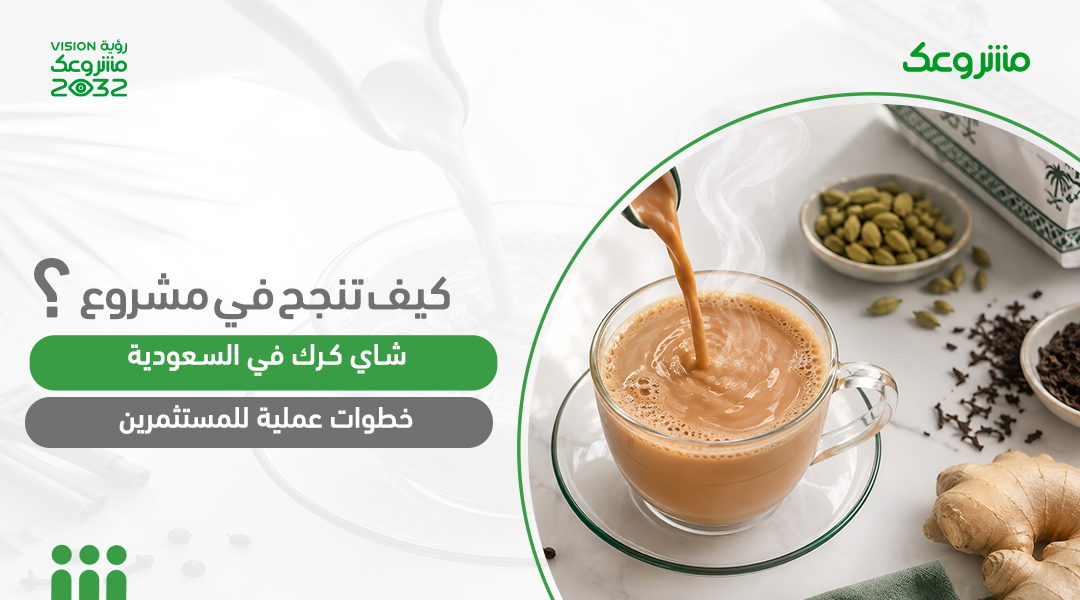
In the world of beverages, the appeal of certain products goes beyond their taste, becoming part of consumers’ daily habits and experiences. This applies to Karak tea, which has established a distinctive place among the most popular hot beverages. Accordingly, a Karak tea business presents an investment opportunity that combines a simple concept with the potential to generate good returns when implemented on a well-studied basis.
With diverse customer preferences and the growing popularity of cafés and quick-service beverage outlets, offering Karak tea with consistent quality, distinctive flavors, and fast service has become an important factor in attracting customers and building a loyal customer base. Therefore, launching this project requires a thorough analysis of the market, competitors, costs, location, and target audience to develop an investment model capable of competing and achieving sustainable growth.
A Karak tea business can be defined as a project specialized in preparing and serving Karak tea professionally by blending tea with milk, spices, and seasonings that give it its distinctive flavor, and serving it to customers in ready-to-consume cups.
The project targets hot beverage enthusiasts and can be implemented through various business models, such as a small shop, kiosk, mobile cart, or retail outlet in a high-traffic location. The product menu can also be diversified by offering different Karak tea flavors and sizes, along with selected hot and cold beverages and light desserts. This can help increase the average sales value and attract a wider range of customers.
Tea Business: Your Comprehensive Guide to Starting a Sustainable Business in 2026
Yes, a Karak tea business is considered a promising project, supported by the continued growth of the global tea market. According to the available data, the global tea market was valued at USD 69.5 billion in 2025, rising to USD 74.0 billion in 2026. Revenue is expected to reach USD 115.2 billion by 2033, representing a compound annual growth rate (CAGR) of 6.5% between 2026 and 2033.
Read Here: Saudi Arabia Food Market Report
A Karak tea business offers several investment advantages, particularly in the Saudi market, including:
Read Here: Best Successful Small Projects for Youth in 2026
The cost of a Karak tea business varies depending on the project’s size, location, shop area, level of fit-out, number of employees, and services offered. A business focused solely on Karak tea will have different costs from one that offers a wider range of beverages and customer seating. The main cost components generally include:
A feasibility study is an essential tool for reducing risks and increasing the chances of success for a Karak tea business. It provides a comprehensive view of the marketing, technical, and financial aspects before implementation, helping investors make informed decisions and avoid potential challenges. A feasibility study can help reduce risks by:
Read here: Feasibility Study – Its Importance, How to Prepare It, and How to Conduct a Feasibility Study
| Challenges | Practical Solutions |
|---|---|
| High competition among Karak tea shops and cafés | Offer distinctive recipes, enhance the customer experience, and build a strong brand identity. |
| Choosing an unsuitable location | Conduct market research and select a high-traffic location near commercial areas, universities, or offices. |
| Rising raw material costs | Work with reliable suppliers and purchase appropriate quantities to reduce procurement costs. |
| Low demand during the initial operating period | Launch social media marketing campaigns and offer opening promotions and customer loyalty programs. |
| Inconsistent product quality | Standardize preparation recipes, use high-quality ingredients, and provide continuous staff training. |
| High operating costs | Monitor expenses regularly, optimize resource consumption, and improve operational efficiency. |
| Difficulty retaining customers | Provide fast service, maintain beverage quality, and continuously respond to customer feedback. |
| Shortage of qualified staff | Hire experienced employees and provide training programs in beverage preparation and customer service. |
| Weak digital marketing | Create professional social media accounts, collaborate with local influencers, and leverage delivery platforms. |
| Unplanned expansion | Rely on performance indicators and financial results before opening new branches o |
When I decided to launch a Karak tea business, I was aware of the strong demand for this popular beverage in the Saudi market. However, I also understood that the success of the business would depend not only on product quality but also on proper planning and professional management. During the initial implementation phase, I faced several challenges, including uncertainty about the expected level of demand, difficulty selecting the right location, accurately estimating operating costs, managing cash flows, and allocating capital effectively. These challenges affected my ability to make sound investment decisions.
At that point, I sought the support of the experts at Mashroo3k Consulting, who prepared a comprehensive feasibility study covering the marketing, technical, financial, and administrative aspects of the project. The study provided me with a clear understanding of market needs, operational requirements, and a detailed financial plan that helped me organize expenses, manage liquidity, and overcome the financial challenges facing the business. It also helped me select the appropriate equipment and develop an effective marketing strategy to reach my target customers.
Thanks to this specialized support, the business began operating more efficiently, while overall performance and productivity improved. I was able to meet growing demand with greater confidence, and my business became better positioned to compete and achieve stable results in the Saudi market.
Karak tea is prepared by boiling black tea with water and adding spices such as cardamom, ginger, and cinnamon until the flavors are well blended. Milk and sugar are then added, and the mixture is simmered for a few minutes until it develops a rich consistency and distinctive taste. The tea is then strained and served hot. Saffron or other flavors can also be added according to preference to give the beverage a unique character.
Opening a tea business requires careful planning before implementation. This begins with preparing a feasibility study to determine expected demand and costs, followed by selecting a strategic and easily accessible location and obtaining the necessary licenses and permits. The business should then be equipped with the essential equipment and supplied with high-quality raw materials. It is also important to develop a product menu suited to the target audience, hire a qualified team, and establish an effective marketing plan to introduce the business and attract customers. Maintaining beverage and service quality is essential for achieving sustainable success and profitability.
The price of Karak tea varies depending on the cup size, café location, and quality of the ingredients used. In Saudi Arabia, a small or medium-sized cup typically ranges from SAR 6 to SAR 12, while larger sizes or varieties containing additions such as saffron may cost SAR 15 or more at some specialty cafés.
Choosing the best tea depends on the quality and flavor you want to offer in your business. However, several brands are widely trusted by cafés and restaurants, including Ahmad Tea, Lipton, Taj Mahal, Brooke Bond, Tetley, and Dilmah. These brands are known for offering strong black tea that gives Karak tea a rich color and distinctive flavor.
Black tea is the most popular and widely consumed type of tea in Saudi Arabia and is commonly used to prepare both Karak tea and traditional tea. Ceylon tea and Assam tea are also highly popular due to their strong flavor and rich color, making them preferred choices for many cafés and Karak tea shops. There is also growing demand for tea flavored with cardamom, saffron, and mint.
A Karak tea business remains a project with strong potential for success, supported by growing demand for this popular beverage and the flexibility to develop and expand the business in the future. However, achieving the desired results requires more than simply having a distinctive business idea. It requires accurate market analysis, proper cost estimation, and a well-planned operational and marketing strategy to ensure business continuity and sustainable profitability.
Therefore, working with a specialized feasibility study provider can give you a clear understanding of the project before making your investment. It also helps you make decisions based on sound analytical foundations, allowing you to launch your Karak tea business with greater confidence and improve its prospects for success in a competitive market.

To get in touch and request a feasibility study for a Karak Tea Business
The kebab restaurant project is one of the food-service ventures that combines strong demand for grilled meals with the opportunity to target a diverse customer base, including individuals, families, and lovers of traditional Middle Eastern cuisine. With growing competition in the restaurant sector, however, the project’s success is no longer determined by food taste alone. […]
Read moreA children’s toy store project is not limited to selling toys; it is built on understanding what attracts children and what families look for when choosing products that combine entertainment and educational value. With the wide variety of educational toys, skill-development games, recreational toys, and gifts available, the store has opportunities to meet the needs […]
Read moreA residential complex project is no longer simply an investment in a collection of real estate units. It has evolved into an integrated development model that combines comfortable living, diverse services, and long-term investment value. As cities expand and residents’ needs evolve, demand is growing for residential complexes that offer a comprehensive environment suited to […]
Read moreThe veterinary clinic project comes at a time when animal care is no longer limited to treating illnesses or injuries, but has expanded to include health monitoring, vaccinations, routine checkups, and care for both pets and livestock. However, many animal owners face challenges in accessing specialized veterinary services that combine prompt response, high-quality care, and […]
Read more
خصم 25% على خدمات مشروعك استفد من العرض الآن، فالفرصة متاحة لفترة محدودة فقط
سجّل بياناتك واحصل على خصم 25% الآن


