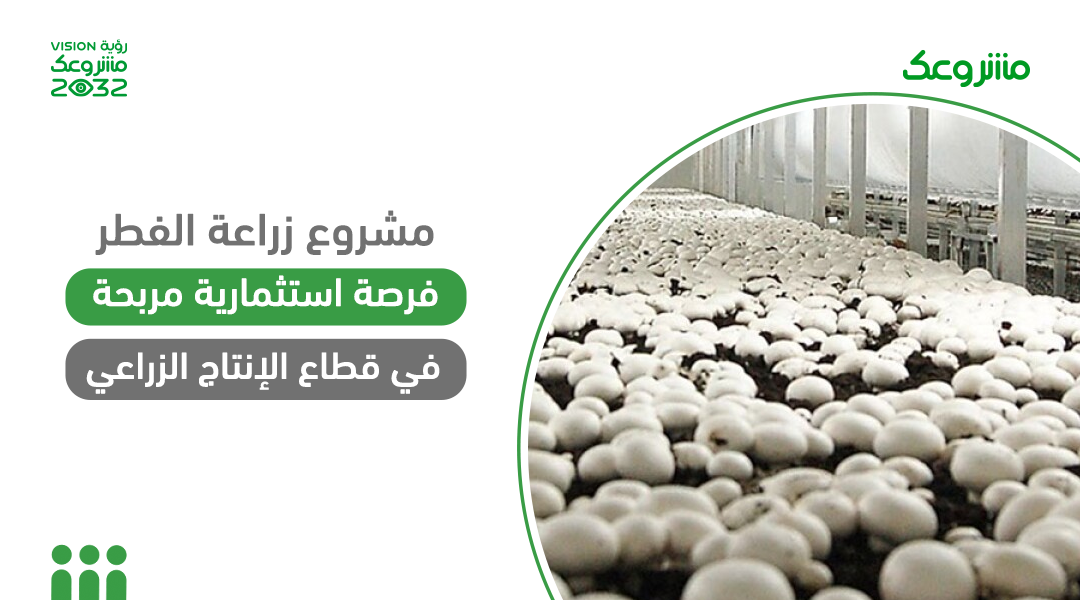
The agricultural sector is witnessing rapid transformations that open up new investment opportunities, among which mushroom farming stands out as a promising option combining a fast production cycle with attractive economic returns. The project focuses on producing a highly nutritious food that is experiencing growing demand both locally and globally, driven by changing consumption patterns and the increasing trend toward healthy and natural foods. Thanks to advancements in agricultural and environmental control technologies, this project can be implemented within a professional model that ensures stable production and profitable returns, with the possibility of gradual expansion. This project represents a strategic entry point into a dynamic food sector characterized by continuous growth and strong long-term sustainability.
Mushroom farming is a specialized agricultural activity that focuses on producing various edible mushroom types within controlled, enclosed environments, using modern technologies that ensure consistent quality and year-round production. The project relies on establishing farming units equipped with advanced systems to regulate temperature, humidity, and ventilation, providing the ideal conditions for cultivating a crop that is highly nutritious and economically attractive.
Yes, mushroom farming is considered a profitable venture, driven by the rapid growth of the global mushroom market. According to global statistical indicators, the market size is expected to increase from USD 73.14 billion in 2025 to USD 79.83 billion in 2026, registering a compound annual growth rate (CAGR) of 9.2%. This upward momentum is projected to continue, reaching USD 117.11 billion by 2030, with a CAGR of 10.1%. This steady growth reflects the rising demand for mushrooms as a healthy and versatile food ingredient, opening promising investment opportunities for producers, especially given the short production cycle, controllable operating costs, and diverse local and export marketing channels. Therefore, the project not only offers quick returns but also provides opportunities for expansion and long-term sustainability in a globally growing food sector.
Advantages of a Mushroom Farming Project
A mushroom farming project offers numerous economic, productive, and environmental advantages, making it an attractive option, especially for small and medium-sized enterprises. Key benefits include:
Steps to Start a Mushroom Farming Project
It focuses on analyzing the current and projected market size, studying the supply and demand levels for fresh mushrooms and their products, and identifying market gaps that the project can exploit. It also includes evaluating direct and indirect competitors and analyzing their strengths and weaknesses, alongside preparing a comprehensive SWOT analysis for the project. The study concludes with the development of an effective promotional plan that leverages both digital and traditional channels to reach target segments and enhance market share.
The technical study includes Determining the appropriate location, its size, and technical facilities, along with studying the required infrastructure such as ventilation, lighting, temperature and humidity control, and water and electricity supply. It also includes selecting the suitable type of mushroom for production, specifying the necessary equipment and tools, and outlining the production process stages from preparing and sterilizing the cultivation medium to harvesting and packaging. Additionally, it involves reviewing the required permits and regulatory requirements, estimating the needed workforce, projected production capacity, and technical operating costs, while considering potential future expansion.
The financial study addresses the determination of the funding structure for the mushroom cultivation project and its potential sources, detailing the invested capital into fixed and working components. It also includes an itemization of operating expenses, fixed and variable costs, and the preparation of projected financial statements such as the income statement and cash flow statement. The study focuses on calculating key financial indicators, including return on investment (ROI), break-even point, payback period, and net present value (NPV), in addition to conducting a sensitivity analysis to measure the impact of market changes on the financial outcomes.
It aims to establish a clear organizational structure for the mushroom cultivation project, defining lines of supervision and responsibilities, along with preparing precise job descriptions for each position. It also includes analyzing potential marketing, operational, and financial risks and developing effective strategies to manage them. Based on this, a comprehensive final report is prepared, consolidating the results of the various studies and providing practical recommendations to ensure the project’s success and long-term sustainability.
For more information, read here: Steps to Prepare an Agricultural Project Feasibility Study to Ensure the Success of Your Investment and Achieve Your Goals.
Factors for Success and Sustainability in a Mushroom Farming Project
Potential Risks When Starting a Mushroom Farming Project
Requirements for Starting a Mushroom Farming Project
For more information about mushroom (or fungi) cultivation, click here
1. Which type of mushroom is the most profitable to cultivate?
Oyster mushrooms and white button mushrooms are among the most profitable types, due to their high demand, short production cycles, and ease of marketing compared to other varieties.
2. How much fresh mushroom does 1 kilogram of spawn produce?
On average, 1 kilogram of mushroom spawn (mycelium) produces between 8 to 12 kilograms of fresh mushrooms, with variations depending on the strain type and cultivation conditions.
3. Which mushroom types are the most expensive to grow?
Mushroom cultivation costs vary based on technical requirements. Varieties such as Lion’s Mane and Enoki mushrooms are among the most expensive due to the need for precise control of humidity, temperature, and lighting. Shiitake mushrooms have medium to slightly high costs, while truffles cannot be grown conventionally; they grow symbiotically with tree roots, making them a long-term (5–10 years) agricultural project with uncertain success.
4. What type of mushroom is called a truffle?
Truffles are a rare type of wild fungus, scientifically known as Truffles. They grow underground, usually at depths of 5–30 cm, unlike most mushrooms that grow above ground. Truffles develop symbiotically with the roots of certain trees, especially oak and beech, and rely on specific climatic conditions like seasonal rainfall and calcareous soil. They are considered among the most expensive mushrooms in the world due to their rarity and difficulty in finding them.
The price of a kilogram of mushrooms varies depending on the type, quality, and target market, ranging from moderate levels for common mushrooms like white and oyster mushrooms to higher levels for premium varieties such as shiitake and truffles.
It can be said that mushroom cultivation is one of the most prominent investment opportunities, combining growing demand, a fast production cycle, and stable financial returns in both the short and long term. With careful planning, adherence to technical standards, and selecting the strains best suited to market needs, it can be transformed into a successful and scalable production activity. Therefore, this project represents a smart choice for investors seeking to enter a sustainable agricultural sector that aligns with market trends and delivers real economic value.

For inquiries and to request a feasibility study for a mushroom cultivation project
The kebab restaurant project is one of the food-service ventures that combines strong demand for grilled meals with the opportunity to target a diverse customer base, including individuals, families, and lovers of traditional Middle Eastern cuisine. With growing competition in the restaurant sector, however, the project’s success is no longer determined by food taste alone. […]
Read moreA children’s toy store project is not limited to selling toys; it is built on understanding what attracts children and what families look for when choosing products that combine entertainment and educational value. With the wide variety of educational toys, skill-development games, recreational toys, and gifts available, the store has opportunities to meet the needs […]
Read moreA residential complex project is no longer simply an investment in a collection of real estate units. It has evolved into an integrated development model that combines comfortable living, diverse services, and long-term investment value. As cities expand and residents’ needs evolve, demand is growing for residential complexes that offer a comprehensive environment suited to […]
Read moreThe veterinary clinic project comes at a time when animal care is no longer limited to treating illnesses or injuries, but has expanded to include health monitoring, vaccinations, routine checkups, and care for both pets and livestock. However, many animal owners face challenges in accessing specialized veterinary services that combine prompt response, high-quality care, and […]
Read more
خصم 25% على خدمات مشروعك استفد من العرض الآن، فالفرصة متاحة لفترة محدودة فقط
سجّل بياناتك واحصل على خصم 25% الآن


