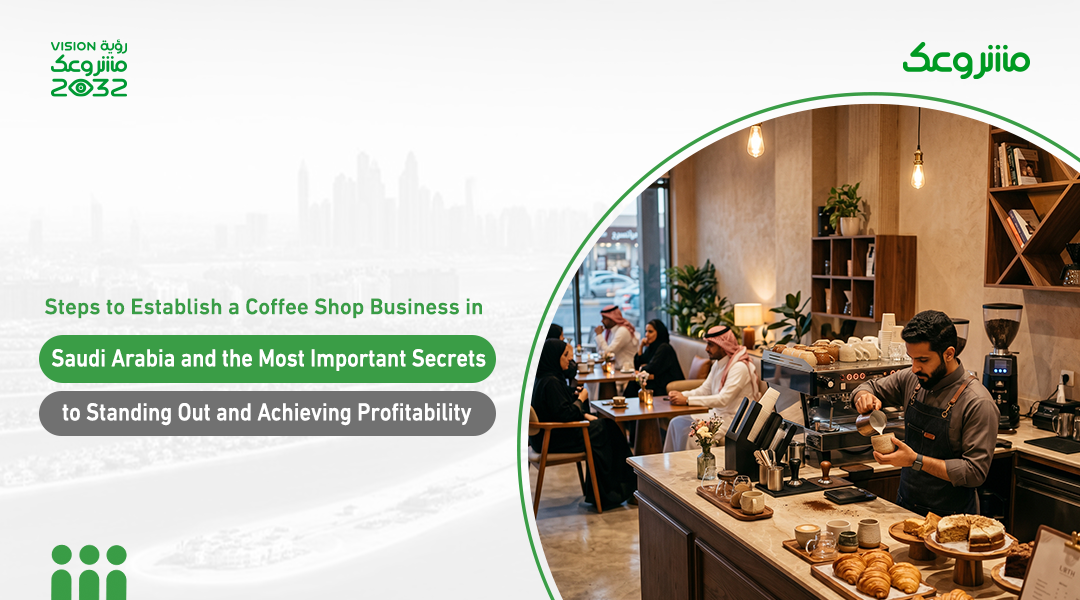
A coffee shop business is now considered one of the most promising and attractive investment opportunities, drawing significant interest from ambitious entrepreneurs. This is largely due to its unique combination of growing demand for exceptional hospitality experiences and its potential to generate sustainable, long-term profitability. A café is no longer just a place to serve hot or cold beverages; it has evolved into a comprehensive social and cultural space focused on delivering an outstanding customer experience. This experience is reflected in its warm and inviting atmosphere, distinctive visual identity, and high-quality, professional service. Together, these elements enable investors to build a strong, recognizable brand and cultivate a loyal customer base.
It is worth noting that, in light of the intense competition within the hospitality industry, the success of a coffee shop business depends primarily on having a clear strategic vision supported by a well-planned and professionally developed business plan. This plan begins with conducting a comprehensive market analysis, followed by selecting the ideal strategic location, and culminates in designing a unique customer experience that not only meets customers’ expectations but exceeds them. Such an approach helps ensure a sustainable competitive advantage, long-term success, and business continuity.
A coffee shop business is one of the most promising ventures in the hospitality and service industry. At its core, it offers a wide variety of hot and cold beverages—most notably coffee in its many varieties and brewing methods—alongside a selection of light meals and snacks that enhance the overall customer experience and make each visit more enjoyable and complete. However, the modern coffee shop has evolved far beyond its traditional role as simply a place to serve drinks. Today, it represents an integrated business concept that combines high-quality products, exceptional customer service, and thoughtfully designed interiors that create a comfortable and inviting atmosphere, encouraging customers to stay longer and return more frequently.
One of the key strengths of a coffee shop business is its ability to attract a broad and diverse customer base. This includes young people looking for a place to socialize, employees seeking a relaxing break during a busy workday, and entrepreneurs who prefer to hold meetings in a casual and comfortable setting. This diversity in the target audience gives the business exceptional flexibility and provides strong potential for long-term growth and expansion.
To achieve long-term success in an increasingly competitive market, a coffee shop must be built on several essential success factors. Foremost among these is selecting a strategic location that ensures a steady flow of customers, along with consistently offering high-quality products that encourage repeat visits. Equally important is developing a distinctive visual identity and a strong brand that secures the café’s place in customers’ minds and fosters a genuine emotional connection that goes beyond a simple transactional relationship. This connection transforms ordinary customers into loyal brand advocates who actively strengthen the café’s reputation and presence within the community.
Please read here: Coffee Grinding Business: A Comprehensive Guide to Starting a Profitable Business from Scratch
Yes, a coffee shop is considered one of the most promising and economically viable business ventures, particularly given the rapid global expansion of the hospitality and food service industry. According to the latest market research and industry reports, the global coffee shop market reached an estimated value of approximately US$313.65 billion in 2024. This figure clearly highlights the growing consumer demand for coffee shop services worldwide and reflects the well-established role of cafés as an essential part of modern daily life.
Moreover, future market indicators point to even greater opportunities and stronger growth prospects. Industry reports forecast that the global coffee shop market will continue its upward trajectory, reaching an estimated value of approximately US$430.02 billion by 2030. This growth represents a compound annual growth rate (CAGR) of approximately 5.4% throughout the forecast period, underscoring the sector’s strong potential for sustained expansion and long-term profitability.
Read here: Coffee Market Report in the Kingdom of Saudi Arabia
A coffee shop business offers numerous advantages that make it one of the strongest investment opportunities today, particularly in the Saudi market. Some of its key benefits include:
Please read here: How to Find the Best Investment in Saudi Arabia? A Smart Investor’s Guide to Promising Opportunities
The startup cost of a coffee shop varies significantly depending on a set of key factors that are closely interconnected and ultimately determine the true scale of the required investment. The main cost components include:
Location rent or purchase: This is one of the largest expenses, as it depends on the commercial activity of the chosen area and its proximity to residential communities or business centers.
Coffee shop equipment: This includes professional coffee machines, cups, spoons, and specialized brewing tools, and can represent a significant portion of the total budget on its own.
Raw materials: Such as coffee beans, milk, and various additives that must be secured before opening to ensure the shop is fully ready for operation.
Setup and interior design: This includes interior design work, lighting, and furniture that reflect the identity of the place and create an attractive atmosphere that leaves a lasting positive impression on customers.
POS systems and order management systems: These systems are no longer optional but essential for organizing operations, improving customer experience, and accurately tracking revenue.
Permits and legal licenses: This includes the commercial registration and all official requirements imposed by the relevant authorities.
Staff and employees: Such as baristas, cashiers, and customer service staff, in addition to training and onboarding costs before launch.
Marketing and advertising: To attract customers and build a sustainable customer base, whether through social media platforms or promotional offers during the launch phase.
Equipment maintenance: Professional machines require regular maintenance to maintain efficiency and extend their lifespan.
Monthly operating costs: These include electricity, water, internet bills, and continuous supply of raw materials.
The machines and equipment required vary significantly depending on the size of the coffee shop and the level of service offered. However, they can generally be categorized into the following main areas:
Read here: A detailed guide to starting a coffee roasting and grinding project
Read here: How to start investing in successful small projects in Saudi Arabia?
| Challenges | How to Avoid Them |
|---|---|
| High competition in the coffee shop market | Provide a unique and distinctive experience that makes the café a destination, not just an option, by building a strong and differentiated brand identity that ensures customer loyalty. |
| High operating costs | Continuously monitor costs, choose cost-effective suppliers without compromising quality, and reduce waste in materials and energy. |
| Poor location selection | Conduct thorough research on customer traffic and density, and choose a strategic, high-traffic, easily accessible location. |
| Low initial customer turnout | Implement a strong marketing plan before and after opening using social media, supported by promotional offers to attract customers. |
| Inconsistent beverage quality | Provide professional staff training and standardize preparation procedures to ensure consistent quality every time. |
| High employee turnover | Create a supportive work environment with clear financial and non-financial incentives to improve employee retention. |
| Weak brand identity | Build a clear visual identity (logo, colors, presentation style) supported by strong marketing content to strengthen the brand. |
| Poor inventory management | Use modern inventory management systems to track stock in real time and reduce waste or shortages. |
| Changing customer preferences | Continuously monitor market trends and regularly update the menu to match evolving customer tastes. |
| Weak in-store customer experience | Improve interior design, lighting, and service quality to create a comfortable experience that encourages repeat visits and recommendations. |
Read here: How to Achieve Financial Success by Investing in Successful Small Projects
Location Requirements:
For More Information About Commercial Signage Requirements, Click Here.
For More Information About the Requirements for Selling Tobacco Products, Click Here.
“I’m K.R. from Riyadh, and I’d like to share my experience of establishing my own coffee shop in Saudi Arabia. At the beginning, I faced several challenges, particularly in developing a solid business plan and securing the funding needed to launch the project. This led me to seek the support of Mashroo3k Consulting, whose team helped me overcome these obstacles through a structured and professional approach. Their experts prepared a comprehensive feasibility study covering all the key aspects of the business, including marketing, technical, financial, and administrative analyses. This provided me with a clear roadmap based on accurate data and realistic projections. The company also played a crucial role in addressing my financing challenges by offering well-planned funding solutions, which ultimately helped me secure financial support from the Social Development Bank. Thanks to the integrated technical and financial support provided by Mashroo3k’s experts, my project successfully progressed from the initial startup stage to full operation and stable performance. Today, it has become a well-established and organized business that has exceeded my original expectations prior to receiving their consultancy services.”
Read Here: Best Successful Small Projects for Youth in 2026
A coffee shop’s monthly income cannot be defined by a fixed figure, as it varies significantly from one business to another depending on several interconnected factors. The café’s location and overall size provide the foundation for its revenue potential, while actual income is directly influenced by the number of daily customers and the quality of the products and services offered. Coffee shops that secure a prime location and deliver an exceptional customer experience are more likely to generate stable and growing revenue. Ultimately, however, monthly income depends on a simple equation: strong daily sales combined with effective cost management.
Starting a small coffee shop requires following a well-planned, step-by-step process. The journey begins with conducting market research to understand the target audience, their preferences, and their actual needs. The next step is selecting a strategic location that ensures strong foot traffic and a steady flow of customers. From there, a comprehensive business plan should be developed, covering every aspect of the operation—from startup costs and operating expenses to the equipment required and the overall café setup. It is equally important to create a beverage menu that balances quality with the preferences of the target market. Finally, the launch should be supported by a well-executed marketing campaign to introduce the café, attract its first customers, and turn them into loyal patrons who can become the business’s strongest advocates.
The success of a small coffee shop is never a matter of chance; it is the result of genuine attention to every detail. High-quality beverages are the foundation of a café’s reputation, but they are not enough on their own unless they are complemented by a comfortable and memorable customer experience that encourages guests to return. This experience is shaped by details that some may consider minor, such as prompt service, a clean and well-maintained environment, and attractive décor that gives the café its unique character. Beyond these elements, smart marketing, warm customer engagement, and regularly updating the menu are among the key drivers of long-term success, helping the business remain competitive and thrive in an ever-evolving market.
The profitability of a coffee shop varies depending on the size of the business and its level of operation. In general, profit is determined by the difference between daily revenue and operating expenses, such as raw materials, employee salaries, and rent. The more efficiently the business is managed and operating costs are controlled, the greater the opportunity to achieve a healthy and sustainable profit margin.
The equipment required for a small coffee shop includes essential items such as an espresso machine, a coffee grinder, refrigerators, beverage preparation equipment, and a point-of-sale (POS) system. It also includes furniture and décor that reflect the café’s brand identity. In addition, serving utensils, cleaning supplies, and storage equipment are necessary to ensure smooth, efficient, and well-organized daily operations.
In conclusion, a coffee shop remains an exceptional investment opportunity that combines passion with profitability. However, achieving success requires far more than simply offering a quality product—it demands a clear vision and professional execution that keeps pace with evolving market trends and customer expectations. True differentiation lies in creating a complete customer experience that leaves a lasting impression and makes your café the preferred choice time and time again. Every step you take today—from conducting in-depth market research to mastering the finest operational details—serves as a building block for a business capable of achieving sustainable growth and standing out in a competitive market. If you are looking for an investment opportunity that offers both a strong market presence and long-term financial returns, launching your own coffee shop could be the ideal path to achieving your goals. Start today by consulting with the experts at Mashroo3k Consulting to develop a carefully planned strategy for launching your investment project.

Contact Us to Request a Coffee Shop Feasibility Study
The kebab restaurant project is one of the food-service ventures that combines strong demand for grilled meals with the opportunity to target a diverse customer base, including individuals, families, and lovers of traditional Middle Eastern cuisine. With growing competition in the restaurant sector, however, the project’s success is no longer determined by food taste alone. […]
Read moreA children’s toy store project is not limited to selling toys; it is built on understanding what attracts children and what families look for when choosing products that combine entertainment and educational value. With the wide variety of educational toys, skill-development games, recreational toys, and gifts available, the store has opportunities to meet the needs […]
Read moreA residential complex project is no longer simply an investment in a collection of real estate units. It has evolved into an integrated development model that combines comfortable living, diverse services, and long-term investment value. As cities expand and residents’ needs evolve, demand is growing for residential complexes that offer a comprehensive environment suited to […]
Read moreThe veterinary clinic project comes at a time when animal care is no longer limited to treating illnesses or injuries, but has expanded to include health monitoring, vaccinations, routine checkups, and care for both pets and livestock. However, many animal owners face challenges in accessing specialized veterinary services that combine prompt response, high-quality care, and […]
Read more
خصم 25% على خدمات مشروعك استفد من العرض الآن، فالفرصة متاحة لفترة محدودة فقط
سجّل بياناتك واحصل على خصم 25% الآن


