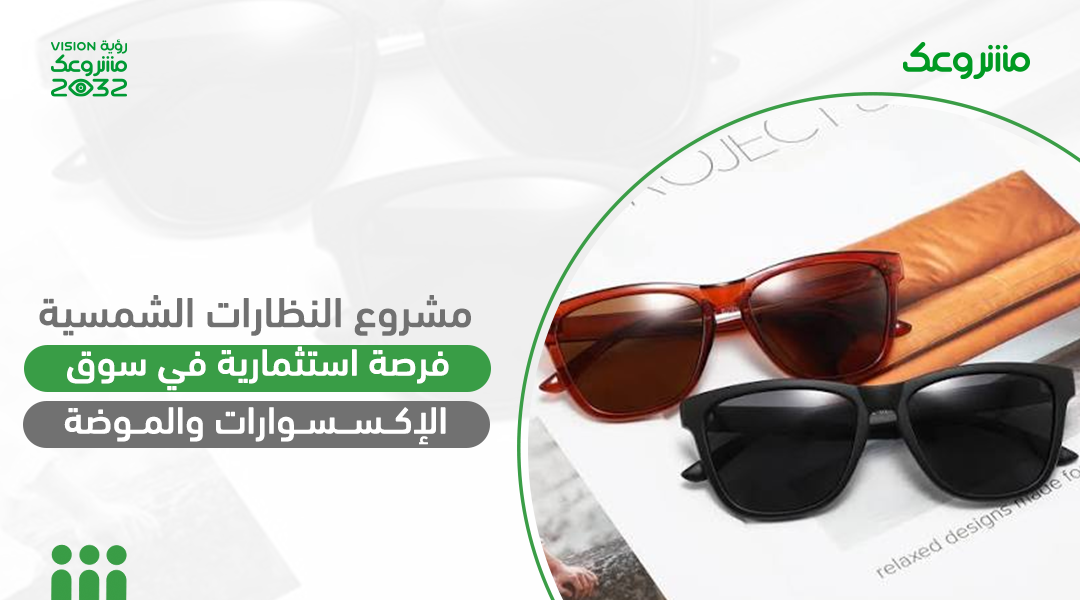
The sunglasses project combines demand for practical products with growing interest in style and personal appearance, giving it broad potential to target different customer segments. Sunglasses are no longer simply a means of protecting the eyes from sunlight; they have become fashion accessories that enhance one’s appearance and reflect individual taste and personality. This creates opportunities for a wide variety of designs, materials, and price points.
The project focuses on offering a carefully selected range of sunglasses that meet customer needs and keep pace with the latest trends, with models available to suit different ages and preferences. Its chances of success can also be strengthened by choosing a suitable location, developing a well-planned product assortment, and leveraging digital marketing to reach customers.
With thorough research into the market, competitors, and costs, a sunglasses project can be developed with strong potential for growth and sustainable returns.
A sunglasses project is a commercial business that involves purchasing sunglasses from manufacturers or suppliers and selling them to consumers through a dedicated retail outlet or online. The business includes displaying products in an organized manner, offering suitable sizes and designs, and managing sales transactions, inventory records, and customer orders.
The project may rely on purchasing ready-made sunglasses for resale or partnering with specialized brands and suppliers, depending on the nature of the business and its operating model.
Market indicators point to promising growth opportunities for a sunglasses project, driven by the continued expansion of global demand for eyewear products and their diverse applications. The global sunglasses market was valued at approximately USD 21.67 billion in 2025 and is projected to reach around USD 31.06 billion by 2031, growing at a compound annual growth rate (CAGR) of approximately 6.16% over the forecast period.
These indicators reflect the market’s expanding scope and the growing opportunities for businesses capable of offering a suitable product range, keeping pace with consumer trends, and selecting price segments and designs that align with their target markets.
Several essential aspects should be studied before launching a sunglasses project, including the following:
Read here:How to Start a Small Business and Ensure Its Profitability in 2026
The project location should be selected based on several factors that help reach target customers and increase sales opportunities. The most important include:
The cost of a sunglasses project varies depending on several factors related to the project’s size, product range, and business location. The most significant costs include:
Read here: How to find profitable business ideas that match your budget?
| Challenges | How to Overcome Them |
|---|---|
| Intense competition | Offer a diverse range of styles, focusing on product quality, competitive prices, and excellent customer service. |
| Slow-moving styles | Analyze sales performance and manage inventory to reduce the stock of slow-selling products. |
| Changing consumer tastes | Monitor fashion trends and regularly update the product range based on demand. |
| Seasonal demand fluctuations | Diversify products and offer promotional deals during periods of lower demand. |
| Variations in product quality | Work with reliable suppliers and inspect products before offering them for sale. |
| Rising operating costs | Monitor expenses and choose sales channels and a location that suit the project’s size. |
| Difficulty attracting and retaining customers | Enhance the shopping experience, provide excellent customer service, and build lasting relationships with customers. |
The success of a sunglasses project depends on several factors that help attract customers, increase sales, and build a competitive advantage. The most important include:
Read here:How to Achieve Financial Success by Investing in Successful Small Projects
The project requires a range of essential equipment to display products in an organized and attractive manner, support efficient sales and storage operations, and provide a suitable, comfortable environment for customers. The most important items include:
The materials used to manufacture sunglasses vary depending on the product type, quality, and design. Some materials are used to make frames, while others are used to manufacture lenses. The most common include:
| Material | Uses | Key Properties |
|---|---|---|
| Acetate and plastic | Manufacturing sunglass frames | Lightweight, available in a variety of designs and colors, and easy to mold. |
| Stainless steel | Manufacturing frames and metal components | Durable, corrosion-resistant, and stylish in appearance. |
| Titanium | Manufacturing high-quality frames | Lightweight, durable, and corrosion-resistant, making it suitable for premium products. |
| Nylon | Manufacturing certain types of frames, especially sports sunglasses | Flexible, lightweight, and resistant to repeated use. |
| Glass | Manufacturing certain types of lenses | Provides good optical clarity and high scratch resistance, but is heavier than plastic lenses. |
| Polycarbonate | Manufacturing lenses | Lightweight, impact-resistant, and suitable for applications requiring greater durability. |
A feasibility study for a sunglasses project includes several essential components that help assess the project’s chances of success and determine its investment viability. It begins with a market study, which analyzes demand, identifies target customers and competitors, and examines purchasing trends. This is followed by a technical study, which determines the appropriate location, space, required equipment, and suitable sources for sourcing sunglasses.
The study also includes a financial analysis to estimate startup and operating costs, expected revenues, and potential profits, alongside a marketing study focused on selecting effective promotional strategies and increasing sales. It also covers the administrative and organizational requirements needed to manage the project efficiently, as well as the legal requirements and licenses necessary to operate the business.
Furthermore, the feasibility study analyzes potential risks, such as changing fashion trends, price fluctuations, and intense competition, and develops appropriate plans to minimize their impact and ensure the project’s long-term sustainability.
Read Here:Learn About the Types of Feasibility Studies in Detail Before Starting Your Project.
The main challenges I faced when considering launching a sunglasses project were uncertainty about the required investment, the project’s potential to generate satisfactory returns, and the difficulty of identifying the most in-demand products, the appropriate inventory levels, and expected operating costs. Making a decision to proceed without a specialized study could have exposed my capital to unforeseen risks.
Therefore, I sought the assistance of Mashroo3k Consulting to prepare a comprehensive feasibility study covering the analysis of project-related data and information, as well as its marketing, technical, financial, regulatory, and administrative aspects.
The study helped me gain a clearer understanding of the project’s requirements, expected costs, and potential revenues, while identifying the main risks and challenges I might face. Thanks to the study’s findings, I became better equipped to evaluate the project and make an investment decision based on clear data and analysis rather than relying solely on expectations.
Read here: Feasibility Study (Definition, Objectives, Steps, Components, and Template)
The choice depends on the user’s needs. Glass lenses offer good optical clarity and greater scratch resistance, while plastic lenses are lightweight and impact-resistant, making them more suitable for everyday use and various activities. When choosing sunglasses, it is important to focus on lens quality and effective ultraviolet (UV) protection, rather than material type alone.
The risk of slow-moving inventory can be reduced by studying demand before purchasing, starting with carefully planned quantities, continuously monitoring sales, and updating the product range based on the most popular styles. Offering clearance promotions on slow-selling products can also help prevent excess inventory from accumulating.
The capital required for a sunglasses project depends on the project’s size, location, number of styles, product quality, and sales model. Therefore, there is no fixed cost. The exact amount should be determined by assessing rental, setup, inventory, marketing, and operating expenses before launching the project.
Demand for a sunglasses project is influenced by several factors, most notably seasonality and weather conditions, changing fashion trends, customers’ purchasing power, product quality and variety, and prevailing prices and competition in the market.
A sunglasses project represents a promising investment opportunity, given the diversity of customer needs and evolving consumer preferences. However, achieving success requires careful planning and evaluating all aspects of the business before implementation. These include identifying the target market, selecting suitable products and suppliers, estimating costs, developing an appropriate marketing strategy, managing inventory, and monitoring sales performance.
A comprehensive feasibility study helps assess the project’s potential, identify its requirements, and support more informed investment decisions.

Contact us to request a feasibility study for a sunglasses project.
The kebab restaurant project is one of the food-service ventures that combines strong demand for grilled meals with the opportunity to target a diverse customer base, including individuals, families, and lovers of traditional Middle Eastern cuisine. With growing competition in the restaurant sector, however, the project’s success is no longer determined by food taste alone. […]
Read moreA children’s toy store project is not limited to selling toys; it is built on understanding what attracts children and what families look for when choosing products that combine entertainment and educational value. With the wide variety of educational toys, skill-development games, recreational toys, and gifts available, the store has opportunities to meet the needs […]
Read moreA residential complex project is no longer simply an investment in a collection of real estate units. It has evolved into an integrated development model that combines comfortable living, diverse services, and long-term investment value. As cities expand and residents’ needs evolve, demand is growing for residential complexes that offer a comprehensive environment suited to […]
Read moreThe veterinary clinic project comes at a time when animal care is no longer limited to treating illnesses or injuries, but has expanded to include health monitoring, vaccinations, routine checkups, and care for both pets and livestock. However, many animal owners face challenges in accessing specialized veterinary services that combine prompt response, high-quality care, and […]
Read more
خصم 25% على خدمات مشروعك استفد من العرض الآن، فالفرصة متاحة لفترة محدودة فقط
سجّل بياناتك واحصل على خصم 25% الآن


