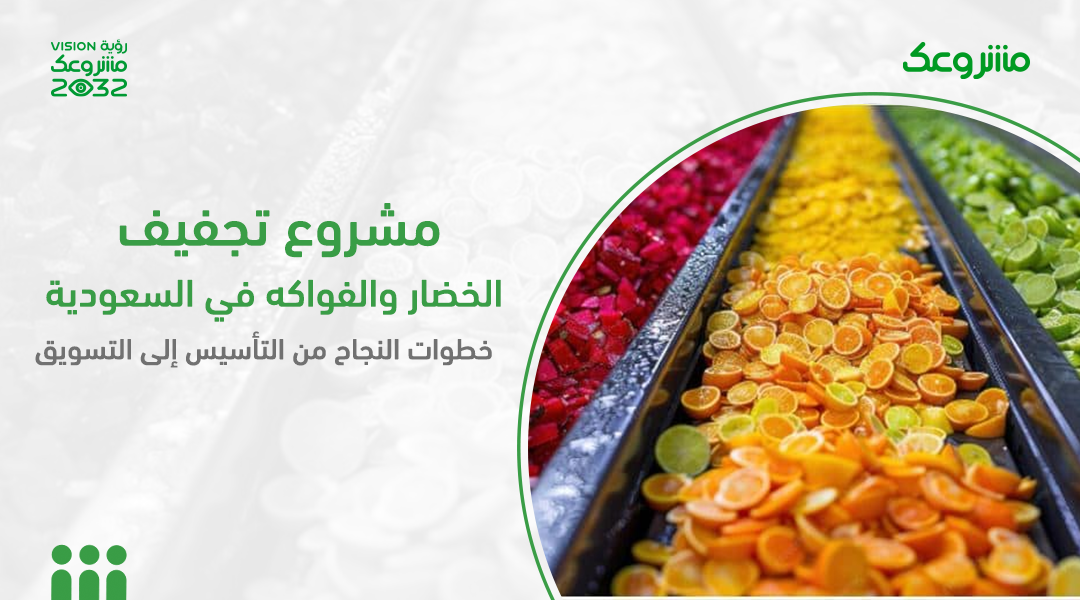
The vegetable and fruit drying project is considered one of the modern food projects that has gained significant prominence in the investment sector, driven by the growing demand for healthy and natural foods that combine high nutritional value with ease of storage and use. With the global shift toward healthier lifestyles, this project has become a promising investment opportunity characterized by capital flexibility and the potential to generate attractive long-term returns.
The project’s success depends on the quality of raw materials and the adoption of modern drying technologies that preserve nutritional value, in addition to careful attention to the packaging stage, which plays an important role in attracting consumers and enhancing the product’s market value. The project also offers broad opportunities for growth and expansion, both locally and through exports to international markets, particularly with the growing global demand for natural products.
Thus, the project represents a smart investment option that combines sustainability and profitability, provided that it is supported by sound planning and a commitment to quality standards and innovation at every stage.
The vegetable and fruit drying project is one of the modern food ventures that relies on reducing the moisture content of agricultural products using various techniques, such as solar, thermal, or freeze drying, with the aim of extending their shelf life and preserving their nutritional value and natural flavor without the need for preservatives. This process inhibits the growth of bacteria and fungi, making the products safer and easier to store and transport.
The project is also considered a promising investment opportunity that is experiencing growing demand from restaurants, food processing companies, and consumer markets, particularly for products such as tomatoes, onions, garlic, herbs, and dried fruits. The project is highly flexible, as it can be launched on a small scale and gradually expanded, with the potential to develop into an integrated industrial operation that includes packaging, marketing, and export, making it an investment opportunity that combines sustainability and profitability.
Please read here: Concept, Benefits, and Production Stages
Recent estimates indicate that the size of the vegetable and fruit drying market… The global freeze-dried food market reached approximately USD 27.25 billion in 2025, reflecting a strong and growing market base for this sector. The market is also expected to expand further, increasing from approximately USD 29.08 billion in 2026 to nearly USD 52.22 billion by 2035, reflecting a clear and sustainable upward growth trajectory over the coming years.
During this period, the market is projected to register a compound annual growth rate (CAGR) of approximately 6.72%, confirming the continued growth in global demand for freeze-dried food products, particularly as health awareness increases and consumers increasingly favor natural, shelf-stable, and easy-to-use foods.
These indicators demonstrate that the vegetable and fruit drying project represents a promising investment opportunity with strong potential for long-term growth and profitability.
Read Here: Best Successful Small Projects for Youth in 2026
Investing in a vegetable and fruit drying project offers numerous advantages that make it a promising investment opportunity, particularly with the growing demand for healthy and naturally preserved food products. The key advantages of this project include:
The cost of a vegetable and fruit drying project varies significantly depending on several key factors, primarily the targeted project size, required production capacity, the type of drying technologies used, and the quality of the selected equipment and machinery. These costs are distributed across several key areas that collectively form the project’s financial structure, most notably:
Read here: How do you start small industrial projects and achieve long-term financial sustainability?
Read here: Discover the Best Small Project That Fits Your Resources
| Challenges | Ways to Overcome Them |
|---|---|
| Variations in the quality of fresh raw materials | Select reliable suppliers and purchase during peak seasons of availability. |
| Difficulty controlling the optimal drying temperature | Use modern equipment and continuously monitor moisture levels. |
| High initial equipment costs | Start with basic equipment and expand gradually according to production volume. |
| Maintaining product quality after drying | Use airtight packaging and proper storage conditions. |
| Intense market competition | Focus on high quality, attractive packaging, and distinctive marketing. |
| Fluctuating raw material prices | Contract with reliable suppliers or purchase in bulk during suitable seasons. |
| Limited consumer awareness of the product | Conduct awareness campaigns highlighting the benefits of dried products. |
| Storage and moisture-related issues | Prepare dry, properly equipped storage facilities to maintain product quality. |
Read here: How to Achieve Financial Success by Investing in Successful Small Projects
My experience with the vegetable and fruit drying project began after I noticed the growing demand for dried food products in the Saudi market. Initially, I faced several challenges that delayed the implementation process, most notably the difficulty of properly planning the project, particularly in determining the appropriate production capacity and selecting the equipment, operating model, and marketing strategy. I also faced difficulties in securing the necessary financing to equip the project and begin operations in an organized manner.
At this stage, I decided to contact Mashroo3k Consulting, and they played a clear role in organizing the project across all aspects. The team prepared a comprehensive feasibility study covering the marketing, technical, financial, and administrative aspects. The study was thorough and helped me understand the project’s actual requirements, costs, and practical operating model.
They also helped me overcome the financing challenge through structured solutions. With their support, I was able to obtain financing from the Saudi Industrial Development Fund, which contributed to equipping the project and starting production more efficiently.
After implementing the proposed operational plan, the project began operating steadily, while production quality and management efficiency improved significantly. This had a positive impact on the continuity and growth of the business during the following period.
Many vegetables can be easily dried while retaining a significant portion of their nutritional value and flavor. The most notable include tomatoes, onions, garlic, and various types of peppers, whether sweet or hot, as well as carrots, potatoes, zucchini, eggplant, okra, spinach, and mushrooms. Some green herbs can also be dried, such as parsley, coriander, dill, and cabbage.
Among the best equipment used for fruit drying are hot-air dryers, which are the most commonly used in small-scale projects. They work by circulating hot air inside enclosed chambers to ensure fast and uniform drying of the products. Heat pump dryers are also considered an advanced technology characterized by high energy efficiency and precise control over temperature and humidity, helping preserve the color, flavor, and nutritional value of dried fruits. In addition, multi-tray dryers are suitable for medium-sized projects, offering operational flexibility and good production capacity, while large industrial drying chambers are used in large-scale projects due to their high level of control over drying conditions and their ability to achieve high production capacity. Ultimately, selecting the appropriate equipment depends on the project size, target production capacity, and required quality level.
Most fruits can be dried, but some types are not recommended or may be impractical to dry due to their very high water content or undesirable changes in texture and flavor after drying. These include watermelon, cantaloupe, and cucumber, which is sometimes classified as a fruit, as they quickly lose their texture and may become excessively brittle or lack a distinct flavor after the removal of moisture. Highly juicy fruits, such as very ripe strawberries or grapes, are also not recommended without special treatment, as they may become sticky or deteriorate during drying if not professionally prepared. In addition, some fruits, such as bananas, may develop a sticky texture if the temperature is not carefully controlled.
Many fruits can be easily dried while retaining a significant portion of their nutritional value and flavor. The most notable include apples, bananas, mangoes, apricots, peaches, pears, pineapples, dates, figs, and grapes, in addition to strawberries and cherries in some cases when properly prepared. These fruits are considered suitable for drying because they contain moisture levels that can be effectively controlled during the process, making them suitable for long-term use without spoilage.
Dried fruits are food products that enjoy widespread demand in the market due to their high nutritional value and ease of storage. Some of the most notable types include raisins (dried grapes), dates, and dried figs, in addition to dried apricots and apples. Other highly demanded varieties include dried mangoes, bananas, and pineapples, along with dried peaches and pears. These varieties offer a diverse range of flavors and health benefits, making them a preferred choice among different consumer segments, whether for direct consumption or use in food and confectionery industries.
The fruit drying process requires a range of essential supplies to ensure production quality and efficiency, foremost among them industrial drying equipment that relies on hot air or modern drying technologies. The necessary tools also include stainless steel washing basins for cleaning fruits and cutting and preparation machines for producing suitable sizes, along with mesh trays that help distribute air evenly during drying. Other requirements include sorting tools and electronic scales for accurately measuring quantities, as well as filling and packaging equipment that helps maintain product quality and extend its shelf life. It is also preferable to provide cooling units or refrigerators for storing fresh fruits before the production process begins, ensuring the highest levels of quality throughout all stages of production.
Read here: How to Start a Small Business and Ensure Its Profitability in 2026
| Element | Solar Drying | Industrial Drying |
|---|---|---|
| Drying Method | Relies on sunlight and natural air | Relies on thermal or advanced drying equipment and machinery |
| Drying Time | Relatively longer and affected by weather conditions | Faster and more consistent in terms of drying time |
| Product Quality | May vary depending on environmental conditions | More consistent quality and greater control over results |
| Cost | Very low and does not require complex equipment | Higher due to equipment and energy costs |
| Process Control | Limited and dependent on weather conditions | Full control over temperature and humidity |
| Hygiene and Safety | Less control over contamination factors | Higher levels of hygiene and compliance with health standards |
| Productivity | Limited and inconsistent | High and consistent productivity |
| Dependence on Weather | Fully dependent on weather conditions | Not affected by weather and can operate year-round |
The vegetable and fruit drying project proves to be a smart investment formula that balances well-planned operating costs with growing profit opportunities, driven by a modern lifestyle that places greater value on healthy, easy-to-store food. The success of this project as a brand and a sustainable source of income is not a matter of chance, but rather the result of careful planning, strict selection of raw materials, and professionalism at every stage, from drying to packaging and marketing.
If you are looking for a genuine starting point in the food business and aspire to establish a project that combines profitability with sustainability, the vegetable and fruit drying project is your gateway to beginning your investment journey today with confidence and passion.

For inquiries and to request a feasibility study for a vegetable and fruit drying project
The kebab restaurant project is one of the food-service ventures that combines strong demand for grilled meals with the opportunity to target a diverse customer base, including individuals, families, and lovers of traditional Middle Eastern cuisine. With growing competition in the restaurant sector, however, the project’s success is no longer determined by food taste alone. […]
Read moreA children’s toy store project is not limited to selling toys; it is built on understanding what attracts children and what families look for when choosing products that combine entertainment and educational value. With the wide variety of educational toys, skill-development games, recreational toys, and gifts available, the store has opportunities to meet the needs […]
Read moreA residential complex project is no longer simply an investment in a collection of real estate units. It has evolved into an integrated development model that combines comfortable living, diverse services, and long-term investment value. As cities expand and residents’ needs evolve, demand is growing for residential complexes that offer a comprehensive environment suited to […]
Read moreThe veterinary clinic project comes at a time when animal care is no longer limited to treating illnesses or injuries, but has expanded to include health monitoring, vaccinations, routine checkups, and care for both pets and livestock. However, many animal owners face challenges in accessing specialized veterinary services that combine prompt response, high-quality care, and […]
Read more
خصم 25% على خدمات مشروعك استفد من العرض الآن، فالفرصة متاحة لفترة محدودة فقط
سجّل بياناتك واحصل على خصم 25% الآن


