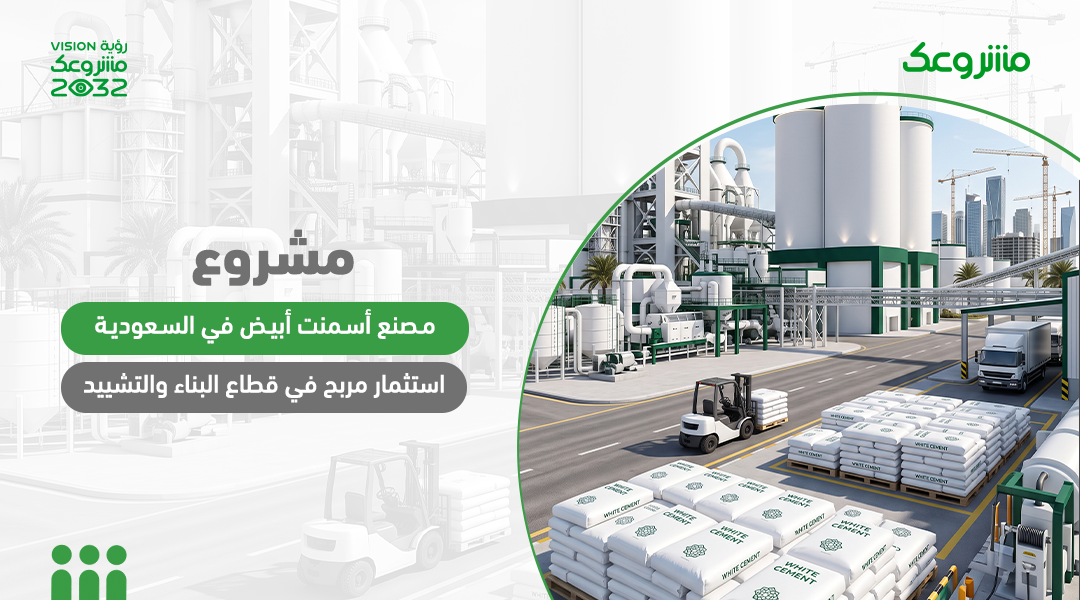
A white cement factory project is considered one of the most promising industrial ventures, representing an important investment opportunity amid the continued demand for cement as one of the key materials in the construction and building sector. However, the success of the project does not depend solely on the size of the investment; it requires careful planning and a comprehensive study of various market, technical, financial, and operational aspects. The importance of preparing a comprehensive feasibility study lies in determining the appropriate investment size, selecting a strategic location for the factory, and estimating the costs of equipment, labor, and raw materials, in addition to calculating production capacity, expected revenues, and projected profits. Engaging a specialized team and developing a clear operational and marketing plan also contribute to reducing risks and enhancing the potential for achieving sustainable investment returns. Therefore, making the decision to establish a white cement factory after carefully studying all project requirements and challenges provides investors with greater clari
The concept of a white cement factory project is based on establishing a specialized industrial facility for producing white cement that meets the required specifications and quality standards to serve the needs of the construction and building sector, as well as finishing and decoration works. The factory relies on preparing and grinding raw materials, followed by processing and firing them in specialized kilns at high temperatures. The product is then cooled, ground, and packaged in accordance with standard specifications. White cement has a wide range of applications, particularly in façade and flooring finishes, decorative elements, and cement-based products, making it a product with strong marketing and investment potential.
Yes, a white cement factory project is considered one of the promising and profitable industrial ventures. According to market statistics, the global cement market was valued at USD 384 billion in 2025 and is projected to grow from USD 394.82 billion in 2026 to USD 500.3 billion by 2034, registering a compound annual growth rate (CAGR) of 3.3% during the forecast period.
A white cement factory project is considered one of the most promising investment opportunities due to the numerous advantages it offers, including the following:
Read here: Why Residential Apartment Projects Are the Ideal Investment Choice
A white cement factory project in Saudi Arabia can benefit from the growth of the construction and building sector through increasing demand for construction materials used in residential, commercial, tourism, and infrastructure projects, particularly as white cement is widely used in finishing works, façades, tiles, and decorative applications. Statistics indicate that the Saudi construction market was valued at USD 101.4 billion in 2025 and is projected to reach USD 140.4 billion by 2034, registering a compound annual growth rate (CAGR) of 3.6% during the period from 2026 to 2034. This growth is driven by major projects under Saudi Vision 2030, alongside the expansion of real estate development and tourism and entertainment projects, which increases demand for specialized cement products and creates opportunities for local factories to meet growing market needs.
Read here: Construction and Building Sector Report in Saudi Arabia
Read Here: How to Start a Construction Equipment Rental Project in 2026
Read Here: How to Start a Concrete Block Factory in Saudi Arabia and Succeed in the Construction Market?
The costs of a White Cement Factory Project are divided into capital costs incurred to establish and equip the factory, and ongoing operating costs required to maintain the production process. They include the following:
Choosing the right location for a White Cement Factory Project is a critical step in ensuring the project’s success and long-term sustainability. Therefore, several criteria should be considered, including:
Read Here: Concrete Block Factory: 5 Key Points to Consider When Starting the Project
With the massive urban expansion taking place in Riyadh, the gap between the growing demand for construction materials and available production capacity presented a genuine investment opportunity, which prompted me to establish a White Cement Factory Project to meet the needs of the local market. Despite the clear potential of the idea, I initially faced complex challenges, including difficulties in the project’s structural planning, securing substantial financing, as well as technical issues related to selecting suitable production lines and managing energy and environmental emissions plans in accordance with standard requirements.
At that point, I sought the support of Mashroo3k Consulting, whose team prepared a comprehensive feasibility study that provided engineering and technical solutions to address operational challenges and optimize overall costs. Based on the reliable data and analyses included in the study, I submitted a complete application to the Saudi Industrial Development Fund and successfully obtained the necessary financing, enabling the factory to enter actual production with high efficiency and strong competitiveness.
The price per ton of cement at the factory varies depending on the type of cement, production capacity, raw material and energy costs, as well as market conditions and the volume of supplied quantities.
The workforce required for a Cement Factory Project depends on the production capacity, the size of the production lines, and the level of automation. It typically includes production line operators and technicians, electrical and mechanical engineers, maintenance technicians, quality control specialists, packaging and warehouse workers, as well as administrative, accounting, sales, security, and safety staff. The workforce size generally increases as production capacity expands and the number of production lines increases.
The appropriate area for establishing a Cement Factory Project varies depending on production capacity, the number of production lines, and the type of equipment. However, medium- and large-scale factories generally require extensive areas to accommodate production lines, kilns, raw material, clinker, and cement storage areas, administrative buildings, transportation facilities, and other services. It is preferable to select a site that allows for safe movement within the factory and provides room for future expansion, while also considering proximity to raw material sources and transportation networks.
The raw materials used in cement manufacturing vary depending on the type of product. They primarily include limestone and shale or clay, along with gypsum, which is added during clinker grinding. Additional materials such as sand and iron ore may also be used to adjust the chemical composition and achieve the required specifications. White cement, however, relies on high-purity raw materials with low iron and manganese oxide content to maintain the white color of the final product.
Licensing requirements vary by country and factory location. However, establishing a cement factory typically requires several approvals, including an industrial activity license, environmental approval, building permit, safety and civil defense approvals, and permits for land and utility use. Additional licenses may be required for the extraction or transportation of raw materials if the factory relies on quarries. All applicable local requirements and regulations should be fulfilled before construction and operation begin.
It can be concluded that this is an industrial project directly linked to the needs of the construction and building sector, making it an investment that requires a thorough assessment of various aspects before implementation. Selecting the appropriate production capacity, determining the factory’s equipment and raw material requirements, and analyzing construction and operating costs are all essential elements for developing a clear understanding of the investment size and expected returns. In addition, understanding the nature of the market and the level of demand for cement helps investors make more accurate decisions regarding production and distribution. To transform the idea of a Cement Factory Project into a viable project based on clear foundations, it is important to seek the support of a specialized firm such as Mashro3k Consulting to prepare a comprehensive feasibility study that outlines the technical, financial, and marketing requirements and helps evaluate the investment opportunity from an integrated perspective.

For inquiries and to request a feasibility study for a Cement Factory Project.
The kebab restaurant project is one of the food-service ventures that combines strong demand for grilled meals with the opportunity to target a diverse customer base, including individuals, families, and lovers of traditional Middle Eastern cuisine. With growing competition in the restaurant sector, however, the project’s success is no longer determined by food taste alone. […]
Read moreA children’s toy store project is not limited to selling toys; it is built on understanding what attracts children and what families look for when choosing products that combine entertainment and educational value. With the wide variety of educational toys, skill-development games, recreational toys, and gifts available, the store has opportunities to meet the needs […]
Read moreA residential complex project is no longer simply an investment in a collection of real estate units. It has evolved into an integrated development model that combines comfortable living, diverse services, and long-term investment value. As cities expand and residents’ needs evolve, demand is growing for residential complexes that offer a comprehensive environment suited to […]
Read moreThe veterinary clinic project comes at a time when animal care is no longer limited to treating illnesses or injuries, but has expanded to include health monitoring, vaccinations, routine checkups, and care for both pets and livestock. However, many animal owners face challenges in accessing specialized veterinary services that combine prompt response, high-quality care, and […]
Read more
خصم 25% على خدمات مشروعك استفد من العرض الآن، فالفرصة متاحة لفترة محدودة فقط
سجّل بياناتك واحصل على خصم 25% الآن


