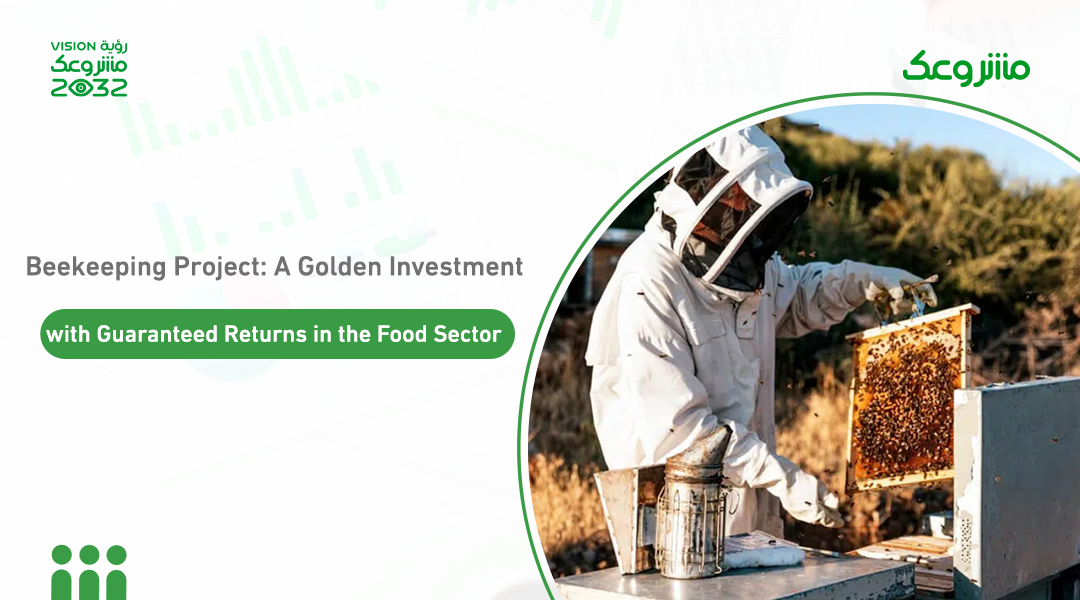
Beekeeping Project: A Golden Investment with Guaranteed Returns in the Food Sector
Amid the growing global demand for natural products and increasing health awareness, the beekeeping project stands out as a promising investment opportunity that combines high profitability with environmental and economic sustainability. It is not merely a traditional agricultural activity but a smart investment aligned with modern economic transformations. The project contributes to enhancing the added value of the food sector through high-quality products such as honey, pollen, beeswax, and royal jelly — all of which enjoy strong competitiveness in both local and international markets.
This trend is supported by a favorable investment environment that includes government initiatives backing the agricultural sector, along with a growing focus on food security and diversifying national income sources. Hence, beekeeping becomes a strategic choice not only for entrepreneurs seeking rewarding financial returns but also for those who aspire to actively participate in building a green and sustainable economy.
Beekeeping is an agricultural and investment activity focused on breeding and managing bee colonies scientifically and systematically to produce natural honey and other bee-derived products such as beeswax, royal jelly, and pollen. It is one of the most profitable and sustainable projects that combines economic feasibility with environmental benefits, as bees play a key role in enhancing biodiversity and improving crop productivity through pollination.
The project is also highly flexible in terms of scale and resources — it can start as a small individual venture or be expanded into a large-scale commercial investment that meets both local and international market needs.
Read here: Agricultural Sector Market Report in Saudi Arabia
Identify investment size, fixed and variable costs, production expectations, pricing, and marketing plans to minimize risks and ensure clear business vision
Read here: Economic Feasibility Study — Definition, Importance, Objectives, and Its Role in Risk Assessment
Select an area rich in flowering plants, close to water sources, far from pollution and pesticides, and easily accessible with fencing for protection.
Provide appropriate hives, protective suits, smokers, and inspection tools. Some equipment can be produced locally to reduce costs.
Source colonies from trusted suppliers and choose breeds suited to the local environment for better productivity and disease resistance.
Attend workshops or work alongside experienced beekeepers to gain practical knowledge in hive management and colony health.
Provide sugar syrup or protein substitutes during flower scarcity, monitor food reserves, and supply clean water regularly.
Implement preventive health management against common threats such as Varroa mites, and document all procedures and treatments.
Regularly inspect colonies, monitor queen performance, and manage swarming and hive expansion as needed.
Extract honey only when fully matured, maintaining hygiene and correct moisture standards, and package it attractively for market appeal.
Start locally through shops and markets, then expand to value-added products like wax and propolis, and explore export opportunities later.
Read here: Marketing — Its Concept, Importance, Types, and the Best Mechanism for Implementation
To read the complete technical guide for the beekeeping activity in Saudi Arabia, click here
Absolutely. Beekeeping is among the most promising investment ventures.
The global beekeeping market grew from USD 12.4 billion in 2024 to USD 13.32 billion in 2025 (CAGR 7.4%) and is expected to reach USD 16.39 billion by 2029 with a 5.3% annual growth rate.
These figures confirm that beekeeping is not just a traditional activity — it is a lucrative and scalable business in a rapidly expanding global market.
To view The Business Research Company report on the market, click here.

For inquiries and to request a feasibility study for the beekeeping project
The kebab restaurant project is one of the food-service ventures that combines strong demand for grilled meals with the opportunity to target a diverse customer base, including individuals, families, and lovers of traditional Middle Eastern cuisine. With growing competition in the restaurant sector, however, the project’s success is no longer determined by food taste alone. […]
Read moreA children’s toy store project is not limited to selling toys; it is built on understanding what attracts children and what families look for when choosing products that combine entertainment and educational value. With the wide variety of educational toys, skill-development games, recreational toys, and gifts available, the store has opportunities to meet the needs […]
Read moreA residential complex project is no longer simply an investment in a collection of real estate units. It has evolved into an integrated development model that combines comfortable living, diverse services, and long-term investment value. As cities expand and residents’ needs evolve, demand is growing for residential complexes that offer a comprehensive environment suited to […]
Read moreThe veterinary clinic project comes at a time when animal care is no longer limited to treating illnesses or injuries, but has expanded to include health monitoring, vaccinations, routine checkups, and care for both pets and livestock. However, many animal owners face challenges in accessing specialized veterinary services that combine prompt response, high-quality care, and […]
Read more
خصم 25% على خدمات مشروعك استفد من العرض الآن، فالفرصة متاحة لفترة محدودة فقط
سجّل بياناتك واحصل على خصم 25% الآن


