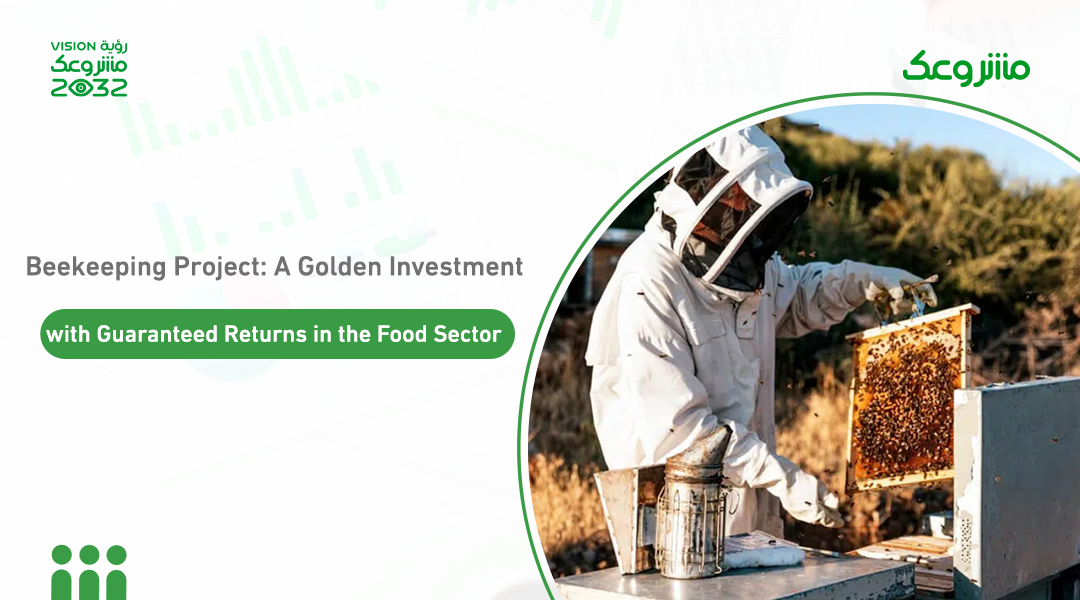
Beekeeping Project: A Golden Investment with Guaranteed Returns in the Food Sector - Mashroo3k Consulting
Published19 Oct 2025 0 comments 1109 Observation
Beekeeping Project: A Golden Investment with Guaranteed Returns in the Food Sector

Beekeeping Project: A Golden Investment with Guaranteed Returns in the Food Sector

Amid the growing global demand for natural products and increasing health awareness, the beekeeping project stands out as a promising investment opportunity that combines high profitability with environmental and economic sustainability. It is not merely a traditional agricultural activity but a smart investment aligned with modern economic transformations. The project contributes to enhancing the added value of the food sector through high-quality products such as honey, pollen, beeswax, and royal jelly — all of which enjoy strong competitiveness in both local and international markets.

This trend is supported by a favorable investment environment that includes government initiatives backing the agricultural sector, along with a growing focus on food security and diversifying national income sources. Hence, beekeeping becomes a strategic choice not only for entrepreneurs seeking rewarding financial returns but also for those who aspire to actively participate in building a green and sustainable economy.

What is a Beekeeping Project?

Beekeeping is an agricultural and investment activity focused on breeding and managing bee colonies scientifically and systematically to produce natural honey and other bee-derived products such as beeswax, royal jelly, and pollen. It is one of the most profitable and sustainable projects that combines economic feasibility with environmental benefits, as bees play a key role in enhancing biodiversity and improving crop productivity through pollination.

The project is also highly flexible in terms of scale and resources — it can start as a small individual venture or be expanded into a large-scale commercial investment that meets both local and international market needs.

Why Invest in a Beekeeping Project?

  • The global demand for natural honey and bee products is increasing, driven by consumer preference for organic and natural alternatives.
  • The project offers high profitability due to the diversity of its products (honey, wax, royal jelly, pollen) and multiple marketing channels.
  • Low operating costs compared to other agricultural or livestock projects — minimal labor and limited land area are required.
  • Can start with a small number of hives and expand gradually according to available resources and experience.
  • Bees significantly improve agricultural productivity through pollination, enhancing the yield and quality of fruits and vegetables.
  • Supported by governmental programs that offer grants, training, and financing facilities as part of national food security and sustainability initiatives.
  • The wide range of bee products allows access to diverse market segments.
  • Strong local and international marketing potential, particularly with the growing honey exports from producing countries to European and Asian markets.
  • Environmentally friendly — enhances biodiversity and preserves ecological balance without pollution or resource depletion.
  • Bee colonies have a long productive lifespan (several years) when managed scientifically.
  • High flexibility in site selection — suitable for rural, mountainous, desert, or suburban areas, provided nectar sources are available.
  • Rising health awareness encourages replacing artificial sweeteners with natural honey and using bee products as nutritional and therapeutic supplements.
  • Possibility to develop value-added products such as cosmetics, natural soaps, and supplements, significantly boosting profitability.
  • Suitable for small and medium investors looking for low-cost, easy-to-manage projects with quick returns.
  • Can be integrated with other agricultural projects (e.g., olive, date, or fruit farms) for an efficient and profitable production system.
  • Can evolve into an agritourism project (“Bee Tourism”), attracting visitors for education and direct product purchases.

Read here: Agricultural Sector Market Report in Saudi Arabia

How to Start a Beekeeping Project

1. Conduct a Feasibility Study

Identify investment size, fixed and variable costs, production expectations, pricing, and marketing plans to minimize risks and ensure clear business vision

Read here: Economic Feasibility Study — Definition, Importance, Objectives, and Its Role in Risk Assessment

2. Choose the Right Location

Select an area rich in flowering plants, close to water sources, far from pollution and pesticides, and easily accessible with fencing for protection.

3. Prepare Hives and Tools

Provide appropriate hives, protective suits, smokers, and inspection tools. Some equipment can be produced locally to reduce costs.

4. Buy Strong Bee Colonies

Source colonies from trusted suppliers and choose breeds suited to the local environment for better productivity and disease resistance.

5. Training and Skill Development

Attend workshops or work alongside experienced beekeepers to gain practical knowledge in hive management and colony health.

6. Feeding and Regular Care

Provide sugar syrup or protein substitutes during flower scarcity, monitor food reserves, and supply clean water regularly.

7. Disease and Pest Control

Implement preventive health management against common threats such as Varroa mites, and document all procedures and treatments.

8. Seasonal Management

Regularly inspect colonies, monitor queen performance, and manage swarming and hive expansion as needed.

9. Honey Harvesting and Quality Control

Extract honey only when fully matured, maintaining hygiene and correct moisture standards, and package it attractively for market appeal.

10. Marketing and Gradual Expansion

Start locally through shops and markets, then expand to value-added products like wax and propolis, and explore export opportunities later.

Read here: Marketing — Its Concept, Importance, Types, and the Best Mechanism for Implementation

Key Requirements to Start a Beekeeping Project

  • Provide official documentation proving ownership or legal use of the apiary site.
  • Ensure the site is suitable for beekeeping and has abundant nectar sources.
  • Must be located away from residential or crowded areas.
  • Avoid polluted areas and unpleasant odors from livestock or poultry farms.
  • Submit a technical and economic feasibility study and any additional documents required by authorities.
  • Register the apiary details on the ministry’s platform and apply for a renewable three-year license.
  • Beekeepers must number their hives and place an identification sign displaying reference information.
  • Maintain sufficient distance between neighboring apiaries.

To read the complete technical guide for the beekeeping activity in Saudi Arabia, click here

Estimated Cost Structure

Fixed Costs

  • Bee hives and colonies with active queens.
  • Protective gear (suits, gloves, masks).
  • Hive maintenance tools (smokers, inspection tools, cleaning equipment).
  • Site preparation (fencing, shaded area).
  • Honey extraction equipment (manual or electric).

Operating Costs

  • Veterinary care and pest control treatments.
  • Supplementary feeding during nectar scarcity.
  • Replacing old queens to sustain productivity.
  • Labor wages.
  • Transport costs for moving hives to pollination areas.
  • Equipment maintenance or hive replacement.
  • Insurance and legal compliance costs.

Marketing Costs

  • Advertising and promotional activities.
  • Packaging materials and branding.

Importance of a Feasibility Study

  • Defines total project costs and capital needs.
  • Identifies new investment opportunities in profitable bee product segments.
  • Helps choose the most productive and disease-resistant bee breeds.
  • Provides accurate annual revenue projections.
  • Guides effective marketing strategies to grow market share.
  • Supports gradual expansion while minimizing risk.
  • Highlights additional income from byproducts (wax, propolis).
  • Evaluates market competition and future challenges.
  • Clarifies licensing and legal requirements.
  • Plans staff training and efficiency improvement.
  • Facilitates loan or financing approval through solid financial analysis.
  • Serves as a long-term monitoring and performance tool.

Is Beekeeping Profitable?

Absolutely. Beekeeping is among the most promising investment ventures.
The global beekeeping market grew from USD 12.4 billion in 2024 to USD 13.32 billion in 2025 (CAGR 7.4%) and is expected to reach USD 16.39 billion by 2029 with a 5.3% annual growth rate.
These figures confirm that beekeeping is not just a traditional activity — it is a lucrative and scalable business in a rapidly expanding global market.

To view The Business Research Company report on the market, click here.

Key Success Factors

  • Proper Site Selection – abundant flowering plants, water availability, and no pesticide exposure.
  • Strong Bee Breeds – high honey yield, disease resistance, and local adaptability.
  • Effective Hive Management – regular inspections, queen monitoring, and optimized frame control.
  • Balanced Nutrition – supplemental feeding during low nectar periods.
  • Disease Prevention – proactive health measures to minimize colony losses.
  • Training and Experience – practical skills from courses or mentorships.
  • Strategic Marketing – diverse sales channels and attractive packaging.
  • Gradual Expansion – start small, grow sustainably.
  • Product Diversification – include wax, pollen, royal jelly, and propolis.
  • Financial Discipline – monitor costs, reinvest profits, and plan long-term growth.

For inquiries and to request a feasibility study for the beekeeping project


Similar Articles

How to Turn a Kebab Restaurant Project into a Distinctive Brand in Egypt?

The kebab restaurant project is one of the food-service ventures that combines strong demand for grilled meals with the opportunity to target a diverse customer base, including individuals, families, and lovers of traditional Middle Eastern cuisine. With growing competition in the restaurant sector, however, the project’s success is no longer determined by food taste alone. […]

Read more

Children’s Play Center Project in Saudi Arabia: How to Create an Experience That Attracts Children and Families?

A children’s toy store project is not limited to selling toys; it is built on understanding what attracts children and what families look for when choosing products that combine entertainment and educational value. With the wide variety of educational toys, skill-development games, recreational toys, and gifts available, the store has opportunities to meet the needs […]

Read more

Residential Complex Project in Saudi Arabia: An Investment That Creates Value Beyond Residential Units

A residential complex project is no longer simply an investment in a collection of real estate units. It has evolved into an integrated development model that combines comfortable living, diverse services, and long-term investment value. As cities expand and residents’ needs evolve, demand is growing for residential complexes that offer a comprehensive environment suited to […]

Read more

Veterinary Clinic Project in Egypt: A Promising Investment Opportunity in the Animal Care Sector

The veterinary clinic project comes at a time when animal care is no longer limited to treating illnesses or injuries, but has expanded to include health monitoring, vaccinations, routine checkups, and care for both pets and livestock. However, many animal owners face challenges in accessing specialized veterinary services that combine prompt response, high-quality care, and […]

Read more
Green Friday

فرصة لا تتكرر

GREEN FRIDAY

خصم 25% على خدمات مشروعك استفد من العرض الآن، فالفرصة متاحة لفترة محدودة فقط
سجّل بياناتك واحصل على خصم 25% الآن