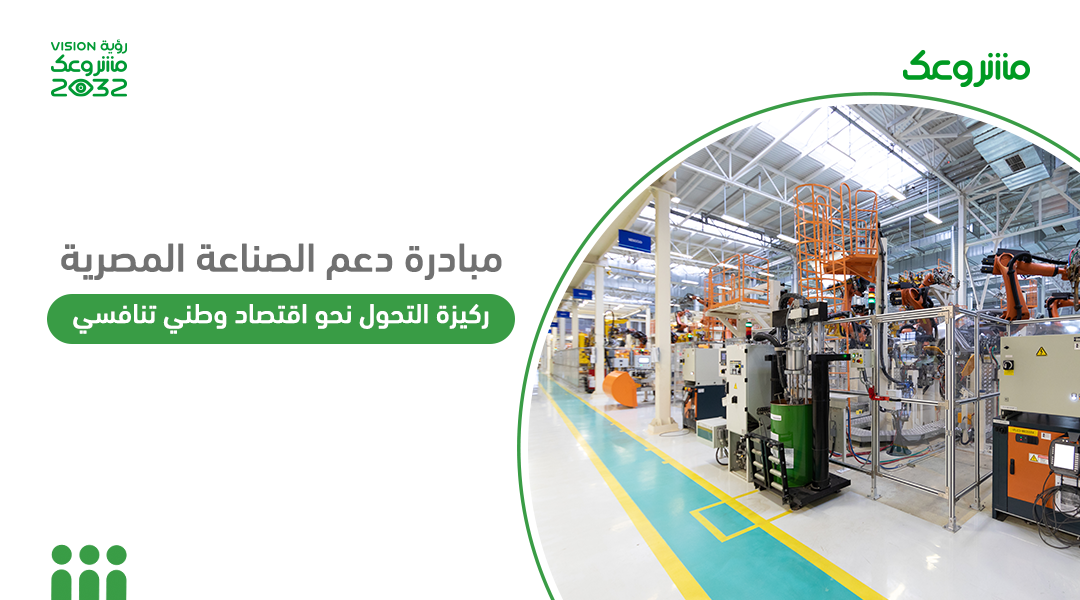
The Egyptian Industry Support Initiative is considered a cornerstone in the journey toward building a competitive national economy rooted in local production. It aims to empower entrepreneurs and small and medium-sized enterprises (SMEs) through an integrated support package that includes accessible financing facilities, production incentives, and technical and administrative development programs.
The initiative enhances the competitiveness of Egyptian products both locally and internationally, reduces reliance on imports, stimulates innovation, and creates genuine employment opportunities. It represents a strategic step toward achieving self-sufficiency and balancing economic growth with sustainability requirements within the framework of Egypt Vision 2030.
This article explores in detail the various dimensions of the initiative, starting with its objectives and the forms of support it provides to factories and companies, moving through the eligibility requirements for obtaining industrial loans and financing, and culminating in its pivotal role in advancing Egypt Vision 2030.
The article also examines its complementary relationship with the “Ebda” Initiative, outlines the steps required to benefit from it, and highlights the key advantages of industrial investment in Egypt today. It serves as a comprehensive guide for anyone seeking to invest in the industrial sector and maximize the benefits of government-backed opportunities that support local production.
The Egyptian Industry Support Initiative is a key government program that provides concessional loans at a reduced interest rate of up to 15% for priority industrial sectors. Updates introduced in January 2026 expanded the initiative to include new strategic activities such as the pharmaceutical and food industries.
Under the revised framework, the maximum financing limit per individual client has been increased to EGP 100 million, while the ceiling for a single client and its related parties has risen to EGP 150 million. This marks a significant increase compared to the previous limits, which stood at EGP 75 million per client and EGP 100 million per client and related parties combined.
The initiative aims to localize industries, increase exports, and enhance the efficiency of the industrial sector in a way that strengthens the foundations of the national economy and aligns with Egypt Vision 2030 for sustainable and inclusive industrial development.
To achieve this, the initiative provides an integrated support system that includes financing facilities, attractive investment incentives, specialized training programs, as well as technical and advisory support to improve production processes and modernize technology.
Through these mechanisms, the initiative enables industrial enterprises of all sizes to expand their operational capacity, improve product quality, and strengthen their competitiveness both locally and globally. This contributes to accelerating industrial transformation, achieving self-sufficiency in vital sectors, and building a robust national production base capable of driving sustainable economic growth.
The Egyptian Industry Support Initiative aims to achieve a set of strategic objectives, foremost among them:
The forms of support provided by the Egyptian Industry Support Initiative are diverse, and the most prominent include:
To receive factory support under the Egyptian Industry Support Initiative, several key conditions must be met to ensure eligibility for the programs and incentives offered. The most important of these conditions include:
Egypt Vision 2030 aims to create a flexible labor market that provides decent and safe job opportunities, with a particular focus on increasing employment rates among priority groups such as youth, women, and persons with disabilities. This approach seeks to maximize their economic participation while reducing unemployment and poverty rates.
In parallel, the vision emphasizes establishing a comprehensive work environment that meets the highest occupational health and safety standards, protects fundamental labor rights, and expands social protection and healthcare coverage to include informal workers, as part of a gradual plan to integrate them into the formal economy and reduce the size of the unregulated sector.
The Egyptian Industry Support Initiative serves as a key executive tool to achieve these objectives, directly contributing to the creation of decent job opportunities through the implementation of major industrial projects and the localization of modern industries that generate thousands of new jobs. It also supports small and medium enterprises and struggling factories to expand their activities and enhance their employment capacity. In addition, it provides advanced technical and vocational training programs—through strategic partnerships with the Ministry of Labor and the development of vocational training centers across various governorates—to qualify the Egyptian workforce according to international standards, thereby ensuring sustainable employment with fair wages that guarantee a decent living and enhance productivity.
Egypt Vision 2030 aims to promote financial inclusion as a core pillar of comprehensive and sustainable economic development. This is achieved by increasing the accessibility of financial services across all segments of society without discrimination, and by building a fair and accessible financial system that enables individuals and small and medium-sized enterprises (SMEs) to access high-quality financial products and services at affordable costs and with full transparency.
Such financial empowerment supports entrepreneurship, encourages household savings and investment, and integrates informal sectors into the economic cycle, thereby enhancing the resilience of the national economy and its ability to achieve sustainable growth that positively impacts the lives of every Egyptian citizen.
Here, the Egyptian Industry Support Initiative emerges as one of the most prominent mechanisms for achieving this goal. It focuses on facilitating access to concessional financing for small and medium-sized industrial enterprises through cooperation protocols with major banks such as the National Bank of Egypt, offering loans at reduced interest rates (up to 15% or lower with additional incentives), and guiding investors to suitable financing entities.
In addition, the initiative provides technical and logistical support to help entrepreneurs and factories secure the necessary funding to expand their operations and localize industries. This role directly promotes financial inclusion by enabling the industrial sector—especially startups and SMEs—to integrate into the formal financial system, reducing financing gaps, stimulating local production, and contributing to the comprehensive objectives of a competitive, diversified economy based on innovation and broad participation.
Egypt Vision 2030 aims to deepen local manufacturing and accelerate industrial growth by supporting technology- and knowledge-based industries, with a strategic focus on labor-intensive sectors that help reduce unemployment and empower the workforce. These include the chemical, food, textile, engineering, construction, and building materials industries, as well as artisanal industries that preserve local production identity.
The vision seeks to strengthen integration between small, medium, and large enterprises through interconnected value chains that enhance production efficiency and localize technology, while placing increasing emphasis on green industry as a key pathway toward a low-carbon economy.
The Egyptian Industry Support Initiative serves as a primary implementation tool to achieve these objectives, focusing on deepening local manufacturing by localizing modern and promising industries, supporting large, small, and medium-sized projects through concessional financing and low-interest loans, streamlining administrative and logistical barriers, and revitalizing struggling factories to increase the local content of production.
Egypt Vision 2030 aims to build an integrated empowerment ecosystem for small and medium-sized enterprises (SMEs) and entrepreneurs by adopting a clear and consistent investment policy that provides a supportive environment for achieving high and sustainable growth rates. The vision promotes entrepreneurship as a deeply rooted societal value and offers specialized technical support to enhance managerial, production, and innovation capabilities.
In addition, it facilitates access to financing by simplifying credit procedures and providing concessional financial guarantees, supports entry into international markets, and develops competitive, human, and technological capacities to enable these enterprises to expand and compete globally.
The Egyptian Industry Support Initiative stands out as one of the key implementation mechanisms to achieve these objectives. It focuses on empowering entrepreneurs and small and medium-sized enterprises (SMEs) by removing administrative and logistical obstacles, facilitating the issuance of industrial licenses, providing specialized technical and advisory support, and assisting in obtaining concessional financing through coordination with banks and financial institutions.
Additionally, the initiative supports the localization of modern industries, restructures struggling factories, and enhances export and competitive capabilities through training and capacity-building programs. This contributes to fostering an entrepreneurial culture, stimulating innovation, expanding market access, and integrating these enterprises into local and global value chains, positioning the private sector as a core partner in achieving the sustainable and inclusive economic growth envisioned by Egypt Vision 2030.
The “Ebda” Initiative serves as a key operational pillar within the framework of the Egyptian Industry Support Initiative, translating its objectives into tangible support mechanisms that enable entrepreneurs and small and medium-sized industrial enterprises to turn their ideas into successful production projects.
The initiative provides a comprehensive package of services, including concessional financing facilities, specialized technical consulting, and targeted training programs to develop managerial and operational competencies. Through this holistic support, “Ebda” empowers startups to enter the industrial market with confidence, improve the quality of their outputs, and build competitive capacities that qualify them to compete locally and integrate into global value chains.
In this way, the initiative acts as a bridge connecting the individual ambitions of project owners with national goals of strengthening local industry and driving sustainable economic growth within the framework of Egypt Vision 2030.
If you own an industrial project or a struggling factory, or face challenges in dealing with government or relevant authorities after submitting your application, the “Ebda” Initiative offers a proactive and supportive solution to overcome these obstacles.
You can access the initiative directly through its official online platform, enter your basic information, and attach a comprehensive feasibility study covering the technical and financial aspects of your project. Once your application is received, a specialized team from the initiative will contact you to analyze the challenges you face and develop a tailored support plan.
This plan may include financial facilitation, effective mediation with relevant authorities, and technical and advisory support, all aimed at enabling your project to resume production efficiently and achieve sustainable success within Egypt’s industrial environment.
Contact the “Ebda” Initiative Here
For more information on investment incentives in Egypt, click here.
It becomes clear that the Egyptian Industry Support Initiative—led by the national “Ebda” Initiative—is not merely a temporary government program, but an ambitious and comprehensive vision that transforms challenges into real opportunities, building a strong national industrial sector capable of driving sustainable development. By empowering factories, SMEs, and entrepreneurs, the initiative lays the foundations for a productive economy based on innovation and high productivity rather than consumption and imports.
Thus, it is not just a gateway for financing or incentives, but a true developmental partnership that opens wide horizons for every individual with an idea or industrial project, enabling them to become an active building block in creating the productive, innovative, and sustainable Egypt we aspire to. Those who seize this opportunity today are not only achieving individual business success but are also contributing to writing a new chapter in Egypt’s journey toward self-sufficiency and industrial leadership.

To communicate and learn more about Mashroo3k company and its services
The kebab restaurant project is one of the food-service ventures that combines strong demand for grilled meals with the opportunity to target a diverse customer base, including individuals, families, and lovers of traditional Middle Eastern cuisine. With growing competition in the restaurant sector, however, the project’s success is no longer determined by food taste alone. […]
Read moreA children’s toy store project is not limited to selling toys; it is built on understanding what attracts children and what families look for when choosing products that combine entertainment and educational value. With the wide variety of educational toys, skill-development games, recreational toys, and gifts available, the store has opportunities to meet the needs […]
Read moreA residential complex project is no longer simply an investment in a collection of real estate units. It has evolved into an integrated development model that combines comfortable living, diverse services, and long-term investment value. As cities expand and residents’ needs evolve, demand is growing for residential complexes that offer a comprehensive environment suited to […]
Read moreThe veterinary clinic project comes at a time when animal care is no longer limited to treating illnesses or injuries, but has expanded to include health monitoring, vaccinations, routine checkups, and care for both pets and livestock. However, many animal owners face challenges in accessing specialized veterinary services that combine prompt response, high-quality care, and […]
Read more
خصم 25% على خدمات مشروعك استفد من العرض الآن، فالفرصة متاحة لفترة محدودة فقط
سجّل بياناتك واحصل على خصم 25% الآن


