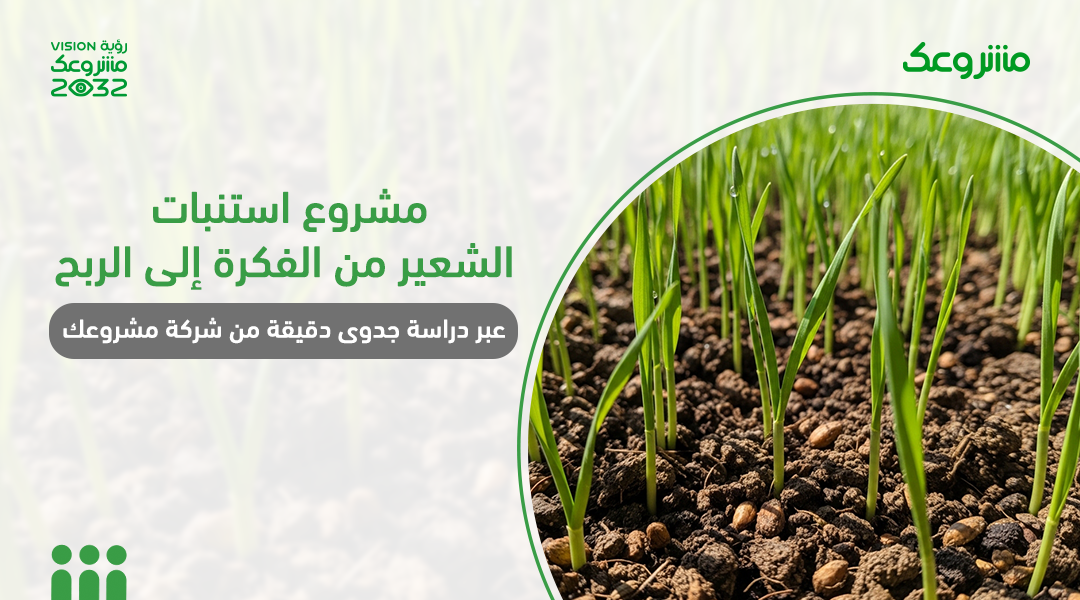
The barley sprouting project has emerged as a fundamental pillar within modern agricultural solutions, gaining increasing momentum in recent years to tackle the dual challenges of the record-high prices of conventional feed and the global scarcity of water resources. With the rising demand for highly nutritious green fodder, the controlled-environment sprouting system offers a practical and sustainable alternative, ensuring regular daily production of uniform quality while significantly reducing the required space and lowering water consumption far beyond conventional agricultural methods. This is achieved through an efficient technological system aimed at transforming dry barley grains into a fresh, nutrient-rich green biomass within a short cycle of just a few days, making it the ideal choice for livestock farmers seeking to simultaneously reduce operational costs and boost livestock production efficiency.
The barley sprouting project is a modern agricultural project that focuses on producing fresh green fodder from barley grains within a short period of time. This is achieved by germinating the grains in a controlled environment without using soil, relying on water, humidity, and proper ventilation. The project involves placing barley grains in trays inside a room or a designated container where temperature, lighting, and humidity are precisely regulated. The grains begin to sprout within a few days, transforming into green fodder ready for feeding. The production cycle usually takes only a few days, allowing for continuous daily production.
Barley sprouting is primarily used in feeding cattle, sheep, camels, and poultry, due to its good nutritional value and ease of digestion. Additionally, the project is considered a suitable option for livestock breeders who seek to reduce dry feed costs, rationalize water consumption, and achieve stable feed supply throughout the year.
Yes, the barley sprouting project is considered one of the profitable and sustainable projects and is supported by strong market indicators. According to the Mordor Intelligence report, the barley market size was about 28.9 billion USD in 2025. By the end of 2026, forecasts indicate that the market value will rise to 30.70 billion USD, reaching 35.80 billion USD by 2031, which means that the market has achieved a compound annual growth rate of approximately 3.12% during the period from 2026 to 2031.
Read here: Discover the Top 7 Profitable Agricultural Projects
Steps to Start a Barley Sprouting Project
Marketing Study for the Barley Sprouting Project
The marketing study for a barley sprouting project focuses on analyzing the local and regional market size to evaluate supply and demand levels. This helps determine the capacity of the agricultural and livestock sectors to absorb modern green feed products.
The study also aims to identify precise market gaps, such as the shortage of specific high-quality feed types, or underserved segments of livestock and poultry farmers. It assesses unmet consumer needs regarding feed cost and supply continuity, while estimating the target market share for the project.
Additionally, the study includes an in-depth competitor analysis, covering both producers of traditional feeds (direct competitors) and suppliers of alternative feed options (indirect competitors). Key comparison factors include pricing, nutritional quality, efficiency of supply chains and distribution channels, and the strength of established brands.
This analysis is complemented by a comprehensive SWOT matrix, highlighting the project’s internal strengths and weaknesses, available market opportunities, and potential threats.
Please read here: Marketing Feasibility Study: Its Definition, Importance, Preparation Method, and Key Tools
The technical study of the barley sprouting project focuses on all aspects related to production and product quality, starting from selecting the appropriate site and preparing the production and storage areas, passing through identifying the necessary equipment and raw materials for sprouting and packaging operations, and reaching the development of sprouting protocols and ensuring consistent quality. The study also addresses workflow planning within the project, production control processes, and occupational health and safety procedures, in addition to determining the required production capacity according to the target market size, while considering flexibility for future expansion and meeting increasing demand without affecting product quality.
Read here: 7 Essential Elements Underpinning the Technical Feasibility Study of Projects
The financial study of the barley sprouting project focuses on a precise and comprehensive identification of the initial investment costs required to launch the project, which includes preparing the production site according to the highest environmental control standards, purchasing specialized equipment for sprouting systems, and providing the initial stock of high-quality barley grains. It also encompasses the monthly operating expenses such as salaries for trained personnel, energy and water bills, consumable materials, and marketing and promotion budgets. The study also includes a realistic estimation of the expected revenues based on the planned production volume and competitive feed market prices, calculating the break-even point at which profits begin to be realized, and analyzing the net profit margin to evaluate operational efficiency and the project’s ability to achieve a sustainable financial return. Additionally, the financial study contributes to establishing a flexible and balanced financing plan that combines self-financing with external financing options, along with conducting a sensitivity analysis to measure the impact of changes in costs or revenues on the project’s feasibility.
Also read: The importance of having a financial feasibility study for your investment project
The organizational and administrative study for a barley sprouting project focuses on building a comprehensive management structure that clearly defines roles and responsibilities to ensure operations run at maximum efficiency.
The study includes identifying the required competencies for each critical department, from production and quality control to marketing, sales, inventory management, and financial operations. It establishes an effective internal communication system and clear decision-making mechanisms.
Standard operating policies and procedures are set to regulate daily operations, with precise methods for performance monitoring and quality control according to established standards. Special attention is given to a training plan to develop staff skills and establish solid foundations for human resource and financial management.
This structured administrative approach supports the sustainability of the barley sprouting project and creates an environment conducive to future expansion, without compromising product quality or operational efficiency.
Read here: Feasibility Study – Its Importance, How to Prepare It, and How to Conduct a Feasibility Study
Cost of a Barley Sprouting Room
The total cost of setting up a barley sprouting room varies depending on several technical and operational factors, including:
How to Build a Barley Sprouting Room
Client Success Story: “M.S.” with a Barley Sprouting Project
Our client “M.S.” began with a dream of establishing a sustainable agricultural initiative to provide high-quality, cost-effective green feed. To launch the project on solid foundations and avoid risks, he engaged “Mashroo3k” Consulting from the very beginning to prepare a comprehensive feasibility study covering marketing, technical, financial, and administrative dimensions.
The study served as a strategic roadmap, helping him understand market dynamics, assess actual demand, and implement a precise operational plan from day one—ensuring a strong start and steady growth.
Upon successfully completing the initial phase and aiming to scale from a limited operation to institutional growth, Mashroo3k continued support by facilitating financial solutions. The company assisted in securing funding from the National Bank of Egypt, allowing him to expand sprouting rooms, enhance production lines, and improve operational efficiency.
Ongoing technical consulting and monitoring of the investment plan further strengthened the project’s chances of success and ensured its sustainability.
At the conclusion of his successful experience, M.S. expressed his deep gratitude, saying:
Without the professional support and careful planning that accompanied me from the very beginning, and the financing facilitated through the National Bank of Egypt thanks to Mashroo3k, my project would not have reached this stage. Mashroo3k Consulting was a true partner in my success journey, helping me turn an investment idea into reality.
This certificate serves as conclusive proof that leveraging specialized expertise from the very start, along with access to appropriate financing, is the golden key to building successful, scalable, and sustainable projects in the promising agricultural sector.
How much green feed does one kilogram of barley produce?
The yield of sprouted barley varies depending on the seed quality and controlled environmental conditions. On average, 1 kilogram of dry barley seeds can produce between 5 to 8 kilograms of fresh green feed, thanks to water absorption, seed swelling, and root and sprout growth. This results in soft, nutrient-rich feed suitable for animal nutrition.
How long does barley sprouting take?
The sprouting cycle is fast, typically taking no more than 7 days from soaking to full biomass growth, ready for feeding. This speed is a key competitive advantage over traditional farming, which requires months, allowing fresh feed production daily and continuously.
What is the shelf life of sprouted barley?
Sprouted barley has a relatively short shelf life due to its high moisture content. It is best consumed within 24–48 hours to preserve nutritional value and prevent mold growth. To extend its shelf life, store it in vacuum-sealed bags in a cool environment.
Types of barley in Egypt
Egyptian barley varieties include hulled barley (often six-rowed) and naked barley (usually two-rowed), as well as forage-specific types suitable for sprouting and animal feed. Varieties are selected based on agricultural or industrial use, such as livestock feed, sprouting, or food industries. Notable examples include Giza 123–128 for saline and new soils and Giza 129–136 for industrial uses.
Is barley cultivation profitable?
Yes, barley cultivation—especially with modern sprouting systems—is profitable when managed efficiently. Economic returns depend on:
Success also relies on high-quality final production, attractive appearance, and a strong, stable marketing network to ensure regular distribution, thereby boosting profit margins and achieving a medium- to long-term return on investment.
What is the cost of barley cultivation?
Investment costs vary significantly based on the project size and type of facilities—ranging from simple manual setups to advanced automated systems. Therefore, there is no fixed cost applicable to all cases. It is recommended to start with a limited, scalable production capacity that aligns with available cash flow and market growth, helping manage financial risk and optimize invested capital.
What are the best types of barley for sprouting?
Selecting the right barley variety is crucial. Preferably, seeds should:
Avoid chemically treated or human-consumption-only seeds that are unsuitable for fast sprouting. Focus on forage barley varieties with strong growth, rapid sprouting, and dense green biomass. These ensure highly nutritious fresh feed, rich in proteins and vitamins, maximizing animal feed efficiency and livestock production.
| Comparison Aspect | Barley | Wheat |
|---|---|---|
| Botanical Classification | Cereal belonging to the Poaceae family | Cereal belonging to the Poaceae family |
| Climate Tolerance | More tolerant to cold, drought, and salinity | Less tolerant to drought and salinity compared to barley |
| Growth Duration | Relatively shorter | Relatively longer |
| Nutritional Value | Rich in fiber and contains a good amount of protein | Rich in carbohydrates and some varieties contain higher protein |
| Uses | Animal feed and some food industries | Bread, pastries, pasta, and other food products |
| Gluten Content | Low | Relatively high |
| Agricultural Distribution | Grown in dry and semi-dry regions | Widely cultivated in most countries worldwide |
| Economic Importance | Important for the feed and livestock sector | One of the main strategic crops for food security |
From what has been mentioned in the table, we find that each of them has its use; barley is highly suitable for fodder and sprouting feed, while wheat is primarily used in food industries, and the preference between them depends on the purpose of use.
It is clearly evident to us that the barley sprouting project goes beyond being merely a traditional agricultural activity to form a modern investment model based on managerial intelligence and operational efficiency. It not only achieves a rewarding economic return but also reinforces the principles of environmental sustainability through the rationalization of water consumption, which is the greatest challenge in our region, making it a strategic solution to enhance animal food security. Although the idea of the project is simple and its production cycle is quick, its real success depends on a precise feasibility study and meticulous marketing planning. It is worth noting that this project contributes to supporting livestock wealth and aligns with global trends toward modern agriculture, thus representing a practical step toward a more resilient and sustainable agricultural future.

Contact Us to Request a Feasibility Study for a Barley Sprouting Project
The kebab restaurant project is one of the food-service ventures that combines strong demand for grilled meals with the opportunity to target a diverse customer base, including individuals, families, and lovers of traditional Middle Eastern cuisine. With growing competition in the restaurant sector, however, the project’s success is no longer determined by food taste alone. […]
Read moreA children’s toy store project is not limited to selling toys; it is built on understanding what attracts children and what families look for when choosing products that combine entertainment and educational value. With the wide variety of educational toys, skill-development games, recreational toys, and gifts available, the store has opportunities to meet the needs […]
Read moreA residential complex project is no longer simply an investment in a collection of real estate units. It has evolved into an integrated development model that combines comfortable living, diverse services, and long-term investment value. As cities expand and residents’ needs evolve, demand is growing for residential complexes that offer a comprehensive environment suited to […]
Read moreThe veterinary clinic project comes at a time when animal care is no longer limited to treating illnesses or injuries, but has expanded to include health monitoring, vaccinations, routine checkups, and care for both pets and livestock. However, many animal owners face challenges in accessing specialized veterinary services that combine prompt response, high-quality care, and […]
Read more
خصم 25% على خدمات مشروعك استفد من العرض الآن، فالفرصة متاحة لفترة محدودة فقط
سجّل بياناتك واحصل على خصم 25% الآن


