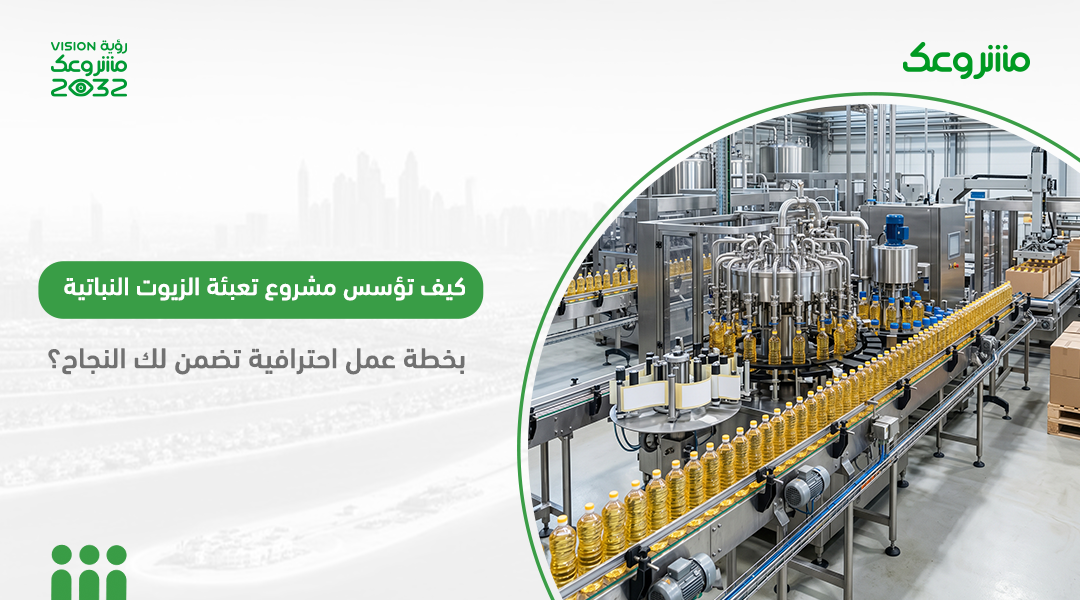
The vegetable oil packaging project is considered one of the promising investment ventures that is witnessing growing demand in the market, due to the wide reliance of consumers on oils for daily food use. With the expansion of the food industry sector and increasing awareness of the importance of high-quality packaged products, this project has become a strong investment opportunity capable of generating stable financial returns.
It is also worth noting that the project is characterized by ease of operation and the availability of raw materials, which helps reduce costs and increase competitiveness. The project is expected to achieve success in light of the rising demand for vegetable oils in cooking and various food industries, especially with the growing focus on quality and health standards.
However, the success of this type of project depends on careful planning, market research, selecting high-quality production lines, and offering a real competitive advantage to stand out in the market.
A vegetable oil packaging project is an industrial venture aimed at receiving raw or refined vegetable oils from various production sources and repackaging them into containers of different sizes for household or commercial consumption, while adhering to quality and food safety standards.
The project relies on processes such as filtration, filling, sealing, and packaging to deliver a ready-to-use final product that preserves the oil’s properties and quality. It is considered one of the food-related projects with continuous demand, due to the reliance of individuals, restaurants, and the food industry on vegetable oils such as soybean, sunflower, and corn oil.
This project is relatively easy to operate compared to large-scale manufacturing industries, with the possibility of gradual expansion in production lines and packaging types. Its success depends on product quality, efficient packaging processes, and compliance with approved health standards.
Advantages of investing in a vegetable oil packaging project
Please read here: Essential Oil Extraction Project: From Idea to Production and Profit
Global indicators confirm that the vegetable oil packaging project has strong economic feasibility, supported by robust growth in the global cooking oil market. The vegetable oil market reached approximately USD 231.63 billion in 2025, with expectations to rise to USD 247.09 billion in 2026, and further increase to USD 430.48 billion by 2034.
Accordingly, the market is projected to achieve a compound annual growth rate (CAGR) of 7.19% between 2026 and 2034, reflecting the continuous global rise in demand for vegetable oils and increasing food consumption rates.
These figures clearly indicate that investing in a vegetable oil packaging project represents a promising opportunity for stable and long-term profits, especially with market expansion and the growing consumer preference for high-quality packaged products.
Read here: How do you start small industrial projects and achieve long-term financial sustainability?
Executive Summary
This section provides a comprehensive overview of the feasibility study results through an integrated evaluation of the project’s various aspects, highlighting its investment viability and market success potential.
Project Description
The project is based on packaging and bottling vegetable oils into containers of different sizes for both household and commercial use, targeting multiple markets driven by the growing demand for edible oils.
Project Objectives
The project aims to achieve sustainable profits, meet market demand for packaged oils, expand market share, and reach high levels of quality and market penetration.
Products or Services Study
The project focuses on packaging various types of vegetable oils such as sunflower oil, soybean oil, and corn oil, while ensuring high quality and preserving the nutritional properties of the products.
Market Analysis
This includes studying supply and demand levels, analyzing competitors, identifying market gaps, and developing effective pricing and distribution strategies to strengthen market presence.
Read here: Why is market research considered an essential tool for business success?
This section includes an explanation of how to obtain the required industrial and health licenses from the relevant authorities, as well as outlining the mechanisms for complying with regulatory standards to ensure the project operates in a legal and safe manner.
It includes setting up a suitable factory equipped with production lines, storage areas, and packaging and filling sections to ensure efficient workflow.
Project Operation Stages
The process goes through several stages, starting with the supply of raw oils, followed by filtration and filling, then packaging and storage, and finally distribution to the markets.
Financial Analysis
This includes estimating capital and operating costs, projected revenues, and analyzing profitability indicators such as return on investment (ROI) and payback period.
Please read here: Financial Analysis: Concept, Objectives, Types, and Methodology
It outlines the distribution of tasks and roles within the project and defines the management structure to ensure operational efficiency and proper organization.
Environmental and Social Assessment
It focuses on minimizing the project’s environmental impact by adhering to safety and sustainability standards, while also considering positive social effects.
Risk Assessment
It addresses potential risks such as price fluctuations and operational challenges, along with setting alternative plans to manage them effectively.
Conclusions and Recommendations
The model concludes that the project represents a promising investment opportunity, with the need to focus on proper planning, quality, and marketing to ensure success and sustainability.
Please read here: Industrial Feasibility Study: Concept, Importance, and Success Factors
Success Factors for a Vegetable Oil Packaging Project
| Potential Risks | Impact on the Project | Ways to Overcome Them |
| Volatility of global crude oil prices | Increased production costs and reduced profit margins | Signing long-term supply contracts and diversifying procurement sources |
| Poor quality of raw materials | Impact on final product quality and loss of customer trust | Selecting reliable suppliers and conducting regular quality inspections |
| Intensity of market competition | Difficulty in achieving a large market share | Improving product quality, developing the brand, and effective marketing |
| Production line breakdowns | Production shutdown and financial losses | Regular maintenance, use of modern equipment, and availability of spare parts |
| Storage and packaging issues | Product spoilage or decline in quality | Using suitable warehouses and proper storage standards |
| Weak distribution and supply chains | Delayed product delivery to markets | Partnering with distributors and expanding the distribution network |
| Changing consumer tastes | Decline in demand for a specific type of oil | Diversifying products (sunflower oil, soybean oil, corn oil, etc.) |
| Health risks or non-compliance with standards | Product recall or financial penalties | Strict compliance with food safety and quality standards |
Please read here: What is risk management in projects, what is its importance, and how can it be implemented?
During a stage in which I was searching for a stable and scalable investment opportunity, the vegetable oil packaging project caught my attention, especially with the continuous rise in demand and its status as an essential daily-use product.
I felt that the idea had real potential for success, but at the same time it required careful study and a clear implementation plan to ensure a professional market entry amid strong competition and multiple challenges related to costs, marketing, and distribution channels.
As I delved deeper into the idea, I realized that success cannot be achieved through individual effort alone. I decided to seek the support of “Moshro3k Consulting,” which played a pivotal role in turning the idea into a fully integrated project.
Their team prepared a comprehensive professional feasibility study that reshaped the project by analyzing the market, identifying opportunities, and building a realistic financial and operational model. This support gave me greater clarity and confidence in execution, so I began the actual steps of setting up the project.
It later started generating positive results and gradual growth, confirming that proper planning is the foundation of any true investment success.
Read here: How do you find the best feasibility study company in the Arab world?
An oil filling machine is an industrial device used to package vegetable oils into containers of various sizes with high precision, either automatically or semi-automatically. It measures the oil quantity, fills the containers, and then seals them, preparing them for packaging.
This machine helps speed up the production process in factories, reduce waste, and ensure consistent quantity and quality in each bottle. As a result, it improves operational efficiency while maintaining hygiene and food safety standards.
The cost of establishing an edible oil factory varies significantly depending on the project size and the investor’s ambitions. It ranges from small-scale projects with limited production capacity to fully integrated industrial plants with high production capacity and wide distribution networks. As production goals and market expansion increase, the overall project costs rise accordingly.
Yes, the vegetable oil project is considered a highly profitable venture due to the continuous and growing demand for it as an essential daily-use product.
The profitability of this project depends on several interconnected factors, primarily product quality, operational efficiency, and well-planned competitive pricing, in addition to the strength of the distribution network and its ability to reach the widest possible market segments.
When these factors are combined with sound management, effective cost control, and careful selection of reliable suppliers, it becomes possible to achieve stable financial returns and ensure long-term sales sustainability.
Prices of edible oil filling machines vary significantly depending on several key factors, most notably the type of machine, whether semi-automatic or fully automatic, as well as the required production capacity and the level of integrated technology.
Small machines are more affordable and suitable for startup projects that aim to begin with limited costs. In contrast, prices increase gradually as production capacity grows and as machines become faster and more precise, especially in large-scale industrial setups designed for mass production.
Additional specifications, such as the number of filling heads and advanced automation control systems, also contribute to increasing the final machine price.
Therefore, selecting the appropriate machine is a strategic decision that should be based on a careful assessment of the project size and available budget, ensuring an optimal balance between production efficiency and investment cost.
Oil packaging offers many important benefits. It helps preserve oil quality and protects it from contamination or exposure to air and light, which may affect its properties. The packaging process also extends shelf life and makes storage, transportation, and distribution safer and more organized.
In addition, packaging allows the product to be offered in different sizes to meet consumer needs, and enhances its attractiveness through good packaging design, which improves marketing opportunities and market reach.
The difference between heavy oil and light oil mainly depends on viscosity, usage, and the level of refining.
Light oil has a lower density and flows more easily. It is usually purer, absorbs faster, and is preferred for cooking because it is lighter on the stomach and easier to digest.
Heavy oil, on the other hand, is more viscous and dense. It may contain a higher level of natural compounds depending on its type, and it is used in applications that require higher heat resistance or a more stable texture.
In general, the choice between them depends on the intended use and purpose, whether for cooking or industrial applications.

For contact and to request a feasibility study for a vegetable oil packaging project
The kebab restaurant project is one of the food-service ventures that combines strong demand for grilled meals with the opportunity to target a diverse customer base, including individuals, families, and lovers of traditional Middle Eastern cuisine. With growing competition in the restaurant sector, however, the project’s success is no longer determined by food taste alone. […]
Read moreA children’s toy store project is not limited to selling toys; it is built on understanding what attracts children and what families look for when choosing products that combine entertainment and educational value. With the wide variety of educational toys, skill-development games, recreational toys, and gifts available, the store has opportunities to meet the needs […]
Read moreA residential complex project is no longer simply an investment in a collection of real estate units. It has evolved into an integrated development model that combines comfortable living, diverse services, and long-term investment value. As cities expand and residents’ needs evolve, demand is growing for residential complexes that offer a comprehensive environment suited to […]
Read moreThe veterinary clinic project comes at a time when animal care is no longer limited to treating illnesses or injuries, but has expanded to include health monitoring, vaccinations, routine checkups, and care for both pets and livestock. However, many animal owners face challenges in accessing specialized veterinary services that combine prompt response, high-quality care, and […]
Read more
خصم 25% على خدمات مشروعك استفد من العرض الآن، فالفرصة متاحة لفترة محدودة فقط
سجّل بياناتك واحصل على خصم 25% الآن


