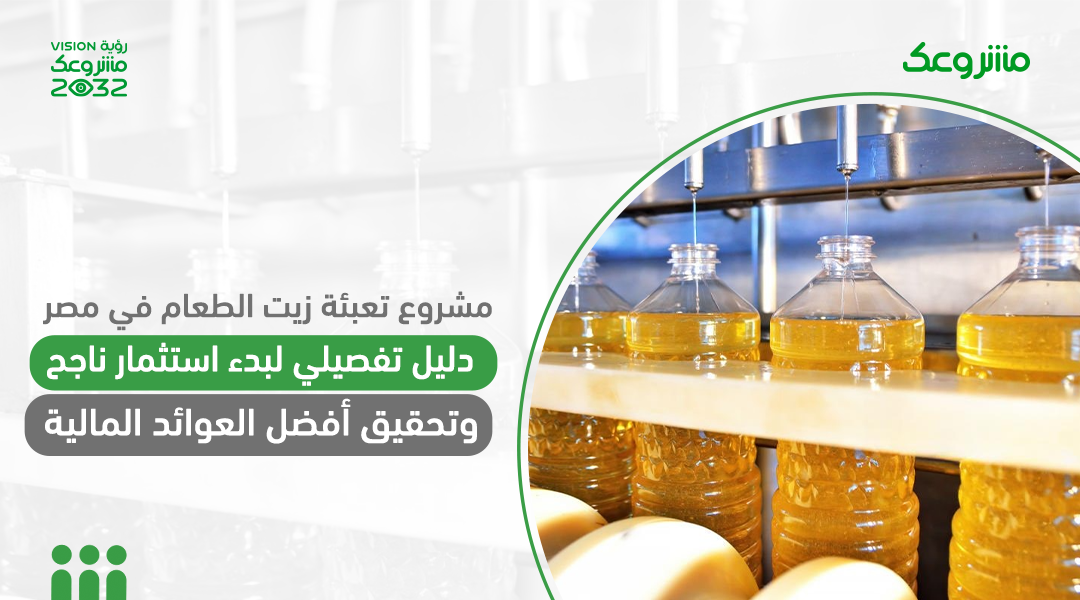
The food oil packaging project is considered one of the best investment ventures with consistent demand, as cooking oil is an essential commodity found in every household and food establishment. With the growing demand for high-quality products packaged in accordance with safety standards, investing in this promising sector has become an attractive opportunity for generating rewarding returns when planned professionally. However, the success of the project does not depend solely on having the necessary equipment or capital; it also requires a thorough market study, selecting a suitable location, and determining the costs and technical and marketing requirements. In this article, we explore everything you need to know about a food oil packaging project, from costs and implementation requirements to the key success factors that can help you build a strong and sustainable business.
A food oil packaging project is an industrial and commercial venture based on purchasing raw or semi-processed cooking oils from producers, then packaging them in containers of various sizes, such as 250 ml, 500 ml, 1 liter, 2 liters, and 5 liters, using dedicated filling and packaging lines. The packaged products are then distributed to wholesalers, supermarkets, restaurants, and hotels, or sold directly to consumers under a private label.
Yes, a food oil packaging project is considered one of the most profitable investment ventures, due to the following factors:
Investors turn to food oil packaging projects because they offer numerous investment advantages, which can be summarized in the following points:
Read here: Essential and Medicinal Oil Extraction Project: From Idea to Production and Profitability
The cost of a food oil packaging project is affected by several factors, most notably the following:
The market study for a food oil packaging project is based on a set of key elements, the most important of which are as follows:
Competitor analysis helps build a strong strategy for the success of a food oil packaging project. It includes the following:
The profits of a food oil packaging project are among the key factors that attract investors to this business. However, profitability varies from one project to another depending on several variables that directly affect revenue and net profit. The most important factors affecting project profitability include:
| Risks | How to Overcome Them |
|---|---|
| Fluctuations in food oil and raw material prices | Contract with multiple suppliers and continuously monitor prices to minimize the impact of fluctuations. |
| High level of market competition | Offer a high-quality product, develop a distinctive brand identity, and adopt a competitive pricing strategy. |
| Decline in product quality due to improper storage or packaging | Adhere to quality standards, use modern equipment, and provide suitable storage conditions. |
| Unexpected production line breakdowns | Implement regular maintenance programs and keep essential spare parts available to minimize downtime. |
| Weak sales | Develop an effective marketing plan, expand distribution channels, and target diverse customer segments. |
| Rising operating costs | Optimize resource consumption, improve operational efficiency, and continuously monitor expenses. |
| Delays in raw material deliveries | Build relationships with multiple suppliers and maintain sufficient safety stock to cover operational needs. |
| Non-compliance with health and legal requirements | Comply with all regulations governing the activity, renew licenses, and implement food safety standards. |
| Low customer trust in the new brand | Focus on product quality, pay attention to packaging design, and provide outstanding customer service. |
| Changes in market needs and consumer preferences | Continuously monitor market trends and develop products and pac |
Read here: Project Risk Management: What Is It, Why Is It Important, and How Can It Be Implemented?
Financing a food oil packaging project is one of the key stages affecting the project’s success and sustainability. Therefore, choosing the right financing institution is just as important as preparing the feasibility study itself. Accordingly, Mashroo3k Consulting provides its clients with comprehensive support throughout the financing process. The process begins by studying the nature of the project and its financing needs, followed by identifying financing institutions whose programs align with the project’s size and investment objectives.
The company’s role is not limited to recommending a specific financing institution; it also includes conducting a detailed comparison of different financing programs in terms of financing amount, financing rates or costs, repayment periods, eligibility requirements, and required guarantees. This helps investors select the financing solution that achieves the best balance between the project’s needs and its repayment capacity.
After studying and analyzing the available financing institutions, it was found that the Micro, Small and Medium Enterprises Development Agency (MSMEDA) is one of the key institutions that may provide suitable financing solutions for a food oil packaging project, given its financing programs aimed at supporting productive enterprises, along with flexible repayment periods and conditions suitable for many small and medium-sized projects.
Through this approach, Mashroo3k Consulting helps facilitate the investor’s journey toward securing suitable financing, enhancing the project’s ability to be implemented on sound financial foundations and increasing its chances of success and achieving its investment objectives.
| Item | Analysis |
|---|---|
| Strengths | Consistent demand for cooking oil as an essential commodity.Potential to generate good returns with effective management.Ease of offering various package sizes to meet the needs of different customers.Potential to build a strong brand in the market. |
| Weaknesses | High raw material purchasing costs when prices fluctuate.Need for adequate capital to equip the production line.Dependence on reliable suppliers to ensure continuity of supply.Need for continuous compliance with quality and food safety standards. |
| Opportunities | Growing demand for packaged food products.Expansion of distribution through supermarkets and online platforms.Potential to produce various package sizes targeting different customer segments.Building partnerships with restaurants, hotels, and wholesalers to increase sales. |
| Threats | Intense competition among local and international brands.Fluctuations in food oil and packaging material prices.Changes in regulations and requirements governing the food industry.Rising operating costs, including transportation, energy, and labor. |
When I decided to launch a food oil packaging project in Cairo, I had the capital and the desire to invest, but I faced a real challenge during the planning stage. I had many questions about market demand, the appropriate production capacity, the equipment I should rely on, as well as how to estimate costs and revenues and establish a clear management framework from day one. With so many aspects to consider, I realized that making any decision without relying on a thorough study could result in additional costs or poorly informed decisions. Therefore, I sought the support of experts… Mashroo3k Consulting CompanyI sought the support of experts who began by preparing a comprehensive feasibility study for the project. It included a market study and competitor analysis, as well as identifying the target customers. The technical study clarified the operational requirements, production line, and necessary equipment, while the financial study determined the expected costs, revenues, and feasibility indicators. In addition, the administrative study helped me organize the work structure and allocate responsibilities within the project.
This comprehensive support gave me a clear vision of all stages of implementation, and the project began operating according to a well-developed plan based on realistic data and analyses. This, in turn, improved operational efficiency and product quality and helped the project achieve better results, thanks to the expertise and comprehensive support provided by the team at Mashroo3k Consulting.
The prices of food oil filling machines in Egypt vary depending on several factors, most notably the type of machine, whether it operates manually, semi-automatically, or fully automatically, production capacity, filling speed, the level of technology used, as well as the country of origin, brand, and after-sales services. The technical specifications and additional components integrated into the production line, such as capping systems, labeling machines, and date and data printing systems, also affect the final cost. Therefore, it is recommended to select a machine that matches the target production volume and project requirements while maintaining a balance between performance quality and investment cost.
Yes, the oil trade can be a profitable commercial activity, as cooking oil is an essential commodity with consistent demand from individuals, restaurants, and food establishments. However, profitability does not depend solely on the nature of the product; it is influenced by several factors, including oil quality, the efficiency of purchasing, packaging, and storage operations, the ability to control operating costs, and the selection of suitable suppliers. It also depends on adopting a competitive pricing strategy and implementing an effective marketing plan. Building a strong distribution network and adhering to quality standards can further increase sales and strengthen customer trust, which positively impacts the project’s profitability and sustainability.
Opening a food oil packaging project requires meeting a set of essential requirements, including obtaining the necessary licenses, selecting a suitable location, equipping the project with the required machinery and equipment, and contracting with reliable suppliers. The project must also comply with quality and food safety standards and use packaging that meets applicable specifications. In addition, an operational and marketing plan should be developed to ensure production efficiency and the project’s ability to compete in the market.
The best products to package depend on market demand and consumer needs. However, food products are among the most successful options due to their consistent demand. These include cooking oil, sugar, rice, flour, legumes, spices, salt, coffee, and tea, in addition to nuts and dates. Selecting a product with stable demand, while maintaining high quality and proper packaging standards, can enhance the project’s chances of success and generate attractive returns.
Yes, a food oil packaging project requires a license, as it is an activity related to the food industry. Therefore, the necessary licenses and permits must be obtained from the relevant authorities before operations begin. The project must also comply with health and technical requirements, as well as quality and food safety standards, to ensure that the product is manufactured and distributed in accordance with approved specifications and to protect consumer safety.
The best containers for packaging cooking oil depend on the nature of the product and the target customer segment. However, plastic containers made from food-grade materials are among the most commonly used options due to their light weight, ease of transportation, and reasonable cost. Glass containers are also used for products targeting customers seeking a more premium appearance, while larger containers are suitable for restaurants, hotels, and food establishments. In all cases, containers should be securely sealed, comply with applicable standards, and preserve the quality of the oil throughout storage and distribution.
We can conclude that a food oil packaging project in Egypt represents a promising investment opportunity, thanks to the consistent demand for the product and the potential to generate attractive returns when planned and implemented professionally. The success of the project depends on preparing an accurate feasibility study, selecting the appropriate equipment, adhering to quality standards, and developing an effective marketing plan that ensures access to target customers. Therefore, making the right decisions from the outset gives your project a greater opportunity for growth, competitiveness, and sustainability in a market experiencing increasing demand for packaged cooking oil products.

For more information and to request a feasibility study for a food oil packaging project.
The kebab restaurant project is one of the food-service ventures that combines strong demand for grilled meals with the opportunity to target a diverse customer base, including individuals, families, and lovers of traditional Middle Eastern cuisine. With growing competition in the restaurant sector, however, the project’s success is no longer determined by food taste alone. […]
Read moreA children’s toy store project is not limited to selling toys; it is built on understanding what attracts children and what families look for when choosing products that combine entertainment and educational value. With the wide variety of educational toys, skill-development games, recreational toys, and gifts available, the store has opportunities to meet the needs […]
Read moreA residential complex project is no longer simply an investment in a collection of real estate units. It has evolved into an integrated development model that combines comfortable living, diverse services, and long-term investment value. As cities expand and residents’ needs evolve, demand is growing for residential complexes that offer a comprehensive environment suited to […]
Read moreThe veterinary clinic project comes at a time when animal care is no longer limited to treating illnesses or injuries, but has expanded to include health monitoring, vaccinations, routine checkups, and care for both pets and livestock. However, many animal owners face challenges in accessing specialized veterinary services that combine prompt response, high-quality care, and […]
Read more
خصم 25% على خدمات مشروعك استفد من العرض الآن، فالفرصة متاحة لفترة محدودة فقط
سجّل بياناتك واحصل على خصم 25% الآن


