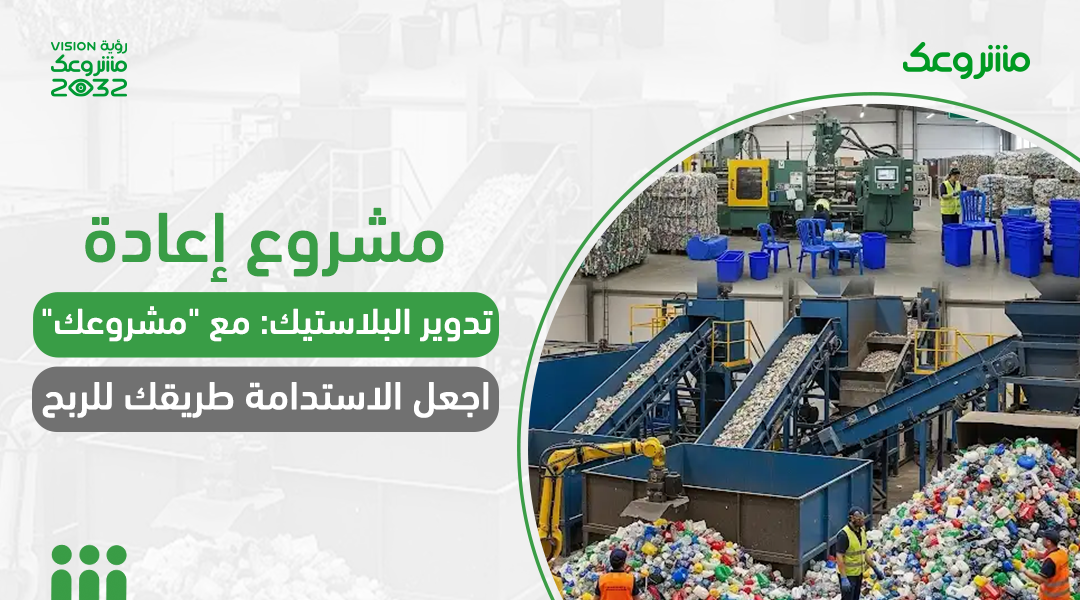
The plastic recycling project is no longer merely an environmental initiative aimed at reducing piles of waste. Today, it has evolved into a strategic investment pillar that intelligently combines attractive financial returns with the principles of sustainability. With the rapid increase in global consumption of plastic products, the urgent need for innovative solutions to manage this waste has emerged, transforming it from a source of environmental pollution into a genuine economic resource.
In this context, the project opens up broad opportunities for investors and entrepreneurs to utilize this waste as a raw material that can be incorporated into the production chains of various industries, creating a circular economic model that strikes a balance between profitability and protecting the planet.
In the following sections, we explore the details of this promising project, its key advantages, essential requirements, and the practical stages of implementation, in addition to the critical factors that ensure its success and sustainability in the market.
A plastic recycling project is an industrial venture aimed at collecting used plastic waste, such as bottles, bags, and containers, then processing and remanufacturing it into raw materials or new products that can be reused. The project involves several essential stages, beginning with sorting plastic according to type and quality, followed by washing and cleaning it of impurities. This is followed by cutting and grinding processes to convert the plastic into pellets, which are later used to manufacture new products such as containers, bags, pipes, and other plastic products.
Read here: Discover how to turn waste into wealth through recycling
Global indicators show that the plastic recycling project is considered a highly economically viable business, with the global recycled plastics market reaching approximately USD 60.19 billion in 2025. The market is expected to grow to USD 65.34 billion in 2026 and continue its significant expansion to reach approximately USD 126.3 billion by 2034. This sustained expansion reflects an estimated compound annual growth rate (CAGR) of approximately 8.6% over the forecast period, indicating growing global demand for recycled materials, driven by both economic and environmental considerations related to sustainability and reducing plastic waste. Therefore, these indicators confirm that the project offers promising profit opportunities and strong long-term growth potential.
The cost of a plastic recycling project varies significantly depending on the project size, type of operations, location, and production capacity. It includes the following:
Read here: Discover the Best Small Project That Fits Your Resources in 2025
Read here: How You Can Implement a Recycling Project
The executive summary is an essential introduction to the Feasibility study, providing a concise and comprehensive overview of the plastic recycling project while highlighting the key findings and final recommendations. It aims to give decision-makers a quick overview of the project’s feasibility in terms of investment opportunities, expected returns, and implementation potential, without requiring them to review the full details of the study.
This section provides a comprehensive overview of the plastic recycling project, which relies on collecting, sorting, and processing plastic waste and converting it into usable raw materials for new industries. It also outlines the project’s objectives of reducing environmental pollution and generating economic value from waste, while defining a future vision that seeks to support sustainability and promote the concept of the circular economy.
This section presents the key findings derived from the study, including the project’s financial, operational, and marketing feasibility, along with an analysis of the growing demand for recycled materials. It also highlights indicators supporting the project’s success, such as the low cost of raw materials and the increasing industrial demand for plastic pellets, which enhances the project’s profitability and sustainability prospects.
This section provides a detailed description of the products resulting from the project, including recycled plastic pellets and raw materials used in various industries, such as packaging. It also highlights the added value of these products in terms of reducing costs for factories, supporting environmental sustainability, and providing cost-effective alternatives to traditional raw materials.
Competitor analysis is an essential element for understanding the market environment surrounding the project. It involves analyzing factories and companies operating in the recycling sector in terms of production capacity, prices, quality, and distribution channels. This analysis also helps identify competitors’ strengths and weaknesses, supporting the development of an effective competitive strategy that enhances the project’s ability to achieve a stable market share.
Read Here: Your Comprehensive Guide to Understanding Competitor Analysis in the Market
The SWOT analysis aims to assess the project’s internal and external environment by identifying strengths, such as the availability and low cost of raw materials, and weaknesses, such as the need for advanced equipment. It also highlights available opportunities, such as the growing global demand for recycled products, and potential threats, such as market price fluctuations or intense competition.
Read Here: Everything You Need to Know About SWOT Analysis and How It Is Applied
This section covers the essential requirements for establishing and operating a plastic recycling project, including legal licenses, environmental requirements, and the technical specifications of the equipment. It also includes site requirements, infrastructure, and occupational safety standards to ensure that the project operates legally, safely, and in compliance with regulatory requirements.
The timeline outlines the stages of project implementation, from establishment to actual operation, divided into specific phases that include site preparation, equipment procurement, production line installation, and trial operation. This planning helps track the project’s progress accurately, ensure adherence to specified deadlines, and minimize any potential delays.
This section presents the project’s sources of financing, which may include self-financing, bank loans, or investment partnerships. It also outlines the allocation and financial ratios of each source, along with an analysis of investment and operating costs to ensure sustainable financing and maintain the project’s financial balance.
The organizational structure outlines the distribution of tasks and responsibilities within the project, from senior management to operational departments such as production, quality, marketing, and finance. This organization helps improve work efficiency, facilitate internal communication, and enhance the project’s overall performance.
This section provides a set of strategic recommendations aimed at enhancing the project’s chances of success, such as focusing on production quality, developing recycling technologies, and building partnerships with major factories. It also emphasizes the need to continuously monitor market changes to ensure the project’s sustainability and achieve the best possible returns.
Read here: Feasibility Study – Its Importance, How to Prepare It, and How to Conduct a Feasibility Study
Read Here: How to Start Small Industrial Projects and Achieve Long-Term Financial Sustainability
The idea of entering the plastic recycling sector was not merely an ordinary investment decision, but rather a step driven by a genuine desire to combine economic feasibility with contributing to environmental preservation. At the beginning of the project, I had the enthusiasm and a general vision, but I quickly encountered complex challenges related to operational mechanisms, securing raw materials, selecting the appropriate equipment, and accurately estimating costs.
At that stage, working with specialized experts at “Mashroo3k Consulting” was an important turning point. A comprehensive feasibility study was prepared covering all marketing, technical, and financial aspects. This helped me gain a deeper understanding of the market, identify sources for collecting plastic waste, and develop a clear vision for the production lines, while selecting the most suitable equipment in terms of quality and cost. A precise financial plan was also developed, which helped attract the necessary financing and begin implementation with greater confidence.
With the start of actual operations, I faced operational challenges such as sorting quality, supply stability, and price fluctuations. However, having a clear plan and organized management helped me gradually overcome these obstacles. Over time, the project began achieving positive results through the production of good-quality plastic pellets and contracts with factories that rely on recycled materials.
Today, I can say that this experience was not merely a business project, but rather a true learning journey that combined challenges and growth. It proved to me that the success of a recycling project depends on sound planning, continuity, and the ability to continuously develop in response to changing market conditions.
To start a plastic recycling project, you need to select a suitable location, equip it with the necessary machinery, such as washing, shredding, and pelletizing machines, secure continuous sources of plastic materials, and hire a team to manage the production lines, along with developing a marketing plan to market the final product.
Please read here: Projects with a Future in Arab Countries: Key Investment Opportunities
Yes, the plastic recycling project is considered a successful and profitable venture, especially with the increasing demand for recycled plastic products and growing government interest in environmental sustainability.
Read Here: Best Successful Small Projects for Youth in 2026
The prices of plastic recycling machines vary depending on the type and production capacity.
Plastic bottles can be sold after being collected and sorted to companies and factories specializing in recycling, or to production companies that require them as raw materials. Partnership agreements can also be signed with local distributors.
The price of a ton of plastic raw material varies depending on the type and quality, with prices differing according to local and international market conditions.
Plastic takes between 100 and 500 years to fully decompose in the environment, highlighting the importance of recycling rather than disposing of it.
The most dangerous types of plastic are those containing BPA or PVC, as well as single-use plastics, as they contribute to environmental and health pollution and can take hundreds of years to decompose.
It is clear that the plastic recycling project is not merely a profitable investment opportunity, but also an effective contribution to protecting the environment and reducing pollution. With sound planning, the right equipment, and smart operational management, plastic waste can be transformed into valuable products used across multiple industries, generating sustainable financial returns for investors while serving the community at the same time. Therefore, if you are looking for a project that combines profitability with environmental responsibility, the plastic recycling project is an ideal choice for embarking on a successful investment journey and a promising future.

For inquiries and to request a feasibility study for a plastic recycling project
The kebab restaurant project is one of the food-service ventures that combines strong demand for grilled meals with the opportunity to target a diverse customer base, including individuals, families, and lovers of traditional Middle Eastern cuisine. With growing competition in the restaurant sector, however, the project’s success is no longer determined by food taste alone. […]
Read moreA children’s toy store project is not limited to selling toys; it is built on understanding what attracts children and what families look for when choosing products that combine entertainment and educational value. With the wide variety of educational toys, skill-development games, recreational toys, and gifts available, the store has opportunities to meet the needs […]
Read moreA residential complex project is no longer simply an investment in a collection of real estate units. It has evolved into an integrated development model that combines comfortable living, diverse services, and long-term investment value. As cities expand and residents’ needs evolve, demand is growing for residential complexes that offer a comprehensive environment suited to […]
Read moreThe veterinary clinic project comes at a time when animal care is no longer limited to treating illnesses or injuries, but has expanded to include health monitoring, vaccinations, routine checkups, and care for both pets and livestock. However, many animal owners face challenges in accessing specialized veterinary services that combine prompt response, high-quality care, and […]
Read more
خصم 25% على خدمات مشروعك استفد من العرض الآن، فالفرصة متاحة لفترة محدودة فقط
سجّل بياناتك واحصل على خصم 25% الآن


