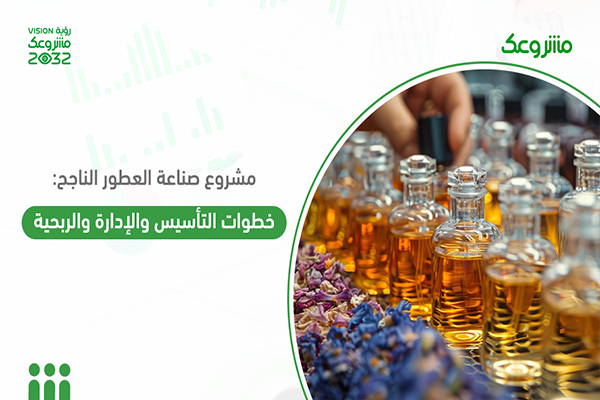
A perfume manufacturing project represents a smart and promising investment opportunity, skillfully balancing high financial returns with creative distinction—particularly in light of the shift in global and regional markets from viewing perfume as a mere consumer product to recognizing it as an authentic expression of personal identity and a refined lifestyle.
Demand is steadily growing for unique fragrance brands, especially local ones that combine premium quality with cultural touches inspired by Eastern heritage, such as oud, musk, and other signature notes. This project is characterized by high flexibility in initial capital requirements, strong potential for development and rapid expansion, and the ability to build a powerful brand identity even within a vibrant and highly competitive market.
For the savvy investor, the perfume business represents a strategic gateway into a dynamic and sustainable market rich with opportunities, offering clear potential for attractive returns over the medium and long term. This sector is gaining increasing momentum in the Gulf region in particular, where awareness of luxury and customized fragrances is on the rise, alongside growing consumer trust in local brands that reflect their identity and rich cultural heritage. This growth is further supported by relatively low production costs compared to the high profit margins achievable at the point of sale.
It is also worth noting that this project is well positioned to enter the e-commerce market, expand operations, and build a broad customer base without the need for substantial capital investments—opening new horizons for export as well as local and regional expansion. With national visions across the Gulf states focused on economic diversification and the promotion of entrepreneurship, the perfume manufacturing project stands out as an ideal model that combines high profitability with environmental and cultural sustainability.
The perfume manufacturing project is a creative business activity centered on developing unique and distinctive fragrance compositions by blending natural essential oils and synthetic compounds in precise and carefully calibrated proportions. These fragrances are then packaged in elegant containers and introduced to the market under a proprietary brand that reflects a distinctive identity.
The aim is to offer high-quality perfume products that cater to the tastes of diverse customer segments—whether authentic Oriental fragrances inspired by heritage elements such as oud, musk, and saffron; modern Western fragrances based on refreshing floral and citrus notes; or even fully customized perfumes tailored to individual customer preferences.
This project is characterized by high flexibility in its scope of implementation, as it can be launched as a freelance venture from a small laboratory using basic tools, then gradually expanded into a specialized small-scale factory, and eventually developed into a well-known brand.
The project’s success fundamentally depends on selecting high-quality raw materials from reliable sources, the precision of fragrance formulation—which requires skill and expertise in balancing top, middle, and base notes—and continuous innovation in creating new and distinctive scents. Equally important is an effective marketing strategy that leverages digital channels and social media, along with building a cohesive visual and olfactory brand identity that includes packaging design, logo, and brand story. All of these elements contribute to achieving sustainable differentiation in a highly competitive, opportunity-rich market.
Yes, the perfume manufacturing project is considered one of the highly successful and profitable ventures, supported by strong statistical indicators that reveal steady growth in both global and regional markets. The global perfume market was valued at approximately USD 56.75 billion in 2024, and is expected to increase to USD 59.85 billion in 2025, reaching USD 78.85 billion by 2030. This reflects a compound annual growth rate (CAGR) of 5.7% during the period from 2025 to 2030, according to reports by Grand View Research.
To start a perfume manufacturing project in a well-planned and success-oriented way, it is recommended to follow these steps:
Read Here: Start a Perfume Blending Project with Simple Steps and Achieve a Stable Income
Please read here: Marketing Feasibility Study: Definition, Importance, Preparation, and Key Tools
Read here: 7 Essential Elements Underpinning the Technical Feasibility Study of Projects
Read here: The Importance of Having a Financial Feasibility Study for Your Investment Project
Finally, a comprehensive risk study is conducted, covering marketing risks—such as demand fluctuations, intense competition, and changes in consumer preferences—and financial risks, including rising raw material costs or currency exchange volatility. Technical risks related to fragrance quality or supply chain reliability are also assessed.
Based on these analyses, a comprehensive strategic plan is developed to mitigate risks through flexible mechanisms, such as diversifying supply sources, adopting dynamic pricing models, implementing quality assurance techniques, and building a strong brand identity that fosters customer loyalty.
This effort culminates in the preparation of a comprehensive final report covering all aspects of the project—from economic and technical feasibility to competitive analysis and marketing strategy—while providing clear and actionable recommendations aimed at ensuring the project’s sustainability and enhancing its potential for long-term growth and expansion in a dynamic and promising market environment, such as the perfume industry.
For more information on the requirements for a perfume manufacturing project in Saudi Arabia, click here.
Perfume manufacturing relies on a precise blend of diverse raw materials, including:
Natural essential oils extracted from plant sources such as rose, jasmine, lavender, citrus fruits, and spices, or rare animal-derived substances like musk and amber.
Synthetic aromatic compounds, created in laboratories to replicate natural scents or invent entirely new fragrance notes not found in nature, providing greater variety at a lower cost.
Ethanol (pure ethyl alcohol) is the main carrier solvent, helping to disperse fragrance oils and release them gradually on the skin, while distilled or purified water is sometimes added to adjust concentration and achieve the desired balance.
Raw materials also include natural fixatives like frankincense resins and gum arabic, or synthetic fixatives such as benzoates and synthetic musk, which slow the evaporation of top notes and enhance fragrance longevity for hours or even days.
Additional supporting ingredients, such as stabilizers and preservatives, are used to ensure the quality and shelf life of the final perfume product.
Perfume formulation tools include a basic set of precise and specialized equipment that ensures the accuracy of formulations and their high quality, such as high-precision electronic scales that measure quantities in milligrams to ensure the precise balance of fragrance notes, and glass pipettes of various sizes for transferring liquids with utmost accuracy without waste or contamination. They also include glass mixing vessels made of borosilicate glass resistant to chemical reactions, as well as fragrance testing strips (scent swabs) used to evaluate the progression of the scent through its different stages. The tools also encompass dark or amber storage bottles to protect formulations from light and oxidation, small storage vials for aging and maturing perfumes over time, and sterilization tools such as medical alcohol, disinfectant wipes, and sterilizers, alongside other auxiliary tools like protective gloves, tweezers, and labels for accurately recording formulations. This enables a perfumer to work with professional efficiency, whether in a small laboratory or a specialized factory.
The substance used to fix perfume is known as a fixative. Or the fixative Its function is to slow down the evaporation of the fragrance components, thereby prolonging the life of the perfume on the skin or clothing and maintaining the balance of its scent over time
The scent’s ability to project does not rely on a single ingredient; rather, it is influenced by a combination of interconnected factors. Foremost among these is the concentration of aromatic oils in the formula; the higher this concentration, as in ‘Parfum’ or ‘Eau de Parfum’ fragrances, the stronger and more lasting the projection. The choice of top notes also plays a crucial role; these are usually composed of light, fast-evaporating molecules such as citrus (lemon, bergamot, orange) and refreshing herbal elements, which create a strong, initial, projecting impression. To ensure a deep and long-lasting projection, materials with high diffusion and radiance enter even the middle and base notes, such as musk (natural or synthetic), amber, patchouli, oud, vanilla, in addition to specialized synthetic aromatic compounds like Iso E Super, Ambrocenide, and Hedione. However, the precise balance among these components—along with external factors such as skin type, humidity, and the perfume’s overall composition—ultimately determines the fragrance’s spread: some formulations have the ability to ‘fill the room’ with their scent, while others remain more intimate and close to the skin.
The amounts of perfume composition vary according to the type and strength of the fragrance, and depend on a balanced blend of essential oils, alcohol, and stabilizers, taking into account the harmony of the aromatic notes for a homogeneous and stable scent.
The sustainability of the perfume industry is achieved through the use of safe and environmentally friendly raw materials, the implementation of efficient production practices that minimize waste, and the use of packaging that is either recyclable or made from sustainable materials.
It can be said that the perfume manufacturing project is one of the promising investment opportunities that skillfully combines refined taste with economic viability, especially in light of the increasing demand for distinctive fragrance products that carry a unique identity and reflect a personal or cultural character. With careful planning, meticulous selection of raw materials, and a focus on creating authentic fragrance formulations that meet and exceed customer expectations, this project can be transformed from a creative idea into an established brand capable of competing in the market.

For inquiries and to request a feasibility study for a perfume production project
The kebab restaurant project is one of the food-service ventures that combines strong demand for grilled meals with the opportunity to target a diverse customer base, including individuals, families, and lovers of traditional Middle Eastern cuisine. With growing competition in the restaurant sector, however, the project’s success is no longer determined by food taste alone. […]
Read moreA children’s toy store project is not limited to selling toys; it is built on understanding what attracts children and what families look for when choosing products that combine entertainment and educational value. With the wide variety of educational toys, skill-development games, recreational toys, and gifts available, the store has opportunities to meet the needs […]
Read moreA residential complex project is no longer simply an investment in a collection of real estate units. It has evolved into an integrated development model that combines comfortable living, diverse services, and long-term investment value. As cities expand and residents’ needs evolve, demand is growing for residential complexes that offer a comprehensive environment suited to […]
Read moreThe veterinary clinic project comes at a time when animal care is no longer limited to treating illnesses or injuries, but has expanded to include health monitoring, vaccinations, routine checkups, and care for both pets and livestock. However, many animal owners face challenges in accessing specialized veterinary services that combine prompt response, high-quality care, and […]
Read more
خصم 25% على خدمات مشروعك استفد من العرض الآن، فالفرصة متاحة لفترة محدودة فقط
سجّل بياناتك واحصل على خصم 25% الآن


