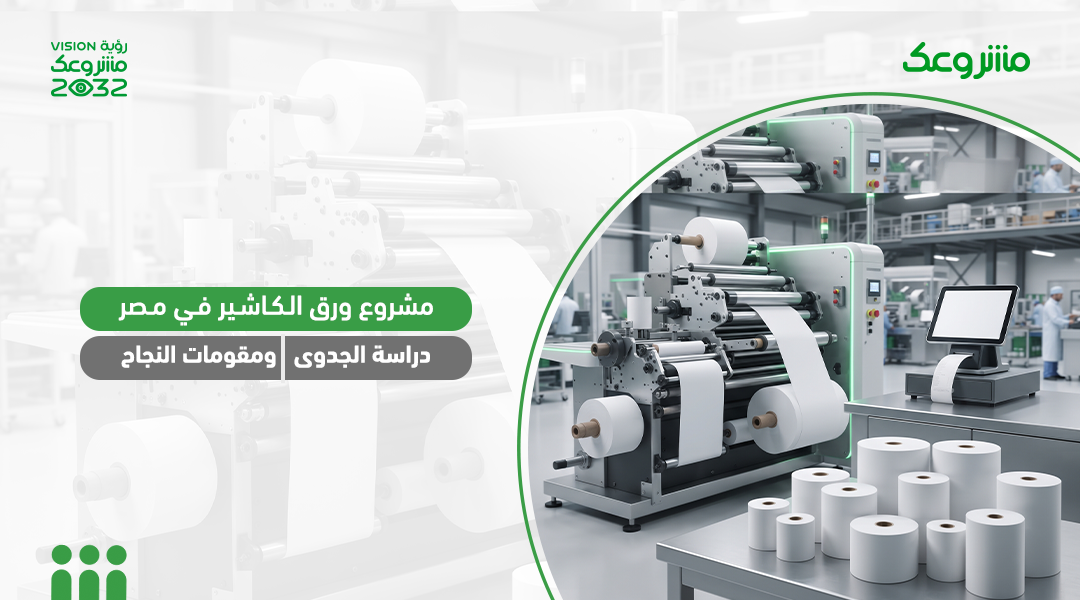
The cash register paper manufacturing project is considered one of the promising and widely established industrial projects in the Egyptian market, given its connection to essential daily needs across retail stores, restaurants, pharmacies, delivery companies, and various other commercial activities. With the continued expansion in the use of point-of-sale (POS) machines and electronic cash registers, demand for cash register paper is increasing significantly, making this project a suitable investment opportunity for those seeking a relatively stable income with moderate capital. The project is also characterized by ease of management, relatively low operating costs compared to many other businesses, rapid capital turnover, and sustained demand for the product. In this guide, we explore the key aspects of the project, starting with the feasibility study and establishment costs, followed by raw material sourcing and production stages, and concluding with the most effective marketing strategies and ways to achieve the highest possible return.
The cash register paper project is an industrial business specializing in producing and manufacturing thermal cash register paper rolls used in point-of-sale (POS) systems, cash registers, and receipt and invoice printers. The project involves processing thermal paper, cutting it into the required sizes, then rolling and packaging it in suitable packages for supply to retail stores, restaurants, pharmacies, gas stations, supermarkets, and other businesses that rely on continuous receipt printing.
Read More: Thermal Printing Project: A Smart Investment in the World of Personalized Gifts
Yes, the cash register paper project is considered a promising industrial venture, given the sustained demand for thermal paper used in point-of-sale (POS) systems, cash registers, and receipt printing. Estimates indicate that the global thermal paper market was valued at approximately USD 4.2 billion in 2025 and is expected to reach around USD 4.4 billion by the end of 2026, growing to approximately USD 6 billion by 2033, at a compound annual growth rate (CAGR) of about 4.6% from 2026 to 2033.
These indicators point to favorable opportunities for project growth and attractive returns, particularly with the continued expansion of electronic payment systems and POS terminals across retail stores, restaurants, pharmacies, gas stations, and other commercial activities.
Read Here: Best Successful Small Projects for Youth in 2026
The cost of a cash register paper project varies depending on the project size, production capacity, and type of equipment. However, costs can generally be divided into investment costs incurred during project establishment and operating costs that recur throughout the operation, as follows:
Read here: Discover the Best Small Project That Fits Your Resources
Read here: How do you start small industrial projects and achieve long-term financial sustainability?
Rising prices of thermal paper and other raw materials can increase production costs and reduce profit margins. Therefore, it is advisable to work with multiple suppliers, regularly compare prices, and purchase quantities that match the actual level of demand.
Using low-quality raw materials may lead to poor-quality cash register paper rolls. Therefore, paper samples should be tested before entering into contracts, and reliable suppliers should be selected to ensure consistent quality.
Delays in receiving raw materials can interrupt production and postpone order deliveries. To avoid this, it is preferable to maintain an appropriate inventory level and work with multiple suppliers to ensure production continuity.
Equipment downtime can affect production and delivery schedules. This can be minimized through regular maintenance, keeping essential spare parts available, and relying on a specialized technician when necessary.
Electricity, labor, maintenance, and transportation costs can affect net profits. Therefore, expenses should be closely monitored, waste should be minimized, and production and distribution processes should be efficiently organized.
The project may face competition from other manufacturers and suppliers. This can be addressed by offering high-quality paper at competitive prices, meeting delivery deadlines, and providing better customer service.
The project needs to gradually build a customer base. Therefore, marketing efforts should focus on directly targeting stores, restaurants, pharmacies, and wholesalers, while also leveraging digital marketing.
Producing quantities that exceed actual demand may tie up working capital and increase storage costs. Therefore, production should be aligned with actual sales volume, with a focus on the most in-demand sizes.
I began considering the establishment of a cash register paper manufacturing and sales project after noticing the growing demand for this product in the Egyptian market, as it is an essential product used by retail stores, restaurants, pharmacies, supermarkets, and various points of sale for printing receipts and invoices. Despite having a clear business idea, I initially faced several challenges, most notably the lack of a comprehensive understanding of the project’s implementation steps, actual requirements, and the investment and operating costs involved. Limited liquidity also posed an obstacle to purchasing the necessary equipment and raw materials and increasing production capacity.
Therefore, I sought the support of Mashroo3k Consulting, where I received a comprehensive and detailed feasibility study covering all aspects of the project, from technical requirements and production stages to expected costs, revenues, marketing opportunities, and financing needs. The company’s role was not limited to preparing the feasibility study; it also assisted me in preparing the required project file and documents for submission to financing institutions, which facilitated obtaining the necessary funding from… Micro, Small and Medium Enterprise Development Agency (MSMEDA)This funding enabled me to purchase the essential requirements for the project, improve the production process, and increase operational capacity, allowing me to meet customer orders more efficiently. By implementing the recommendations outlined in the feasibility study, the project achieved a noticeable improvement in production and overall performance, becoming more competitive and capable of generating good returns in the market.
Cash register paper comes in different types depending on paper quality, dimensions, and intended use. Thermal paper is the most widely used type, as it relies on heat to display printed information without the need for ink. Cash register paper rolls are also available in various sizes and lengths to suit different cash register machines and point-of-sale (POS) devices. Other types vary in terms of print quality and how long the printed information remains legible. High-quality paper is used for businesses that require clearer receipts with better data retention, while economical paper is suitable for everyday uses where receipts do not need to be retained for long periods.
The cost of a paper factory varies depending on the factory size, production capacity, type of machinery, and facility area. In general, the investment cost includes purchasing and preparing the site, purchasing cash register paper cutting and rewinding machines, packaging equipment, electrical and storage facilities, as well as licensing, transportation, and installation costs. The factory also requires working capital to purchase raw materials such as thermal paper and cover wages, electricity, maintenance, and marketing expenses during the initial operating period.
A cash register paper manufacturing machine is the equipment used to process and convert thermal paper into cash register rolls of the required sizes through cutting, rewinding, trimming, and packaging processes, depending on the nature of the production line. The machinery used varies according to the project size and required production capacity, with equipment available for small-scale projects and others designed for high-volume production.
Read More: Paper Printing Project: A Successful Investment That Meets Market Needs
The materials used vary depending on the type of paper. However, thermal cash register paper primarily consists of specially treated paper coated with a heat-sensitive thermal layer. This thermal coating typically contains chemicals that enable the printed text to appear when exposed to the heat generated by the print head of the cash register. Therefore, this type of paper does not require ink during printing.
Traditional paper, on the other hand, is primarily manufactured from cellulose fibers extracted from wood pulp or other plant-based sources.
To start a paper manufacturing project, you should first conduct a market study and identify the type of paper to be produced and the level of demand for it. Then, select a suitable factory location that accommodates the production lines and storage requirements. Next, determine the appropriate raw materials, such as wood pulp or recycled paper, and select the manufacturing lines and equipment based on the type of product and targeted production capacity.
The factory should also be equipped with the necessary utilities, and all required licenses and legal procedures should be completed. After that, the equipment should be installed, and the necessary technical and administrative staff should be recruited. Once production begins, quality tests should be conducted to ensure the paper meets the required standards for thickness, smoothness, durability, and other specifications. The products can then be marketed and distributed to printing presses, factories, stationery stores, wholesalers, and other customers, while gradually developing production in line with market needs.
In conclusion, the cash register paper project remains one of the attractive options for those looking to enter the world of business and investment through a well-planned approach. The project is not significantly affected by seasonal fluctuations and does not require complex technical expertise. Instead, its success depends primarily on effective organization and building strong relationships with customers and suppliers.
With the continued expansion in the use of different types of cash registers and POS machines, demand for this product is expected to remain ongoing, providing business owners with income stability and genuine opportunities for future expansion—whether by increasing production volume or reaching new markets and customer segments.
If you have modest capital and the willingness to work hard and grow your business, starting a cash register paper project could be a step toward greater financial indep

Contact us to request a feasibility study for the Cash Register Paper Project
The kebab restaurant project is one of the food-service ventures that combines strong demand for grilled meals with the opportunity to target a diverse customer base, including individuals, families, and lovers of traditional Middle Eastern cuisine. With growing competition in the restaurant sector, however, the project’s success is no longer determined by food taste alone. […]
Read moreA children’s toy store project is not limited to selling toys; it is built on understanding what attracts children and what families look for when choosing products that combine entertainment and educational value. With the wide variety of educational toys, skill-development games, recreational toys, and gifts available, the store has opportunities to meet the needs […]
Read moreA residential complex project is no longer simply an investment in a collection of real estate units. It has evolved into an integrated development model that combines comfortable living, diverse services, and long-term investment value. As cities expand and residents’ needs evolve, demand is growing for residential complexes that offer a comprehensive environment suited to […]
Read moreThe veterinary clinic project comes at a time when animal care is no longer limited to treating illnesses or injuries, but has expanded to include health monitoring, vaccinations, routine checkups, and care for both pets and livestock. However, many animal owners face challenges in accessing specialized veterinary services that combine prompt response, high-quality care, and […]
Read more
خصم 25% على خدمات مشروعك استفد من العرض الآن، فالفرصة متاحة لفترة محدودة فقط
سجّل بياناتك واحصل على خصم 25% الآن


