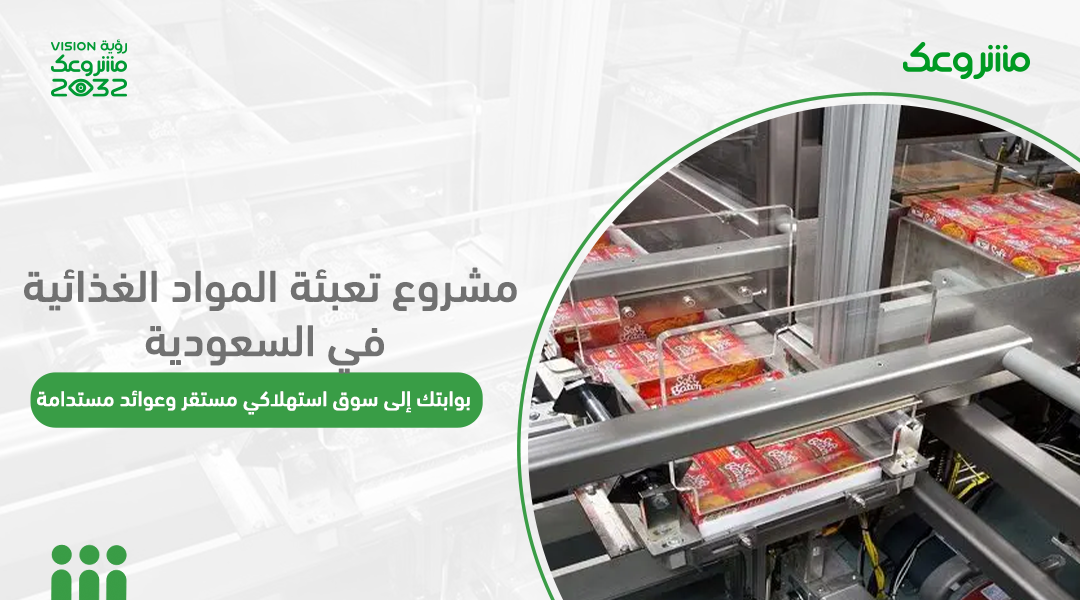
With the rapid growth of the food industry sector and the increasing consumer demand for ready-to-use packaged products, food packaging projects have emerged as one of the most attractive and stable investment opportunities. Food products are essential goods with consistent demand, giving this type of project a strong competitive advantage and continuous opportunities to generate sales and profits.
The flexibility of the project also allows investors to start with different investment levels and gradually expand according to market needs and demand. The project’s importance goes beyond simply repackaging products; it also adds real value to food products by improving their appearance, enhancing their quality, and presenting them to consumers in a safer and more attractive form.
With the continuous development of packaging and marketing methods, investors can build strong brands capable of competing and establishing a distinctive presence in local and regional markets.
Therefore, if you are looking for a project that combines relatively low risk, fast capital turnover, and multiple opportunities for growth and expansion, a food packaging project represents a promising investment option worth considering. In this article, we cover everything you need to know about the project, from establishment and equipment requirements to success factors and potential challenges, along with key tips to help you build a successful and sustainable business.
A food packaging project is a commercial business based on purchasing food products in bulk from suppliers or manufacturers, then repackaging and packaging them into different-sized containers for sale to consumers or retail stores.
The project can include packaging a variety of products such as rice, sugar, flour, legumes, spices, and nuts, with a focus on packaging quality and providing essential information on the packages, such as the production date, expiry date, and weight.
This type of project is in demand in the market due to the daily and consistent consumption of food products, as well as the ease of marketing them and the potential to generate attractive profits.
Please read here: Projects with a Future in Arab Countries: Key Investment Opportunities
Yes, global economic indicators confirm that food packaging projects are currently among the most promising investment opportunities in terms of economic viability. This is clearly reflected in the figures, as the global food packaging market was valued at approximately USD 533.22 billion in 2025 and increased to USD 564.02 billion in 2026. This figure reflects the significant transformation in global demand for this sector.
This upward trajectory is expected to continue, with the market projected to exceed USD 930.89 billion by 2034, achieving a compound annual growth rate (CAGR) of 6.46% during the forecast period (2026–2034).
Read here: Food Market Report in Saudi Arabia
Investing in a food packaging project offers numerous advantages that make it an attractive option for investors and entrepreneurs, particularly in light of the global focus on food products. The key advantages include:
Please read here: The Saudi Food Manufacturing Exhibition: Your Gateway to Smart Investment in the Post-Oil Economy
The cost of a food packaging project varies depending on the targeted production volume, the types of products being packaged, and the level of equipment and machinery used. Costs also vary according to the project’s space and operational requirements. The main cost items include:
Read here: How to Start a Small Business and Ensure Its Profitability in 2026
How Can You Turn Your Idea into a Profitable and Sustainable Business?
Marketing is one of the most important factors in the success of a food packaging project. It is the means of reaching customers, increasing market presence, and driving sales. With a variety of modern marketing methods available, an effective and well-organized marketing strategy can help achieve strong sales and build a powerful brand. The key marketing methods include:
| Challenges | Ways to Overcome Them |
|---|---|
| Intense market competition | Focus on product quality, distinctive packaging, and building a strong brand. |
| Fluctuating raw material prices | Work with multiple suppliers and purchase in bulk when prices are favorable. |
| Difficulty building a distribution network initially | Start by partnering with local grocery stores and supermarkets, then gradually expand distribution. |
| Weak marketing in the early stages | Use digital marketing, social media platforms, and paid advertising campaigns. |
| Compliance with health requirements and licensing | Closely monitor local regulations and prepare the facility according to the required standards. |
| High operating costs | Reduce unnecessary expenses and improve resource management. |
| Storage and product quality issues | Provide a clean and dry storage environment and conduct regular product quality checks. |
| Difficulty gaining customer trust | Provide high-quality products and consistently meet quality standards and delivery commitments. |
| Equipment and machinery breakdowns | Perform regular maintenance and invest in high-quality equipment from the beginning. |
| Delayed customer payments | Establish a clear payment system and initially work with reliable customers. |
One of our clients contacted us through social media and asked: “I am planning to start a food packaging project. What do you recommend?”
The truth is that the success of this project depends not only on having sufficient capital or equipment, but also on careful planning and a clear understanding of market requirements and consumer needs. Based on our experience in preparing feasibility studies for food projects, we can summarize the key recommendations for those looking to enter this field as follows:
Read Here: Best Successful Small Projects for Youth in 2026
My Experience with a Food Packaging Project
My experience in the Saudi market began when I identified a promising growth opportunity in the food packaging sector, driven by consistent demand for packaged food products. However, moving from the idea to implementation revealed real challenges that nearly threatened the project’s continuity, including the lack of accurate scientific planning, an unclear investment vision, as well as financing difficulties and securing the liquidity required to purchase production lines and raw materials.
At this critical stage, I turned to Mashroo3k Consulting based on trusted recommendations. The team of experts restructured the project from the ground up through a comprehensive feasibility study that included an accurate analysis of market demand and competitors, a technical assessment of the optimal equipment and production capacity, and well-structured financial and administrative planning that established a clear path for the project.
The support went beyond consulting and extended to resolving the financing challenge in practice—from preparing a structured financing file and fulfilling all regulatory requirements to securing government financing from the Social Development Bank.
Today, the project has completely overcome its stagnation and transitioned into an operational production line running with high efficiency and a competitive capacity far exceeding what it had at the beginning.
A food packaging machine is a machine or piece of equipment used to weigh and package food products such as rice, sugar, flour, legumes, and spices into containers or bags of specified sizes, either automatically or semi-automatically.
This equipment facilitates the packaging process with a high level of accuracy in terms of weight and quantity, while reducing the time and effort required compared to manual packaging. It also helps improve the quality of the finished product, ensure consistent packaging, and increase production efficiency.
The types of food packaging machines vary depending on the nature of the product and the size of the project. There are manual packaging machines designed for small businesses, as well as semi-automatic and fully automatic machines suitable for large-scale factories and production projects.
The prices of food packaging machines vary significantly depending on the machine type, capabilities, and production volume required for the project. Basic machines designed for small businesses are generally less expensive than semi-automatic and fully automatic machines intended for large-scale production lines.
The nature of the products being packaged, such as grains, powders, or spices, also affects the type of machine required and, consequently, its cost. In addition, manufacturing quality, brand, packaging speed and accuracy, after-sales services, maintenance, and availability of spare parts all play an important role in determining the final price of the machine.
Read here:Discover the Best Small Project That Fits Your Resources
A food packaging project begins by identifying the targeted food products and studying their market demand, followed by preparing a suitable location and obtaining the necessary licenses to operate the business. The next step is to provide the required packaging equipment and establish agreements with reliable suppliers to ensure the quality of raw materials.
Attention should also be given to designing attractive packaging that reflects the product’s brand identity, along with developing an effective marketing plan targeting retail outlets and potential customers. Maintaining quality and accuracy throughout all stages of operations remains the most important factor in ensuring the project’s success and sustainability.
Read here: How do you start small industrial projects and achieve long-term financial sustainability?
The best food products suitable for packaging are those that have consistently high demand and can be easily preserved and stored for long periods without spoilage, such as different types of rice, sugar, and flour, as well as legumes such as lentils, fava beans, chickpeas, and beans.
Spices and seasonings are also highly suitable for this type of project due to their daily consumption in households, in addition to tea and coffee, which enjoy widespread demand. Dry products such as pasta, salt, and sesame can also be included among the products suitable for packaging, as they are all easy to package and distribute and benefit from stable market demand.
Selecting the right location for a food packaging project depends on providing a safe and efficient operating environment that supports production quality and continuity. Therefore, the location should ideally have sufficient space to organize packaging and storage operations efficiently, along with good ventilation and the essential utilities required for operation.
It should also be located away from sources of contamination and moisture to ensure product safety, while providing easy access to facilitate the receipt of raw materials and the distribution of finished products. A well-organized and properly equipped location contributes to improving operational efficiency, reducing operating costs, and enhancing the project’s chances of success.
In its initial stages, a food packaging project does not require a large workforce. It can be operated with a small team responsible for filling, packaging, weighing, and quality control. Workforce requirements vary depending on production volume and the level of equipment used, as modern machinery helps reduce reliance on manual labor.
As the project grows and demand increases, the workforce can be gradually expanded to cover the various operations, ensuring operational efficiency and maintaining product quality.
It is clear that this project is not merely a traditional business activity, but rather a promising investment opportunity supported by consistent demand for food products and strong potential for expansion and growth. With proper planning, careful product selection, and adherence to the highest quality standards, the project can evolve from a simple idea into an established brand with a strong market presence.
In a world where competition continues to increase day after day, excellence in quality and the ability to meet customer needs remain the true keys to success. Therefore, if you are considering entering this field, make your market study and operational plan the starting point for building a sustainable project that delivers long-term growth and profitability.

For more information and to request a feasibility study for a food packaging project, please contact us.
The kebab restaurant project is one of the food-service ventures that combines strong demand for grilled meals with the opportunity to target a diverse customer base, including individuals, families, and lovers of traditional Middle Eastern cuisine. With growing competition in the restaurant sector, however, the project’s success is no longer determined by food taste alone. […]
Read moreA children’s toy store project is not limited to selling toys; it is built on understanding what attracts children and what families look for when choosing products that combine entertainment and educational value. With the wide variety of educational toys, skill-development games, recreational toys, and gifts available, the store has opportunities to meet the needs […]
Read moreA residential complex project is no longer simply an investment in a collection of real estate units. It has evolved into an integrated development model that combines comfortable living, diverse services, and long-term investment value. As cities expand and residents’ needs evolve, demand is growing for residential complexes that offer a comprehensive environment suited to […]
Read moreThe veterinary clinic project comes at a time when animal care is no longer limited to treating illnesses or injuries, but has expanded to include health monitoring, vaccinations, routine checkups, and care for both pets and livestock. However, many animal owners face challenges in accessing specialized veterinary services that combine prompt response, high-quality care, and […]
Read more
خصم 25% على خدمات مشروعك استفد من العرض الآن، فالفرصة متاحة لفترة محدودة فقط
سجّل بياناتك واحصل على خصم 25% الآن


