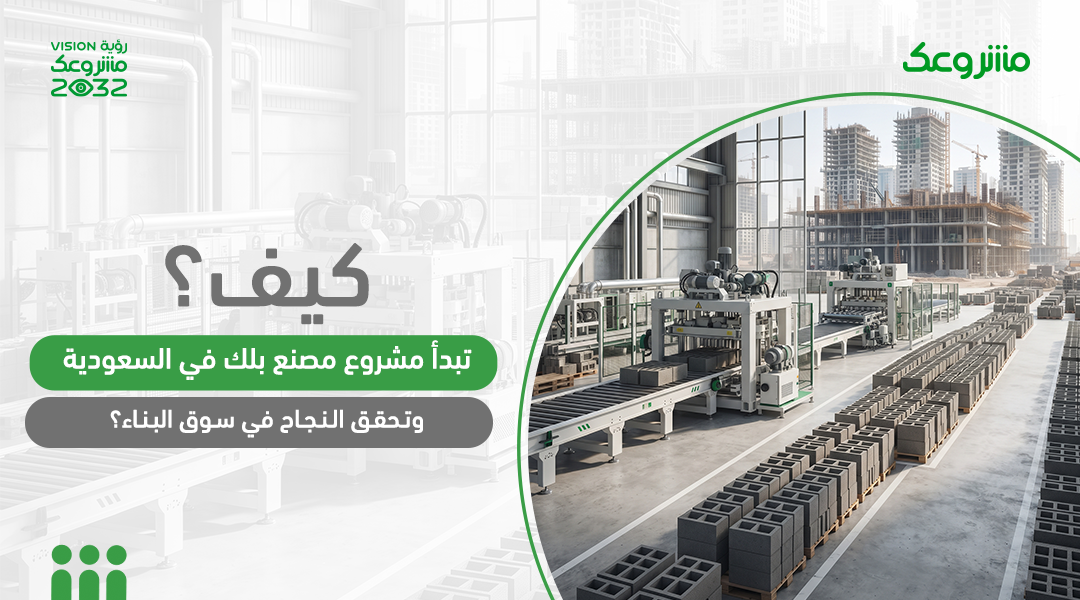
The block manufacturing plant project is considered one of the prominent industrial projects attracting investors’ attention, given the growing demand for block products in the construction and building sector, which continues to expand across various markets. The project has the potential to generate attractive returns when professionally planned, particularly through the use of modern production equipment, selecting a suitable location, and sourcing high-quality raw materials to ensure the production of blocks that comply with the required specifications.
The diverse applications of blocks in residential, commercial, and industrial projects also contribute to maintaining stable demand throughout the year, enhancing the project’s potential for success and sustainability. However, achieving these results requires a thorough market study, a clear understanding of costs, production capacity, operating and marketing strategies, and the overall requirements of the project.
In this context, we explore everything you need to know to start a block manufacturing plant, beginning with the market study and essential requirements, followed by costs and equipment, and concluding with the key success factors and challenges that should be anticipated to achieve the best possible return on investment.
A block manufacturing plant is an industrial project aimed at producing blocks in various types and sizes using raw materials such as cement, sand, gravel, and water. Specialized production lines and equipment are used to ensure that the products meet the required standard specifications.
Blocks are widely used in the construction of residential, commercial, and industrial buildings due to their durability, ease of installation, and competitive cost compared with some other building materials.
The success of the project depends on selecting the appropriate production technology, securing high-quality raw materials, complying with manufacturing standards, and studying the needs of the target market to ensure that demand is met and a sustainable return on investment is achieved.
Read Here: Real Estate Development Project: Your Gateway to Secure Investment and Sustainable Returns
Yes, a block manufacturing plant is considered one of the most profitable industrial projects. The global concrete blocks and bricks manufacturing market was valued at USD 954.3 billion in 2025 and is projected to reach USD 1,578.6 billion by 2036, growing at a compound annual growth rate (CAGR) of 4.7% from 2026 to 2036.
Read here: Construction and Building Sector Report in Saudi Arabia
A block manufacturing plant offers numerous advantages that make it a promising industrial investment, particularly with the continued expansion of the construction and building sector. The key advantages include:
Read Here: Concrete Block Factory: 5 Key Points to Consider When Starting the Project
The cost of establishing a block manufacturing plant in Saudi Arabia varies depending on the plant size, production capacity, level of automation, and project location. However, the main cost items include:
A block manufacturing plant goes through several operational stages to ensure the production of high-quality products, including:
Continuous increases in the prices of cement, sand, and other materials may raise production costs and reduce profit margins. This can be addressed by contracting with reliable suppliers, purchasing in appropriate quantities, and continuously monitoring prices to secure the best available offers.
Production line breakdowns can lead to work stoppages and delays in fulfilling orders, negatively affecting productivity. This can be overcome by implementing a regular maintenance program, using high-quality equipment, and keeping essential spare parts available to minimize downtime.
The plant may face competition from other manufacturers offering products at different prices or with higher production capacities. To overcome this challenge, the project should focus on product quality, compliance with standard specifications, and improving production efficiency to deliver competitive value.
Demand for blocks may vary depending on activity in the construction sector and the volume of construction projects. To address this, the plant should diversify its products, serve different customer segments, and monitor market trends to plan production efficiently.
Operating costs include electricity, water, fuel, and labor expenses, all of which may affect profitability. To control these costs, the plant should optimize resource consumption, use energy-efficient equipment, and continuously monitor operating expenses.
A shortage of technical expertise may lead to lower production quality and an increased error rate. Therefore, the plant should hire qualified personnel and provide continuous training programs to employees on equipment operation and the application of quality standards.
Any variation in block quality may result in a loss of customer confidence and an increase in product returns. To overcome this challenge, the plant should inspect raw materials, monitor all production stages, and conduct regular quality tests on finished products.
Poor inventory management may result in shortages of raw materials or an accumulation of finished products, affecting workflow. To overcome this challenge, the plant should implement an effective inventory management system and regularly monitor raw material and finished product levels to ensure continuous production.
A feasibility study helps increase the chances of success for a block manufacturing plant project by providing a clear overview of all aspects of the project before implementation. This is achieved through the following:
After conducting an initial market assessment, I started a block manufacturing plant project, driven by the growing demand for building materials in the Kingdom of Saudi Arabia as a result of ongoing urban expansion and construction projects.
Although the idea showed strong potential, the project initially faced several challenges, most notably the lack of a clear operational plan, difficulty in accurately estimating actual costs and determining the appropriate production capacity, as well as limited liquidity needed to equip the plant and purchase production lines. This made securing financing a significant obstacle to implementing the project.
At that point, I sought the assistance of Mashroo3k Consulting, which prepared a professional feasibility study for me and accurately identified the project’s operational requirements. The company also helped me complete the requirements for obtaining financing from the Saudi Industrial Development Fund, enabling me to overcome the financial challenges and secure the necessary equipment for the plant.
Thanks to the consulting support provided by Mashroo3k Consulting’s experts, production operations became more efficient, product quality improved, and the plant’s production capacity increased. This strengthened its competitiveness and enhanced its ability to efficiently meet the needs of the Saudi market.
The appropriate area for a block manufacturing plant depends on the production volume and operational capacity. However, it typically ranges from 2,000 to 10,000 square meters. The facility should have sufficient space to accommodate production lines, raw material and finished product storage areas, and operational facilities, while also allowing room for future expansion as production capacity increases or additional production lines are added.
The number of workers required depends on the size of the plant and the level of automation used in the production lines. However, a small or medium-sized plant typically requires a team of 10 to 30 workers, including machine operators, production workers, maintenance technicians, quality control supervisors, and loading and storage workers, in addition to administrative and accounting staff.
A block manufacturing plant can produce various types of blocks to meet the needs of the construction sector. The main types include solid concrete blocks, hollow concrete blocks, thermal insulation blocks, soundproof blocks, lightweight blocks, and colored blocks, in addition to blocks with different sizes and dimensions suitable for residential, commercial, and industrial projects.
The main difference lies in the level of automation and production capacity. A manual block plant relies heavily on human intervention throughout most manufacturing stages, making it suitable for small-scale projects with limited production and lower establishment costs.
An automatic block plant, on the other hand, relies on automated production lines that perform most operations automatically. This helps increase production capacity, improve product quality, reduce waste, and minimize reliance on labor, making it suitable for medium- and large-scale projects.
A block manufacturing plant relies on several essential raw materials to produce durable and high-quality blocks. These include cement, sand, gravel or crushed stone, and water. Certain chemical additives may also be used to improve the properties of the concrete mix, such as increasing strength, accelerating the hardening process, or improving moisture resistance.
We find that it represents an investment opportunity that combines stable demand with the potential to generate attractive returns, particularly when established according to a well-developed plan based on a thorough analysis of the market and customer needs.
The more your investment decisions are based on clear data and a strategic vision, the greater the project’s chances of success and future expansion. Therefore, preparing a professional feasibility study is the first step toward building a competitive manufacturing plant capable of achieving sustainable growth.
If you are looking to turn your idea into a successful project, Mashroo3k Consulting provides comprehensive consulting support, starting with feasibility studies and market analysis and extending to developing an operational plan that helps you launch with confidence and achieve the best possible return on your investment.

For more information or to request a feasibility study for a block manufacturing plant project
The kebab restaurant project is one of the food-service ventures that combines strong demand for grilled meals with the opportunity to target a diverse customer base, including individuals, families, and lovers of traditional Middle Eastern cuisine. With growing competition in the restaurant sector, however, the project’s success is no longer determined by food taste alone. […]
Read moreA children’s toy store project is not limited to selling toys; it is built on understanding what attracts children and what families look for when choosing products that combine entertainment and educational value. With the wide variety of educational toys, skill-development games, recreational toys, and gifts available, the store has opportunities to meet the needs […]
Read moreA residential complex project is no longer simply an investment in a collection of real estate units. It has evolved into an integrated development model that combines comfortable living, diverse services, and long-term investment value. As cities expand and residents’ needs evolve, demand is growing for residential complexes that offer a comprehensive environment suited to […]
Read moreThe veterinary clinic project comes at a time when animal care is no longer limited to treating illnesses or injuries, but has expanded to include health monitoring, vaccinations, routine checkups, and care for both pets and livestock. However, many animal owners face challenges in accessing specialized veterinary services that combine prompt response, high-quality care, and […]
Read more
خصم 25% على خدمات مشروعك استفد من العرض الآن، فالفرصة متاحة لفترة محدودة فقط
سجّل بياناتك واحصل على خصم 25% الآن


