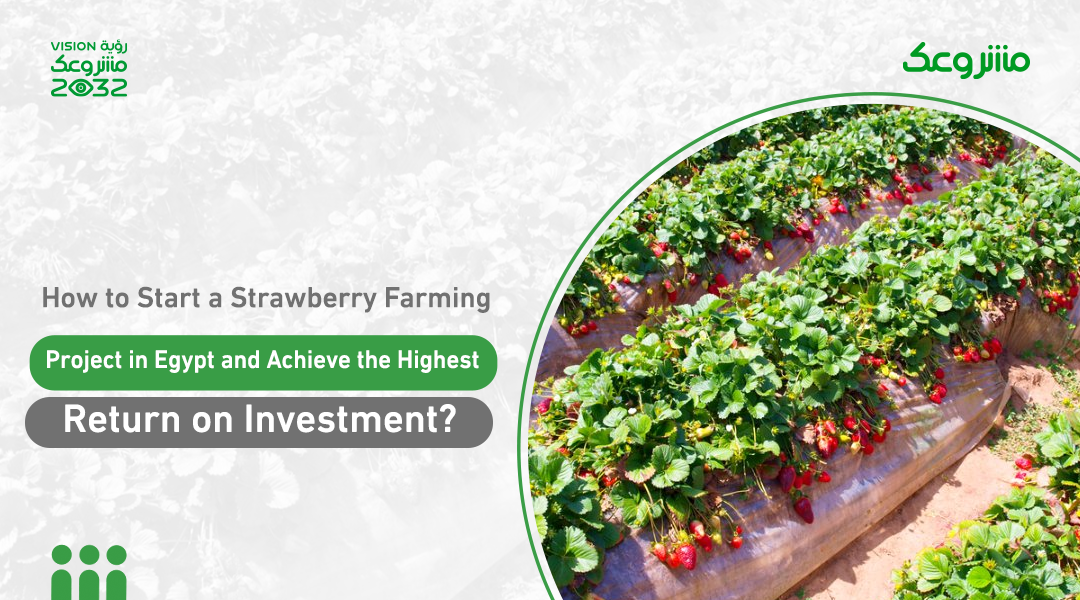
A strawberry farming project is considered one of the most promising agricultural investments, attracting significant interest from investors due to the growing demand for strawberries in both local and international markets, in addition to their high economic value and wide range of applications in fresh consumption, as well as in the production of juices, jams, desserts, and various food products.
With the rapid advancement of modern agricultural technologies, such as protected cultivation and drip irrigation systems, strawberry farming has become more efficient and productive, helping to increase returns while reducing operating costs.
The success of the project, however, depends not only on selecting quality seedlings or securing suitable agricultural land, but also on preparing a comprehensive feasibility study, developing an effective operational and marketing plan, and managing resources efficiently to ensure high-quality production, strengthen competitiveness, and establish a sustainable agricultural business capable of generating attractive profits in both the short and long term.
A strawberry farming project is an agricultural venture aimed at producing strawberries using suitable cultivation methods, whether in open fields or protected greenhouses, to meet the needs of both local and international markets. The project relies on selecting high-quality varieties and providing optimal growing conditions in terms of soil, irrigation, and fertilization to produce a crop with superior quality and strong market value.
It is considered one of the most promising agricultural investment opportunities, offering the potential for attractive returns due to the continuous demand for strawberries and their wide range of uses in fresh consumption as well as in the food processing industry.
Yes, a strawberry farming project is considered one of the most profitable agricultural investments. The Arab Republic of Egypt holds a leading position in strawberry production, thanks to the availability of favorable agricultural conditions, including a suitable climate, fertile soil, and extensive experience in horticultural crop cultivation.
This is reflected in the country’s substantial production, which reached 952,043 tons of strawberries cultivated over an area of approximately 66,867 feddans. These figures highlight Egypt’s ability to achieve high productivity, meet domestic market demand, and support export opportunities to numerous international markets.
These indicators demonstrate Egypt’s strong competitive position in strawberry cultivation, making investment in this sector a promising opportunity for generating attractive economic returns.
Starting a strawberry farming project requires following a series of well-planned steps to ensure the project’s success and achieve high-quality, high-yield production. These steps include:
The costs of a strawberry farming project are divided into capital (investment) costs, which are incurred during the establishment phase, and operating costs, which recur throughout each production cycle. Accurately identifying these costs helps determine the required capital and develop a financial plan that supports the project’s sustainability and maximizes return on investment.
Pest and Disease Infestation
Pests and fungal diseases are among the most significant challenges that can affect crop quality and productivity. These risks can be minimized by implementing preventive control programs, using recommended pesticides, and conducting regular crop monitoring.
Market Price Fluctuations
Strawberry prices may decline during periods of oversupply, affecting profit margins. To overcome this challenge, it is advisable to diversify marketing channels, secure advance sales contracts with buyers, and target export markets whenever possible.
Rising Production Costs
Increases in the prices of seedlings, fertilizers, or other agricultural inputs may raise the overall cost of the project. This impact can be reduced through proper financial planning, efficient resource utilization, and purchasing from reliable suppliers offering competitive prices.
Climate Changes
High temperatures or extreme cold can negatively affect plant growth and fruit quality. To reduce these risks, it is important to select suitable planting dates and adopt agricultural practices that help protect the crop.
Irrigation and Water Management Issues
Water shortages or poor irrigation management can lead to lower productivity and reduced crop quality. Therefore, it is recommended to use drip irrigation systems and monitor the plant’s water requirements according to its different growth stages.
Difficulties in Marketing the Harvest
The project may face challenges in selling the harvest, particularly in the absence of a clear marketing strategy. This can be overcome by building a strong customer network, establishing contracts with wholesalers and retail chains, and focusing on high-quality packaging to enhance market competitiveness.
The success of a strawberry farming project depends on several key factors that ensure high productivity and superior crop quality. The most important include:
When I decided to invest in a strawberry farming project, I was confident that this crop offered promising opportunities in the Egyptian market, driven by its growing domestic demand and its strong position in export markets. However, I quickly realized that the success of the project depended not only on cultivating strawberries but also on careful planning and a comprehensive assessment of every aspect of implementation.
At the beginning, I faced several challenges, most notably determining the appropriate investment size, estimating operating costs, selecting the highest-yielding varieties, preparing the agricultural land, establishing an efficient irrigation system, and securing production inputs that would ensure high crop quality. I also encountered difficulties in obtaining the financing required to cover both the establishment and operating costs, which led me to seek a specialized consultancy capable of helping me implement the project on sound investment principles.
That is when I turned to the experts at Mashroo3ak Consulting, who prepared a comprehensive feasibility study covering the marketing, technical, financial, and administrative aspects of the project, along with a clear operational plan tailored to the project’s nature and objectives.
The company’s role extended beyond preparing the feasibility study to include developing the financing file and fulfilling all the requirements necessary to obtain funding from the Micro, Small, and Medium Enterprise Development Agency (MSMEDA). This support enabled me to secure the capital needed to launch the project with confidence and stability.
Thanks to this specialized support, I was able to implement the strawberry farming project more efficiently, improve production quality, enhance the farm’s operational capacity, and meet market demand effectively. As a result, the project has progressed steadily toward achieving attractive returns and long-term sustainability.
The profit generated from one feddan of strawberries depends on several factors, including the yield per feddan, seasonal selling prices, crop quality, cultivation and operating costs, and marketing channels. Therefore, it is not possible to determine a fixed profit value, as returns vary from one project to another. A comprehensive financial feasibility study is the most reliable way to estimate the expected profitability based on the project’s nature, location, and investment size.
Strawberries in Egypt are cultivated during the winter growing season, with planting typically taking place from mid-September to the end of October, although the exact timing may vary slightly depending on the variety and the cultivation area. Adhering to these planting dates is one of the key factors for achieving healthy plant growth, higher productivity, and premium-quality fruit.
There are many strawberry varieties that differ in productivity, fruit quality, and adaptability to climatic conditions. Choosing the right variety depends on the cultivation area, planting season, and the intended market, whether for local consumption, export, or food processing. The most popular strawberry varieties include:
Strawberry plants typically begin producing fruit approximately 60 to 90 days after planting, and the production season usually lasts 4 to 6 months, depending on the cultivated variety, climatic conditions, and agricultural management practices. Productivity increases when proper irrigation, balanced fertilization, and sound agricultural practices are consistently applied, ensuring a continuous harvest of high-quality fruit throughout the season.
The average lifespan of a strawberry plant is one to two years. However, most growers treat strawberries as a seasonal crop and replant after the production season ends to maintain high fruit quality and maximize productivity. The productive lifespan of the plant depends on the cultivated variety, climatic conditions, and the level of agricultural care provided.
The proper way to grow strawberries is to select healthy, certified seedlings and plant them in fertile, well-drained, and well-aerated soil, while maintaining appropriate spacing between plants. It is also important to use a drip irrigation system to supply water efficiently, follow a balanced fertilization program, and continuously monitor and control pests and diseases. Applying these agricultural practices helps improve plant growth, increase productivity, and produce high-quality fruit.
The availability of fertile, well-drained soil, regular irrigation without overwatering, and a balanced fertilization program that meets the plant’s nutritional requirements, together with adequate exposure to sunlight, helps strawberry plants achieve optimal growth. In addition, regular pest and disease management, weed control, and adherence to proper agricultural practices contribute to healthier plant development, increased productivity, and improved fruit quality.
The best fertilizer for strawberries depends on the plant’s growth stage. However, strawberries generally require a balanced fertilization program that includes major nutrients such as nitrogen to promote vegetative growth, phosphorus to strengthen root development, and potassium to improve fruit quality and increase productivity, in addition to essential micronutrients such as iron, zinc, calcium, and magnesium. Furthermore, applying well-decomposed organic fertilizer before planting helps improve soil fertility and creates a suitable environment for healthy plant growth.
The best fertilizer for strawberries depends on the plant’s growth stage. However, strawberries generally require a balanced fertilization program that includes major nutrients such as nitrogen to promote vegetative growth, phosphorus to strengthen root development, and potassium to improve fruit quality and increase productivity, in addition to essential micronutrients such as iron, zinc, calcium, and magnesium. Furthermore, applying well-decomposed organic fertilizer before planting helps improve soil fertility and creates a suitable environment for healthy plant growth.
It can be concluded that, in light of the continuous growth of the agricultural sector, a strawberry farming project in Egypt stands out as one of the most promising investment opportunities, combining strong domestic demand, export potential, and the ability to generate attractive economic returns when managed efficiently. However, the success of the project depends on proper planning and a thorough assessment of all technical, financial, and marketing aspects before implementation.

Contact us to request a feasibility study for a Strawberry Farming Project.
The kebab restaurant project is one of the food-service ventures that combines strong demand for grilled meals with the opportunity to target a diverse customer base, including individuals, families, and lovers of traditional Middle Eastern cuisine. With growing competition in the restaurant sector, however, the project’s success is no longer determined by food taste alone. […]
Read moreA children’s toy store project is not limited to selling toys; it is built on understanding what attracts children and what families look for when choosing products that combine entertainment and educational value. With the wide variety of educational toys, skill-development games, recreational toys, and gifts available, the store has opportunities to meet the needs […]
Read moreA residential complex project is no longer simply an investment in a collection of real estate units. It has evolved into an integrated development model that combines comfortable living, diverse services, and long-term investment value. As cities expand and residents’ needs evolve, demand is growing for residential complexes that offer a comprehensive environment suited to […]
Read moreThe veterinary clinic project comes at a time when animal care is no longer limited to treating illnesses or injuries, but has expanded to include health monitoring, vaccinations, routine checkups, and care for both pets and livestock. However, many animal owners face challenges in accessing specialized veterinary services that combine prompt response, high-quality care, and […]
Read more
خصم 25% على خدمات مشروعك استفد من العرض الآن، فالفرصة متاحة لفترة محدودة فقط
سجّل بياناتك واحصل على خصم 25% الآن


